

I've stopped telling clients to chase more traffic. I know that sounds backwards for someone who sells SEO work, but I've watched too many sites grow sessions while enquiries stayed flat. The advantages of SEO are real. They just aren't the flat list most articles repeat. They're conditional on intent, on the SERP in front of you, and on whether a click is still needed at all.
Table of Contents
- Why Traffic Is No Longer the Whole Story
- The Acquisition Case for Organic Search
- Discoverability as an Eligibility System
- Why Position Still Matters and Why It Is Not Enough
- Which Queries Still Pay and Which Ones Stopped
- Performance Engineering as Conversion Support
- Measuring the Advantages That Actually Matter
Why Traffic Is No Longer the Whole Story
I used to open audits with a traffic chart. I don't anymore. I open with a simple split. Some queries still send people to websites. Others now end inside Google, and if I budget for both the same way, I'll waste your money.
Pew Research analyzed nearly 70,000 Google searches from about 900 U.S. adults and found traditional-result clicks occurred in roughly 15% of searches without an AI Overview, versus about 8% when one appeared, while links inside AI Overviews were clicked in only about 1% of visits, according to Sistrix's summary of the Pew Research findings. I read that as a budgeting problem, not a reason to quit SEO.
Two kinds of SEO value
I now separate traffic-generating SEO from visibility-generating SEO. The first targets queries where you still need to click, compare, book, calculate, or buy. The second targets queries where Google answers directly, and my job is to get you cited, remembered, and searched for by name later.
- Traffic-generating work: I target product, service, local, and comparison intent where a session can become an enquiry.
- Visibility-generating work: I target definitions and simple explanations where impressions and citations matter more than sessions.
- Mixed intent: I check the live SERP before I assign a budget, because volume alone tells me nothing useful.
I've seen a trades business chase broad how-to guides and celebrate rising sessions while the phone stayed quiet. We rebuilt the plan around service and location pages, tightened calls to action, and used practical ideas to boost enquiries and calls from your website. Sessions didn't need to explode for that work to pay. Better intent did the heavy lifting.
If a query can't plausibly lead to a next step, I won't sell it to you as an acquisition play.
That's my filter for everything that follows. SEO can still influence buyers when it produces fewer sessions, but I have to measure that influence. I track impressions, branded search, assisted conversions, qualified leads, and citations alongside traffic. If I don't, I'll either kill useful visibility work too early or keep funding informational pages that'll never convert.
The Acquisition Case for Organic Search
I still make the acquisition case first, because the channel is too large to treat as a side project. BrightEdge reported that organic search generated 53.3% of trackable web traffic, while organic social contributed about 5%, in BrightEdge's channel share research. I don't treat that as a promise for your site. I treat it as a reason to benchmark your own category before you decide organic isn't worth serious budget.
What that share means in practice
A well-optimized page can keep attracting visitors after publication. Paid search generally stops when the budget stops. That's the durability advantage I care about, and it's why I push clients to build pages for demand they expect to still want next year, not just this quarter.
Search visitors also arrive with an expressed need. You're not interrupting them. You're showing up after they've described a problem in their own words, which is why I plan differently for B2B buyers who research in stages. If that's your market, I'd map that journey the way I outline in my guide to SEO for B2B companies before I write a single page.
| Channel | Typical Traffic Share | Click Cost | Durability After Spend Stops | Visitor Intent |
|---|---|---|---|---|
| Organic search | 53.3% in the BrightEdge study | No per-click media cost | Continues while pages stay relevant | Expressed need |
| Paid search | Lower than organic in that study | Paid per click | Stops with budget | Expressed need |
| Organic social | About 5% in that study | No per-click media cost | Post dependent | Discovery led |
I don't frame paid and organic as rivals. I use paid to test messages quickly and organic to own durable demand. In retail, I apply the same logic to category and product pages, and I often point store owners to ecommerce SEO strategies that work when they need the operational basics for collections and product discovery.
My prioritization workflow is simple. I use keyword volume and traffic estimates to find demand, competitor top pages to see who's capturing it, and SERP history to separate durable opportunities from spikes. If I skip that last check, I'll chase a trend that disappears before the page ranks.
Discoverability as an Eligibility System
I treat SEO as an eligibility system before I treat it as a ranking exercise. If Google can't discover, crawl, render, and index your page, I don't have a ranking problem yet. I have an access problem, and rewriting copy won't fix it.
Google says it primarily discovers pages through links from pages it has already crawled, while XML sitemaps provide a second, explicit way to identify important URLs, as explained in Google's SEO Starter Guide. That order matters. I build internal linking first and use the sitemap as a clean inventory, not as a rescue plan for orphaned pages.
The diagram below shows the sequence I check before I touch content.
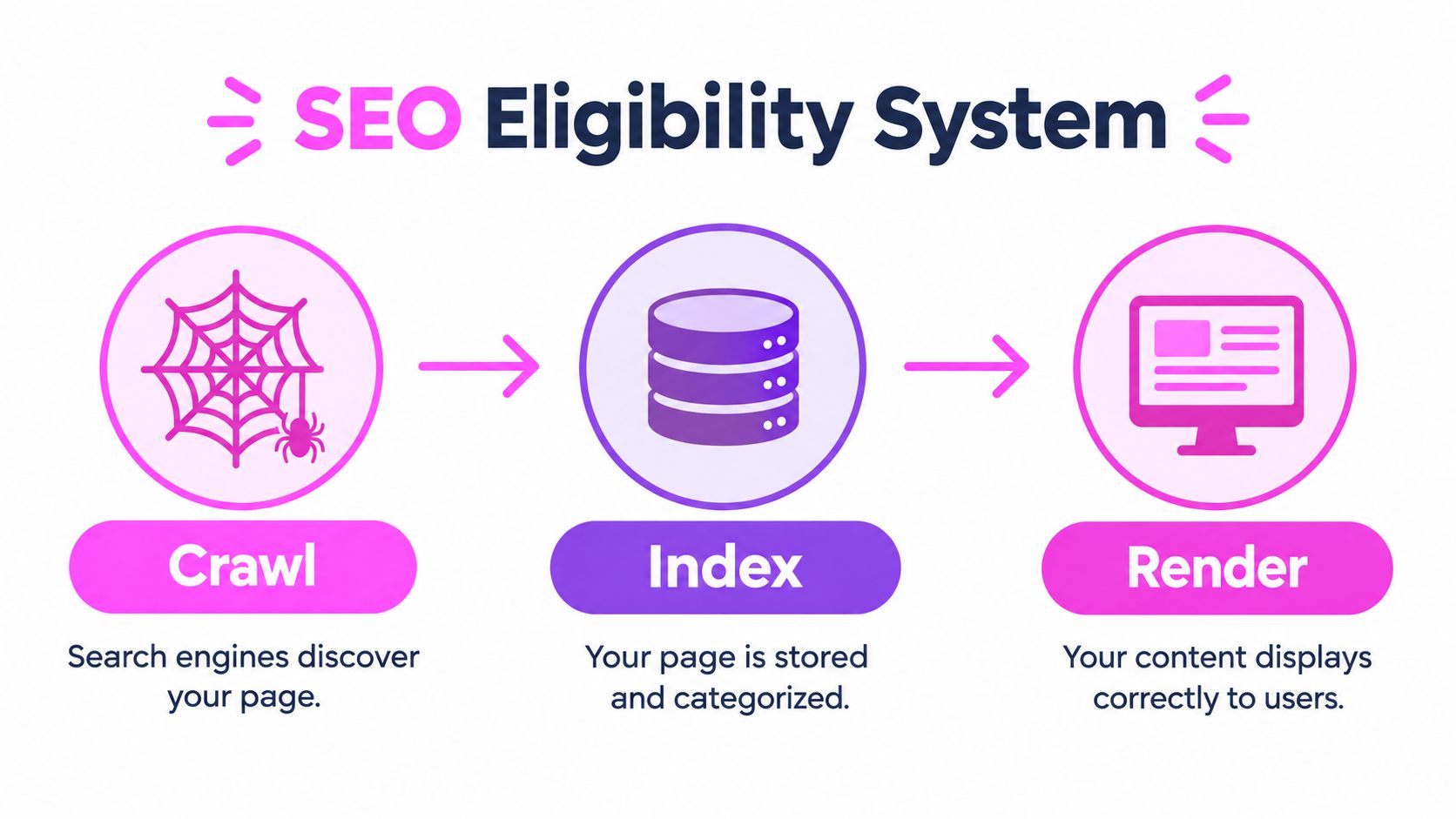
My audit sequence
- Map important URLs: I list every commercially important page and check it is reachable through crawlable HTML links.
- Compare three sets: I compare linked URLs against the sitemap and the indexed pages in Search Console.
- Check blockers: I review robots.txt, meta robots, redirects, canonical tags, and server responses.
- Inspect rendering: I verify what Google sees, not just what I see in my browser.
The failure I see most often is a page that exists in the CMS and sitemap but has no meaningful internal links. It's technically published and practically orphaned. The second failure is a sitemap full of redirected, canonicalized, or noindexed URLs. That doesn't build authority. It adds noise and makes my diagnostics harder.
Practical rule: I submit only preferred, indexable URLs, and I link them from relevant pages with descriptive anchor text.
I also separate indexing from ranking in every diagnosis. Google describes indexing as finding and reading a page, processing its content, and adding it to the index before it can appear in Search, in Google's indexing and ranking FAQ. An indexed page is eligible. It isn't automatically visible, and it certainly isn't guaranteed traffic.
That separation saves my clients money. I don't ask writers to rewrite pages Google can't access. I don't ask developers to fix indexing when the problem is intent mismatch. On large sites, one blocked template can suppress thousands of URLs at once, so I always rule that out before I blame content quality.
Why Position Still Matters and Why It Is Not Enough
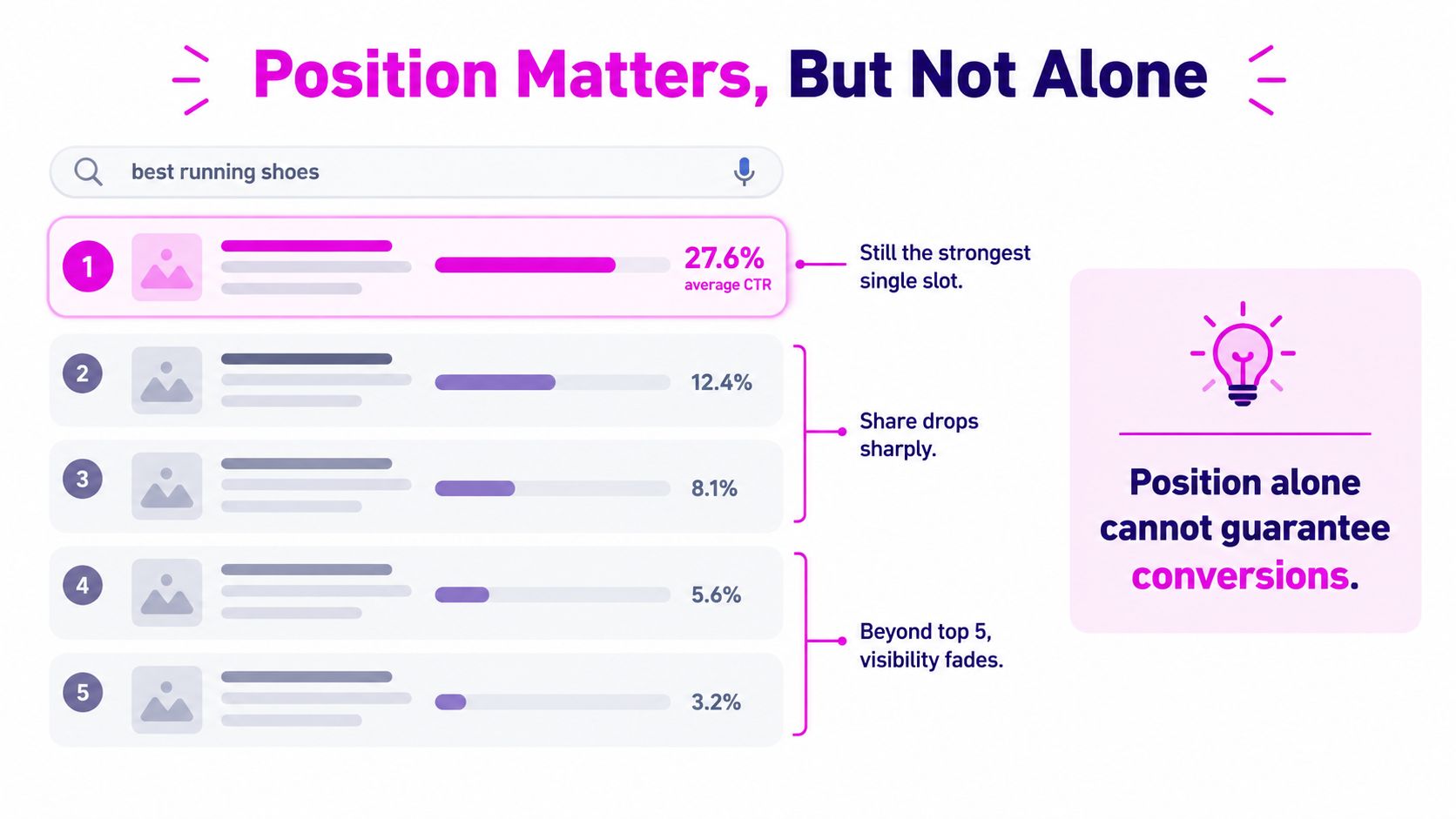
I won't pretend position stopped mattering. Click distribution is still brutally unequal. A large-scale analysis found Google's first organic result receives an average 27.6% click-through rate, while the second receives roughly 15% and the third about 11%, according to OwlClaw's SEO statistics summary. Moving up still changes your share of the same demand.
The chart below makes that drop hard to ignore.
What earns the click after you rank
I use titles and meta descriptions as testing variables, not a one-time checklist. Google's developer guidance recommends descriptive titles and meta descriptions because unique, relevant text helps Google understand relevance and can increase search traffic, as set out in Google's guidance for developers getting started with Search.
I export duplicate titles and missing descriptions first. Then I rewrite a controlled group of similar pages, record impressions and clicks before the change, and compare like with like afterward. I learned the hard way that editing a whole site at once destroys your baseline. You won't know what worked.
There's an edge case I always warn about. Google can ignore your meta description and pull other page text if it thinks that text better answers the query. So I fix the opening paragraph and headings too. If I only polish metadata, I'm trying to control a snippet I don't control.
- Comparison pages: I make the comparison explicit in the title, because vague titles lose qualified clicks.
- Documentation pages: I name the task and product version, because searchers scan for exact fit.
- Location pages: I avoid swapping only a city name across hundreds of titles, because weak differentiation makes testing impossible.
My bigger shift is the optimization unit. I don't run domain-wide ranking campaigns anymore. I map keywords to exact URLs, cluster related queries, classify intent from the SERP, and study competitor top pages. Position is still valuable. But under AI Overviews, the same position can produce very different outcomes depending on intent and SERP features, so I use those CTR averages for prioritization, never as forecasts.
Which Queries Still Pay and Which Ones Stopped
I allocate budget by query type now, not by volume. That's the change most of my clients resist at first, because a big number in a keyword tool feels like opportunity. It isn't, if Google satisfies the searcher before your page gets a chance.
Seer Interactive studied 3,119 informational queries across 42 organizations and reported organic CTR for queries with AI Overviews fell from 1.41% to 0.64% year over year, while CTR improved for queries without them, in Seer Interactive's CTR and AI Overview analysis. I use that gap to sort my content plan before anyone writes a brief.
Where I still invest for clicks
I prioritize queries where a click remains necessary. Product comparisons, local services, transactions, complex tools, regulated advice, and proprietary research all require a next step Google can't fully complete for you. That's where SEO still compounds commercially.
I treat simple definitions and basic how-to queries differently. I'll still target some of them, but I'll label them as visibility or brand-building plays. If I promise you leads from a definition page in an AI Overview heavy SERP, I'm not being straight with you.
When I teach this to in-house teams, I often use a niche example because it forces sharper thinking. A mattress keyword research guide is useful precisely because mattress buyers compare firmness, size, materials, trials, and price before they buy. Those comparison and product queries behave very differently from a simple definition query, and I'd budget for them differently.
A lower-volume query with strong commercial intent often beats a high-volume query that Google answers for free.
My scoring combines six inputs before I approve a target. I check intent, SERP features, AI Overview presence, historical click behavior, conversion value, and competition together. If I look at volume alone, I'll build the wrong portfolio.
That's why I lean on page-level keyword clustering and historical SERP analysis. Clustering stops me from building five thin pages for one intent. SERP history shows me whether Google keeps changing what it wants for that query. If the result type keeps flipping between guides, products, and tools, I slow down. I'd rather pick a stable, lower-volume target with less answer-engine substitution than gamble your budget on a moving SERP.
Performance Engineering as Conversion Support
I don't sell Core Web Vitals as a ranking trick. I sell them as conversion support. A slow, jumpy page loses people before they reach your form, your checkout, or your phone number. That's a revenue problem whether Google rewards the fix or not.
Google defines three Core Web Vitals from real-user field data, with good thresholds of LCP within 2.5 seconds, INP below 200 milliseconds, and CLS below 0.1, in Google's Core Web Vitals documentation. I use field data because lab tests don't show me what your actual visitors on actual phones experience.
The checklist below is how I explain the three metrics to non-technical stakeholders.
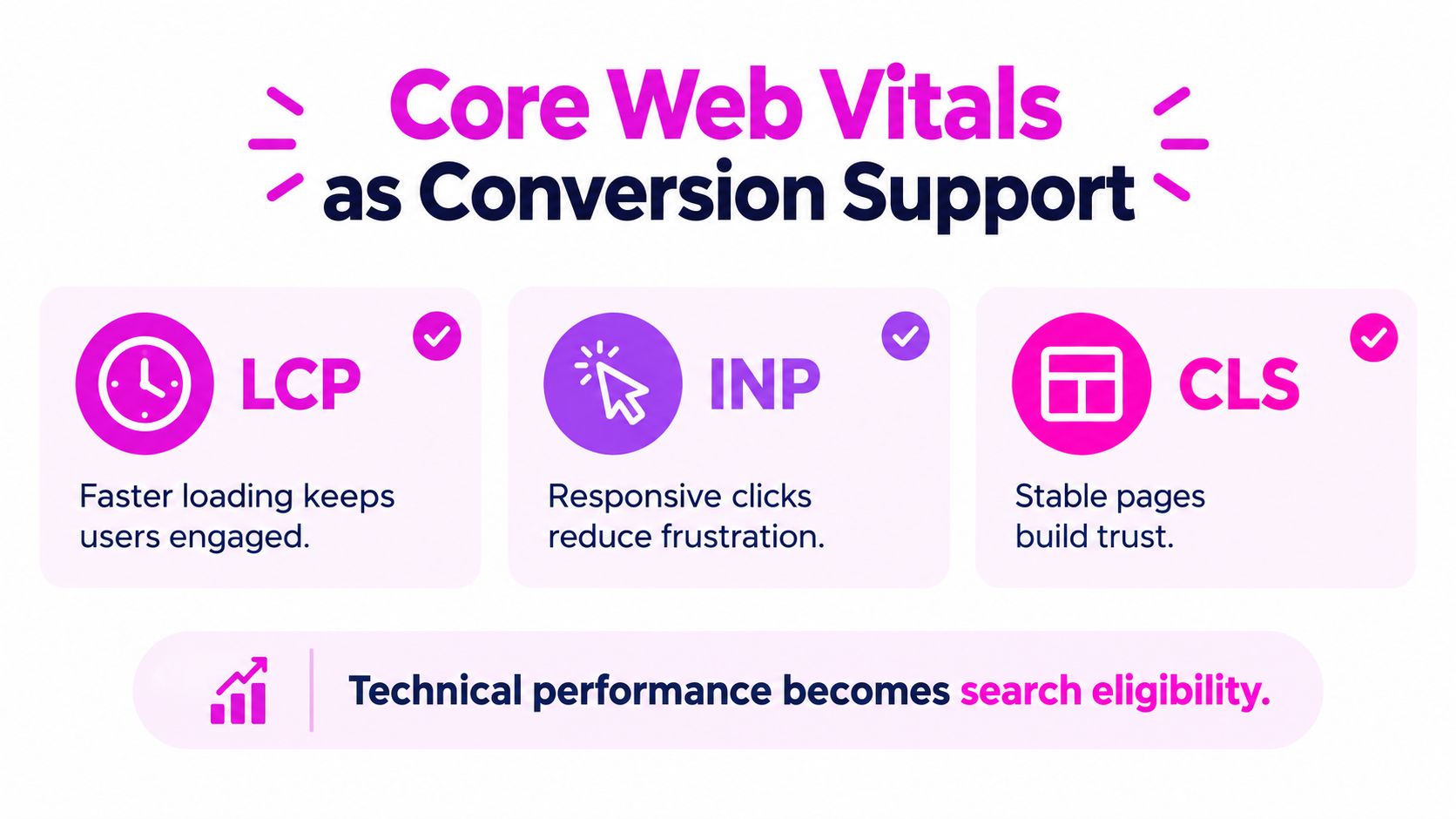
The levers I actually pull
- Largest Contentful Paint: I cut render-blocking resources and server latency so your main content appears sooner.
- Interaction to Next Paint: I reduce JavaScript execution and long tasks so taps and clicks respond without a visible delay.
- Cumulative Layout Shift: I reserve dimensions for images and ads so buttons don't move while someone's trying to press them.
I've watched CLS do quiet damage on mobile service pages. A visitor reaches for a call button, a banner loads late, the layout shifts, and they tap the wrong thing. They don't file a bug report. They leave. Reserving space is unglamorous work, and it protects conversions I already paid to earn through rankings.
I'll be honest about the limit. Google states good Core Web Vitals alone don't guarantee top rankings, and I believe that. If your content doesn't match intent, a fast page won't save it. Performance removes friction. It doesn't create relevance.
My workflow starts in Search Console field data, then I overlay page-level keyword and traffic value. I fix high-value URLs first, compare mobile against desktop separately, and reassess rankings and conversions after meaningful changes ship. I don't chase a perfect score on a page nobody visits. I'd rather improve the landing page that's already close to converting and losing people at the interaction stage.
Measuring the Advantages That Actually Matter
I report SEO in layers now, because sessions alone will mislead you. I start with eligibility, then visibility, then clicks, then qualified outcomes. If I skip the early layers, I'll misread a visibility win as a failure just because traffic stayed flat.
The dashboard view below is the habit I'm building with clients. We look at the full stack together, not one chart in isolation.
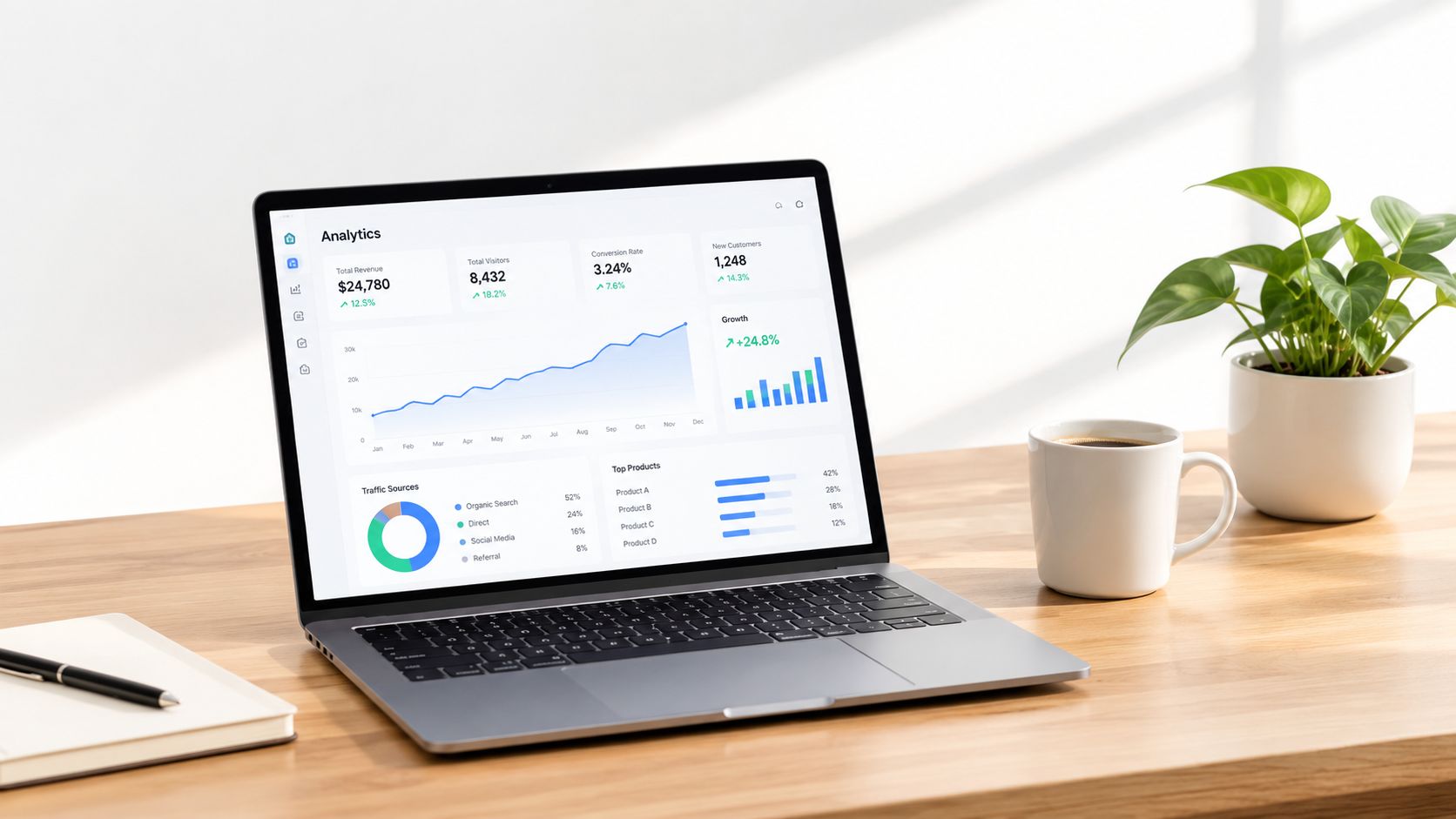
My measurement stack
- Impressions and citations: I track whether we're seen and cited, including the exact URLs referenced in AI answers.
- Branded search growth: I watch whether more people search for you by name after repeated exposure.
- Assisted conversions and qualified leads: I connect organic touches to outcomes that close later through direct or other channels.
- Sessions by intent: I segment traffic so informational losses don't hide commercial gains.
I use SemDash as one option in that workflow for AI Overviews visibility, because it lists keywords that trigger domain mentions and the exact URLs cited. I pair that citation view with the traffic segmentation approach I describe in my organic traffic analysis guide, so I'm not judging visibility work by session counts alone.
The short walkthrough below shows the kind of dashboard review I run before I recommend more content.
My final audit question is always the same. Where's the inefficiency? I'll check whether your important pages are eligible, whether your queries still pay, whether performance is leaking conversions, and whether you're cited where clicks have dried up. The advantages of SEO in 2026 aren't automatic. I earn them by matching each investment to the kind of value that query can still produce, and I cut the work that can't pass that test.
If you're ready to separate traffic that pays from visibility that only looks busy, use SemDash to map keywords to exact ranking URLs, cluster them by intent, and track where your pages get cited in AI Overviews. Start with your highest-value commercial queries, audit their eligibility and SERP environment, and build your next quarter of SEO work from that evidence instead of volume alone.