%20(1)-B86R08ZzwhPzS6UZbG3mSxRWPCwGwn.png)


Get AI Citations in 60–90 Days with Digital PR for SEO

Digital PR for SEO means earning editorial coverage, expert citations, and brand mentions from journalists rather than asking for links directly, and its biggest payoff in 2026 isn’t a domain rating bump. It’s showing up as the cited source inside AI Overviews and chatbot answers. Expect branded search lift almost immediately, AI citation appearances within 60 to 90 days of strong placements, and ranking or domain authority movement over 6 to 12 months.
TL;DR:
- Branded search lift and AI citation appearances from digital PR can happen within 60 to 90 days of strong placements, with domain authority changes taking 6 to 12 months.
- Brand mentions correlate three times more strongly with AI search visibility than backlinks, making them a primary focus for increasing recognition in AI Overviews.
- Data-led studies and quick expert commentary provide the highest return on investment, especially when packaged into concise, journalist-friendly assets.
- Successful campaigns require a four-phase process: assess gaps, build relevant assets, pitch with a tailored angle, and follow up to recover mentions and backlinks.
- Measuring modern SEO impact involves tracking referring domains, unlinked mentions, AI citations, referral traffic, branded search lift, and revenue, with timelines varying for each metric.
What Is Digital PR for SEO and How Does It Differ From Link Building?
Link building, in its classic form, is a direct ask: you find a page that could plausibly link to yours, and you request the link. Digital PR works backward from a story. You build something newsworthy first, a data set, an expert opinion, a timely reaction, and let journalists cover it because it serves their readers, not because you asked for a backlink.
The distinction matters more now than it did five years ago. Google’s systems and the large language models powering AI Overviews weigh entities and mentions alongside links, and a mention doesn’t need an anchor tag to register as a signal of authority. When Search Engine Land describes thinking beyond links, the point is that link building, linkable assets, and digital PR work as three interlocking systems. Pull one out and the other two lose leverage.
Here’s the part that should reorder your priorities: brand mentions correlate roughly three times more strongly with AI search visibility than backlinks do. An analysis of 75,000 brands found a correlation of about 0.664 for mentions versus 0.218 for backlinks, according to the Link Building Journal’s digital PR guide. Backlinks still matter for traditional rankings. But if your north star metric is “does the model know who we are and cite us,” mentions are doing more work than links alone ever will.
Digital PR functions as a multiplier, not a replacement. It amplifies whatever technical and on-page SEO you’ve already built. A perfectly optimized page with zero external validation still struggles to rank for competitive terms or get cited by an AI system that has never encountered your brand name outside your own site. Digital PR solves that visibility gap by putting your brand and your ideas in front of the outlets and datasets that both Google and AI models draw from.
Quick stat: Brand mentions show a 0.664 correlation with AI visibility, versus 0.218 for backlinks, roughly three times stronger, per the Link Building Journal analysis of 75,000 brands.
What this looks like in practice:
- Editorial backlinks from DR 50+ publications that pass authority and topical relevance simultaneously
- Unlinked brand mentions in trade press, roundups, and expert commentary sections that still build entity recognition
- Citations inside AI-generated answers when your published data or quote becomes the source a model pulls from
- Referral traffic and branded search increases that compound as more people encounter your name in a trusted context
None of this replaces the fundamentals. You still need clean technical SEO, solid on-page optimization, and a content strategy that targets real search intent. Digital PR is the layer that makes those fundamentals pay off faster, because it feeds Google and AI systems the third-party validation they use to decide whose content deserves the top spot.
What Campaign Types Actually Earn Editorial Links and AI Citations?
Not every PR tactic earns the same return. Four formats consistently outperform the rest for SEO and AI citation purposes, and they reward different amounts of prep time.
Data-led studies are the highest-leverage format available. A proprietary survey, even a modest one, gives journalists something they can’t get anywhere else. Practitioner guidance suggests a minimum viable study needs a modest number of targeted respondents, though larger proprietary data sets and recurring annual reports perform better and keep earning links long after publication, according to SEOBeni’s practitioner guide. Package the findings into a one-page summary with a headline stat, three supporting data points, one quotable line, and a single clean chart. That packaging alone raises pickup rates, based on the Link Building Journal’s reporting on what journalists actually use.
Expert commentary and newsjacking trade scale for speed. When a relevant news event breaks, a fast, quotable reaction from someone at your company can land in coverage within hours. The trick is preparation: keep two or three “quote ready” lines drafted in advance for topics adjacent to your industry, so when a reporter’s inbox opens at 8 a.m., you’re not starting from a blank page. A usable quote sounds something like, “The real risk here isn’t the policy change itself, it’s how quickly retailers can adapt their pricing models before the holiday season,” specific, attributable, and immediately usable without editing.
Evergreen interactive tools and resource pages earn links slowly but keep earning them. A calculator, an interactive map, or a well-maintained resource hub gets referenced by writers for years after launch, unlike a one-week news hook. These assets take longer to build but need almost no ongoing outreach once they rank and get discovered organically.
Publication targeting should run trade-first, then tier up. Pitch the trade and niche outlets covering your exact space before you chase national press. Trade coverage tends to be more topically aligned, which both Google and AI models weight more heavily than a generic mention in a broad outlet, and trade pickup often gives you the case study and data you need to make the pitch to bigger publications credible.
Pro Tip: Build your quote bank before you need it. Draft five potential expert reactions to plausible industry events each quarter, so newsjacking becomes a five-minute edit instead of a scramble.
How Do You Run a Digital PR Campaign Step by Step?
A repeatable campaign follows the same four phases every time: assess, build, pitch, and follow up. Skipping any one of them is the most common reason campaigns underperform.
- Run an authority-gap assessment. Audit which competitors get cited in AI Overviews for your core topics and map where you have no presence at all. This is a topic-ownership exercise as much as a competitive one, you’re looking for questions your industry gets asked repeatedly where no single brand has claimed the authoritative answer yet.
- Build the citable asset. This is a landing page on your own domain, not a PDF or a press release hosted elsewhere. Include the data, a one-page press kit version, at least one clean visual, and a quote-ready spokesperson. Publishing the asset on your own domain first matters more than it sounds: if you distribute through a wire service without a strong owned page, syndicators and wire copies can capture the citation that should have gone to you.
- Pitch like a journalist, not a marketer. Lead with the finding, not your company name. Tailor the angle to the specific beat you’re pitching, a fintech reporter and a workplace-culture reporter need different framings of the same data set. Offering something exclusive, an early look, a custom data cut for their specific audience, converts far better than a mass blast, a pattern confirmed across practitioner workflows in SEOBeni’s 2026 guide.
- Follow up and recover links. Journalists sometimes mention your brand without linking. A polite, specific follow-up asking for attribution recovers a meaningful share of those mentions. Build a syndication workflow to catch when your data gets picked up by secondary outlets, and set a cadence to refresh and relaunch the asset with updated numbers every 6 to 12 months, which gives you a legitimate reason to re-pitch the same relationships.
Within each phase, a few tactical habits separate campaigns that compound from campaigns that fizzle after one placement:
- Keep a running list of 20 target journalists per topic cluster, sorted by beat and outlet tier
- Track which pitches got a reply, not just which got coverage, reply rate tells you if your subject lines and framing are working
- Store every quote and data point you’ve ever pitched in one place so you’re never starting from zero on the next cycle
- Treat the PRSA’s public relations standards as your baseline for outreach ethics, especially around disclosure and sourcing accuracy
Which KPIs Actually Prove Digital PR Is Working?
Referring domains, weighted by authority rather than counted flatly, remain a core metric, but they’re no longer the only one that matters. A modern measurement framework tracks six signals together, because any single metric in isolation can mislead you about whether a campaign actually worked.
- Referring domains (quality-weighted): count new unique domains linking to your asset, but weight a DR 60 trade publication far above ten low-authority directories
- Unlinked brand mentions: track mentions of your brand name or spokesperson that didn’t include a link, since these still feed entity recognition
- AI citation appearances: manually audit or monitor how often your brand or asset gets cited inside AI Overviews and chatbot answers for your target queries
- Referral traffic: measure direct visits from the publications that covered you, which tells you if the placement drove real human interest
- Branded search lift: watch for an increase in searches for your company name in the weeks following major coverage
- Conversion and revenue from referral traffic: the metric that ties the whole campaign back to business impact, not just visibility
Building a correlation dashboard means plotting link acquisition dates against ranking movement and AI citation appearances on the same timeline. When you see a cluster of high-authority placements followed a few weeks later by a jump in AI mentions, that’s your evidence the campaign, not some unrelated algorithm update, drove the change.
Quick stat: AI citation visibility can shift within a couple of months of high-authority editorial placements, while domain authority movement typically takes several months to a year, according to Flux.
Set expectations against those timelines from day one. A stakeholder expecting a domain authority jump in month two will call the campaign a failure right when the AI citation signal is just starting to show up. Tracking AI citations and brand-mention audits has become one of the more requested KPIs among PR and SEO teams over the past two years, per Flux.LA’s reporting, largely because clients want proof their spend translates into visibility inside the tools their own customers now use to research purchases.
What Does Digital PR Cost and What Usually Goes Wrong?
Costs vary widely depending on what kind of campaign you’re running, but the biggest lever is research depth. A reactive newsjacking response, built on an existing spokesperson and a quick quote, costs mostly time, a few hours from your comms lead. A data-led study with a 150 to 200 person survey, professional visualization, and a dedicated PR agency running outreach costs considerably more, driven up by sample size, the quality of the charts and design, and how senior the outreach team pitching it is.
The pitfalls that sink campaigns tend to repeat across teams and industries:
- Weak or mispackaged assets: a data set with no headline stat, no chart, and no quote is a burden for a journalist to write about, not a gift
- Poor targeting: blasting national press before proving the story works with trade outlets wastes both the exclusive angle and the credibility a niche win would have built
- No follow-up: leaving unlinked mentions unclaimed and letting syndicated coverage disappear without tracking it forfeits value you already earned
- Treating PR as a one-off: a single campaign generates a short-term spike; a sustained program with a content calendar and refreshed data compounds authority over years, a point Search Engine Land’s framework on thinking beyond individual links makes directly
Building repeatability means running digital PR on a calendar, not a whim. Set a cadence for refreshing your core data sets, quarterly or annually depending on how fast your industry’s numbers shift, and invest time in nurturing relationships with the same 15 to 20 journalists who cover your beat regularly. Those relationships are the actual asset. The dataset is just this quarter’s reason to email them.
How Do Research Platforms Support Digital PR Workflows?
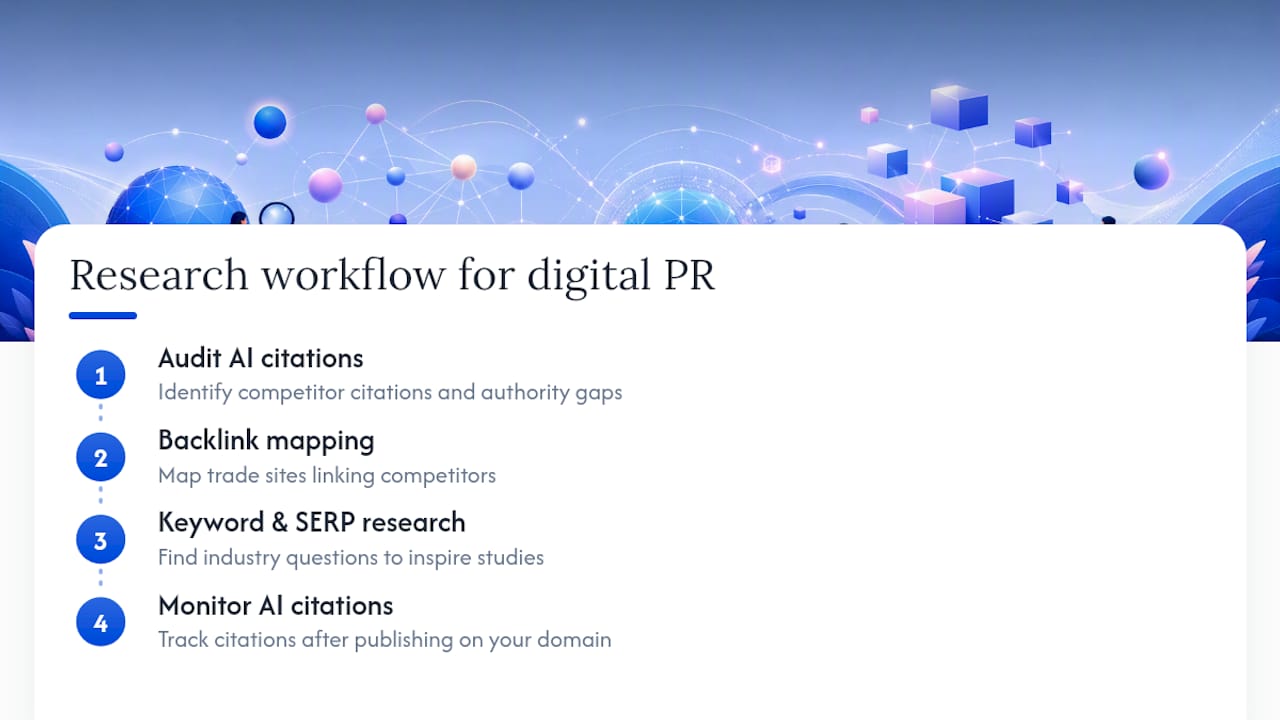
A digital PR program runs on research just as much as it runs on outreach, and that’s where an SEO competition analysis tool earns its place in the workflow. Use it to run an authority-gap audit: see which competitors show up in AI Overviews for your core topics and where your brand has no citation footprint at all.
From there, backlink research helps map which trade publications already link to competitors, giving you a prioritized outreach list instead of a guess. Keyword and SERP data surface the exact questions your industry gets asked, which is usually where your next data-led study idea comes from. AI Overview monitoring closes the loop by tracking whether your citations actually appear once the campaign is live.
One detail worth repeating: publish your asset on your own domain, not a wire service page. That’s how your site, not a syndicated copy, collects the citation when an AI model pulls the answer.
Why Most Teams Overinvest in the Wrong Part of Digital PR
Most teams over-invest in outreach volume and under-invest in the asset itself. You can email two hundred journalists a mediocre press release and get nothing, or email fifteen the right data point and get three placements that actually move rankings. The asset is the leverage point, and that’s the piece people rush.

My prioritized recommendation: start with a data-led minimum viable campaign rather than trying to build an interactive tool or a six-figure annual report on your first attempt. A tight, well-packaged study beats an ambitious, half-finished one every time.
This week, do four things: run a citation audit to see where you’re invisible in AI answers for your core topics, pick one data set you can realistically gather or already have internally, draft a one-page asset with a headline stat and a chart, and build a list of 20 target outlets sorted by beat. That’s a real campaign, not a plan for one.
— Leonid
How Semdash Speeds Up Your Digital PR Research
Every digital PR campaign starts with a research problem before it becomes an outreach problem, and that’s exactly where a lot of teams lose weeks. Semdash gives you the keyword research to find the questions your industry actually asks, the competitor analysis to spot which brands own the AI citations you’re missing, and backlink data to build a prioritized list of trade outlets worth pitching first.
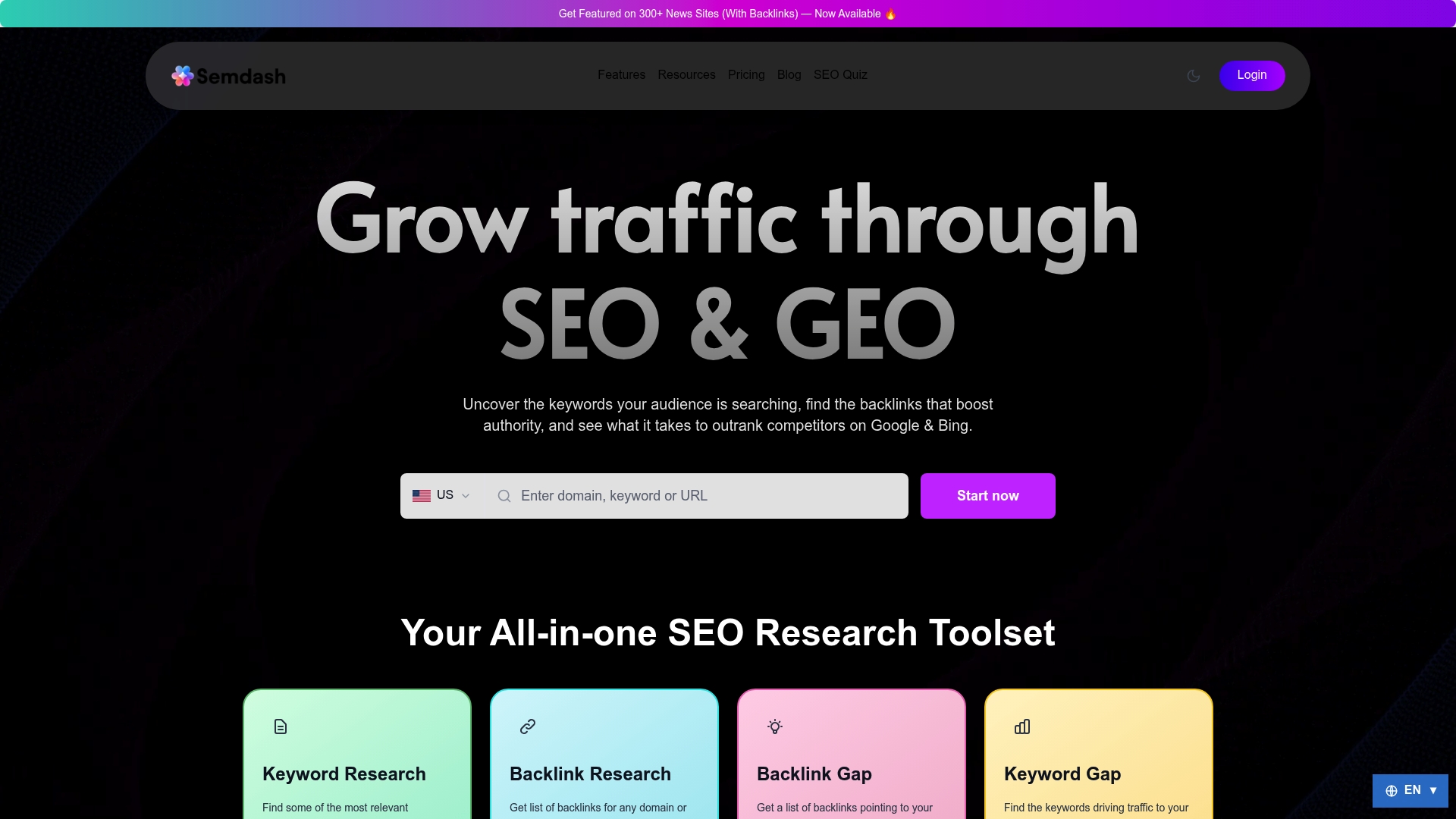
Instead of manually checking AI Overviews query by query, run a citation audit inside the platform to see exactly where your brand is absent and where a competitor has quietly claimed the answer. Pair that with backlink research to identify which publications are already linking to your competitors, and you’ve got a target list before you’ve written a single pitch email. If distribution is your bottleneck rather than research, Semdash’s press release service handles getting your asset in front of news sites that can carry the link back to your own domain.
Start with the SEO competition analysis tool this week and see exactly where your authority gap sits before you write another pitch.
Sources
The Flux.LA guide to digital PR for SEO covers realistic timelines for AI citation shifts and domain authority movement. The Link Building Journal’s digital PR guide provides the brand-mention correlation data and journalist packaging tactics. Search Engine Land’s link building framework explains how digital PR, link building, and linkable assets work together. SEOBeni’s practitioner guide offers the step-by-step workflow for data-led campaigns. For dashboard-building beyond this article, see this overview of AI SEO metrics.
- Flux
- Link building works better when you think beyond links - Search Engine Land
- Digital PR for Link Building: The Complete Guide (2026) - Link Building Journal
- Digital PR Link Building: A Practitioner’s 2026 Guide - SEOBeni
FAQ
What Is the Difference Between Digital PR and Link Building?
Link building directly requests a link on an existing page, while digital PR earns editorial coverage and brand mentions through newsworthy content that journalists choose to cover on their own.
How Long Does Digital PR Take to Affect SEO Rankings?
Domain authority typically shifts over 6 to 12 months, while AI citation appearances can show up within 60 to 90 days of high-authority editorial placements, according to Flux.LA’s analysis.
Do Unlinked Brand Mentions Help SEO?
Yes. Brand mentions correlate roughly three times more strongly with AI search visibility than backlinks, at 0.664 versus 0.218, based on the Link Building Journal’s analysis of 75,000 brands.
How Much Does a Digital PR Campaign Cost?
Costs range from a few hours of staff time for a reactive newsjacking response to a much larger investment for a data-led study, driven mainly by survey sample size, visualization quality, and outreach team seniority.
What Tools Help Track Digital PR Results for SEO?
Backlink research and AI Overview monitoring tools, like those built into Semdash, let teams track referring domains, brand mentions, and AI citation appearances in one place.