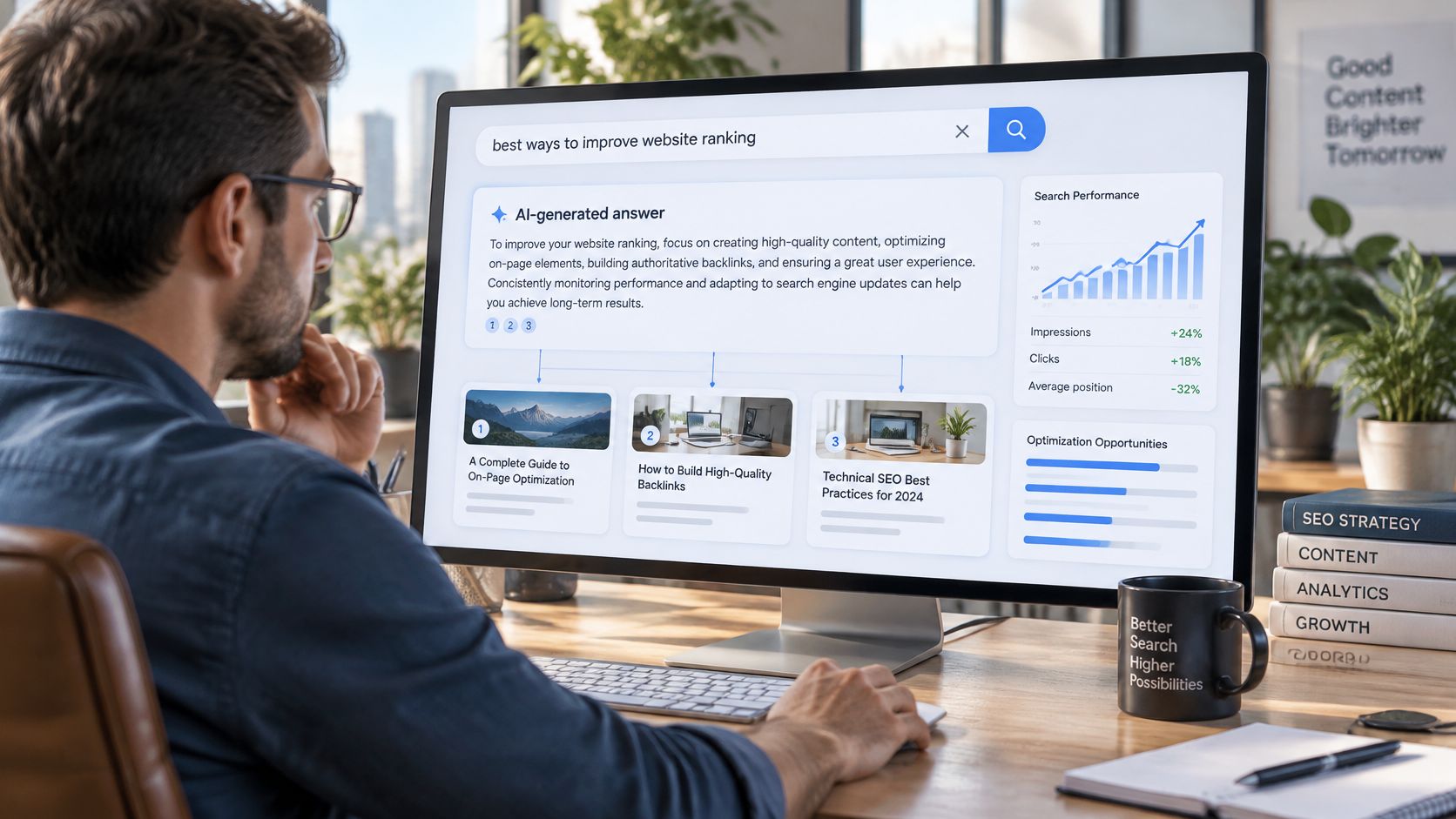


Keyword lists fail in the same way: a column of head terms sorted by search volume, no intent label, no URL owner. That looks thorough until you try to build pages from it and realize nobody decided what job each query should do.
I stopped sorting by volume first. Omnibound's Google search statistics report puts global volume at more than 5 trillion searches a year, about 158,000 every second, so collecting more phrases is rarely the constraint. The constraint is classification. In SemDash I tag intent, cluster near-duplicates, and assign each term one page before I care about difficulty.
Each example of SEO keywords below maps to a page decision: query, URL that should own it, volume treated as a ballpark, and the mismatch I see most often when that choice goes wrong. Run your own list through the same eight types and the wasted effort usually shows up fast.
Table of Contents
- 1. Informational Long-Tail Keywords and 'How to Fix a Leaky Kitchen Faucet' (Content Marketers and Bloggers)
- 2. Definitional Keywords and 'What Is Keyword Cannibalization' (SEO Specialists and Consultants)
- 3. Commercial Investigation Keywords and 'Best CRM for Small Business' (SaaS Growth Teams)
- 4. Product-Modifier Keywords and 'Best Wireless Earbuds Under $100' (E-commerce and Affiliate Sites)
- 5. Transactional Product Keywords and 'Men's Trail Running Shoes Size 11 Wide' (E-commerce Teams)
- 6. Local Transactional Keywords and 'Emergency Plumber Near Me' (Small Businesses and Solopreneurs)
- 7. Navigational Brand Keywords and 'SemDash Pricing' and 'Ahrefs Login' (SaaS and Agency Teams)
- 8. Question-Based Keywords for AI Overviews and 'Does Schema Markup Improve Rankings' (Content Marketers and Agencies)
- How the eight keyword types compare by intent, audience, and sample query
- Turn These Eight Keyword Types Into a Working Plan
1. Informational Long-Tail Keywords and 'How to Fix a Leaky Kitchen Faucet' (Content Marketers and Bloggers)
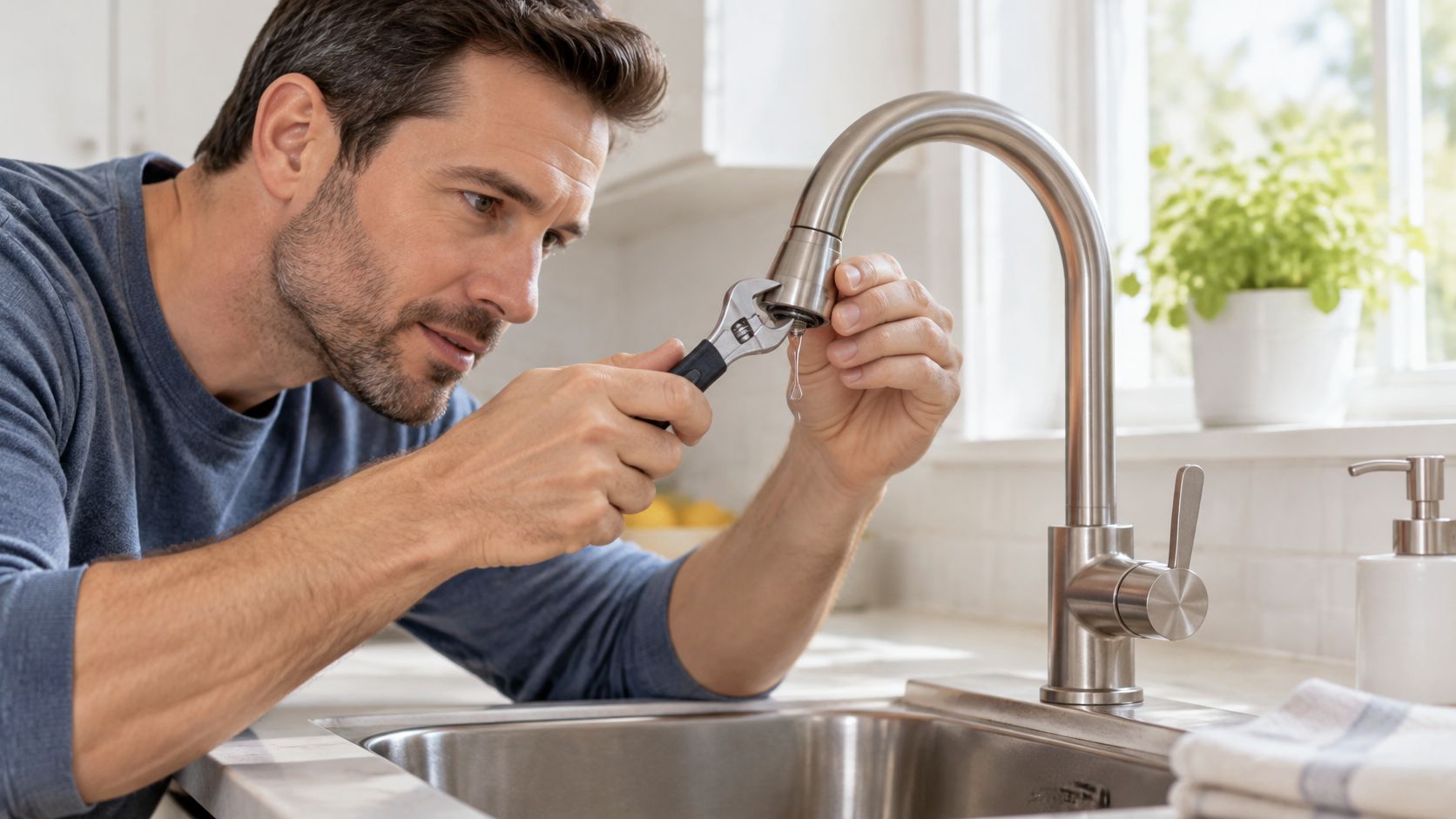
The query how to fix a leaky kitchen faucet puts the searcher in a kitchen with an active drip and a limited window before dinner. A home-improvement blog can answer that completely, then route the reader to the washer, cartridge, or supply line the repair requires.
The page decision is a step-by-step repair guide with parts links. The common failure is assigning the term to a plumbing category page because the category has more authority; the searcher leaves because nobody showed them which screw to turn first.
This repair photo shows exactly the kind of specific problem these queries describe.
How I build these pages
I start in SemDash's Long-Tail and People Also Ask suggestions and pull the sub-questions readers actually ask: shutoff valve location, cartridge identification, when to replace instead of repair. Those become H2s. Before writing, I check whether the result page is dominated by guides or product grids, because a pure how-to can lose if every ranking page sells the part on the same URL.
I treat the reported volume as a ballpark. How-to terms often look thin in tools while real demand shows up across repeated PAA variants, so I judge the cluster by how many neighbouring problems it can answer cleanly.
Examples I put in this bucket include what causes a water heater to make popping noises for a plumbing service site and how to remove a stripped screw from drywall for a DIY hardware retailer. Each one names one problem. I use Keyword Clustering to keep neighbouring problems on separate articles so they do not cannibalize each other.
Practical rule: Informational traffic isn't free traffic. If the page has no path to a product, service, or signup, you've built a library nobody pays for.
The trade-off is real. These queries rarely convert on their own, so I place one contextual link to a related commercial page early, while the reader is still mid-task and the part is the next decision.
I also plan for answer engines now, because long questions aren't automatically safe. I favour questions that need photos, tools, sequence, or safety checks over questions a summary can finish in one sentence.
This video walkthrough is the kind of first-hand demonstration a text-only summary can't replace.
2. Definitional Keywords and 'What Is Keyword Cannibalization' (SEO Specialists and Consultants)
A definitional query looks simple, and that's the trap. Someone searching what is keyword cannibalization usually suspects the problem exists on their own site right now. A dictionary-style paragraph confirms the term and tells them nothing about whether they have it.
So the page decision is fixed before I write: definition first, diagnosis second, fix third. I open with a two-sentence answer a snippet can lift, then I show the reader how to check their own site, then I hand off to the worked guide on how to fix keyword cannibalization. Detection without a next step dead-ends the visit.
What separates a useful definition from filler
For the cannibalization page, the self-check is concrete: search the cluster's core terms, or run them through the SERP Checker, and look for two of your own URLs splitting positions across weeks. That single test turns an abstract term into a yes-or-no answer about the reader's site. A glossary page that stops at the definition can't do that, and in my experience those pages stall outside the top results while pages carrying a diagnostic step hold.
I apply the same three-part test to what is search intent in SEO and what is a canonical tag. Each gets a snippet-ready answer, a check the reader can run in a few minutes, and one link onward to remediation. The trade-off is worth naming: definitional volume is modest, and keyword tools only give me a ballpark for these terms, so I judge these pages on how many readers run the check rather than on raw sessions.
One failure I stopped repeating: publishing a standalone page per term. Related definitions now go into one guide with anchored sections, because a dozen thin glossary URLs end up splitting rankings exactly the way the cannibalization example describes.
3. Commercial Investigation Keywords and 'Best CRM for Small Business' (SaaS Growth Teams)
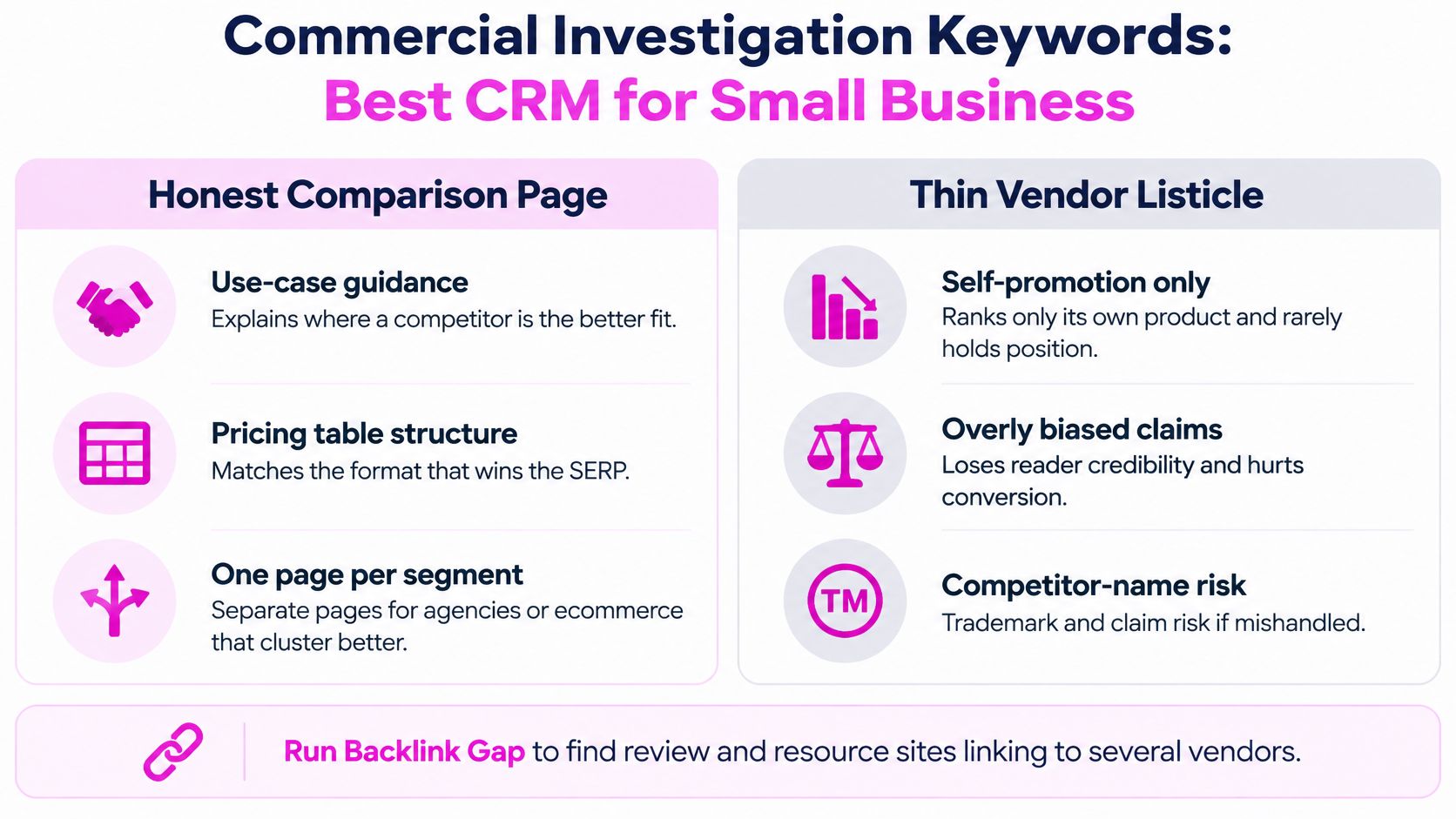
Best CRM for small business is where I see SaaS teams lose pipeline they never knew existed. The reader is shortlisting vendors, not learning what a CRM is. If your page is a thin listicle that ranks only your own product first, it rarely holds position for long.
I write honest comparisons instead. I say where HubSpot vs Pipedrive splits by use case, and I name the segment where a competitor wins. That candour sounds risky, but it's what helps a reader decide, and deciding is the intent.
This chart contrasts the comparison formats I trust with the ones I retire.
How I find the right comparison terms
I start with Domain Keywords and Keyword Gap in SemDash to see which comparison terms competitors already rank for. I prioritise gaps like Mailchimp alternatives for ecommerce or best project management software for agencies only where we have a real differentiator. I build one page per segment rather than one generic best-of page, because segmented pages cluster cleanly and cannibalize less.
I also stop treating volume as visits. A 2024 study of 31,648,226 impressions found the first organic result earned an estimated 9.28% CTR, with 5.82% and 3.11% in positions two and three. Ranking third for a huge term can be worth less than ranking first for a smaller one.
- Study the winners: I use Competitor Top Pages to match the format the SERP already rewards.
- Find link targets: I run Backlink Gap against leading comparison pages to find review sites linking to several vendors.
4. Product-Modifier Keywords and 'Best Wireless Earbuds Under $100' (E-commerce and Affiliate Sites)
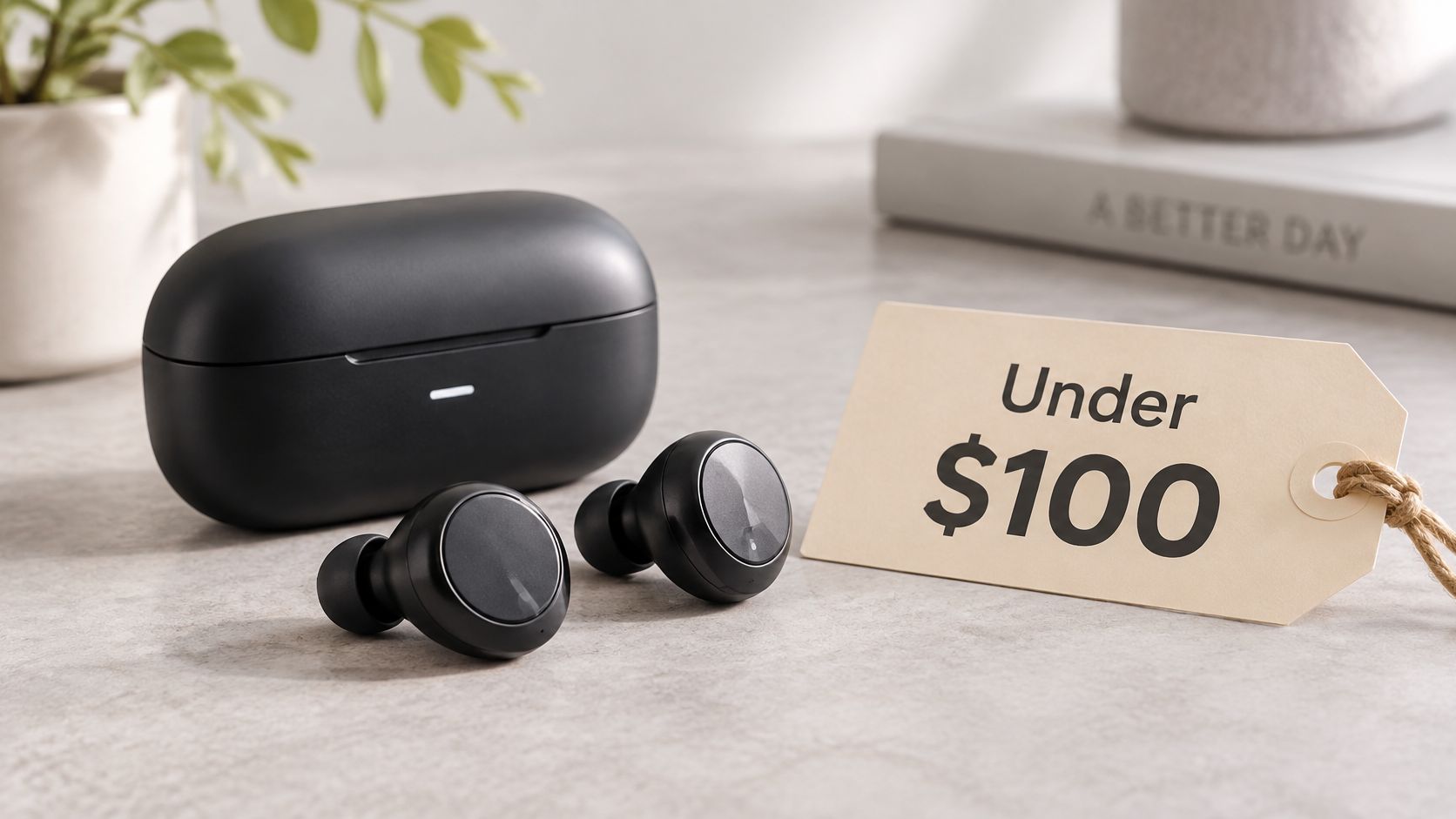
Best wireless earbuds under $100 is the most profitable query type I've worked on for affiliate content, and the fastest to rot. The modifier is the whole point. Price, size, material, or use case tells me this shopper is past curiosity and close to choosing.
The product shot here shows why the price constraint has to be visible and accurate.
I group terms like lightweight running shoes for flat feet, best standing desk for small spaces, and budget DSLR camera for beginners with Keyword Clustering. Every price tier gets its own page, so under $100 and under $200 don't compete. I then check URL-level keyword mapping to confirm the right page ranks for each modifier.
A roundup with stale prices and no testing method isn't out of date by accident. It's out of date because nobody owns the maintenance schedule.
How I keep these pages earning
I put a last-updated date and a testing note near the top, with specifics like how long each product was used. I review the top commercial pages quarterly, remove discontinued items, and recheck intent in the SERP Checker history.
The payoff for intent alignment is documented. One ecommerce campaign grew engaged organic sessions from 12,800 to 27,600, a 115% gain, while Top-10 keywords rose from 2,005 to 2,737. Traffic grew faster than keyword count, which tells me fit beat volume. That's the benchmark I want you measuring against.
5. Transactional Product Keywords and 'Men's Trail Running Shoes Size 11 Wide' (E-commerce Teams)
Men's trail running shoes size 11 wide leaves nothing to interpret. The shopper knows the size, the width, and the terrain. If that query lands on a blog post about trail running tips, I've captured traffic and lost the sale.
I treat these as a catalog problem, not a content problem. Terms like organic cotton crib sheets and stainless steel water bottle 32 oz with straw each need an indexable category or product URL, or a governed filter combination. Without that structure, the store competes with itself.
How I decide which filter pages to index
I pull a Keyword Gap report against two or three competitor stores first. Attribute-level terms they rank for often reveal pages we never built. Then I index only combinations with real demand and unique inventory, and I canonicalize or noindex the rest.
- Map every term: I use URL-level mapping to confirm transactional queries point at product or category pages.
- Watch the layout: I set SERP Checker alerts for categories where Google starts showing shopping results, because the organic opportunity shifts.
placement matters here too, but within limits. I write the attribute phrase naturally in the title and heading, then I let specs, stock, and reviews do the work. Google's own guidance is clear that its systems prioritise helpful, reliable, people-first content over pages built mainly to manipulate rankings. A category page that answers sizing and returns questions satisfies that test. One that repeats the phrase in every paragraph doesn't, and shoppers feel it before any algorithm does.
6. Local Transactional Keywords and 'Emergency Plumber Near Me' (Small Businesses and Solopreneurs)
For a small service business, emergency plumber near me can be worth more than every blog term combined. The customer calls within minutes. Yet I constantly meet owners who assume their Google Business Profile handles everything and never build a service page.
This technician photo is the kind of real local proof a templated page lacks.

I target queries like dog groomer in Bozeman, same day AC repair Phoenix, and 24 hour locksmith downtown Denver with pages that include a neighbourhood job example or a local review. I check which city modifiers have volume in SemDash's keyword discovery first. If I can't write a unique angle for a location, I skip the page.
The mistake that gets local pages in trouble
Swapping a city name into a template is the failure I clean up most. Google's spam policy defines keyword stuffing as filling a page with keywords to manipulate rankings, including blocks of location names. A footer list of suburbs is exactly that pattern.
I describe services, areas served, and pricing context instead. I keep Business Profile categories, services, and hours aligned with the site, because mismatches weaken both the Map Pack and organic results. I track the top three service plus city combinations monthly, and when a page drops, I check whether a competitor added reviews or a more specific page first.
7. Navigational Brand Keywords and 'SemDash Pricing' and 'Ahrefs Login' (SaaS and Agency Teams)
I don't chase navigational terms for traffic. I use them as a quality check on the site itself. When someone searches SemDash pricing or Ahrefs login, they've already decided where they're going. If they land on a blog post, my architecture failed them.
The page decision here is narrow: pricing queries resolve to the pricing page, login queries to the login or app subdomain, support queries to the help centre. To check, I run a site: search for the brand plus modifier, then confirm the ranking URL in SemDash's URL-level mapping, which shows which page holds each tracked position. If a help article or an old blog post outranks the login page, I tighten internal links, fix the target page's title, and give it a clearer path from the main navigation.
Volume for terms like Semrush keyword magic tool and Mailchimp customer support is a ballpark, and I say so when I report it. Brand demand moves with ad spend, launches, and press coverage, so a keyword database figure reflects a recent average, not a stable baseline. I track the trend line rather than trusting a single monthly number.
How I audit brand queries
I make sure pricing and login pages are indexable, clearly titled, and linked from both the main navigation and the footer.
- Monitor modifiers: I watch brand plus modifier queries in the keyword database for demand shifts.
- Handle rivals fairly: For competitor brand terms, I build factual alternatives pages and cite claims rather than inventing weaknesses.
I also separate visibility from visits in reporting. Google Search Console counts an impression when a link appears on the results page, even if the user doesn't scroll to it, and calculates CTR as clicks divided by impressions. A brand page can gain impressions and earn almost no clicks. I export query, page, clicks, impressions, and CTR together, then fix titles on the high-impression, low-CTR terms.
8. Question-Based Keywords for AI Overviews and 'Does Schema Markup Improve Rankings' (Content Marketers and Agencies)
Schema markup does not directly improve rankings. Google says structured data can make a page eligible for rich results, but eligibility does not guarantee that Google will show one (Google Search Central). For the query does schema markup improve rankings, lead with that answer, then explain what markup can affect and which result types the page may qualify for.
The same direct-answer approach works for other SEO questions: internal nofollow links are generally unnecessary because Google can crawl links on your own site; keyword density is not a Google ranking factor; and SEO timelines vary, with Google advising that changes can take weeks or months to show results. Each answer needs a useful qualification, not just a yes or no.
Build the answer block around the page decision
For a question-based keyword, write a one- or two-sentence answer immediately below a descriptive heading, then add the evidence and implementation steps. For schema markup, name the relevant type, explain what information it marks up, and validate the structured data with Google's Rich Results Test. Do not add markup for content that users cannot see, or promise a rich result.
In SemDash, use the AI Overviews visibility report to check which queries mention your domain and which URLs receive citations. Treat search volume as an estimate of demand, not a forecast of clicks. A question with modest volume may merit a page update if it matches the audience's decision and the current page can answer it accurately. The trade-off is clear: answer blocks can improve extractability, but an answer alone may satisfy the search without earning a visit.
Pew Research analysed 68,879 Google searches from March 2025 and found users clicked a traditional result in 8% of visits when an AI summary appeared, compared with 15% when it did not. A Semrush study found keywords triggering AI Overviews rose from 6.49% in January 2025 to nearly 25% in July. These findings make citation visibility worth tracking alongside clicks, while keeping the goal focused on useful answers rather than formatting for an AI summary.
Use People Also Ask questions only when they reflect real audience needs, and update answers when Google documentation changes. A FAQ filled with loosely related queries adds pages of text without helping readers make a decision.
How the eight keyword types compare by intent, audience, and sample query
| Item | Search Intent | Business Type | Sample Query |
|---|---|---|---|
| Informational Long-Tail Keywords | Informational | Content marketers, bloggers, and DIY or home-services publishers | how to fix a leaky kitchen faucet |
| Definitional Keywords | Informational, definitional | SEO specialists, consultants, and digital marketing agencies | what is keyword cannibalization |
| Commercial Investigation Keywords | Commercial investigation | SaaS growth teams and software review publishers | best CRM for small business |
| Product-Modifier Keywords | Commercial investigation with purchase intent | E-commerce stores and affiliate publishers | best wireless earbuds under $100 |
| Transactional Product Keywords | Transactional | E-commerce growth and merchandising teams | men's trail running shoes size 11 wide |
| Local Transactional Keywords | Transactional, local | Local service businesses and solopreneurs | emergency plumber near me |
| Navigational Brand Keywords | Navigational | SaaS companies and digital marketing agencies | SemDash pricing |
| Question-Based Keywords for AI Overviews | Informational, question-based | Content marketers, SEO agencies, and in-house editorial teams | does schema markup improve rankings |
Turn These Eight Keyword Types Into a Working Plan
I'd start with a list you already have. Don't research a single new term yet. Tag every keyword with one of these eight intent types, then check which URL currently ranks for it.
That exercise takes an afternoon and it's uncomfortable. You'll find blog posts ranking for transactional terms, a homepage trying to cover five local services, and comparison queries with no page at all. In my experience, those mismatches explain more stalled traffic than any missing keyword ever will.
How I'd sequence the fixes this week
Pick one commercial page and one informational page that compete for the same query. Decide which intent the SERP actually rewards, give the cluster to that page, and rewrite or redirect the loser. Then measure what changed before you touch the next pair.
Measure properly, because position alone will mislead you. As noted earlier, impressions show opportunity and CTR shows whether your title earns the click. A practical breakdown of how to track keyword rankings will help you separate rank movement from actual visits and conversions.
- Tag intent first: Label each term informational, definitional, commercial, transactional, local, navigational, or question-based before you look at volume.
- Assign one owner: Give every cluster a single canonical URL and record it in your sheet.
- Check click potential: Ask whether an AI summary, shopping block, or map pack will take the click before your page gets a chance.
- Fix the worst mismatch: Start where a ranking page clearly serves the wrong intent.
Once those basics hold, use Keyword Gap to find terms competitors own that you don't, and use clustering to plan new pages without recreating cannibalization. That's the order that works. Classification first, expansion second.
I'll be blunt about the trade-off. This approach produces a shorter keyword list than the volume-sorted spreadsheet that many teams defend. It also produces pages you can maintain, measure, and improve. SemDash is one option for running the clustering, gap, and AI Overviews checks in one place, but the classification discipline matters more than the tool. Get the intent right and the rest of the work finally compounds.
Run your current list through SemDash's keyword discovery, clustering, Keyword Gap, and AI Overviews visibility reports to tag intent, assign one URL per cluster, and spot the mismatches costing you clicks. Visit SemDash to start with the domain you manage and fix your first mismatched page this week.