Optimize Content for SEO: Practical Strategies That Work

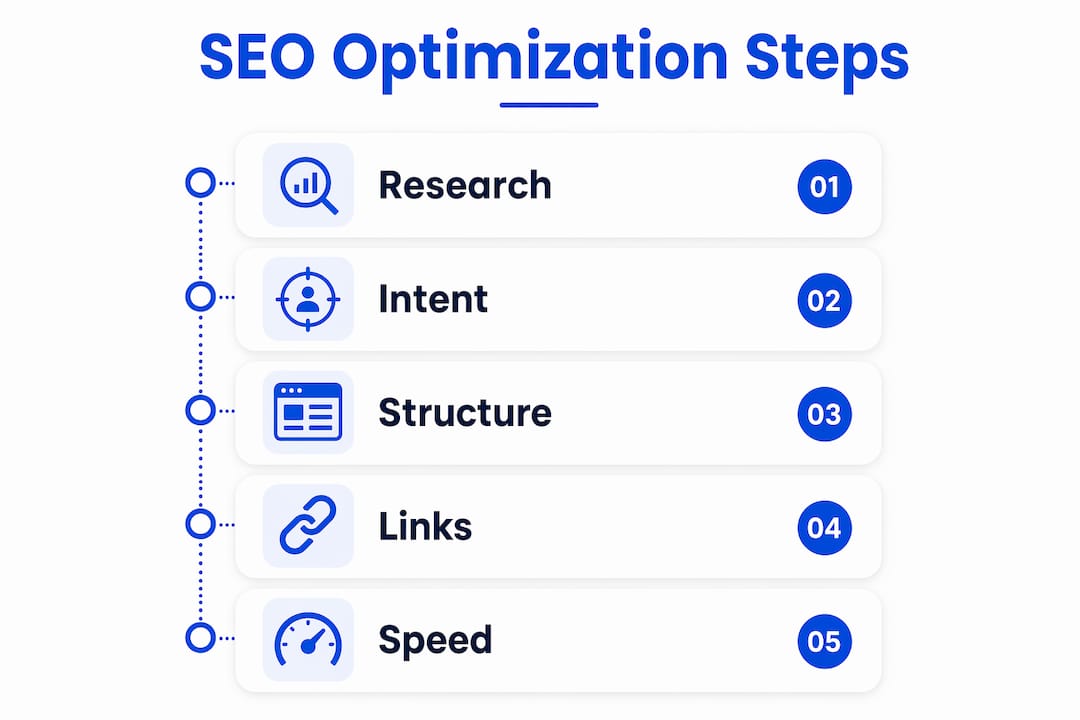
Getting your content to rank isn’t about gaming algorithms. It’s about giving search engines exactly what they need to understand, trust, and surface your pages to the right readers. Here’s the short version of how to optimize content for SEO:
- Target keywords with real traffic potential by researching search volume, keyword difficulty, and user intent before writing a single word.
- Match search intent precisely. Google’s ranking signals increasingly favor pages that answer what the searcher actually wants, not just pages that contain the right words.
- Write comprehensive content that covers a topic in depth, not just its surface. Thin pages rarely hold top positions.
- Structure with clear H1, H2, and H3 headings so both readers and crawlers can navigate your content without friction.
- Craft meta titles and descriptions with your primary keyword close to the front and a clear reason to click.
- Build internal links to related pages so authority flows through your site and users find more of what they need.
- Hit Core Web Vitals benchmarks for page speed, visual stability, and interactivity, especially on mobile.
- Add schema markup using types like Article, FAQPage, or HowTo. Structured data using nested schema markup like Article, FAQPage, and HowTo types can increase AI citations by nearly 40% compared to pages without it.
SEO results take time. Changes you make today often take months to materialize after Google re-crawls and re-indexes your pages. The sections below break down each of these steps in detail.
How to optimize content for SEO through keyword research and intent alignment
Keyword research is where every content decision starts. You’re looking for terms that have genuine search demand, a realistic chance of ranking, and a clear match with what your page actually delivers.
Finding the right keywords
Start with seed terms related to your topic, then expand using tools that surface related queries, questions, and semantic variations. Evaluate each candidate on three dimensions: monthly search volume, keyword difficulty, and commercial or informational value. A step-by-step semantic research process helps you group related terms into clusters rather than targeting isolated phrases, which builds topical authority faster than a one-keyword-per-page approach.
- Semantic clustering groups keywords by meaning, not just exact match, so one page can rank for dozens of related queries.
- Competitive gap analysis reveals terms your competitors rank for that you don’t, giving you a prioritized list of opportunities.
- Long-tail keywords tend to have lower difficulty and higher conversion intent, making them valuable for newer sites.
Mapping intent to content type
User intent is now the primary ranking factor. High domain authority without intent alignment consistently yields poor results, regardless of how many backlinks a page has. Google classifies intent into four categories: informational (the user wants to learn), navigational (the user wants to find a specific site), transactional (the user wants to buy), and commercial (the user is comparing options before buying). Each type calls for a different content format. A transactional query needs a product or landing page; an informational query needs a guide or article.
Before you write, pull the SERP for your target keyword and look at what’s already ranking. If the top results are all listicles, a long-form essay probably won’t displace them. Match the dominant format, then outperform it on depth and accuracy.
Pro Tip: Use People Also Ask boxes and “related searches” at the bottom of Google’s results page to find secondary intent signals. These questions often reveal exactly what your content needs to answer to satisfy the full range of searcher needs.
What makes content comprehensive enough to rank well?
Thin content is one of the fastest ways to lose rankings. Google’s E-E-A-T framework (Experience, Expertise, Authoritativeness, Trustworthiness) rewards pages that demonstrate real knowledge, not just keyword presence. Comprehensive content covers a topic from multiple angles, anticipates follow-up questions, and cites verifiable sources.
The most effective organizations treat content as a modular system rather than a series of one-off articles. A modular content engine links platform-specific pieces back to a central research base, so deep expertise gets repurposed across blog posts, FAQs, social content, and video scripts without starting from scratch each time.
- Original data and case studies give your content something no competitor can copy. A proprietary survey, an internal experiment, or a documented client outcome all qualify.
- Expert quotes and attributed claims signal credibility to both readers and algorithms. Linking to credible primary sources increases AI-generated search visibility by up to 40%.
- Visuals and real examples reduce bounce rate by giving readers something concrete to engage with, not just text to skim.
- Internal links to cluster content deepen topical coverage. Sites using content cluster models get cited in AI-generated responses about three times more frequently than sites with isolated pages.
Balance keyword coverage with natural language. Forcing exact-match phrases into every paragraph reads awkwardly and triggers over-optimization penalties. Write for the reader first; the semantic context will carry the SEO weight.
How should you structure content for readability and search engines?
Structure is where most content fails. A wall of text with no headings, no white space, and no logical flow loses readers in the first thirty seconds and signals low quality to crawlers.

Heading hierarchy
Use one H1 per page, always containing your primary keyword or its closest natural variant. H2s should map to major subtopics; H3s break those subtopics into specific points. Never skip a level, jumping from H2 to H4, for instance, because search engine crawlers and AI models interpret hierarchical structure as a quality indicator. Keep heading text descriptive and specific. “How to write a meta description” beats “Meta tags” every time.
Formatting for scannability
- Break long sections with subheadings every 200–300 words.
- Use bullet points for lists of three or more parallel items.
- Deploy tables when comparing attributes across multiple options.
- Lead each section with the direct answer, then expand with evidence. This answer-first approach supports featured snippet extraction and AI chatbot citations.
Pro Tip: Keep individual sections moderate in length. Sections that run past 400 words without a subheading tend to see higher scroll-abandonment rates. Split them, or add a subheading to signal a new angle.
How do meta tags and URLs affect your search rankings?
Meta titles and descriptions don’t directly change your ranking position, but they control whether anyone clicks on your listing. A well-written title with the primary keyword near the front and a clear value proposition consistently outperforms a generic one on click-through rate, and click-through rate does feed back into ranking signals over time.
- Meta title: Keep it under 60 characters. Place the primary keyword within the first 50 characters. Avoid keyword stuffing; one clear phrase is enough.
- Meta description: Aim for 150–160 characters. Reflect the search intent, include a secondary keyword naturally, and give the reader a reason to click. Think of it as a two-line ad.
- URL structure: Short, lowercase, and keyword-relevant. Use hyphens between words (never underscores), drop stop words like “a” and “the,” and avoid parameter strings in public-facing URLs. A URL like
/blog/seo-content-optimizationoutperforms/blog/post?id=4872on every dimension: readability, crawlability, and click confidence. - Image alt text: Every image needs a descriptive alt attribute that tells screen readers and crawlers what the image shows. Include a keyword where it fits naturally, but don’t force it. Alt text is both an SEO signal and an accessibility requirement.
Revisit metadata regularly. Pages that ranked well two years ago may have drifted from current intent patterns. Updating the title and description to reflect how searchers phrase queries today can recover lost clicks without touching the body content.
Why internal and outbound linking both matter for SEO
Internal linking is one of the highest-leverage, most underused SEO tactics. Every internal link you add passes authority from one page to another, helps crawlers discover new content, and gives readers a path deeper into your site.
Build your link architecture around topic clusters. A pillar page covers a broad subject at a high level; cluster pages cover specific subtopics in depth and link back to the pillar. This structure signals to Google that your site has sustained, authoritative coverage of a subject, not just a single article on it.
- Anchor text matters. Link on descriptive phrases that describe the destination page’s topic, not on generic phrases like “click here” or “read more.”
- Contextual placement beats sidebar links. A link embedded in a relevant sentence carries more weight than one in a navigation widget.
- Outbound links to authoritative sources strengthen your E-E-A-T signals. Citing a government study or a peer-reviewed source tells Google your content is grounded in verifiable information.
- Audit links periodically. Broken internal links waste crawl budget and frustrate readers. A quarterly audit using a crawl tool catches these before they compound.
Avoid linking every paragraph. Three to five well-placed internal links per 1,000 words is a reasonable target. More than that, and the links start to feel forced and dilute the value of each individual connection.
How does page speed affect your content’s SEO performance?
Page speed is a confirmed Google ranking factor, and its impact compounds on mobile. Core Web Vitals, specifically Largest Contentful Paint (LCP), Cumulative Layout Shift (CLS), and Interaction to Next Paint (INP), measure how fast and stable a page feels to a real user. Pages that fail these thresholds get deprioritized in rankings, regardless of content quality.
Technical accessibility factors like fixing crawl errors, compressing images, and serving lightweight HTML also affect how efficiently AI crawlers index your content. A page that loads slowly or throws 4XX errors doesn’t just frustrate visitors; it signals unreliability to every bot that tries to access it.
- Compress images before uploading. Use modern formats like WebP where browser support allows.
- Minimize render-blocking scripts. JavaScript that loads before the page content delays LCP and hurts user experience.
- Fix 4XX and 5XX errors promptly. A 404 on a linked page wastes crawl budget and breaks the user’s path.
- Test on real mobile devices, not just desktop emulators. Responsive design that looks fine on a 27-inch monitor can still break on a mid-range Android phone.
Improving page speed doesn’t require a full site rebuild. Start with image compression and script deferral; those two changes alone often produce measurable LCP improvements within days.
Which SEO tools actually help you optimize content?
The right research platform removes guesswork from content decisions. You stop writing based on intuition and start writing based on what the data shows searchers actually want.
Semdash is built for exactly this workflow. It combines keyword research, competitor analysis, backlink tracking, and AI Overview monitoring in a single interface, at a price point accessible to solopreneurs and agencies alike. Its semantic keyword clustering groups related terms automatically, so you can build a full content cluster from a single seed keyword without manually sorting hundreds of rows in a spreadsheet.
Key Semdash features that directly support content optimization:
- SERP tracking with historical data shows how rankings shift over time, so you can measure the impact of every content update.
- Content-gap research identifies topics your competitors cover that you don’t, giving you a prioritized editorial calendar.
- Backlink discovery surfaces link-building opportunities and monitors your existing profile for lost or broken links.
- AI Overview monitoring tracks when your content appears in Google’s AI-generated answers, a visibility layer that standard rank trackers miss entirely.
- Featured snippet and People Also Ask tracking pinpoints the exact questions your content should answer to capture zero-click positions.
| Feature category | What it does | Best for |
|---|---|---|
| Keyword and SERP analysis | Surfaces search volume, difficulty, and intent signals | Building a targeted keyword list |
| Semantic clustering | Groups related terms by meaning | Planning content clusters |
| Content-gap research | Finds topics competitors rank for that you don’t | Prioritizing new content |
| Backlink tracking | Monitors link profile and finds new opportunities | Authority building |
| AI Overview monitoring | Tracks AI-generated answer appearances | Measuring generative search visibility |
Pro Tip: Apply the 80/20 rule to your content calendar. Roughly 20% of your SEO actions generate 80% of results. Prioritize refreshing high-traffic pages, fixing crawlability issues, and adding extractable answer blocks before creating new content from scratch.
How to optimize images for SEO and accessibility
Images are often the largest files on a page, and they’re also one of the most overlooked SEO opportunities. Every image you publish has three optimization levers: file size, file name, and alt text.

File names should be descriptive and keyword-relevant before you upload. “seo-content-structure-diagram.webp” tells crawlers far more than “IMG_4821.jpg.” Compress every image to the smallest file size that preserves acceptable visual quality. Uncompressed images are a leading cause of slow LCP scores.
Alt text serves two purposes simultaneously: it describes the image to screen readers for accessibility, and it gives search engines a text signal about the image’s content. Write alt text as a plain description of what the image shows, and include a relevant keyword only when it fits naturally. A forced keyword in alt text reads as spam to both algorithms and assistive technology users. For decorative images that carry no informational value, use an empty alt attribute (alt="") so screen readers skip them cleanly.
Why you should regularly update and maintain your content
Published content decays. Statistics go stale, products change, and search intent shifts. A page that ranked in the top three for a keyword in 2023 can slip to page two by 2025 simply because newer, fresher content has displaced it.
Freshness signals and visible update dates increase both trust and ranking potential. When you update a page, change the published or “last updated” date in your schema markup and in the visible byline. Google’s crawlers notice recency signals, and readers trust a 2026 update date more than a 2021 one on a fast-moving topic.
A practical maintenance schedule: audit your top 20 traffic-driving pages quarterly. Check for outdated statistics, broken links, and intent drift. For pages that have dropped in rankings, look at whether the SERP has shifted toward a different content format or whether competitors have published more comprehensive coverage. Sometimes a targeted refresh of 200–300 words, adding a new data point or an updated example, is enough to recover lost ground.
How do engagement metrics reveal content quality problems?
Bounce rate and dwell time are proxies for a simple question: did the reader find what they came for? A high bounce rate on an informational page usually means the content didn’t match the searcher’s intent, loaded too slowly, or failed to answer the question quickly enough. Dwell time, the amount of time a visitor spends on a page before returning to the SERP, signals depth of engagement.
Watch these metrics in Google Search Console and Google Analytics together. A page with strong impressions and clicks but a high bounce rate has a content quality or intent-mismatch problem, not a visibility problem. Fix the content before spending time on link building for that page.
Practical ways to improve engagement: add a clear answer in the first paragraph, break up long sections with subheadings, include at least one visual per major section, and use internal links to guide readers to related content rather than letting them hit a dead end. Pages that keep readers moving through the site consistently show lower bounce rates than pages that function as isolated destinations.
What does SEO-friendly content formatting actually look like?
Formatting is the difference between content that gets read and content that gets skimmed and abandoned. Search engines reward pages where structure matches content hierarchy, and readers reward pages where they can find answers without hunting.
Use your H1 for the page title, H2s for major sections, and H3s for subsections within those. Bullet points work well for parallel items, steps, and feature lists. Numbered lists signal sequence, so use them for processes where order matters. Tables are the right format for comparisons and attribute-heavy data. Avoid using bold text for decoration; bold a phrase only when it’s genuinely the most important thing in a paragraph.
Paragraph length matters too. Three to five sentences per paragraph is the practical ceiling for online reading. Longer blocks feel dense and slow readers down. White space isn’t wasted space; it’s what makes a page feel readable rather than overwhelming. For content targeting engaging social and video formats, short punchy paragraphs and clear visual breaks translate even better across platforms.
Key Takeaways
Effective SEO content optimization requires aligning keyword research, search intent, technical structure, and regular maintenance into a single, repeatable process.
| Point | Details |
|---|---|
| Intent alignment is foundational | High domain authority without intent alignment yields poor rankings, regardless of backlink count. |
| Structured data lifts AI visibility | Nested schema markup boosts AI citations by nearly 40% compared to pages without it. |
| Content clusters multiply authority | Sites using cluster models get cited in AI-generated responses about three times more often. |
| Freshness signals matter | Updating content with visible dates increases trust and ranking potential for relevant topics. |
| The 80/20 rule applies | A minority of SEO actions generate the majority of results; prioritize refreshes and crawlability fixes first. |
FAQ
What is the fastest way to improve SEO on existing content?
Refresh your highest-traffic pages first: update outdated statistics, fix broken links, and add a direct answer in the opening paragraph. These changes often recover lost rankings faster than publishing new content.
How often should you update content for SEO?
Audit your top pages quarterly and update any page where statistics, intent signals, or competitor coverage have shifted. Visible update dates reinforce freshness signals for both readers and crawlers.
Does schema markup really help with rankings?
Schema markup doesn’t directly change your ranking position, but it significantly improves how search engines and AI models extract and display your content. Structured data using types like Article, FAQPage, and HowTo can increase AI citations by nearly 40%.
How many keywords should one page target?
One primary keyword per page, supported by a cluster of semantically related secondary terms. Targeting multiple unrelated primary keywords on a single page dilutes focus and confuses intent signals.
What is E-E-A-T and why does it matter for content SEO?
E-E-A-T stands for Experience, Expertise, Authoritativeness, and Trustworthiness. Google uses these signals to evaluate content quality, and pages that demonstrate real expertise through original data, credible citations, and author credentials consistently outperform thin or generic content.