


You're looking at a traffic drop, and your backlink dashboard still shows growth. That's frustrating, but it's also a reason to stop treating the total as a verdict. I'd first check who links to you, what those links reference, and whether anything changed around the pages that lost visibility.
Table of Contents
- What a Backlink Profile Is and Why It Matters
- The Metrics That Make Up a Profile
- Why Link Quality Beats Link Count
- Link Attributes, Anchors and Risk Signals
- How to Assess a Profile in Five Steps
- Decide Which Links to Act On First
What a Backlink Profile Is and Why It Matters
A backlink profile is the full collection of external links pointing to your domain or a specific URL, including their sources, destinations, anchor text, and attributes. Say you're investigating a client's traffic decline and the first question is who links to the site. I'd use that question to open an investigation, not to assume backlinks caused the drop.
Think of your profile as a reference file. You wouldn't judge professional references by their number alone. You'd ask who supplied them, how closely their work relates to yours, and whether their recommendation makes sense in context.

Separate the layers before drawing conclusions
When you ask “what is a backlink profile,” keep these layers separate:
- Backlinks: The individual links pointing to your site.
- Referring domains: The distinct websites supplying those links.
- Target pages: The exact URLs receiving them.
You might have growing link volume without gaining independent references. You might also earn useful citations to a guide while the commercial page you're trying to rank receives nothing directly.
Competitor analysis gives you context for those differences. In LinkDoctor's 2023 Link Building Survey, 64.67% of surveyed link builders used competitor backlink analysis. I'd compare the actual ranking pages, not just businesses you consider competitors.
Audit starting point: Describe your profile in terms of sources and destinations before describing its size.
Use that description to decide where to look first. If your links come from a narrow group of websites, inspect referring domains. If your sources look credible but your priority URL has little support, inspect target pages. You're evaluating a risk-and-context portfolio, not awarding yourself a link-count score.
The Metrics That Make Up a Profile
Backlink profile metrics and what they signal
| Metric | What it tells you | Healthy signal | Warning sign |
|---|---|---|---|
| Total backlinks | Every external link pointing at your domain or page | Growth alongside new referring domains | A sitewide footer placement repeated across thousands of pages |
| Referring domains | Unique websites linking to you | Independent sites relevant to your niche | Repeated links from a shared network or template |
| Third-party authority score | A tool's estimate of linking strength | Useful for shortlisting outreach targets | Treating it as a Google score |
| Anchor text mix | The words used to link to you | Branded, URL, generic, and descriptive wording that fits the context | Heavy repetition of exact-match commercial phrases |
| Link attributes | Followed links versus sponsored, ugc, or nofollow | Markup that matches how you acquired each link | Paid links left as plain followed links |
| Pages by links | Which URLs receive links | Relevant citations to commercial pages and guides too | Nearly all links pointing to your homepage |
| New and lost links | Changes in your profile over time | Movement you can explain | Unexplained spikes or sustained losses |
| Broken backlinks | Links to dead or moved URLs | Working destinations or relevant redirects | Dead targets without a useful replacement |
I'd start with referring domains and pages by links. Those checks establish whether you're gaining independent sources and whether you're supporting the URLs that matter to your search strategy.
A hypothetical footer placement across thousands of pages can make your backlink total jump without adding a comparable range of endorsements. Keep the links in your inventory, but group them by domain and placement so you don't mistake repetition for breadth.
Use scores to filter, not decide
Treat a third-party authority score as an estimate from that tool's own model, not a Google metric. Use it to organize a prospect list, then open the referring page and inspect its topic, audience, and reason for linking.
Don't set an arbitrary minimum score and reject every smaller specialist publication. You can miss a highly relevant source that way. Equally, don't accept an unrelated placement just because you like its domain score.
According to figures reported by AgencyHandy, 35.85% of backlinks pointed to homepages in 2023, down from 45.41% in 2022. Use that as a reason to examine homepage concentration, not as a target distribution for your own site.
You don't need to reproduce an industry average. You need to understand whether your linked pages match your business priorities.
Once you've checked source diversity and destination coverage, drill into anchors and attributes wherever you find a mismatch. Keep a routine sample check even when those headline metrics look reasonable, since an aggregate can conceal individual problems.
Why Link Quality Beats Link Count
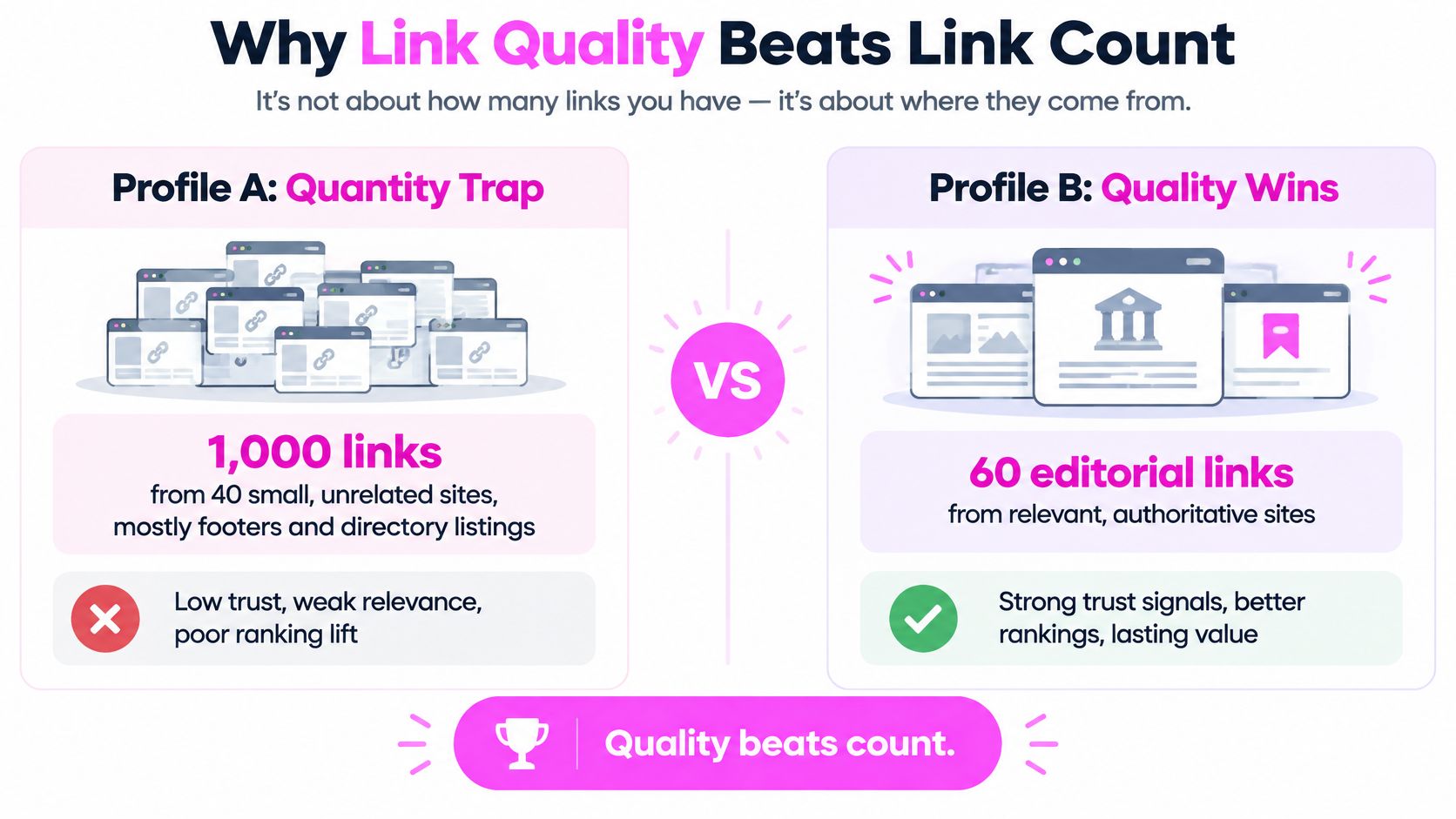
Compare these hypothetical profiles: Profile A has 1,000 links from 40 small, unrelated sites, mostly footers and directory listings. Profile B has 60 editorial links from respected sites covering your topic. I'd investigate Profile B's actual placements before giving Profile A any credit for its larger total.
With Profile A, you have at most 40 domain-level sources, not 1,000 independent endorsements. You also need to establish whether those sources operate independently. The placement pattern warrants inspection, but it doesn't establish manipulation by itself.
The underlying logic comes from Brin and Page's original 1998 paper: under PageRank, you gain importance through links from important pages, while each linking page divides its influence among its outgoing links. Don't turn that principle into a modern ranking calculator. Use it to understand why you can't value every backlink equally.
Inspect the endorsement, not just the domain
I'd run these questions on a prospective or questionable link:
- Independence: Do you control the source, or can you identify a separate publisher making an editorial decision?
- Relevance: Would the source's audience reasonably need your resource?
- Editorial intent: Have you earned a citation, or arranged a placement primarily for ranking credit?
- Destination fit: Does your linked URL deliver what the surrounding paragraph promises?
For my review queue, I'd flag a link that fails two or more of those checks. That's a triage rule, not a Google threshold or proof that you should remove it.
Say you sell commercial kitchen equipment. You could earn a useful citation from a small food-safety consultant's guide to cleaning procedures. I wouldn't reject it for lacking the scale of a national publisher, provided the explanation and destination help the reader.
Conversely, I wouldn't pursue an unrelated lifestyle article merely to secure a stronger-looking domain metric. Count relevant, independently earned references before raw links, then use volume to understand scale. You'll make better outreach decisions without pretending you can predict a ranking outcome from a single placement.
Link Attributes, Anchors and Risk Signals
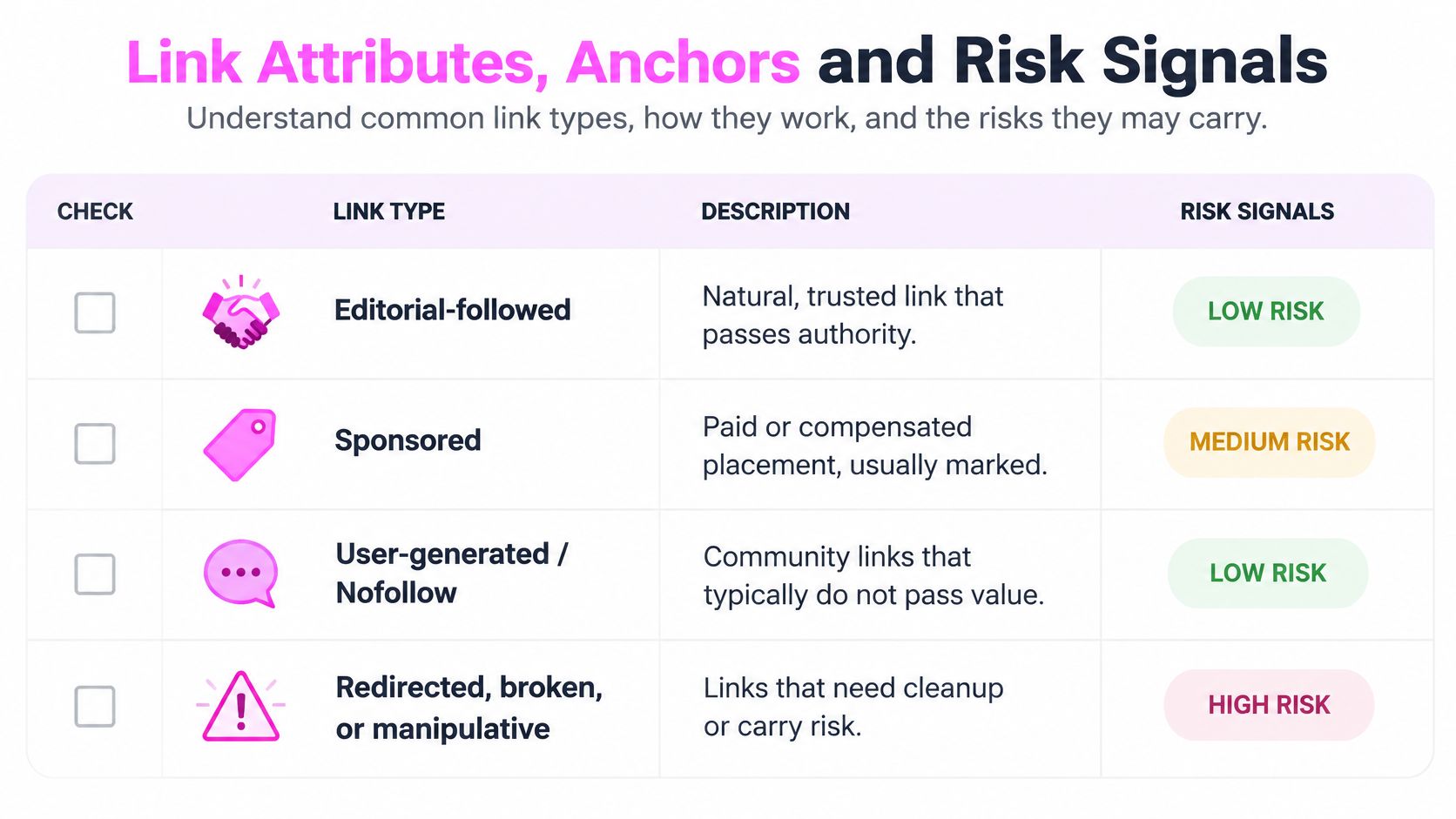
Don't label every nofollow link worthless. You can receive qualified visitors from a mention without receiving a normal followed endorsement, and you can gain discovery that later leads to an editorial citation.
Use Google's outbound-link qualification guidance to distinguish sponsored, user-generated, and non-endorsed links. Google treats these attributes as hints rather than absolute blocking commands, and you can combine values, such as rel="ugc nofollow".
Link attributes and what each one signals
| Attribute | Use it when | How I read it |
|---|---|---|
| Followed (no qualifying attribute) | You editorially endorse the destination | Strongest case for ranking value when source and context are relevant, without a guarantee |
rel="sponsored" |
You publish ads, paid placements, sponsorships, or compensated links | Expected qualification for a commercial relationship |
rel="ugc" |
You host comments, forum posts, or user profiles | Less publisher control; inspect for spam patterns |
rel="nofollow" |
You don't want to imply endorsement | A hint, not a block; still assess referral visits and discovery |
For your audit, classify acquisition type separately from technical condition. Use editorial-followed, sponsored, user-generated, or nofollow to describe the relationship, then record whether the destination redirects, breaks, or requires a manipulation review. A sponsored link can also be broken, so don't force everything into mutually exclusive buckets.
Review suspicious groups in context
Use repeated commercial anchors, unrelated sources, sitewide placements, and abrupt acquisition spikes as investigation prompts, not automatic removal rules. Under Google's spam policies, buying links for ranking purposes, excessive exchanges, and automated link creation can constitute link spam.
Before acting, check:
- Acquisition history: Can you connect the group to advertising, outreach, syndication, or an old agency campaign?
- Placement: Do you see a useful citation, a navigation element, or an inserted keyword?
- Ownership: Can you identify independent publishers rather than a coordinated network?
- Markup and intent: Does the qualification match the commercial relationship?
You might explain a sudden spike through legitimate coverage or a template change. You might also uncover paid placements without appropriate qualification. Record the evidence before choosing an action.
A sitewide nofollow percentage isn't a target. Judge why you received each type of link and whether its context, markup, and purpose align.
How to Assess a Profile in Five Steps
Build your audit around decisions you can implement, not a spreadsheet you'll never reopen. Keep source URLs, target URLs, classifications, and action notes together so you can verify each recommendation.
Use the workflow below to connect link records with page-level priorities.

Build a comparable inventory
Export your site and ranking competitors. Pull referring domains, anchors, linking pages, target URLs, and attributes for your site and two or three competitors appearing for your priority queries. Use the same tool and filters so you aren't comparing unlike datasets.
Classify sources and individual placements. Label domains by their predominant acquisition context, then retain link-level exceptions for sponsored, user-generated, nofollow, redirected, broken, or suspicious placements. Record first-seen dates where available, but don't assume your crawler's discovery date equals the publication date.
Compare patterns, not quotas. Check referring-domain counts and anchor distributions against your ranking competitors, then inspect any substantial difference manually. If you're auditing executive-name queries, use TheBestReputation's reputation SEO guide for executives as additional planning context, while keeping that search objective separate from product-query analysis.
Don't copy a competitor's questionable pattern just because you find it on a ranking page. You're looking for credible sources and useful resources you can evaluate, not permission to reproduce every placement.
Test whether the right URL benefits
Map each linking page to its destination. Check whether your important commercial and informational URLs receive credible, contextually appropriate citations, rather than assuming homepage links support every target equally. A 2025 Search Atlas analysis of 350,159 backlink placements across 13,002 target landing pages associated stronger linking domains and relevant anchors with better page-level outcomes, but didn't establish that links alone caused those outcomes.
Build a change timeline. Align new, lost, and redirected links with rankings and organic clicks for each target URL. Annotate content edits, internal-link changes, seasonality, and algorithm updates so you don't attribute every movement to external links.
For a visual companion to your audit work, you can use this walkthrough.
Finish with a concise action sheet: priority pages with relevant citations, priority pages without them, and suspicious groups requiring manual review. Add an owner and next action to each entry. You should be able to hand that sheet to a developer or outreach specialist without asking them to reinterpret your entire export.
Decide Which Links to Act On First
Reclaim useful links first, pursue relevant editorial opportunities second, investigate suspicious groups third, and leave harmless low-value links alone. I'd prioritize in that order because you can often repair a destination you control before committing time or budget to outreach.
Don't confuse activity with improvement. Removing an unremarkable forum mention can consume time without solving the reason your commercial URL isn't competitive.
Recover what you can control
Start with broken targets and unnecessary redirect chains. If you've moved an equivalent resource, implement a 301 redirect to its live replacement, update internal references, and test the complete path from the old URL.
Don't redirect every deleted page to your homepage. If you can't offer a relevant replacement, consider restoring the original resource or asking the publisher to update the citation. You're trying to preserve a useful journey and recover eligible link equity, not merely eliminate error responses.
Implementation check: Open the original linked URL after your fix and confirm that you reach the intended resource without a loop or irrelevant destination.
At SemDash, our Backlink Gap tool helps you find new link-building opportunities among domains linking to competitors but not your site; we also identify broken backlinks you can fix or redirect, and our Anchors report shows why people link to a page. Use those outputs together to distinguish a repair task from an outreach opportunity.
Earn the missing citation before chasing volume
For new outreach, select domains citing resources comparable to your strongest work. Inspect what you'd need to contribute: an original dataset, a useful tool, clearer documentation, or a guide that answers a specific unresolved question.
If you're considering outside help, use AY Rank's link building services as a starting point for discussing scope, then evaluate proposed sources, acquisition methods, destination choices, and paid-link qualification. Don't substitute a placement quota for an editorial rationale.
Keep suspicious groups in a separate review queue. Confirm whether you arranged paid or manipulative placements, or whether you're looking at unfamiliar sources. I'd consider disavowal only in a narrowly justified case supported by clear evidence, not because a tool assigned an alarming label.
Leave ordinary nofollow and user-generated mentions alone unless you can identify a concrete problem. You don't need a perfectly tidy inventory, and you shouldn't spend your recovery budget removing links just because you wouldn't pursue them.
This week, export your profile, classify it, and fix the top three broken or misdirected links. Choose the repairs by source relevance and destination usefulness, then verify the result before expanding your outreach list.
Use our backlink research, competitor gap analysis, and broken-link workflows to turn your profile into a practical action queue. Visit SemDash to identify your referring domains, inspect the pages receiving links, and choose which recovery or outreach task to tackle first.