%20(1)-B86R08ZzwhPzS6UZbG3mSxRWPCwGwn.png)


Most advice about who is linked to my website starts with the wrong output: a large backlink number. That number can tell you how many discovered links point toward your pages, but it won't tell you whether those links come from diverse domains, whether they still work, whether they're editorial, or whether important brand mentions remain unlinked.
I audit link profiles as a living record, not a static scorecard. The useful questions are more demanding: which websites link to me, which pages receive those links, what type of links are they, what has disappeared, and where is my brand being referenced without a clickable link? That broader view also matters as search expands into AI-generated answers, where citation patterns don't always match traditional organic rankings.
Table of Contents
- Why Backlink Counts Are Usually Misleading
- The Practical Backlink Audit Workflow
- Distinguishing Link Types for Real Authority
- Reclaiming Equity From Unlinked Mentions
- Understanding Link Decay and Reciprocal Patterns
- Expanding Visibility Into AI Overview Citations
Why Backlink Counts Are Usually Misleading
A backlink is a link from another website to a page on your site. Google Search Console's Links report is built to show who links to you most, which pages receive links, and related external-link data, including the total backlink count and the sites or pages involved, as described in Google's Search Console links documentation.
The problem starts when you treat every link as an independent vote. Backlinks and referring domains are different measurements. A backlink is an individual link. A referring domain is a unique website linking to your target. Ahrefs explains this distinction in its SEO statistics reference, and it changes how I read almost every audit.
One authoritative publication might link to your homepage, product page, research report, and several articles. Those links may be useful, especially when they send qualified referral traffic, but they don't represent the same breadth as links from several relevant websites. Raw volume can therefore make a profile look healthier than its actual link diversity.
What I check instead
I start by separating the profile into three layers:
- Total backlinks: The number of discovered links, useful for locating individual linking pages and monitoring changes.
- Referring domains: The number of unique websites linking to you, a clearer view of domain diversity.
- Linking pages: The specific URLs that contain the links, which reveal context, placement, and whether the page is still accessible.
A domain-level report can hide important variation. Ahrefs' Backlinks report capabilities include analysis for a domain, directory, or exact URL, along with referring pages, anchor text, and first-seen dates. I use those fields to understand whether the profile grew through genuine editorial coverage, syndicated content, directories, partnerships, or repeated sitewide placements.
Practical rule: Treat the backlink count as an inventory, not a verdict.
A high count can still contain duplicated sitewide links, old URLs, redirected pages, user-generated links, and links that disappeared from the web but remain in a historical database. A smaller profile can be strategically stronger if it contains relevant, indexable editorial links from distinct sites.
That doesn't mean every referring domain has equal authority. Relevance, page context, crawlability, anchor text, destination, and link attributes all affect how I prioritize a domain. The first job is to stop confusing more rows in a report with a stronger web footprint.
The Practical Backlink Audit Workflow
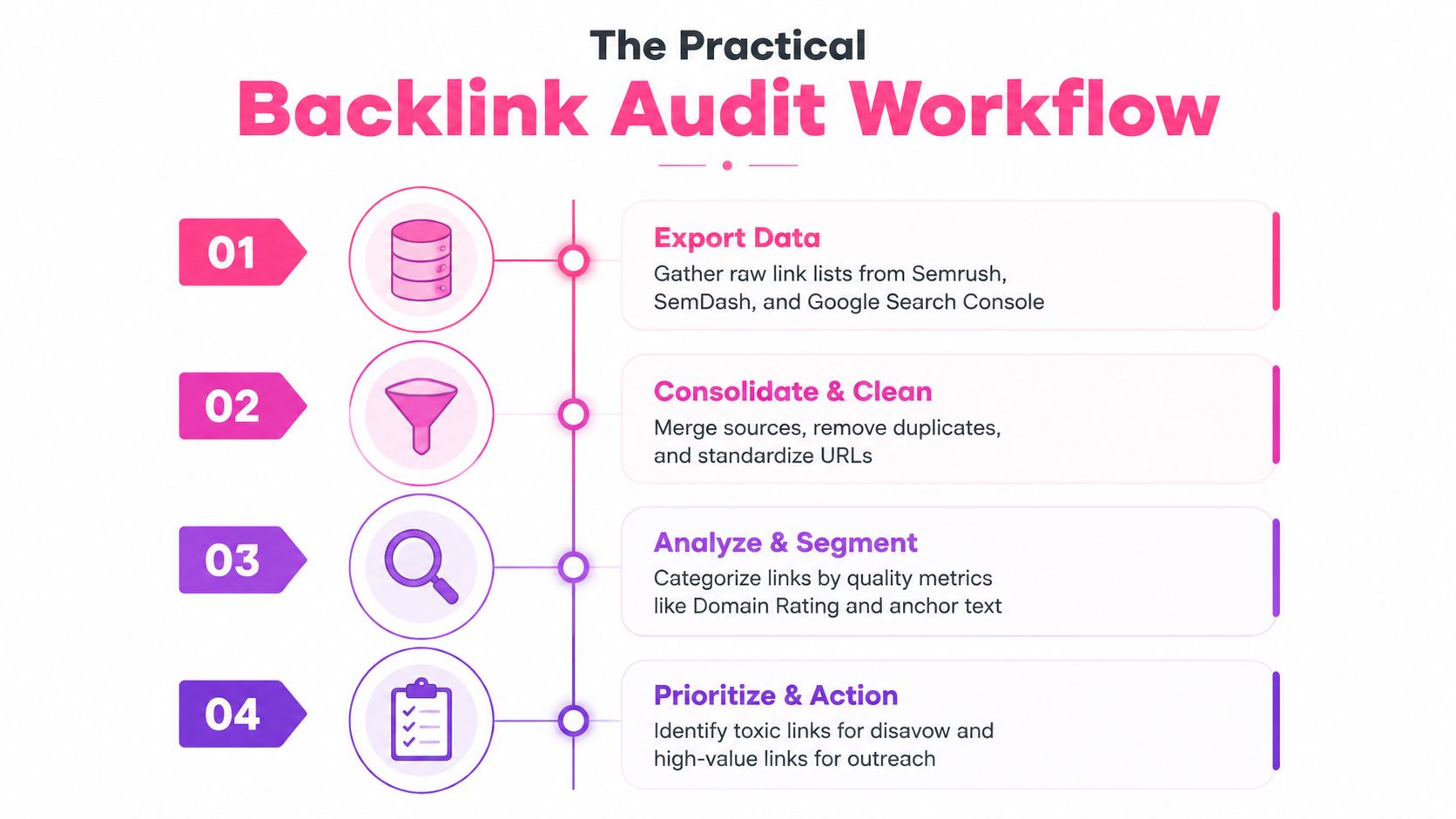
A backlink audit fails before the first judgment if the underlying inventory is incomplete. I start by building a working dataset, because crawlers cover different parts of the web and may interpret redirects, canonical URLs, or suspicious patterns differently. That same dataset should expose link decay, unlinked brand references, and signals worth comparing with later AI Overview visibility, not just count existing links.
Build one clean inventory
Export link data from Google Search Console and several commercial crawlers, such as Semrush, SemDash, or Ahrefs. A platform such as SemDash backlink research can organize referring domains, linking pages, and anchor data. I compare its results with other sources rather than treating any index as complete.
Merge the exports into one sheet or database. Standardize protocol, hostname, trailing slashes, URL parameters, and redirected destinations. Deduplicate at several levels:
- Exact link level: Same source URL, target URL, and anchor.
- Linking-page level: Several links from one page may need separate review, but they should not inflate page counts.
- Referring-domain level: Group subdomains carefully so genuine domain breadth remains distinct from repeated properties controlled by one organization.
Retain the source URL, target URL, anchor text, first-seen information when available, link attribute, HTTP status, and referring domain. Add fields for the current target, whether the source page still resolves, and any related brand mention without a link. That turns the file into an audit trail and makes later reclamation work more reliable.
Segment before judging
Record a baseline for total backlinks, referring domains, linking pages, dofollow and nofollow distribution, anchor-text distribution, and estimated referral traffic. The baseline is a comparison point after reclamation, migrations, content pruning, or outreach. It should also note lost links and newly discovered unlinked mentions, since a static backlink count can hide both forms of opportunity.
Then assign practical quality tiers:
- Editorial and relevant: A contextual mention on a page serving the same audience.
- Useful but limited: A directory, profile, partner page, or community listing that may support discovery or referrals.
- Review required: A site with weak relevance, unusual anchor text, unclear ownership, or heavy repetition.
- Broken or lost: A source page that returns an error, points to an obsolete URL, or no longer contains the link.
I do not label a link toxic solely because a third-party metric is low. A niche publication may have limited measured authority but strong audience relevance. A high-metric domain can still offer little value if the link is buried, blocked from indexing, or placed in a clearly commercial area.
Review distribution before pursuing removals or disavowal. Concentration, repeated anchors, clusters of related domains, target-page patterns, and timing anomalies often reveal the issue faster than a long list of suspicious URLs.
A manual submission can suit a legitimate business when the directory is relevant, transparent, and useful to visitors. In that narrow context, StartupSubmit manual submission is a placement opportunity to evaluate, not an automatic authority link.
Use this visual walkthrough to reinforce the sequence:
Distinguishing Link Types for Real Authority
A backlink list answers where a link exists. It doesn't automatically answer whether the link represents an editorial endorsement, a paid placement, a user contribution, or an unendorsed reference.
Google's guidance on qualifying outbound links distinguishes sponsored, ugc, and nofollow attributes. Those labels help search engines understand the relationship behind a link:
- Sponsored: Used for paid placements, advertisements, or other compensated arrangements.
- UGC: Used for content created by users, such as forum posts or comments.
- Nofollow: Used when the publisher doesn't want to endorse or associate the link in the usual way.
I record the attribute rather than collapsing everything into “good” or “bad.” A nofollow link from a respected publication may send valuable referral traffic, expose your brand to a relevant audience, and lead to partnerships even if you shouldn't treat it like a conventional editorial link. A sponsored link can be commercially useful while remaining a poor candidate for an authority-building objective.
The decision framework I use
For each important referring domain, I ask four questions:
| Question | What I'm trying to establish |
|---|---|
| Is the page relevant? | Whether the audience and topic match the destination |
| Is the link editorial? | Whether the publisher chose it as part of the content rather than placing it mechanically |
| Is the page indexable? | Whether search engines can access and interpret the source page |
| Is the link usable? | Whether it supports rankings, referrals, brand discovery, or a relationship worth developing |
This prevents a raw count from driving the strategy. The objective isn't more backlinks for their own sake. I want domains that link in a relevant, contextual, indexable way and that can contribute to search visibility, referral traffic, partnerships, or broader brand recognition.
Anchor text needs the same treatment. Branded anchors and plain URLs may reflect natural coverage. Exact-match commercial anchors deserve closer review, especially when they appear across unrelated sites or in templated content. I don't recommend changing natural editorial anchors just to make a distribution chart look tidy. I investigate patterns that suggest manipulation, not harmless variation.
Where audits go wrong
The most damaging shortcut is to sort by a third-party authority metric and contact every low-scoring site. That wastes time and can remove useful niche references. Another is to assume nofollow means worthless or dofollow means valuable. Neither shortcut captures context, intent, page quality, or the business value of the relationship.
My final prioritization usually separates three queues: links to protect, links to reclaim or improve, and links to investigate. That is far more actionable than a single “toxic backlink” list.
Reclaiming Equity From Unlinked Mentions
The fastest link opportunities often already exist in public writing about your company, product, founders, executives, research, or campaigns. The page mentions you, but the author never added a clickable link. I treat those mentions as a separate discovery layer, not as failed backlinks.
Start by exporting brand mentions from the last 90 to 180 days, then export your current backlink set. Flag mention URLs that don't appear in the backlink inventory. The comparison matters because a mention may already link through a different URL, a redirect, a canonical page, or a link your crawler hasn't indexed.
My reclamation sequence
- Collect the mention: Save the source URL, page title, author, publication, brand wording, and the surrounding paragraph.
- Check the current link state: Search the rendered page and source where necessary. Confirm whether the link points to the correct destination, an old URL, a redirect, or nowhere.
- Assess the opportunity: Review topical relevance, audience fit, recency, page accessibility, and whether a useful destination exists.
- Choose the request: Ask for a brand link, a corrected destination, a replacement for a broken URL, or an attribution link for original research.
- Record the result: Track contacted, updated, declined, unavailable, and not worth pursuing.
The request should reduce work for the publisher. I provide one suggested destination and explain why it helps the reader. I don't send a generic “please link to us” message when the page already contains a natural place for a reference.
A published dataset covering 289 campaigns reported an average 31.4% success rate for unlinked-mention reclamation, with a 12-day average time to recovery in SaaS and tech, according to Vrid's link-reclamation analysis. Broader reclamation guidance commonly cites 15% to 30% recovery rates with proper outreach in the same reference. Those figures don't guarantee a result for your site, but they explain why I audit existing coverage before launching cold prospecting.
Don't ignore broken backlinks
Link decay creates another reclamation queue. A once-useful link may now lead to a removed article, a changed slug, a redirected page, or a destination that no longer matches the original context. I review the source page first, then decide whether to restore the old destination, redirect it, or suggest a more relevant replacement.
Recovery principle: Preserve the publisher's original intent. A link update works when the replacement remains useful to that publisher's readers.
Unlinked mentions also deserve a second classification. Some pages are valuable for direct referral traffic or brand credibility even if the editor declines to add a link. I keep those references in the entity and citation dataset instead of marking them as failures. That distinction becomes more important when evaluating visibility in AI-generated search results.
Understanding Link Decay and Reciprocal Patterns
A link profile is historical evidence. It records relationships that were created, changed, redirected, and sometimes erased. If I inspect only the current live links, I miss the reason a site's authority appeared to rise and fall.
Ahrefs reports that pages ranking higher in Google's results tend to acquire more new followed referring domains, based on analysis across 10,000 SERPs, and that top-ranking pages usually gain followed backlinks from new referring domains at roughly 5% to 14.5% per month. The findings are summarized in Ahrefs' Site Explorer data. I use this as context for evaluating link momentum, not as a promise that any individual page will follow the same pattern.
The same source reports that 73.6% of domains have reciprocal links and 43.7% of top-ranking pages have some reciprocal links. Reciprocal linking therefore isn't automatically suspicious. A genuine partnership, association, supplier relationship, or community connection can naturally produce links in both directions. The concern starts when exchanges appear systematic, irrelevant, or designed primarily to manufacture authority.
Read the profile as a timeline
I compare first-seen dates with content launches, digital PR activity, partnerships, migrations, and major campaigns. A sudden cluster of links from similar domains can reflect a successful announcement, syndicated coverage, or a problematic acquisition pattern. Without dates, those possibilities look identical in a static export.
The historical record also needs a decay column. Ahrefs reports that 66.5% of links to sites in the last nine years are dead, a figure that illustrates how much churn exists in the web's link graph. I don't interpret that as a reason to chase every lost URL. I use it to set realistic expectations and justify monitoring.
For ongoing maintenance, I watch:
- Destination changes: Links pointing to pages that moved or were consolidated.
- Source-page status: Pages returning errors, disappearing, or losing the original context.
- Domain continuity: Referring sites that expire, change ownership, or become unrelated.
- Link persistence: Important links that vanish after redesigns or editorial updates.
A strong acquisition process includes a maintenance plan. I document the original source, destination, anchor, and context so a future migration doesn't erase useful history. I also separate reciprocal links that support real relationships from patterns that exist only because two sites traded placements.
The practical lesson is simple: who is linked to my website today is only one frame of the story. The more useful audit shows which relationships persist, which decay, and which deserve recovery before I spend effort finding new prospects.
Expanding Visibility Into AI Overview Citations
Traditional backlink reports don't capture every way a brand can become visible in search. A page may mention your company without linking, or an AI-generated answer may cite a URL that doesn't rank in the classic top results. I now treat AI Overview citations and unlinked mentions as adjacent signals, not replacements for link analysis.
A 2025 AI-search study reported a stronger correlation between branded web mentions and AI Overview visibility, about 0.664, than between referring domains and that visibility, about 0.218, in the published AI Overview analysis. Correlation doesn't establish causation, but it supports a practical audit question: where is the brand being discussed, and is that discussion useful enough to be retrieved or cited?
Citation distribution also differs from classic rankings. A 2026 study reported that the top 1% of domains captured 47% of AI Overview citations, while another index covering 3 million queries found that only 38% of cited pages also ranked in the top 10 organic results, according to this AI Overview citation research. I don't use page-one rankings as a proxy for citation coverage.
Build a citation-aware audit
For priority queries, I record every cited source URL, not just the first result. Independent analysis found an average of 4.2 citations per overview, with a range of 2 to 9 depending on intent, as reported in Digital Applied's citation-pattern study.
I also inspect where the answer appears on each cited page. A citation-depth study reported that 55% of AI Overview citations came from the top 30% of a page, 24% from the middle 30% to 60%, and 21% from content below the 60% mark, in the arXiv study on citation depth. That gives me a concrete editorial check: put clear definitions, direct answers, evidence, and important entities near the beginning instead of burying them below long introductions.
Use an AI Overview checker to track which queries produce domain mentions and which exact URLs appear as citations. Then combine the results with your backlink and mention inventory:
- Protect: Relevant editorial links and recurring citation sources.
- Recover: Broken backlinks, lost links, and unlinked mentions with a clear editorial fit.
- Improve: Pages with strong evidence but weak structure or unclear answer placement.
- Expand: Competitor-linked and competitor-cited domains that don't yet reference your site.
- Monitor: Reciprocal patterns, link decay, anchor shifts, and citation changes.
The final deliverable shouldn't be a spreadsheet full of URLs. It should be a prioritized action list with an owner, a reason, a destination page, and a follow-up status. That turns “who is linked to my website?” into a repeatable system for protecting authority, recovering missed opportunities, and understanding how search engines and AI systems discover your brand.
SemDash brings backlink research, referring-domain analysis, broken-link recovery, unlinked brand-mention discovery, and AI Overview citation tracking into one SEO workspace. Visit SemDash to examine who links to your site, which opportunities you've missed, and which URLs are being referenced in AI-generated search answers.