Most comparisons between Ahrefs and SpyFu start with the wrong question. They ask which one is “better,” as if a bigger database or a lower monthly fee settles the matter, and that framing leads people to buy the wrong workflow for the job they actually do.
I pay for both out of pocket, and in client work the difference shows up fast. Ahrefs is the tool I reach for when I need organic depth, backlink forensics, and content gap work. SpyFu is the tool I reach for when I need competitor ad history, PPC overlap, and a quicker read on what rivals have been testing in paid search. The right choice usually isn't about brand loyalty, it's about which dashboard matches your week.
| Decision factor | Ahrefs | SpyFu |
|---|---|---|
| Best for | Organic SEO depth, backlinks, content gaps | Competitor intelligence, PPC history, overlap analysis |
| Keyword scale claim | Around 28.7 billion keywords in one comparison source | 73 billion keywords in one comparison source |
| Starting price in a 2026 comparison | €119/month source | $39/month source |
| Workflow center | Site Explorer, backlink analysis, organic research | Competitor ad intelligence, keyword overlap, historical PPC data |
| Practical buying logic | Choose when organic work drives revenue | Choose when paid search intelligence drives revenue |
Table of Contents
- Why This Comparison Wastes Most People's Time
- Database Size and What Those Numbers Actually Mean
- Feature Parity Check Across the Core Workflows
- Accuracy, Methodology, and Why Your Numbers Will Disagree
- Pricing, Plans, and the Hidden Costs Nobody Mentions
- Best Fit Use Cases by Buyer Persona
- Recommendation Framework and Answers to Common Questions
Why This Comparison Wastes Most People's Time
The most common mistake is assuming that bigger database equals better tool. That sounds sensible until you're in a real client workflow, where the question isn't abstract coverage, it's whether the data helps you make a decision before a campaign deadline or a reporting call.
The real issue is workflow fit
Ahrefs and SpyFu grew around different jobs. Ahrefs is positioned around organic SEO work, including keyword research, backlink analysis, site audits, rank tracking, and content strategy, while SpyFu is built around competitor intelligence and PPC research, especially historical ad data and keyword overlap analysis source. That difference matters more than any single feature list because teams don't need a tool that is “everything,” they need the one that answers the question in front of them.
Practical rule: if you're trying to understand why a rival keeps winning paid traffic, SpyFu usually gets you there faster. If you're trying to understand why a page ranks or doesn't rank, Ahrefs is usually the better fit.
I've seen people waste money because they bought the tool that looked more complete, then used only a sliver of it. They wanted competitor ad history, but paid for a deep organic suite and never touched the backlink reports. Or they needed link opportunities and content gaps, then chose the cheaper PPC-heavy option and ended up exporting around the limitations.
Breadth sounds impressive, but relevance pays the bill
SpyFu has long leaned into breadth claims, including 73 billion results and 7.2 trillion results powering site answers, plus claims of 10x more PPC keywords and 2x more SEO keywords than Ahrefs or Semrush in one published comparison source. Ahrefs has historically leaned into depth in search analysis, where the value is less about shouting the biggest number and more about making backlink and content decisions with confidence.
That's why I don't recommend starting with “which one is bigger.” I recommend starting with the workflow you touch every week, then checking whether the tool's data model matches that job. If your week is mostly paid search audits, SpyFu earns attention. If your week is mostly organic strategy, Ahrefs does.
Database Size and What Those Numbers Actually Mean
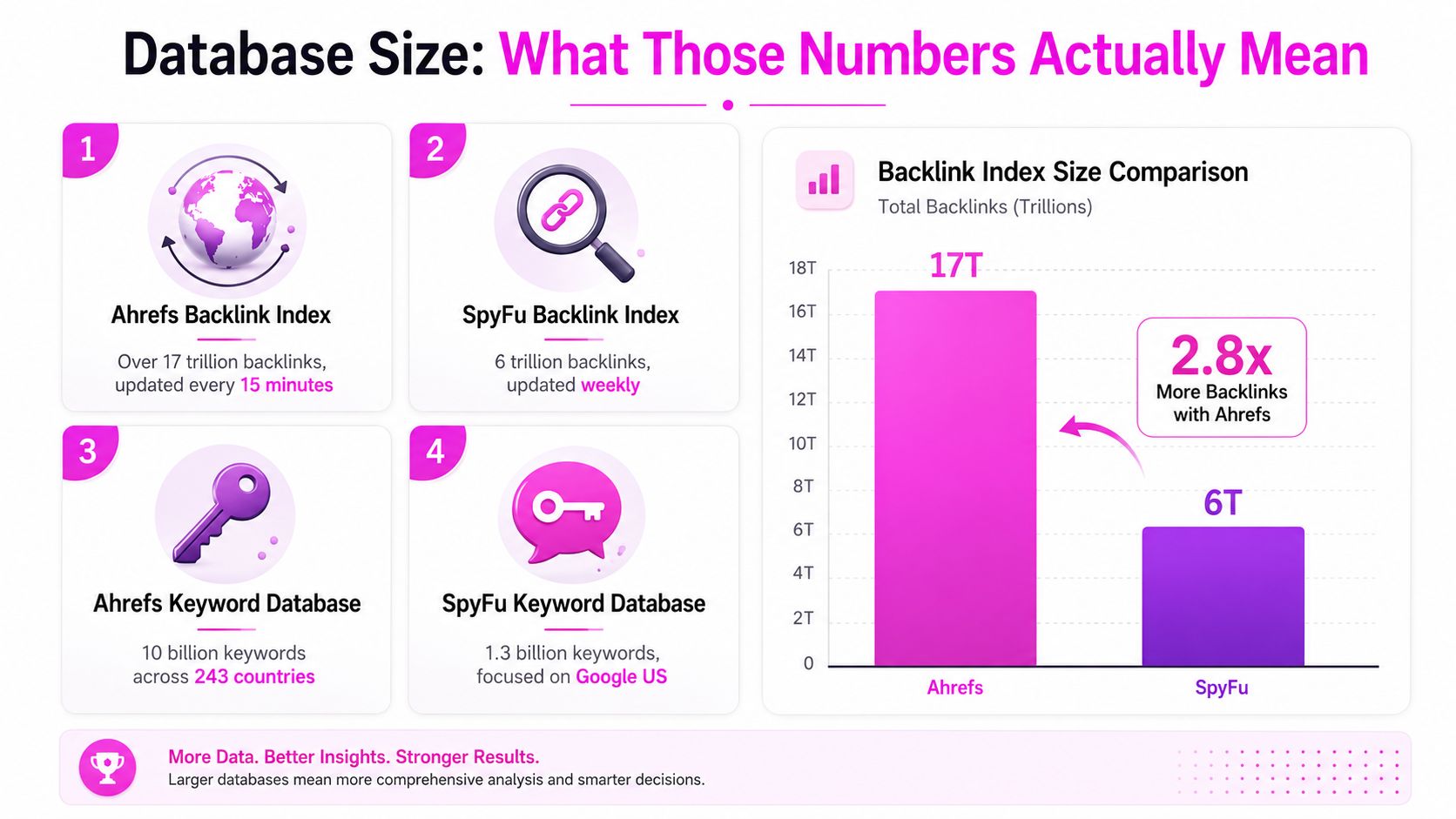
The headline numbers are real, but they're also easy to misuse. A 28.7 billion keyword claim for Ahrefs and a 73 billion keyword claim for SpyFu sound like a clean win for the larger number, yet that tells you almost nothing about whether the tool will surface the queries you need in the market you care about source.
Keyword scale matters less than keyword usefulness
A practical example is more useful than a brochure claim. One test cited a Best Buy domain showing 10 million keywords in SpyFu versus 4.3 million in Ahrefs, which tells you the tools can surface very different interpretations of the same site source. That doesn't mean one is wrong. It means the index is shaped by the way each platform collects, normalizes, and surfaces search data.
For me, the better question is whether the dataset is broad enough to catch the terms that matter in your geography and vertical, and whether the interface helps you filter to the terms that map to revenue. A huge index that buries the signal is still a noisy index.
Backlinks are where depth starts to matter
On links, Ahrefs has long been the tool people associate with organic backlink analysis and live crawl depth, while SpyFu is more often used for competitor-oriented link discovery and overlap analysis source. In practice, that means Ahrefs is usually where I go when I need a cleaner audit trail for a page's link profile. SpyFu is the place I check when I want to see which competitor signals are connected to ranking behavior, not to run a full forensic audit.
A useful third-party reference for broader tool selection is this browse Analytics monitoring platforms roundup from MetricsWatch, especially if you're comparing SEO tooling by workflow instead of brand.
The takeaway is simple. Database size is a proxy, not a verdict. If the database is large but the workflow is wrong, you still lose time. If the database is smaller but better aligned with your task, you move faster and make better calls.
Feature Parity Check Across the Core Workflows
Most feature tables flatten everything into checkmarks. That hides the fact that both tools can cover the same broad categories while serving them in very different ways. I prefer to think in workflows, because that's how I use the tools when a client asks for answers by tomorrow morning.
Keyword research and content planning
Ahrefs gives me a more natural path for keyword research, content gap analysis, and organic targeting. Its workflow is built for finding terms, grouping them, and then moving into pages and links. SpyFu's Kombat and keyword research tools are more useful when I care about overlap, competitor set mapping, and paid search spillover. If I need to know what a rival is bidding on and where that overlaps with organic opportunity, SpyFu is efficient. If I need to build a content map around search intent and internal linking, Ahrefs is usually cleaner.
Backlinks, rankings, and PPC history
Ahrefs' Site Explorer and referring domain filters are still the reports I trust most for link-led work. They're the reports I open when I'm checking whether a link is live, whether an opportunity exists, or whether a page has enough authority to justify a push. SpyFu's Backlinks and Backlink History are useful, but I use them more as competitor context than as the core of a link-building workflow.
SpyFu's edge shows up when the question is, “What has this competitor been doing in paid search over time?” That's a different question from, “What's the health of this site's backlink profile?”
For readers comparing the wider market too, I'd also explore modern SEO tool swaps from LLMrefs. That's useful if you're evaluating where SpyFu sits among other competitor-intel tools rather than only against Ahrefs.
| Workflow capability | Ahrefs | SpyFu |
|---|---|---|
| Keyword research | Strong for organic discovery, clustering, and content planning | Strong for competitor overlap and paid search angles |
| Content gap analysis | Built for organic gap discovery | Useful for spotting shared and exclusive keywords |
| Backlink analysis | Stronger fit for audits and live link review | Better as competitor context than deep forensic review |
| Rank tracking | Organic-focused reporting and monitoring | Useful, but more tied to competitor and PPC history |
| PPC insight | Limited relative to SpyFu | Core strength, especially historical ad behavior |
I'm intentionally leaving out “parity” language because parity isn't the point. The point is whether the feature behaves the way you need it to behave in an actual workflow. Both tools can show keywords, but only one is usually the better starting point for the job in front of you.
The same goes for internal comparison shopping. If you're benchmarking tools against the wider field, I'd keep SemDash's SEO research tool overview in the mix because it frames keyword, backlink, and SERP work as separate research tasks instead of one blended promise.
Accuracy, Methodology, and Why Your Numbers Will Disagree
If you've ever run the same domain through both platforms and gotten different answers, that's normal. The gap isn't a bug. It's the result of different models, different crawls, and different assumptions about what counts as meaningful search behavior.
Why two dashboards disagree on the same page
Ahrefs and SpyFu both estimate organic opportunity, but they don't come at it from the same angle. Ahrefs' organic workflow is shaped by search and link analysis, while SpyFu's heritage is in competitor intelligence and PPC data source. That affects what gets emphasized in the output, which keywords rise to the top, and how much weight the tool assigns to historical behavior versus current visibility.
In practice, I treat one tool as the primary read and the other as the sanity check. If Ahrefs says a page has strong organic potential but SpyFu shows very little overlap with competitor ad behavior, I don't average the numbers. I ask which question I'm trying to answer. If the answer is “what should we build for organic search,” Ahrefs gets more weight. If the answer is “what are competitors paying to test,” SpyFu gets more weight.
Use the tool that matches the question
A real workflow usually looks like this. I'll inspect a target query, compare the ranking pages, and look at how each tool frames the opportunity. Then I decide whether the number is serving content planning, link planning, or PPC planning. That's a more reliable method than chasing a single “true” estimate that doesn't exist across tools.
Rule I use weekly: don't merge two estimates just because they're both available. Pick the tool that matches the decision you're making, then cross-check the result with the other platform only if the answer changes budget or scope.
For a related comparison mindset around performance diagnostics, the core web vitals tracking breakdown from PageSpeed Plus is a good model. It shows the same principle clearly. Different tools can observe the same page and still be useful for different decisions.
The main lesson is trust hierarchy. One number is often enough if it comes from the tool whose methodology matches your workflow. If not, the mismatch is a signal, not a problem to smooth away.
Pricing, Plans, and the Hidden Costs Nobody Mentions
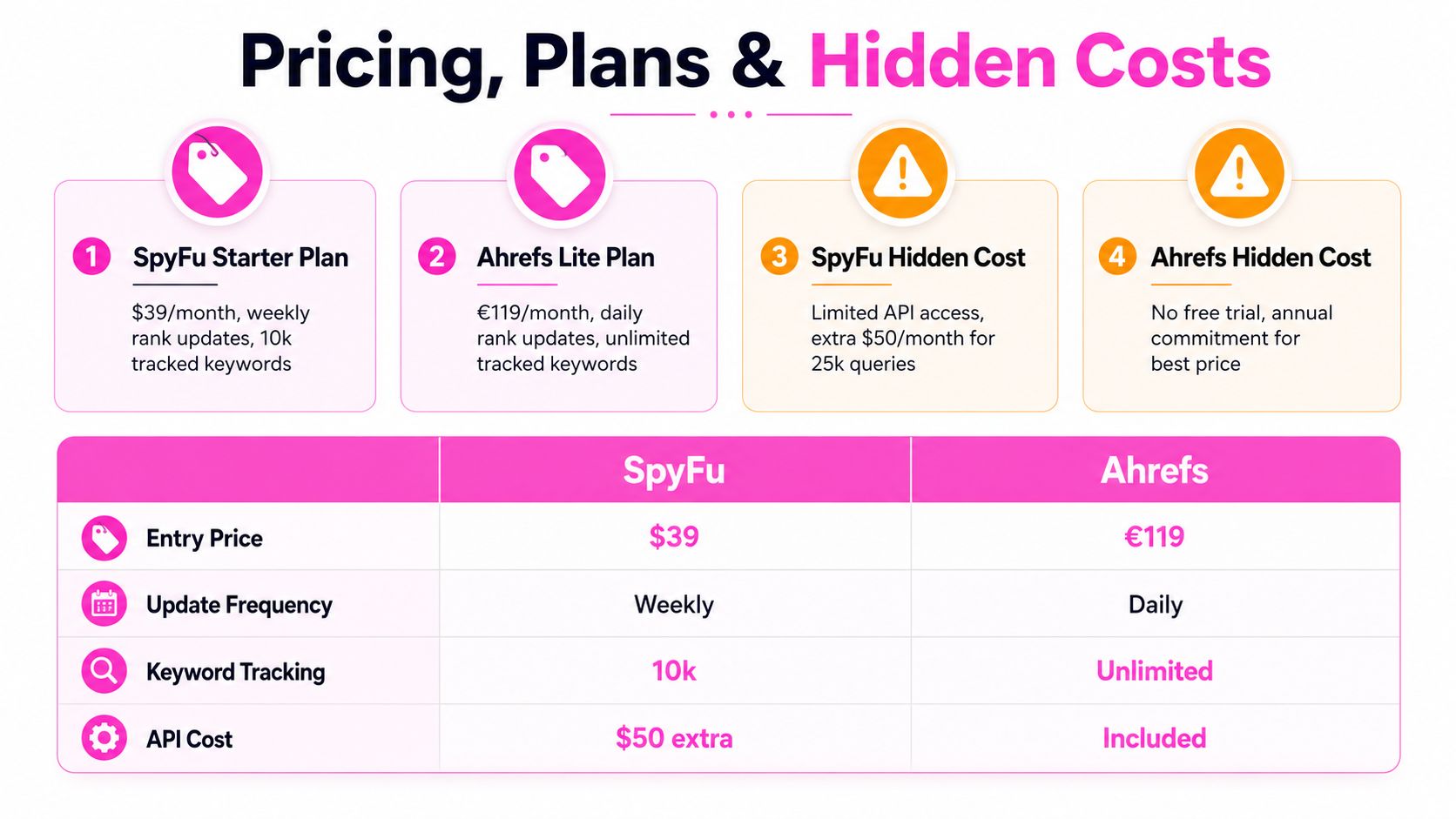
The list price gets all the attention, but the actual cost is what happens after the first month of use. SpyFu's entry plan sits at $39/month with weekly rank updates, while Ahrefs' entry plan sits at €119/month in one 2026 comparison source. That gap is large enough that the wrong purchase hurts, but it still doesn't tell the full ownership story.
The plan price is only the first gate
SpyFu's Pro + AI plan is also noted at $119/month for white-label client reports source. That matters if you're an agency, because client-facing reporting often changes the actual plan you need. Ahrefs' pricing is steeper at the entry point, so a solo consultant can feel the cost quickly if the workflow doesn't use the platform every week.
I also look for hidden friction. Ahrefs is known for a more restrictive, credit-sensitive feel in many workflows, while SpyFu's lower entry cost makes it easier to live with if you're only using a few reports heavily. Those differences affect how often you log in, how deep you go in each session, and whether the tool gets used as intended or treated like an occasional export machine.
Match spend to buyer type
A solo consultant who mostly needs competitor ad history can probably justify SpyFu faster than Ahrefs. A five-person agency doing content strategy and backlink work usually gets more value from Ahrefs, especially when the deliverable is organic rather than paid. An in-house team with both channels under one roof has to ask which workflow is driving revenue, because paying for the wrong depth gets expensive fast.
I'd also think about upgrade pain before I buy. Once the team starts relying on exports, tracked keywords, or report sharing, the “cheap” plan stops being cheap if it blocks the work. That's where hidden cost really lives, not in the headline price, but in the moment your process outgrows the tier.
Best Fit Use Cases by Buyer Persona
The cleanest way to choose is to map the tool to the person who has to use it on Tuesday morning. That's usually more honest than a feature matrix, because the right answer depends on what gets billed, reported, or shipped.

PPC-heavy agency
If I'm running paid search audits or comparing ad copy across rivals, SpyFu is the more natural fit. It's built for competitor intelligence, historical PPC behavior, and keyword overlap, so the reports line up with the questions a paid media team asks every week. The trade-off is that I'm not buying the deepest organic forensics in the market.
Organic content team
If the job is content planning, internal linking, and gap analysis, Ahrefs usually wins the workflow test. The reports are more aligned with topic research, backlink discovery, and figuring out why one URL outranks another. That's the kind of work where breadth in ad history doesn't matter much, but organic depth does.
Small business or solo operator
If budget is tight and the work mixes light SEO with competitor curiosity, SpyFu is often the easier first buy. The lower entry price makes it simpler to test whether the insights change your decisions. If the site's growth depends on link building or organic content, though, that savings can disappear fast because the workflow is the wrong one.
Agency or team evaluating broader stacks
If you're comparing tools across the market, I'd also look at SemDash's Ahrefs alternatives guide because it helps frame where Ahrefs sits relative to other research stacks. That's useful when you're deciding whether you need a specialist tool, a broader suite, or a cheaper bridge while the team matures.
I've seen teams overbuy because they wanted one platform to do everything. That rarely ends well. The better move is to assign the tool to the dominant job, then add the other only if the second workflow is frequent enough to justify it.
Recommendation Framework and Answers to Common Questions
My default recommendation is simple. Choose Ahrefs when organic search depth, backlink forensics, and content gap analysis drive the work. Choose SpyFu when PPC history, competitor ad intelligence, and paid search overlap drive the work. Pair them only when both workflows are equally important and the budget can support that.
Quick answers I get all the time
Can you cancel mid-cycle. The answer depends on the plan terms you buy into, so I always check billing language before I commit.
Is keyword migration hard. Not really, but the pain is in rebuilding saved workflows, exports, and repeat reports, not in moving a list of terms.
Which is better for YouTube and Bing. Neither is my first pick for those channels, so I wouldn't buy either tool for that reason alone.
Are free trials enough to decide. They're enough to get a feel for the interface, but not enough to judge whether the tool fits a monthly workflow with real client pressure.
If you want one rule to keep, use this one. Ahrefs for organic depth, SpyFu for competitor ad intelligence. That rule saves more money than any feature comparison ever will.
A CTA for SemDash.