%20(1)-B86R08ZzwhPzS6UZbG3mSxRWPCwGwn.png)


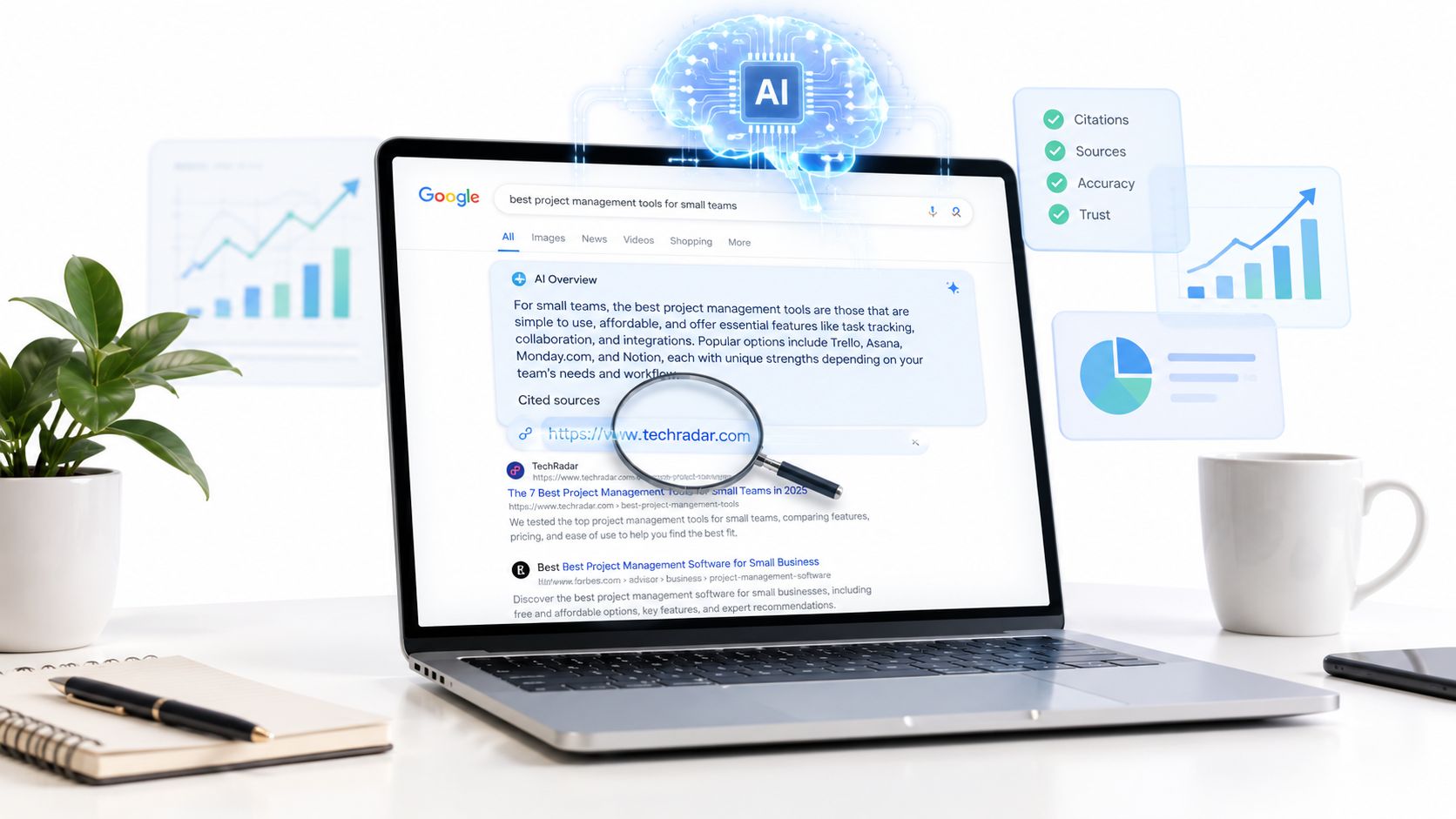
You've checked Google Search Console, and the report looks deceptively healthy. Your priority pages still hold similar average positions, competitors haven't obviously displaced you, and yet organic sessions are slipping. The first instinct is usually to investigate an algorithm update or rewrite the pages around a new keyword.
That diagnosis misses a separate search surface. AI Overviews can occupy the most prominent part of the results page while your blue-link ranking remains stable, changing the value of that ranking without necessarily changing the ranking itself. The practical question in AI Overviews SEO is no longer only, “Where do I rank?” It's also, “Which URL does Google cite, for which claim, and what happens after the citation?”
Table of Contents
- Why Your Rankings Are Stable But Traffic Is Dropping
- How AI Overviews Became a Global SERP Feature
- Three Distinct Optimization Objectives in AI Search
- The False Assumption That Top Rankings Guarantee Citation
- Auditing AI Overview Visibility with SemDash and Search Console
- Why URL-Level Tracking Matters More Than Domain Visibility
- Turning AI Overview Insights Into Actionable SEO Strategy
Why Your Rankings Are Stable But Traffic Is Dropping
I ran into this pattern while reviewing a SaaS content set with several pages holding strong organic positions. The ranking history looked ordinary, but clicks had weakened for informational queries. Once we checked the result pages query by query, the explanation became clearer: AI Overviews were answering part of the search above the traditional listings.
Google's AI Overview behavior creates two competing paths to visibility. A page can earn a conventional organic result, or it can become a supporting source inside the generated answer. Those paths overlap, but they aren't interchangeable. A position-one result may be less valuable when the user sees a complete summary, while a cited page can receive attention from a user who wants to verify or expand on the answer.
The Pew Research Center browsing analysis reported by Indian Express measured traditional-result clicks in 8% of visits containing an AI-generated summary, compared with 15% of visits without one. The gap was 7 percentage points, or approximately a 47% relative reduction in the observed traditional-result click rate. That doesn't predict the outcome for every query, but it gives me a useful diagnostic benchmark.
The diagnosis I use
I don't start by rewriting a page. I first separate four signals:
- Ranking position: Has the target URL lost its blue-link position?
- Overview presence: Does the query now trigger an AI Overview?
- Citation status: Is the domain mentioned, and is the exact URL cited?
- Post-click outcome: Are impressions, clicks, landing-page engagement, and conversions moving together?
This distinction matters because stable rankings with declining clicks point toward SERP composition, not necessarily content failure. I also compare device, intent, and query variants. A broad educational query may show an Overview while a product-specific variant does not, so aggregate reporting can hide the pattern.
Practical rule: Never call a ranking-stable traffic decline an algorithm problem until you've checked whether the affected queries gained an AI Overview.
Traditional SEO still matters. The historical lessons in this SaaS SEO timeline and takeaways remain relevant for technical foundations, content depth, and competitive research. But AI Overviews add a layer that rank trackers often flatten into a single visibility score.
The fix, therefore, isn't to push a page from position four to position one. I want to know whether the page resolves a passage Google can extract, whether another URL is being cited for the same sub-intent, and whether the cited page captures the remaining demand better than mine. That shift from rank tracking to citation-level attribution is the foundation of a useful audit.
How AI Overviews Became a Global SERP Feature
A query that produced ten blue links can now return a generated answer with citations before the organic results. Google tested that format through the Search Generative Experience in 2023, then introduced AI Overviews to general users in the United States on May 14, 2024, replacing the experimental SGE experience. The initial format summarized an answer within the results and linked to supporting webpages, adding a visibility layer beyond conventional rankings. The rollout history appears in this AI Overviews timeline from SE Ranking.
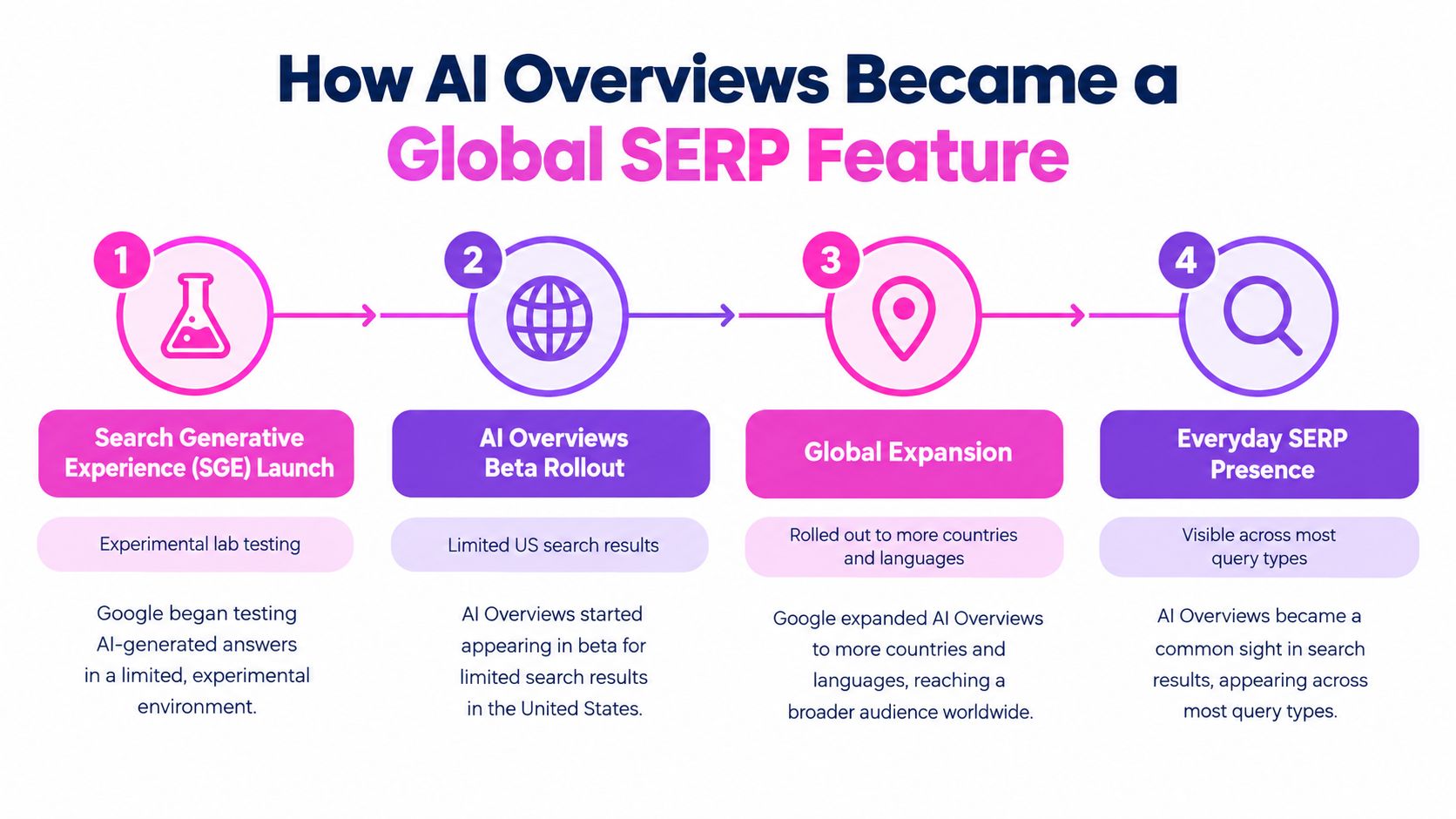
By October 2024, the feature had expanded beyond the United States into more than 100 countries and territories. It later became available across more than 200 countries and territories and more than 40 languages. That expansion changed the operating context for international SEO teams. AI Overview eligibility became a market-specific concern, not a US-only experiment.
SGE observations still provide useful history, but they cannot be treated as a stable benchmark. SGE was an experimental environment. AI Overviews became part of everyday Google Search, with availability, language support, triggering patterns, and market behavior changing over time. A result recorded during one testing phase may not represent the SERP shown in another country, on another device, or on another date.
I translate that history into four tracking requirements:
- Market monitoring: Record the country, language, device, query, and date for every visibility check.
- SERP monitoring: Log whether the observed query produces an Overview instead of assigning the feature a permanent keyword status.
- Source monitoring: Save the exact cited URL, because domain-level visibility can hide which page Google selected.
- Performance monitoring: Compare citation status with impressions, clicks, and conversions.
The rollout moved quickly enough that international teams need live observations rather than a static “AI-friendly content” checklist. A page can be cited for an English query in one market and absent for a localized equivalent. Triggering frequency can also change with intent and wording. Those differences create a practical gap between a page's traditional ranking and its eligibility for inclusion in an AI-generated answer.
Google's own AI features documentation keeps the technical foundation familiar. Crawl access, indexability, internal discoverability, visible text, relevant media, page experience, and consistent structured data still affect whether Google can process a page. The measurement target has changed. I record a conventional ranking as one visibility event and an exact URL citation as another, then compare both with the resulting business outcome.
Three Distinct Optimization Objectives in AI Search
AI Overviews create three separate optimization objectives, not one blended version of “ranking well.” I track them independently because each answers a different question about the page.
First, can the page rank conventionally?
The first objective is the familiar one: earning an organic ranking for the query. This still supports discovery, establishes a baseline for comparison, and often improves the likelihood that Google can find the page as a candidate source. It also remains essential for queries where no Overview appears.
Ranking data tells me whether the page is competitive in the conventional index. It doesn't tell me whether Google will use the page inside a generated answer, whether the answer will cite the page, or whether another page will satisfy a narrower passage more effectively.
Second, does the query trigger an Overview?
The second objective belongs to the query rather than the page. Some searches produce an AI Overview, while others return a conventional SERP. Triggering status can change with query wording, location, device, language, and date, so I record it as a property of the observed SERP state.
This point is where many reports go wrong. A page can lose clicks because the query gained an Overview, even if the URL's ranking position barely moved. Conversely, a page can rank well for a keyword that rarely produces the feature, making citation optimization a low-priority investment for that cluster.
Third, does Google cite the exact URL?
The third objective is source selection. Google may cite a page inside the generated answer when that page supplies a useful passage for a particular claim or sub-intent. A domain mention is not the same as a citation, and a citation to one URL doesn't mean Google selected every relevant page on that domain.
Research covering 1 million AI Overviews and 1.9 million citations found that cited pages occupied several different organic ranking ranges, as detailed in this Ahrefs analysis of search rankings and AI citations. The result is a practical split between earning a traditional ranking and becoming a cited or linked source within the generated answer.
I use a simple three-column report for each tracked query:
| Objective | Question | Useful decision |
|---|---|---|
| Organic ranking | Where does the target URL rank? | Improve relevance, authority, or technical quality |
| Overview trigger | Does this SERP contain an AI Overview? | Estimate exposure to answer-first search |
| Citation inclusion | Which exact URL does Google cite? | Fix passage-level and page-level gaps |
The mistake is optimizing the first column while ignoring the other two. A page that ranks first but never earns citations may need better answer structure. A page outside the top ten that is repeatedly cited may contain a sub-answer worth expanding into a stronger, more intentional asset.
The False Assumption That Top Rankings Guarantee Citation
A competitor can sit below your page in the organic results and still supply the passage used in an AI Overview. Top-ten rankings improve eligibility, yet they do not guarantee that Google will cite the same URL.
In the study of 1 million AI Overviews and 1.9 million citations, 76.10% of cited pages ranked in Google's top 10, 9.50% ranked between positions 11 and 100, and 14.40% did not rank in the top 100, according to the Ahrefs study of AI citations. The distribution makes organic visibility useful, but incomplete, as a way to predict citation selection.
A separate 2026 analysis from Cognizo reported that only 38% of pages cited inside AI Overviews also ranked in the organic top 10, compared with 76% eighteen months earlier, as reported in Cognizo's analysis of Google AI Overview statistics. These figures should not be treated as a direct contradiction. The studies may differ in timeframe, query sample, market coverage, and how they define a cited page or an organic top-ten result. Use them as directional evidence rather than a single benchmark. Both point to the same operational conclusion: ranking and citation eligibility can diverge.
That distinction changes how I review competitor reports. A high-ranking page may lose the citation because it handles the broad topic while another URL answers a narrower sub-question with cleaner wording. A lower-ranking page may win because its supporting passage is easier for Google to extract and connect to the user's query.
What I compare when a competitor wins
When my page ranks higher but a competitor earns the citation, I compare the URLs at passage level. The question is which page gives Google a usable answer, not which page has the larger word count.
- Direct answer coverage: Does the competitor answer the exact question in visible text near a relevant heading?
- Entity clarity: Are the product, method, limitation, or category defined without ambiguity?
- Source specificity: Does the page support the claim with a detailed explanation instead of a broad overview?
- Corroboration: Do internal and external links support the point without burying the relevant passage?
- Conversion relevance: Does the cited URL contain the evidence or next step a user needs?
A generic summary box rarely fixes a missing sub-intent, unclear terminology, or unsupported claim. Expanding every article can create the same problem from another direction. Extra content may push the useful passage deeper into a weak hierarchy and make its purpose less obvious.
The page that ranks highest is not always the page that supplies the cleanest answer.
The reverse pattern creates an opportunity. If a page ranks below the visible organic results but repeatedly appears as a citation, inspect the passage that wins. It may justify a dedicated section, a focused supporting page, or stronger internal links from the ranking URL. Discarding that page because its average position is lower would hide evidence about what Google considers source-worthy.
The practical test is direct: ask which claim the competitor owns inside the answer, then decide whether your page should address that claim more clearly or whether a separate URL would serve it better.
Auditing AI Overview Visibility with SemDash and Search Console
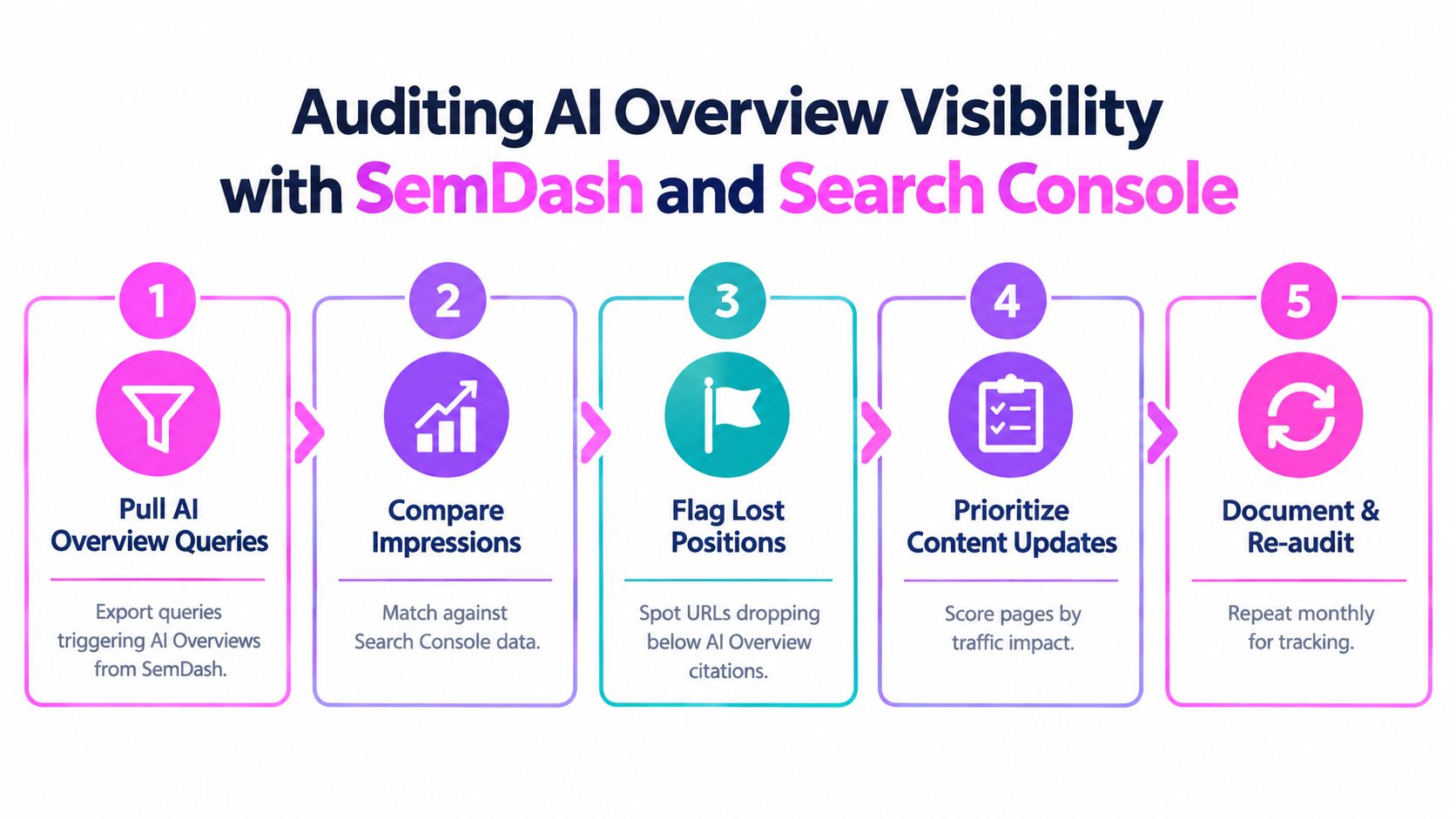
A repeatable audit starts with query-level records, not a screenshot of one search. I use SemDash's AI Overviews visibility tool to pull keywords that generate the feature, identify domain mentions, and see the exact URLs Google cites. Then I cross-reference those observations with Google Search Console rather than treating a citation as proof of traffic.
Build the audit dataset
Start with the affected keyword set and export each query with its observed SERP state. The useful fields are:
- Query and market: Keep country, language, device, and date attached to the record.
- Overview status: Mark whether an AI Overview appeared.
- Domain status: Record whether the site was mentioned.
- Cited URL: Save the precise supporting page.
- Organic URL and position: Keep the conventional ranking page separate from the cited page.
- Performance data: Add impressions, clicks, landing page, and conversion information where available.
I use the SemDash live SERP checker when I need to validate the current result rather than rely only on a historical export. The point isn't to create a larger spreadsheet. It's to prevent domain-level visibility from hiding a page-level mismatch.
Reconcile the data with Search Console
Google's AI Search documentation recommends using the Generative AI performance report in Search Console to assess performance in generative features, as described in Google's AI optimization guidance. I combine that first-party reporting with URL-level citation monitoring because clicks alone can't show whether a page was visible in an Overview without becoming the landing page.
I classify each query and URL into three practical buckets:
- Cited and clicked: The page earned source visibility and downstream engagement. Inspect the landing experience and conversion path.
- Cited but not clicked: The page gained attribution without a visit. Test title framing, page relevance, and whether the citation supports a useful next step.
- Not cited despite ranking: The page has conventional visibility but may lack a clear extractable answer, specific evidence, or the right sub-intent.
The third bucket often deserves the clearest content diagnosis. Compare your page with the cited competitor and identify whether the difference is structural or topical. Don't assume that adding links or increasing word count will solve a passage-level problem.
Score opportunities by business value
I prioritize a query when it combines meaningful commercial relevance, stable organic visibility, Overview exposure, and a clear gap between my page and the cited source. A high-volume informational query with no conversion path may receive less attention than a narrower query where a cited page can lead users to a comparison, tool, demo, or product-specific explanation.
Re-audit after substantive changes, and preserve the earlier citation record. Without dates and exact URLs, you can't distinguish a real change from normal SERP variation.
Why URL-Level Tracking Matters More Than Domain Visibility
A domain-level citation report can make a team feel successful while sending the wrong page to the user. Google may cite a broad comparison page when the detailed pricing guide, implementation article, or compatibility page contains the information that should drive the conversion.
Consider a software comparison site. The overview page names several tools and links to product pages, but the pricing qualifications sit inside an image and the implementation constraints appear only in a downloadable PDF. Google can understand the broad comparison while missing the details you wanted it to cite. A domain mention exists, but the intended conversion URL loses the attribution.
Google doesn't require special AI Overviews markup, a separate optimization format, or an additional technical eligibility process. The page must first be indexed and eligible to appear in Google Search with a snippet before it can qualify as a supporting link, as explained in Google's documentation on AI features in Search.
I treat that requirement as a gating workflow, not an AI SEO checklist:
- Crawl access: Confirm that Google can request the page and isn't blocked by robots.txt.
- Indexability: Check that an accidental noindex directive isn't excluding the URL.
- Internal discoverability: Make sure useful pages are reachable through meaningful site navigation and internal links.
- Visible text: Put essential claims in HTML text, not only in images, tabs, or PDFs.
- Structured data consistency: Confirm that markup matches what the user can see on the page.
Log the supported claim
For every citation, I record the query, date, exact URL, and the claim that URL appears to support. This catches partial citation behavior. A page may be cited for a compatibility question but ignored for a pricing variation of the same topic.
That log also reveals URL cannibalization. If Google repeatedly cites an informational guide while the product page ranks conventionally, the problem may not be authority. The product page may only lack the passage that resolves the user's immediate question. I can then add visible, accurate supporting text and link users to the deeper commercial action.
Schema won't rescue a blocked page, and a domain-wide win won't make every URL eligible. The page is the unit I audit, improve, and measure.
Turning AI Overview Insights Into Actionable SEO Strategy
The audit becomes useful only when it changes what I update first. Raw search volume is too blunt because the expected value of a query depends on its Overview status, ranking, device mix, historical CTR, cited URL, and conversion path.
A page with stable rankings and falling clicks deserves a different response from a page that lost rankings and citations together. In the first case, I investigate answer displacement and citation capture. In the second, I also review relevance, authority, technical issues, and competitive movement.
Prioritize the right pages
I score opportunities using a practical sequence:
- Find exposed queries: Identify keywords that trigger AI Overviews and map them to the pages receiving impressions.
- Separate stable from declining rankings: Flag URLs where clicks weaken while conventional position remains broadly stable.
- Check citation ownership: Record whether my URL, another URL on the domain, or a competitor supplies the cited passage.
- Estimate business value: Give priority to queries with a clear connection to a product, comparison, tool, lead, or purchase decision.
- Choose the smallest useful change: Improve a missing answer, clarify an entity, add evidence, or create a better destination page before rewriting everything.
Write for citation without writing for a machine
The pages I improve most successfully make important claims easy to find. They open with a concise answer or orientation, use headings that reflect real questions, and separate distinct sub-intents instead of mixing them into long narrative blocks.
I keep critical information in visible HTML text. Pricing qualifications, compatibility limits, implementation conditions, dates, and definitions shouldn't exist only inside screenshots or downloadable files. Supporting media can improve understanding, but it shouldn't be the only place where a material claim appears.
A page also needs evidence beyond generic summaries. First-hand implementation notes, original comparisons, product-specific limitations, and clearly explained methodology give users a reason to trust the page and give Google a more specific source to evaluate. I don't add invented case studies or decorative statistics to create that signal. I document what was tested and distinguish observation from established fact.
Build the cluster around the winning sub-intent
Keyword clustering helps me see whether one page should answer several related queries or whether a narrower supporting page is missing. I compare the cited URLs across a cluster, identify the subtopics they repeatedly cover, and connect the relevant pages with descriptive internal links.
For teams refining this workflow, the guide on how to optimize for AI Overviews provides a useful starting point for combining technical eligibility, answer structure, and content planning. Off-page work still has a role, but I don't use it as a substitute for a missing passage. For SaaS teams assessing external visibility options, manual directory submissions for SaaS founders can fit into a broader brand and discovery process, provided each placement is relevant and reviewed for quality.
Measure the outcome at URL level
My reporting separates four outcomes:
- Overview exposure: Did the query produce the feature?
- Brand attribution: Was the domain or brand mentioned?
- Source attribution: Which exact URL was cited?
- Business response: Did impressions, clicks, engagement, and conversions change?
A cited but unclicked page isn't automatically a failure. It may be building recognition, or the Overview may have satisfied the user. But it does tell me to inspect the page title, next-step clarity, and conversion path. A ranking page that never earns citations may need a better answer structure, stronger topical coverage, or a dedicated URL for the sub-intent.
The durable framework is simple: make the page crawlable, make the answer findable, make the source specific, and keep the citation history attached to the URL. Review it by market and query cluster rather than relying on a single domain visibility number. That approach turns AI Overviews from a vague traffic threat into a concrete set of pages, claims, and decisions.
SemDash helps you identify which tracked keywords trigger AI Overviews, whether your domain is mentioned, and which exact URLs receive citations, so you can compare rankings with source attribution instead of guessing. Visit SemDash to audit AI Overview visibility and connect SERP evidence with your SEO workflow.