%20(1)-B86R08ZzwhPzS6UZbG3mSxRWPCwGwn.png)



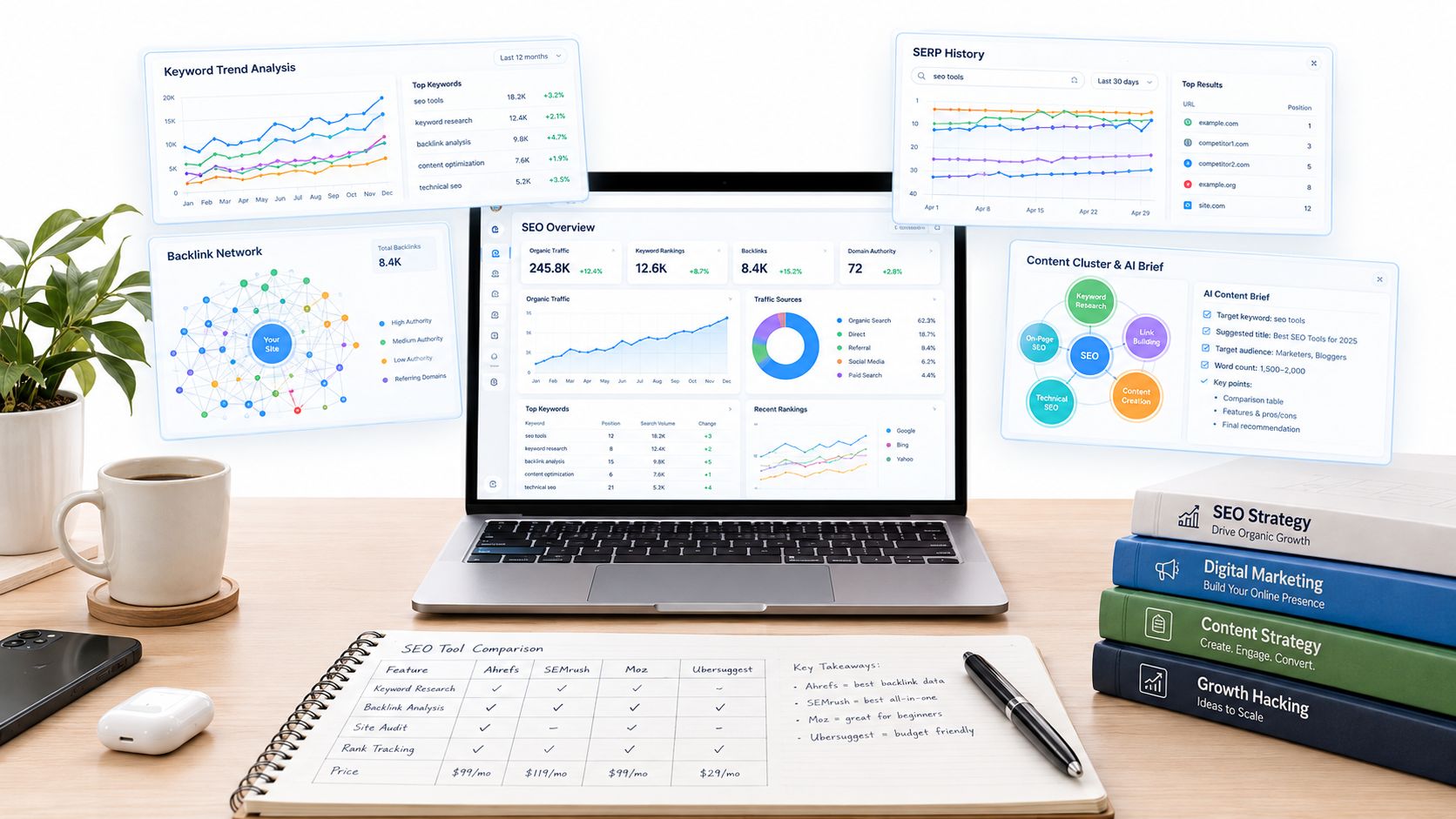
The most popular advice about a live SERP checker is also the most dangerous: search your keyword, look at the position, and treat the result as truth. I've debugged enough ranking drops to know that a snapshot often creates panic rather than clarity. A result can move because of location, device, personalization, a changing SERP feature, or ordinary testing, while the underlying performance of the site remains stable.
The useful question isn't “Where do I rank right now?” It's “What changed, for whom, on which Google surface, and does the change persist?” Modern SERP checking works best as a way to measure volatility and interpret search intent, not as a frozen certificate of ranking reality.
Table of Contents
- Why a Live Snapshot Is Not the Whole Truth
- What a Live SERP Checker Measures
- Separating Normal Churn from Real Algorithm Shifts
- Where Live SERP Data Changes Real Decisions
- Features That Separate Useful Checkers from Shallow Ones
- My SemDash Workflow for Tracking Volatility and Intent
- A Practitioner Checklist for Live SERP Monitoring
Why a Live Snapshot Is Not the Whole Truth
A single Google result page represents one query context. It reflects the selected country, language, device, location, timing, and sometimes user history. An incognito window removes some personalization signals, but it doesn't turn the result into an objective ranking. It gives you another variation of the same search environment.
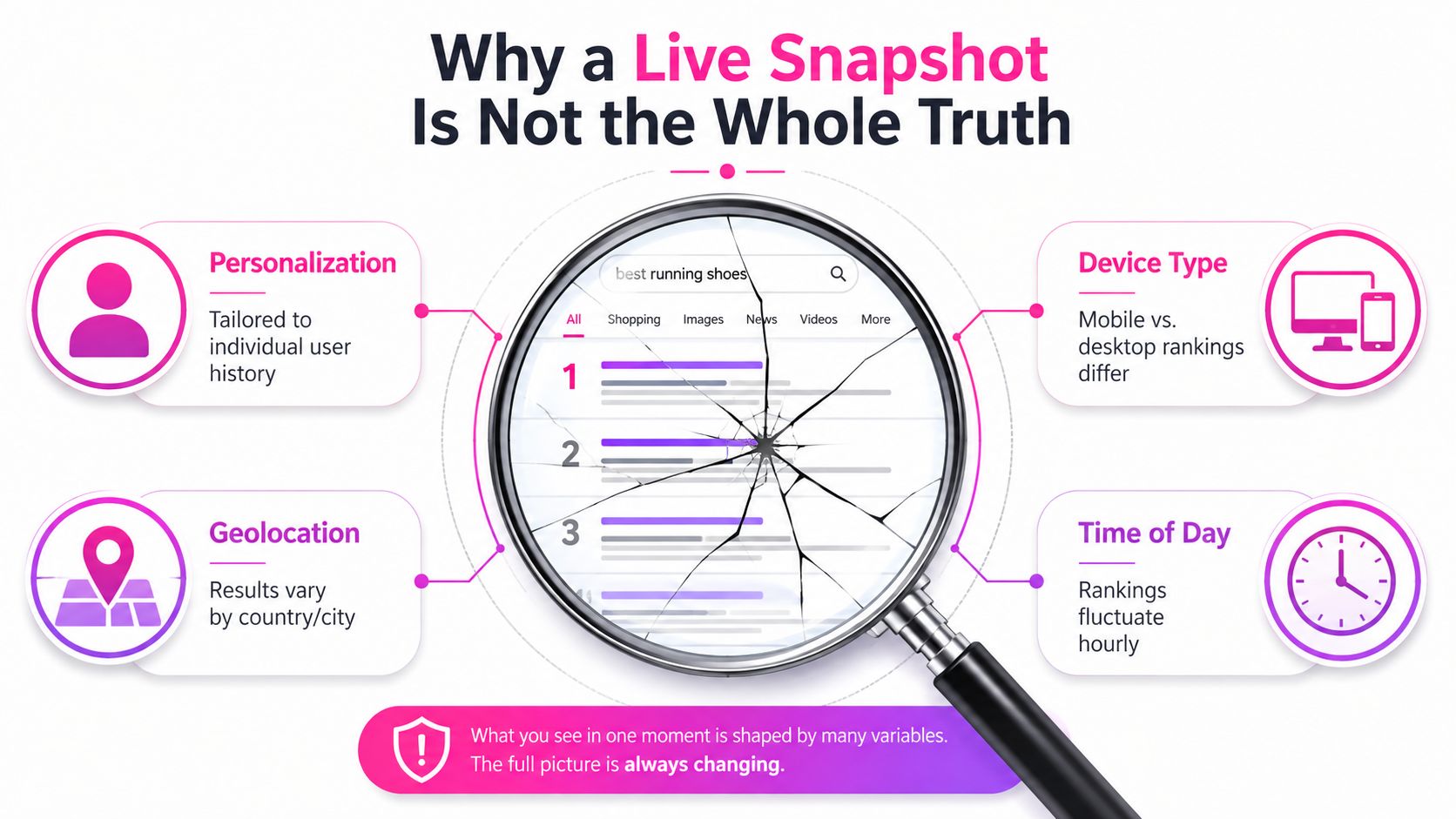
I treat a live snapshot as an observation, not a verdict. Competitive queries can shift throughout the day even when Google hasn't announced an algorithm update. A one-position change across a small group of keywords usually tells me very little. A repeated change across devices, locations, URLs, and SERP features tells me much more.
The wider evidence supports that volatility is a normal property of search, not an exceptional event. An analysis of 11,203 keywords collected Google.com results in the United States on 23 August 2024, 17 October 2024, and 17 January 2025, reporting average volatility scores of 0.30 over roughly eight weeks and 0.29 over roughly thirteen weeks. The model weighted order changes at 70% and feature-presence changes at 30%, which is a useful reminder that ranking order is only part of the story (Authoritas SERP volatility research).
Practical rule: Never make a content, redirect, or technical decision from one unscoped snapshot.
Scope matters especially for international SEO and local search. A public checker may run only against Google in the United States on desktop, while the target audience searches from another country, language, city, or mobile device (LemRank's SERP checker). If you're collecting results at scale, you also need to understand how anti-bot systems affect the collection process. Scrapfly's guide to bypassing DataDome is useful background when a scraping workflow returns incomplete or inconsistent pages.
The value of a live SERP checker appears when I compare observations over time. It helps reveal whether Google is changing the order of results, introducing a different feature mix, or interpreting the query with a different intent. That pattern is more actionable than the position displayed at one particular moment.
What a Live SERP Checker Measures
A scheduled rank tracker provides a useful trend sample, but it reduces a changing search result to one recorded position. A live SERP checker lets me request the page on demand and inspect what appeared at that moment. That difference matters when a ranking drop may reflect noise, personalization, an intent shift, or a broader algorithm change.
The checker measures more than URL order. A useful tool records organic position, featured snippet ownership, People Also Ask expansion, local pack presence, shopping carousels, and AI Overview inclusion. A page moving from position four to six tells only part of the story. A product carousel may have appeared above it, or an AI Overview may have reduced the visible space available to classic organic listings.
AI Overviews make interpretation harder. A live snapshot can show whether the feature appeared, but one observation cannot establish whether it is stable, query-specific, or tied to a particular location, device, or signed-in user. Compare matching conditions before treating the change as structural.
Historical research also shows why a daily number can mislead. In a two-week ranking-stability analysis, only 16.5% of ranking positions retained the same URL throughout the period, so most observed positions changed at least once (Moz's Google algorithm change resource). A scheduled report may look steady while the URL occupying that position changes underneath it.
| Capability | Live SERP Checker | Traditional Rank Tracker |
|---|---|---|
| Query timing | On-demand inspection of the current result page | Scheduled sampling |
| Ranking detail | Shows the observed URL and position at that moment | Usually reduces performance to a rank value |
| SERP features | Can expose snippets, PAA, local packs, shopping, and AI Overviews | Coverage varies and may be summarized |
| Volatility diagnosis | Supports comparison between snapshots and result composition | Stronger for long-term trend reporting |
| Intent analysis | Reveals changes in page types and feature mix | Often hides the visual SERP context |
A keyword reported at position five may appear at position three in the morning and eight later that day. I do not treat that range as proof that Google has made a final decision. It may reflect intent ambiguity, active testing, personalization, or a competitive result set with weak stability. The next check should preserve the same query, country, city, language, device, and search settings, so the comparison tests SERP change rather than collection differences.
For lightweight teams, Serpview SEO tool for startups can sit alongside a scheduled tracker. The tracker answers how visibility changed over time. The live checker shows what the SERP contains now and which changes deserve investigation.
Separating Normal Churn from Real Algorithm Shifts
Most practitioners overreact to every position change. A live snapshot shows movement, but it cannot tell you whether the cause is routine testing, personalization, an intent shift, or a broader algorithm change. Google's ordinary re-crawling and signal testing can produce one to three position changes continuously, according to SERP volatility tracking. Treat that as background churn unless the pattern spreads across related queries or changes the SERP's composition.
I use a layered diagnostic process before changing a page.
Start with the size and spread of the movement
A single URL slipping one position is weak evidence. A cluster of unrelated keywords moving in the same direction carries more weight. Industry guidance treats simultaneous movement of five or more positions across multiple keywords as more meaningful than isolated changes, as described in SERP Dino's volatility index.
For operational triage, I flag three-plus position changes across five-plus keywords for review. That threshold prompts investigation, not an algorithm-update diagnosis. The next checks must separate a site-wide pattern from a query-specific fluctuation.
Compare the movement with the site's baseline
A keyword that normally stays within a narrow band deserves attention after breaking that range. Store the observed URL, position, SERP features, device, and location, rather than retaining only the rank number. Without those fields, a snapshot cannot distinguish ranking loss from a changed result set or collection settings.
A volatility index helps quantify how much a result page differs from its recent norm. Some trackers use daily moving baselines and classify SERPs by how far current checks deviate from normal levels. Use those classifications as triage signals, not explanations. SemDash's SERP volatility guidance is a useful reference when setting monitoring rules.
Test context before changing the page
Compare desktop and mobile first. If movement appears only on mobile, inspect rendering, page experience, layout shifts, and competing page types before rewriting content.
Then compare SERP features. A new AI Overview, a featured snippet swap, expanded PAA results, or a shopping module can reduce click potential without a matching organic-position change. AI Overviews also create an interpretation gap: a stable blue-link ranking may coexist with reduced visibility because the answer layer now occupies more attention.
Check competitors as well. If several unrelated sites move together, a broad SERP adjustment is more plausible than a page-specific failure. If only one URL moves while intent and competitors remain stable, inspect the page, technical signals, and alignment with the query.
High-volatility events can be severe. A 2026 study reported that during the March 2026 core update, 79.5% of top-three results and 90.7% of top-ten results changed, while 24% of former top-ten pages fell out of the top 100 (The Stacc volatility tracker analysis). That pattern shows why history matters. A live checker without comparison data cannot separate temporary churn from structural loss.
Where Live SERP Data Changes Real Decisions
Live SERP data earns its place in my workflow when it changes what I do next. I don't collect screenshots for their own sake. I use them to decide whether to update a page, consolidate it, or change the format of the content entirely.
Content updates
Suppose a keyword historically returns explanatory articles, but the current SERP introduces product carousels, merchant pages, and commercial landing pages. That shift suggests Google may be testing a more transactional interpretation. I don't immediately delete the article. I compare the page types, headings, structured content, and feature mix across several checks.
If the commercial pattern persists, I'll usually reshape the page around evaluation and buying questions, or create a separate transactional asset if the informational page still serves a distinct audience. The immediate signals are shopping graph insertions, reduced informational coverage, and a different dominant content format.
Redirect decisions
Redirects require more discipline than content edits. A declining page may still have useful links, topical relevance, or informational demand. But if the target query now shows a featured snippet owned by a competitor whose page uses a substantially different format, chasing that snippet with small edits may waste time.
I compare the declining URL with the current top results, inspect whether the query still belongs to the page's original intent, and check for a stronger destination on the same site. If the page has no defensible role and another asset satisfies the current intent, a redirect may be more rational than repeated optimization. I document the reasoning and validate the target rather than redirecting because one snapshot looks bad.
AI Overview targeting
AI Overviews add another layer to the review. A query may gain or lose an AI Overview between checks, and the cited URLs can change even when the classic organic list looks familiar. A comparative study found that 70% of ranking pages in AI Overviews changed over a two-to-three-month window, reinforcing the need to monitor citation membership over time (Authoritas' comparison of search result evolution).
When I see an AI Overview appearing for a cluster, I review whether the site has clear entities, direct answers, supporting evidence, and consistent topical coverage. I don't write for a citation at the expense of users. I make the page easier for both systems and people to understand, then monitor whether the domain and relevant URLs continue to appear.
I aim to make the first decision within 48 hours of detecting a persistent change, but I don't force an implementation before confirming the pattern. A live SERP checker should accelerate diagnosis, not replace judgment.
Here's a short visual reference for the decision process:
Features That Separate Useful Checkers from Shallow Ones
Most free tools answer a narrow question: what appeared for this keyword in this location at this moment? That can be useful for a quick manual check, but it's insufficient for diagnosing volatility. I need enough context to reproduce the observation and compare it with earlier states.
The first requirement is historical archiving. A tool should let me compare the current SERP with earlier observations, such as the same query from a week, month, or quarter ago. Without history, I can identify movement but not persistence.
Device and geographic controls matter just as much. Mobile and desktop results can diverge, especially for local and e-commerce queries. Country-level targeting may still be too broad for a service business whose visibility changes by city or neighborhood. A checker that hides those parameters creates false confidence.
| Feature Category | Shallow Snapshot Tools | Advanced SERP Checkers |
|---|---|---|
| History | Current result only | Archived SERPs and trend comparison |
| Device | One default view | Separate mobile and desktop checks |
| Geography | Country or unspecified location | City, region, or market-level targeting |
| AI surfaces | May omit AI Overviews | Tracks AI Overview presence and citations |
| Feature detail | Flags that a feature exists | Identifies feature type, source URL, and format |
Feature detection needs similar scrutiny. “Featured snippet present” isn't enough for an audit. I want to know which URL owns it, whether it's a paragraph, list, or table, and whether the page format matches the query. The same applies to PAA. A collapsed PAA box and a large expanded question cluster can create very different opportunities.
One tool may be excellent for quick manual verification, while another is designed for research and historical analysis. I choose based on the decision I need to make. If I'm checking a client complaint about a local result, geographic precision is essential. If I'm investigating a broad visibility decline, history, device segmentation, and feature tracking matter more than a fast one-off screenshot.
My SemDash Workflow for Tracking Volatility and Intent
I start with the query context, not the tool interface. I enter the keyword, select the device that matches the client's primary traffic profile, and set the location as precisely as the business model requires. For a national publisher, country targeting may be sufficient. For a local service company, I need a city-level view because proximity can change the result set.
Then I inspect the complete SERP composition. I record the ranking URL, organic position, featured snippet owner, PAA questions, local pack, shopping results, and AI Overview status. The point isn't to copy every visual detail. It's to identify which elements compete for attention and whether the page types still match the query.
Next, I open the historical view and compare today's result with the prior 30-day window. SemDash provides SERP history extending across 12 months for trend analysis, which is useful when a change appears seasonal or tied to a larger market shift. I'm looking for a sustained URL replacement, a recurring feature change, or a new page type entering the results.
I compare mobile and desktop side by side before touching content. A mobile-only decline can point toward a rendering or experience problem, while a change on both devices across several competitors deserves broader algorithm investigation. For AI-specific checks, I use the SemDash AI Overview Checker to review whether the domain is mentioned and which URLs receive citations.
Mistakes I avoid
- Ignoring location: A local pack result can look wrong when the query was checked from the wrong market.
- Collapsing devices: An aggregate rank hides channel-specific movement.
- Reacting to one day: A single observation can reflect churn, personalization, or a temporary feature test.
- Overlooking branded volatility: Knowledge panels, sitelinks, and brand features can change the visible layout even when the core organic result remains stable.
For edge cases, I treat branded queries separately from generic queries. I also record proximity context for local pack searches instead of comparing a city-center result with a suburban result as if they were equivalent. When a keyword's volatility exceeds two standard deviations from its 30-day mean, I flag it for investigation and compare the timing with known update windows. That flag is a prompt to inspect the evidence, not permission to rewrite immediately.
A Practitioner Checklist for Live SERP Monitoring
Use a live snapshot immediately when you need to confirm a reported change, inspect a new SERP feature, verify a competitor entry, or diagnose a mismatch between a rank report and what users see. Before trusting it, confirm the country, language, city, device, and search surface.
Use this checklist:
- Check multiple contexts: Compare mobile and desktop, and repeat the check from the target market.
- Inspect the layout: Record AI Overviews, featured snippets, PAA, local packs, shopping modules, and organic results.
- Compare history: Decide whether today's result is an outlier or part of a sustained pattern.
- Test the spread: Look for movement across related keywords and competing URLs.
- Rule out timing effects: Account for holidays, news-cycle intrusions, and local pack fluctuations.
- Wait when evidence is weak: Give isolated movement 24 to 48 hours before making a major change.
- Set a cadence: Run daily spot checks for high-value keywords and weekly deep dives across the wider portfolio.
The handoff rule is simple. Trust the snapshot for observation, but trust repeated, scoped observations for decisions.
Use SemDash to inspect live SERPs, compare historical result sets, and investigate volatility or intent changes with device and market context. Visit SemDash to build a repeatable SERP monitoring workflow instead of reacting to isolated ranking snapshots.