%20(1)-B86R08ZzwhPzS6UZbG3mSxRWPCwGwn.png)


Broken Link Building: A Complete Workflow for SEO Teams

Broken link building means finding dead outbound links on other websites and pitching your relevant, live page as the replacement. The verdict for 2026: it still works, and works well, but only when you treat each placement as one signal in a broader mix of link diversity and entity credibility rather than a numbers game.
Start today with one concrete move: pull a broken-backlinks export for a single competitor and scan their top resource pages for dead links you can realistically replace.
- Definition: replacing a dead outbound link with your own relevant resource
- 2026 verdict: still effective, best used alongside diversified link sources
- Fastest starter action: export one competitor’s broken backlinks, then check resource hubs in your niche
Quick stat: Well-run campaigns report response rates between 15% and 30%, and 30% to 50% of those responses converting into a live link — solid odds for outreach that costs nothing to send.
Key Takeaways
Broken link building works in 2026 when practitioners prioritize resource hubs, personalize outreach, and treat each placement as one part of a diversified, entity-aware link profile.
| Point | Details |
|---|---|
| Target resource hubs first | A single hub page can hide dozens of broken links, multiplying ROI per outreach hour. |
| Vet before you pitch | Score prospects on relevance, authority, editorial activity, and placement to avoid wasted emails. |
| Match the dead page closely | Use Wayback Machine snapshots to rebuild structure and scope editors expect. |
| Follow up once or twice | Most placements convert after the first or second follow-up, not the initial email. |
| Use Semdash to scale prospecting | Semdash’s backlink research tool exports competitor broken links and verifies domain signals in one workflow. |
What Is Broken Link Building and Why Does It Work?
Broken link building, sometimes called dead link building or the Moving Man Method, is the practice of finding links on other sites that point to pages which no longer exist, then asking the site owner to replace that dead link with a link to your equivalent content. The mechanic is simple. The psychology behind it is what makes it durable as a tactic.
Cold outreach that just asks for a link gets ignored. Outreach that flags a broken link and hands the editor a ready fix gets answered, because you’re solving a problem they already have, not asking for a favor. A site owner with a 404 hurting their own user experience has a reason to act fast.
The context has shifted, though. As of mid-2026, SEO professionals are moving away from pure volume-based link acquisition toward link diversity and entity signals, where backlinks get evaluated alongside brand mentions and topical consistency rather than in isolation. That doesn’t kill broken link building. It changes what a “good” placement looks like:
- Editorial context matters more than raw domain authority
- Thematic relevance to your entity/topic cluster outweighs generic DR chasing
- A placement on a topically aligned resource page beats a random high-DR mention
A Quick Workflow: Find, Vet, Match, Reach Out, Verify
You don’t need a complicated system to run a broken link campaign. Five stages cover it, and you can execute all of them with a spreadsheet and two browser tabs.
- Find dead links through competitor backlink exports, resource page searches, Wikipedia citations, and archived domains.
- Vet each opportunity for real traffic, editorial activity, and topical fit before you spend outreach time on it.
- Create or match replacement content, either an existing page you already own or something built to mirror the dead resource.
- Reach out with a short, specific email that names the broken link and offers the fix.
- Verify and log the placement once it goes live, then track the data for your next cycle.
Two variants are worth knowing. The classic “reclaim” approach targets links pointing at your own dead or moved pages. The Moving Man Method targets sites, tools, or companies that shut down entirely, leaving a trail of orphaned mentions across the web. A straight 301 takeover, where you acquire or redirect an expired domain, is a separate and riskier play that sits outside standard broken link building.
Expect the full cycle, from prospecting to live link, to run two to four weeks per batch.
How Do You Find Broken Link Prospects?
Prospecting is where most campaigns win or lose. The fastest source is a competitor’s broken backlinks report: run any strong competitor through a backlink tool, filter for referring pages with a 404 target, and you instantly have a list of sites already willing to link to your topic.
Resource pages are the second channel, and arguably the highest-yield one. A search string like intitle:resources OR intitle:"helpful links" [your topic] surfaces curated hub pages, and a single resource page with dozens of external links often hides multiple broken ones at once, which beats chasing single mentions scattered across the web.
Wikipedia is a third channel that gets overlooked. Articles cite external sources constantly, and those sources die at a steady clip. Search a topic on Wikipedia, click through citation links, and note any that return a 404. Wikipedia editors won’t add a commercial link, but the same dead source often appears on dozens of other sites that will.
Finally, dead domains: tools like ExpiredDomains.net or manual checks on shuttered companies in your niche reveal entire link profiles up for grabs through the Moving Man Method.
Once you find a dead URL, run it through Archive to see what the original page looked like. That snapshot tells you exactly what content, format, and depth earned the link in the first place.
- Competitor broken-backlinks export
inurl:resourcesandintitle:"useful links"searches- Wikipedia citation audits by topic
- Wayback Machine snapshots of dead URLs
- Expired domain lists for Moving Man targets
Pro Tip: Prioritize pages linked to by multiple other sites. If five other domains cite the same dead resource, you’ve found one recreation effort that unlocks five outreach opportunities instead of one.
How Do You Vet Broken Link Opportunities?
Not every dead link is worth pursuing. A 404 on a page nobody visits, sitting on a site that hasn’t published in three years, wastes your outreach hour. Vetting separates the real opportunities from the noise before you write a single email.
Run each prospect through a short checklist:
- Does the domain carry meaningful authority relative to your niche, not just raw DR?
- Does the page show organic traffic or ranking positions worth having a link from?
- Has the site published or updated content in the last 6 to 12 months?
- Is the broken link placed in-content, where it passes real editorial weight, versus buried in a footer or sidebar?
- Does the topic match your replacement page closely enough that the swap feels natural to the editor?
Red flags include contact forms that bounce, “last updated” dates stretching back years, and resource pages that look auto-generated rather than curated. Sites with these signs rarely respond, and if they do, the link is often worth little anyway.
Aim to build a working queue of 30 to 50 vetted prospects per campaign cycle. That’s enough volume to hit the 15% to 30% response rate benchmark without spreading your outreach too thin to personalize.
How Do You Build Replacement Content That Gets Accepted?
Editors replace a broken link with yours when your page does the same job the dead one did, or does it better. The closer the match, the higher your acceptance odds.

Four replacement types cover most situations. A replica rebuilds the dead page’s exact structure and content, useful when the original was a simple, well-cited resource. An updated guide takes the same topic further with current information, ideal when the dead page was outdated even before it died. A visual asset, like a chart or diagram, replaces a dead infographic. A data-driven page works when the original was a stats roundup or study reference.
Before pitching, run this checklist against your replacement page:
- Does it cover the same core topic and answer the same reader question?
- Is it at least as comprehensive as what the Wayback Machine shows for the dead version?
- Does it match the expected format (guide, tool, list, data page) the linking site’s audience expects?
- Is it live, indexed, and loading fast before you send a single email?
Sometimes you don’t need to build anything. If you already have a strong, ranking page on the same topic, point the outreach there instead of creating something new. Building fresh content only makes sense when your existing library has a genuine gap.
Pro Tip: Pull the Wayback Machine snapshot of the dead page before you write a word. Matching its heading structure and scope shows the editor you understand exactly what they lost.
How Do You Write Outreach That Gets Links?
The email itself decides most of your outcomes. Keep it short, name the specific broken link, and make saying yes require zero extra work on the editor’s end.
- Subject line: reference the specific page, not a generic pitch (“Broken link on your [topic] resource page”).
- Opening line: name the exact URL with the dead link and where it appears on the page.
- The offer: describe your replacement in one sentence and include the direct URL.
- The ask: request the swap explicitly, and offer the exact anchor text and link code ready to paste.
- Sign-off: keep it short, human, and free of a hard sales pitch.
Avoid generic templates that could apply to any site. Editors get dozens of these and delete them on sight. Avoid asking them to “check out” your content without stating exactly what needs fixing and how.
Follow-ups matter more than most SEOs assume. Most successful placements come after one or two follow-ups, not the initial email. Space your first follow-up 5 to 7 days out, and a second one another week later if you still hear nothing. After that, move on.

Pro Tip: Attach the exact HTML link code, <a href="yoururl">anchor text</a>, in your email. Editors who might ignore a vague request will often act on something they can paste directly into their CMS.
How Do You Verify and Track Placements?
A placement isn’t done when the editor says yes. Confirm it went live, check whether it’s a followed link, verify the anchor text matches what you requested, and note the surrounding placement context.
Track every campaign in a structured log so patterns emerge after volume builds. Fields worth tracking include referring page URL, referring domain authority, broken URL replaced, your replacement URL, outreach dates, reply status, and final link status — that dataset becomes genuinely useful for spotting what works after about 50 placements.
- Confirm the link is live and followed, not nofollow unless expected
- Log anchor text exactly as published
- Note placement context (in-content vs. sidebar/footer)
- Record time from first email to live link
| Field | Purpose |
|---|---|
| Referring domain + DR | Prioritize future prospecting toward similar sites |
| Outreach date + follow-ups | Measure cadence effectiveness |
| Response and link status | Calculate your real conversion rate |
Best Practices, Common Mistakes, and Scaling Without Losing Quality
The single biggest lever in broken link building is reaching the right person. A generic “info@” email gets ignored; a note to the content editor or the page’s actual author gets read. Spend the extra two minutes finding a real name before you send anything.
Avoid pushiness. One polite follow-up or two is standard; a third unsolicited email reads as spam and can damage your domain’s reputation with that publisher long term. Respect that editors run their sites on their own schedule, not yours.
The highest-yield teams don’t run broken link building in isolation. They pair it with link reclamation (recovering lost links to their own pages) and digital PR (mentions and citations from active outreach), which together diversify the backlink profile in exactly the way entity-focused SEO now rewards.
- Find the actual editor or author, not a generic inbox
- Cap follow-ups at two before moving on
- Combine broken link building with reclamation and digital PR
- Batch prospecting and outreach into weekly sprints, not constant ad hoc sends
Pro Tip: Block out one day a week purely for prospecting and a separate day purely for outreach. Context-switching between the two kills your output on both.
What Tools Support a Broken Link Campaign at Scale?
You need five tool categories to run this efficiently: a backlink research tool for broken-backlinks exports, a site crawler for larger domains, a browser extension for quick manual link checks, archive lookup for content reconstruction, and a simple outreach tracker.
A lean small-team workflow looks like this: pull competitor broken-backlink data and verify referring domains using Semdash’s backlink research tool, cross-check dead pages against the Wayback Machine, draft replacement content, then log outreach in a shared spreadsheet or lightweight CRM. Free browser extensions like Check My Links handle quick manual scans of individual resource pages when you don’t need a full export.
- Backlink research: broken-backlinks reports on competitor domains
- Crawlers: for auditing larger resource hubs at scale
- Browser extensions: fast manual link checks
- Archive lookup: Wayback Machine for content reconstruction
- Outreach tracker: spreadsheet or CRM logging every campaign field
Batch your prospecting into weekly exports rather than checking links one at a time, and keep a saved outreach template library so each email takes minutes, not an hour, to personalize.
How Long Until Broken Link Campaigns Show Results?
Set expectations before you start, not after week three when nothing seems to be moving. Response rates in the 15% to 30% range are normal for well-targeted campaigns, and conversion from response to live link typically lands between 30% and 50%.
Live links themselves don’t move rankings instantly. Google needs to recrawl and reindex the referring page, which usually takes one to three weeks, and ranking shifts from a handful of links show up gradually over subsequent months, not overnight. Some of the earlier value now shows up faster in a different form: unlinked brand mentions and diversified link types increasingly influence AI Overview visibility even before rankings move.
Re-run your prospecting cycle every 4 to 6 weeks. Fresh content dies and new resource pages get published constantly, so last month’s exhausted list refills on its own.
What I’ve Learned Running These Campaigns
The single biggest lever isn’t finding more prospects. It’s sending editors something they can act on in under a minute: a specific broken URL, a ready replacement link, and paste-ready anchor text. That combination alone tends to double response rates compared to a vague “I noticed a broken link” email.
That usually signals a topic mismatch, not a bad list. Before hitting send on any batch, confirm three things: the right contact name, a live and indexed replacement page, and a follow-up date already on your calendar.
— Leonid
How Semdash Fits Into a Broken Link Campaign
Most of the manual grind in broken link building is finding and verifying opportunities, and that’s exactly where a dedicated research tool earns its keep over spreadsheets and browser tabs alone.
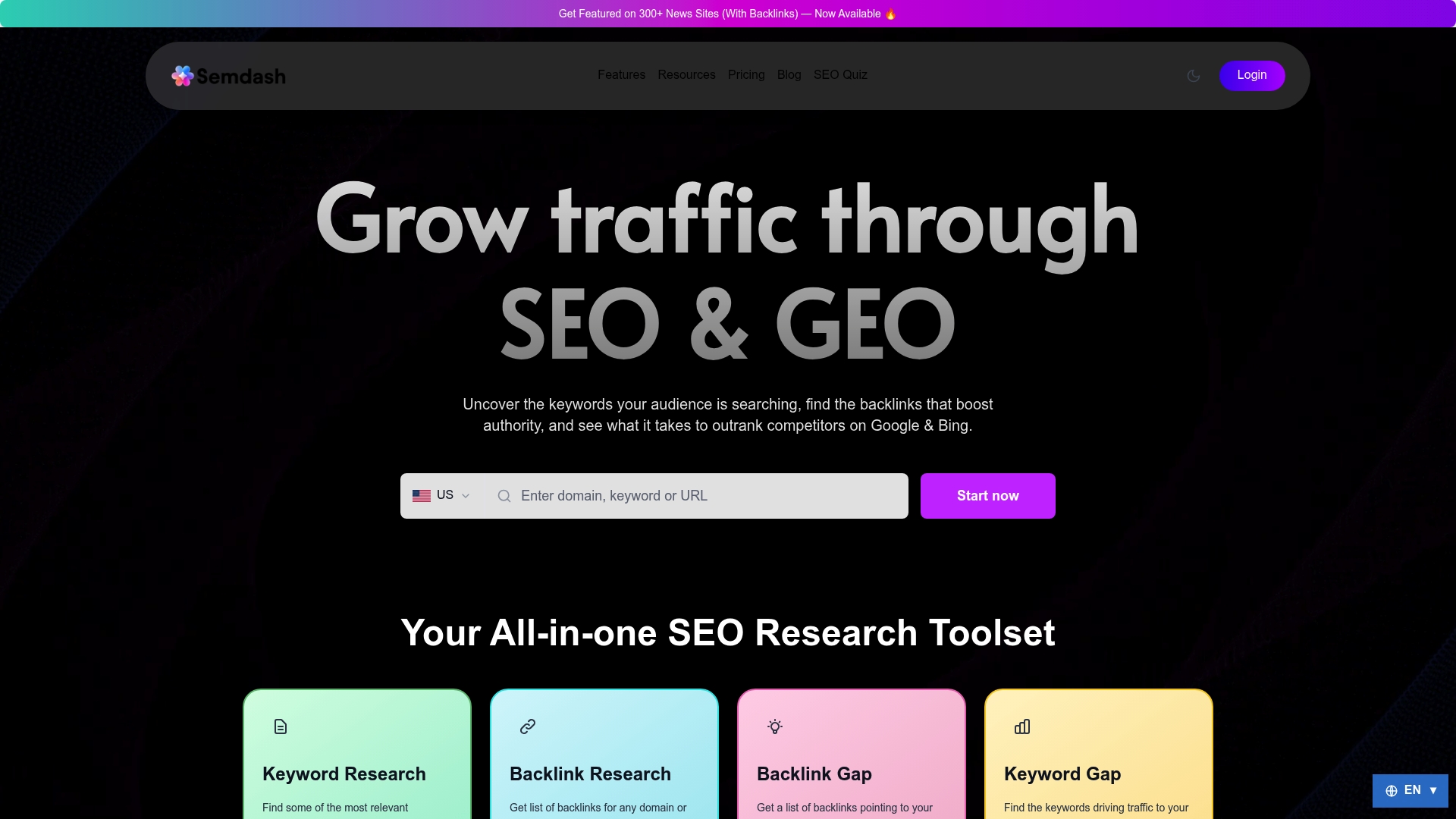
Semdash’s backlink research tool pulls a competitor’s full referring-domain profile so you can isolate broken-backlink opportunities without manually crawling dozens of pages one at a time. Once you’ve built your prospect list, the same platform helps confirm domain authority and traffic signals during vetting, so you’re not guessing which sites deserve your outreach hour. Pair that with keyword research to find the content gaps worth building replacement pages for, and you’ve got prospecting, vetting, and content planning running from one interface instead of three disconnected tools.
Run your first broken-backlinks export on a top competitor today and see how many live opportunities surface in minutes. Start a Semdash trial and turn that list into your next outreach batch.
Sources
For deeper tactical detail, Backlinko’s guide to broken link building covers prospecting mechanics in depth. Search Engine Land’s coverage of AI search explains how entity signals now shape link value. For reconstructing dead pages, Archive.org’s Wayback Machine remains the standard reference tool, and Backlink Diversity in SaaS SEO offers additional strategic context on diversifying link sources.
- How AI search is reshaping link building strategy
- Broken Link Building: The Complete Guide
- Broken Link Building: The Complete Step-by-Step Guide (2026 Edition)
- Wayback Machine
FAQ
What Is Broken Link Building?
Broken link building is the practice of finding dead outbound links on other websites and pitching your own relevant, live page as the replacement, earning you a backlink while fixing the site owner’s broken link.
What Is an Example of a Broken Link?
A resource page linking to a guide that now returns a 404 error is a broken link; you’d offer your own current guide on that same topic as the replacement.
Is Link Building Illegal?
No, link building itself isn’t illegal; it becomes a problem only when it violates Google’s spam policies, such as buying links purely to manipulate rankings, which can trigger a manual penalty rather than any legal consequence.
Why Is Broken Link Building Considered an Effective SEO Strategy?
It converts well because it’s value-first outreach that solves a real problem for the site owner, and response rates commonly fall between 15% and 30% with strong conversion once an editor replies. Tools like Semdash’s backlink research feature make finding these opportunities at scale far faster than manual crawling.