%20(1)-B86R08ZzwhPzS6UZbG3mSxRWPCwGwn.png)



Most international SEO audits still ask the wrong first question: “Are the hreflang tags present?” That check matters, but a passing result doesn't prove that the right page matches the right market, earns local trust, or appears in the search experiences users regularly use. I've seen technically tidy international sites underperform because translated pages target the wrong intent, country versions compete with one another, or a regional page has no authority outside the company's home market.
A reliable international SEO audit has to connect three layers: technical delivery, market-level relevance, and visibility behavior. That means crawling every localized URL relationship, comparing performance by country and language, testing native search intent, reviewing regional authority, and checking how AI-mediated search surfaces different versions. The audit isn't a compliance exercise. It's a diagnosis of whether each market can discover, understand, trust, and choose the correct version of the site.
Table of Contents
- Why Most International SEO Audits Miss the Real Problems
- Validating Hreflang Graph Integrity at Scale
- Segmenting Performance by Market and Language
- Mapping Localized Search Intent Across Markets
- Evaluating Regional Authority and Content Quality
- Building a Prioritized Audit Report
Why Most International SEO Audits Miss the Real Problems
A hreflang validator can tell you that annotations exist. It can't tell you whether the German page uses the language users search, whether the UK page reflects local buying expectations, or whether the US version is attracting queries that belong to another country. That distinction is where many audits fail.
Google removed the International Targeting report from Search Console on September 22, 2022. Auditors could no longer rely on Google's built-in validator and had to crawl and verify hreflang across HTML head elements, HTTP headers, and XML sitemaps themselves. Patrick Stox's explanation of the hreflang audit shift also captures the broader change: international SEO moved from a platform-assisted task toward a crawler-driven diagnostic process.
That technical shift exposed a larger problem. Teams often treat indexation as proof of success. A page can be indexed and still rank for the wrong country, attract poor clicks, fail to answer local intent, or be ignored by an AI-generated answer that selects another regional source. Indexation tells me that a search engine knows about a URL. It doesn't tell me that the URL is trusted or useful for the market it targets.
Translation is not market relevance
A direct translation preserves words, not necessarily demand. Searchers in different countries may use different product terms, spellings, units, regulatory language, and comparison criteria. Even markets that share a language can divide around commercial intent. A translated title can be grammatically correct while still missing the phrase that local users type.
I audit this by comparing the page's primary topic with country-specific query clusters, ranking URLs, SERP features, and competitor pages. If the local page ranks for informational queries but competitors win the commercial variations, the problem may not be technical. The content may be answering the wrong version of the need.
Recent 2026 commentary from GA Agency's analysis of international SEO argues that architectural clarity, native content, and regional authority matter more than machine translation or geographic shortcuts. I treat that as a useful operating principle, not a replacement for crawl data. A technically correct setup can still underperform when the site lacks market-scoped relevance signals.
Practical rule: A healthy international site should pass both tests. Search engines must understand which URL belongs to each locale, and users in that locale must recognize the page as written for them.
The same issue affects international SEO services. Before hiring support, I'd ask whether the provider audits market intent, regional SERPs, and authority alongside hreflang. AY Rank's international SEO services is a relevant example of the broader service category, but the deliverable still needs to show how technical findings connect to individual market outcomes.
Validating Hreflang Graph Integrity at Scale
I don't audit hreflang by checking a handful of pages. I treat the implementation as a directed graph. Each localized URL is a node, and every valid alternate relationship is an edge. A complete cluster should include the expected language and regional versions, self-reference each URL, point to valid alternates, and receive reciprocal references in return.
The scale is justified. A BrightonSEO 2023 study cited by Patrick Stox examined 374,756 domains and found that 67% of domains using hreflang had at least one error. SiteGuru's hreflang resource provides the same large-sample benchmark. Hreflang errors are routine audit findings, not unusual edge cases.
Configure the crawler for relationships, not just status codes
I start with a crawl that renders HTML when necessary, extracts <link rel="alternate" hreflang="..."> elements from the HTML head, reads hreflang from HTTP headers, and ingests XML sitemaps separately. The three locations matter because a site may implement annotations in one place and maintain stale or contradictory versions in another.
The crawler should also retain:
- Canonical target: Record the canonical URL for every localized page and compare it with the hreflang URL.
- Response status: Flag alternates that redirect, return errors, require authentication, or resolve to a non-indexable destination.
- Robots and indexability: Check whether each alternate can be crawled and indexed.
- Locale code: Validate the language and region syntax rather than accepting any arbitrary label.
- Cluster membership: Group every URL that claims to belong to the same alternate set.
Google's documentation specifies one ISO 639-1 language code, optionally followed by an ISO 3166-1 Alpha 2 region code, separated by a dash. Google Search Central's localized versions guidance is the reference I use for code validation. A malformed value can undermine targeting even when the page itself is perfectly translated.
Validate the graph in a fixed sequence
First, check self-referencing hreflang. Each URL should identify itself as the version for its own locale. Then check reciprocity. If the French page points to the German page, the German page needs to point back to the French page. Fakti Digital's hreflang mistake guide explains why missing return tags make a set unreliable.
Next, compare every alternate against its canonical. A page that declares itself canonical to the US version while advertising itself as the UK version creates a direct conflict. I also check x-default, which should lead users without a clearly matched language or region to an intentional fallback, not to an arbitrary homepage.
A benchmark-style analysis cited by Patrick Stox found 31.02% of sites had conflicting hreflang directives, 16.04% lacked self-references, 47.95% didn't use x-default, and 8.91% used unknown language codes. The international SEO audit workflow gives those figures and supports a full-graph approach rather than spot checks.
Finally, rerun the crawl after fixes. I don't close the issue when a developer changes the template. I verify the rendered output, sitemap entries, canonical targets, reciprocal links, and representative clusters across every market. A fix in one template can leave legacy URLs, product variants, or CMS-generated pages broken elsewhere.
Segmenting Performance by Market and Language
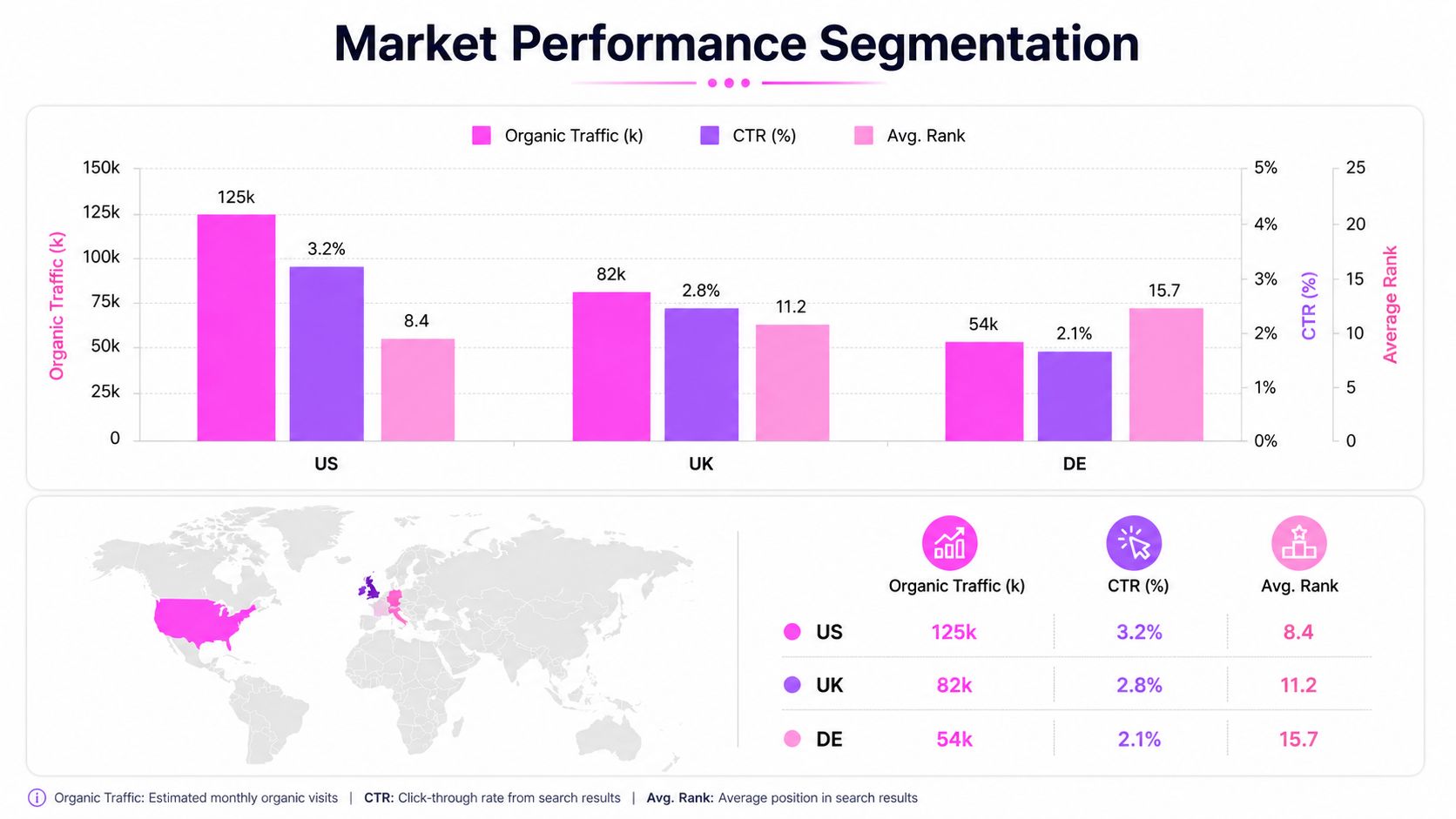
Global averages conceal market-level failures. I segment Search Console data by country and language, then compare each market with its own historical baseline. A market with fewer clicks may be performing well for its available demand, while a large market can look healthy overall even when the wrong regional URL receives the impressions.
I export queries, clicks, impressions, CTR, and average position by country, then join those records to the exact ranking URL. Average position alone is too coarse. The URL shows whether the intended localized page is competing, or whether another regional variant has entered the results.
Separate serving errors from relevance problems
I use four diagnostic patterns:
| Observation | Likely interpretation | Next check |
|---|---|---|
| The wrong country URL ranks | Variant-serving or architecture problem | Hreflang reciprocity, canonicals, redirects, internal links |
| The right URL ranks but CTR is weak | Snippet, intent, or trust problem | Local title, SERP language, offer, brand recognition |
| The right URL ranks and CTR is reasonable but conversions lag | Experience or commercial mismatch | Currency, delivery, legal terms, forms, local proof |
| Multiple regional URLs alternate for the same query | Cannibalization or weak clustering | Canonical alignment, internal linking, page purpose |
A CTR gap combined with confirmed variant-serving errors deserves priority. The searcher may be seeing the wrong regional page, rather than rejecting the correct one. SearchSEO's hreflang and CTR discussion supports comparing Search Console performance with a full hreflang crawl instead of treating either dataset in isolation.
I inspect query groups manually after the initial export. If a UK query repeatedly returns the US page, I verify that the UK page is indexable, internally linked, canonically preferred, and included in the correct regional cluster. If the UK page ranks but its snippet uses unfamiliar terminology, the investigation shifts to localization quality. Changing technical tags will not fix a market relevance problem.
Build a market evidence sheet
For each country and language combination, I maintain one evidence sheet containing:
- Demand: Queries and topic clusters generating impressions.
- Visibility: Ranking URL and position patterns.
- Engagement: CTR compared with that market's baseline.
- Coverage: Indexed pages and pages receiving impressions.
- Quality signals: SERP language, local terminology, and competitor framing.
- Commercial outcome: Leads, sales, or assisted actions where tracking is reliable.
I avoid a universal CTR target. SERP layouts, brand strength, query intent, and local expectations vary by market. The useful test is whether a page is anomalous within its own market and whether the crawl provides a credible explanation.
Hreflang can also correlate with user-behavior changes. A reported 20% bounce-rate reduction on multilingual sites, cited by SearchSEO, is supporting context rather than a forecast. The audit still needs to identify the affected market, URL, query pattern, and behavior before assigning a fix.
Mapping Localized Search Intent Across Markets
I've rejected many “localized” pages that were linguistically accurate but commercially irrelevant. The fastest way to expose that problem is to map intent independently in every target market instead of translating one master keyword list.
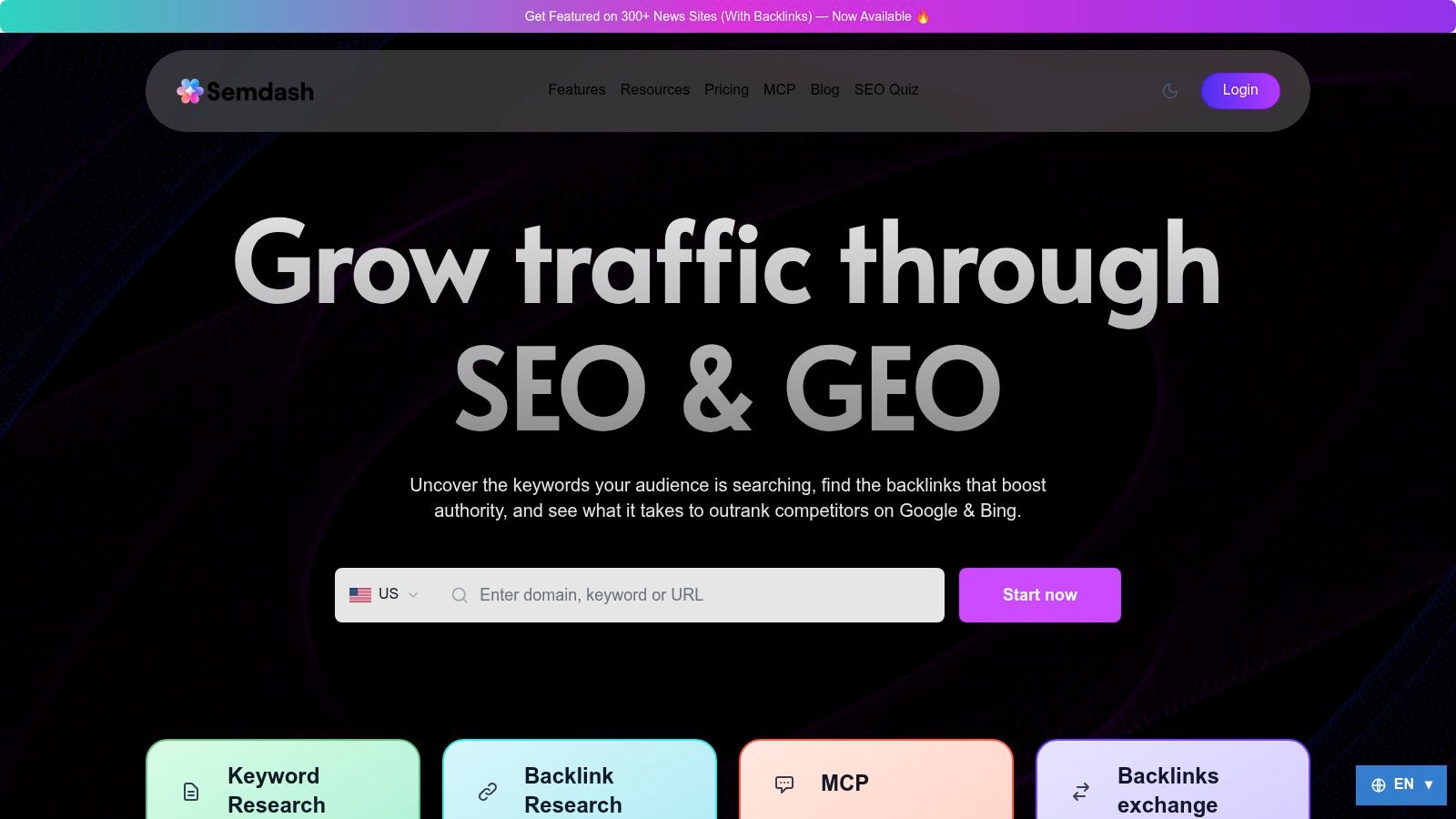
I use SemDash's 6.6B-keyword database to investigate country-specific demand, with interfaces available in English, German, Polish, and Spanish. I start with the seed topic, select the target country and language, and collect the primary terms, long-tail variations, People Also Ask questions, and People Also Search suggestions. Those are not interchangeable lists. They reveal how users frame the same need at different stages of the journey.
Turn query differences into page decisions
I don't automatically create a page for every keyword. I compare the live SERPs and group terms by the page type that consistently satisfies them. A product query may require a category page in one market, while a comparison query may deserve an editorial guide in another. When both markets need the same page type, I map the terms to the corresponding localized URL. When the intent differs, I document why the architecture should diverge.
SemDash's keyword types guide helps structure that research around informational, navigational, commercial, and transactional intent. I then use keyword clustering to group close variants into page-level topics. This reduces the temptation to publish several near-identical regional pages that compete with one another.
A keyword gap is useful only when I understand its reason. A competitor may rank for a local term because it has a dedicated landing page, local links, stronger product availability, or content written around a regional question. The gap report identifies what to investigate. It doesn't prove that copying the competitor's page will work.
Review localization with native judgment
I ask a native speaker or market specialist to review more than grammar. They should assess product terminology, spelling, currency references, legal expectations, examples, calls to action, and whether the page sounds like a local company rather than a translated headquarters page.
Automation can accelerate production, and resources covering automated i18n for global growth can help teams think through localization workflows. I still keep human review in the audit because a translation system can't reliably decide whether a local query implies a different product, service model, or buying concern.
After mapping the clusters, I test each localized page against the actual SERP. I look for mismatched headings, missing question coverage, untranslated structured elements, and competitor pages that satisfy the intent more directly. Then I connect those findings to performance data. A page with strong local demand, impressions, and weak CTR may need a localized title and offer. A page with no impressions may need a different topic, stronger authority, or a technical correction.
This is also where I test AI-mediated search. I query representative prompts in each language and country setting, record the cited URLs, and note whether the system selects the correct regional version. Results can vary, so I treat the exercise as a visibility sample rather than a permanent benchmark.
Evaluating Regional Authority and Content Quality
A localized page can be technically flawless and still look unconvincing in its market. I've found that regional authority often explains why an otherwise sound country section trails competitors. The page may have no meaningful mentions from local publications, industry organizations, partners, or community sites, while competing pages accumulate references that make their market relevance easier to establish.
I review backlinks by country and by destination URL. A global domain with links concentrated in one home market doesn't automatically transfer equivalent authority to every regional folder or subdomain. I want to know whether local sites link to the specific country pages that need visibility.
SemDash's 2.7T-link index supports this type of backlink research, including referring domains, linked pages, and anchor context. Its Backlink Gap report can identify domains that link to competitors in a target region but not to the audited site. I use that output as a prospecting list, then manually qualify the sites for relevance, editorial standards, and genuine regional connection.
Score authority alongside page quality
I keep separate scores for technical eligibility, local relevance, content quality, and regional authority. The point isn't to produce a magical composite number. The point is to prevent a strong technical score from hiding a weak market position.
| Audit layer | Questions I ask |
|---|---|
| Technical eligibility | Can the intended URL be crawled, indexed, canonicalized, and associated with its alternates? |
| Intent alignment | Does the page answer the query pattern users in that market express? |
| Native quality | Does the copy use natural terminology and locally credible examples? |
| Regional authority | Do relevant local domains reference this market's pages? |
| SERP behavior | Does the correct version appear in ordinary and AI-mediated search results? |
Content review needs evidence, not a vague “sounds translated” comment. I compare the page with local competitors and ask whether it includes market-specific pricing logic, delivery information, regulations, customer proof, support language, and decision criteria. If the offer differs by country, the page should explain that difference instead of presenting a translated global template.
For referring-domain analysis, I use the distinction explained in SemDash's guide to referring domains. A referring domain is not the same as a raw link count, and a large number of links from one domain shouldn't be mistaken for broad local endorsement.
Regional authority building also has trade-offs. A local link is useful when it's editorially relevant and earned through a legitimate relationship. Broad outreach for any domain that contains a country code can create noise and may attract links that don't support the page's actual topic. I'd rather build a smaller, relevant set of market connections than inflate a report with geographically convenient but contextually weak placements.
Building a Prioritized Audit Report
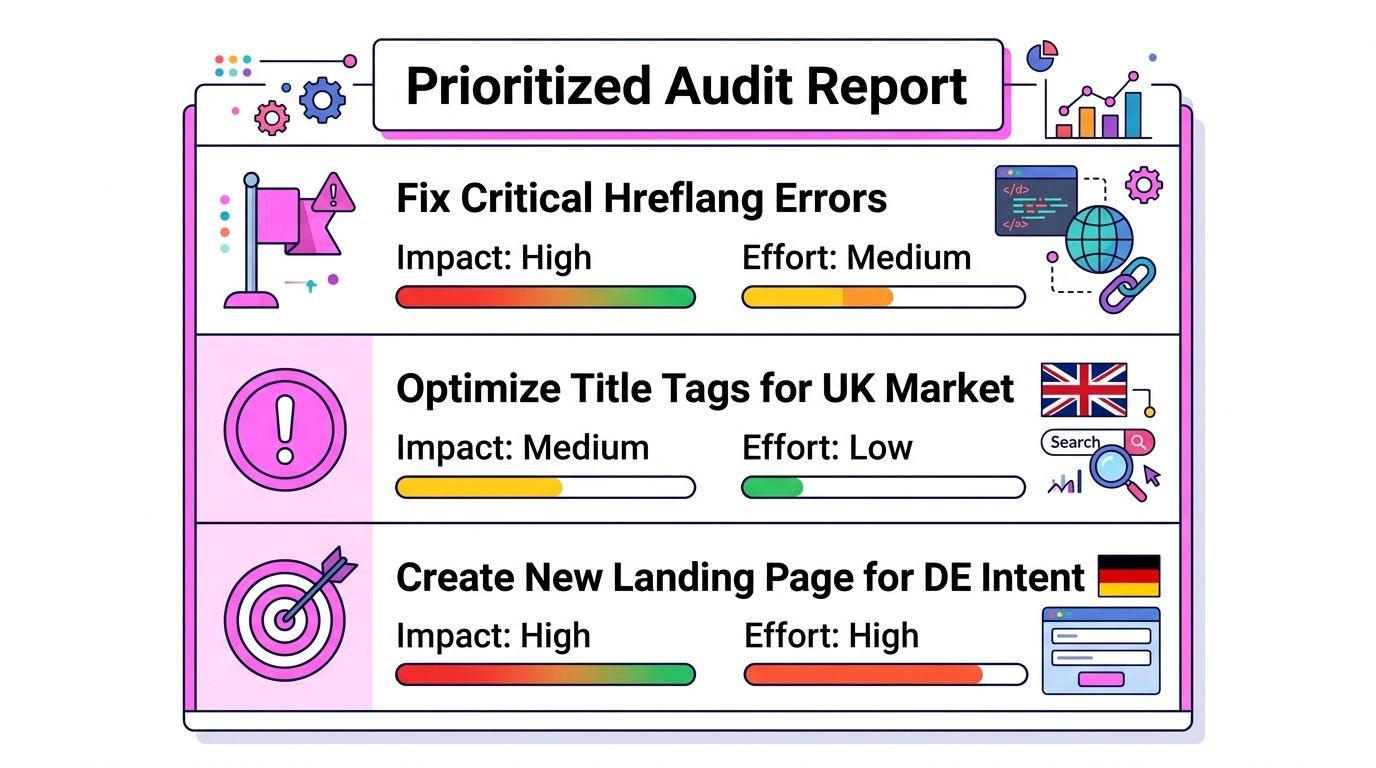
An audit report fails when it lists technical severity instead of business consequence. A broken hreflang tag on a low-demand archive page shouldn't outrank a wrong regional URL serving a high-value product query. I rank issues by market exposure, affected page importance, confidence in diagnosis, implementation effort, and commercial consequence.
The executive summary should fit on a page. For each market, I state the intended architecture, the main visibility problem, the evidence supporting it, and the decision required. Stakeholders need to know whether they should fix templates, revise content, consolidate pages, invest in local authority, or change the market plan.
Use a fix sequence that protects evidence
I normally sequence work like this:
- Stabilize the URL graph. Fix invalid alternates, missing return tags, canonical conflicts, blocked destinations, and incorrect locale codes. Don't optimize copy while search engines are receiving contradictory version signals.
- Correct the served page. Resolve redirects, internal-link mistakes, and template rules that send users or crawlers to the wrong country version.
- Repair market intent. Rework titles, headings, content structure, terminology, and page types based on country-specific query and SERP evidence.
- Fill genuine gaps. Create a new landing page only when the market has a distinct intent that existing URLs can't satisfy without cannibalization.
- Build regional authority. Use competitor backlink gaps to identify relevant local publications, associations, partners, and resources.
- Retest and monitor. Recrawl the affected clusters, inspect ranking URLs, and compare market-level performance after implementation.
I separate critical, high-priority, and opportunistic findings, but I define those labels by impact. Critical issues include a wrong page serving for important market queries or a canonical structure that consolidates the wrong regional version. High-priority work includes missing reciprocity and clear intent mismatches. Opportunistic work includes content expansion and authority opportunities where the technical and relevance foundations are already stable.
Each recommendation gets an owner, affected URL pattern, market, implementation note, validation method, and dependency. I avoid promising a precise traffic lift because the evidence rarely supports one before the fix. Instead, I estimate impact qualitatively and show the signals that justify the estimate, such as impressions, ranking URL mismatches, CTR anomalies, or competitor coverage.
Reporting standard: Every issue should answer five questions. What is broken, where is it happening, why does it matter, what should change, and how will we verify the fix?
The best reports also include a “do not change” list. That protects stable country sections from broad template edits based on one market's problem. International sites are interconnected, but they aren't identical. A fix that helps one locale can create duplicate intent, remove useful local content, or redirect users incorrectly elsewhere.
SemDash brings keyword discovery, URL-level ranking analysis, keyword clustering, backlink gap research, and SERP monitoring into one workspace for international SEO audits. Use the SemDash platform to compare market demand, identify the exact pages competitors rank with, and turn localized technical and content findings into a prioritized action plan.