%20(1)-B86R08ZzwhPzS6UZbG3mSxRWPCwGwn.png)


Competitive Content Analysis: A Cluster-First Playbook

A competitive content analysis delivers one thing: a prioritized cluster map and matching briefs, ready to move into production. Skip the spreadsheet-hoarding phase. The output that matters is a ranked list of topic clusters, each scored for volume potential, competitive difficulty, and strategic fit, with a pillar page and supporting posts assigned to every cluster you decide to build.
Your immediate next action is to export a keyword footprint from three to five competitors and run it against your own domain to isolate what Semdash calls “true gaps.” That single export is where the real work starts, and semantic keyword clustering turns the raw list into something you can actually plan against.
Before you export anything, gather three inputs:
- A target SERP list covering your 15 to 30 highest-priority topics
- A ranked-keyword export for each competitor domain (positions 1 to 20)
- Filtering rules to strip branded, navigational, and irrelevant queries before clustering
Key Takeaways
A competitive content analysis works when gap keywords get grouped into scored clusters and executed on a 90-day production cycle, not left as an unranked list.
| Point | Details |
|---|---|
| Start with true gaps | Isolate keywords where your domain has zero presence in the top 100, not just weak rankings. |
| Cluster before you brief | Group gap keywords into 5 to 15 topic clusters anchored by one pillar page each. |
| Score on three axes | Rank clusters by volume potential, competitive difficulty, and strategic fit before committing resources. |
| Audit for beatability | Use a 0 to 3 rubric across depth, format, angle, freshness, evidence, and linking to spot realistic targets. |
| Repeat every 90 days | Rerun the analysis quarterly with monthly checks so the cluster map doesn’t go stale. |
| Use Semdash for the technical steps | Its keyword exports, content-gap research, semantic clustering, and backlink discovery cover Steps 2 through 5 in one interface. |
What Is Competitive Content Analysis?
Competitive content analysis is the process of comparing your content footprint against competitors ranking in your target SERPs to find topic clusters they own and you don’t. It differs from a content audit, which evaluates your own existing pages for quality and performance, and from standard keyword research, which starts from search volume rather than from what rivals have already proven can rank.
Three events should trigger the exercise; for a more detailed approach, see Analyzing Competitor Content for Winning SEO Strategies:
- Traffic decline. Rankings slip and you need to know whether a competitor published a stronger cluster or simply refreshed an old post.
- A new product or service launch. You need a content foundation before the first campaign runs.
- A strategic pivot. The business moves into a new vertical or audience segment and has no existing footprint to lean on.
Run it well and you get two outcomes worth the effort: measurably stronger topical authority in the niches you target, and traffic that converts better because it’s matched to intent rather than assembled around volume alone. That second point separates this from vanity keyword chasing. A content gap analysis that ignores intent produces traffic that bounces.
Why Cluster Gaps Matter More Than Keyword Counts in 2026
AI-scale publishing has flooded most SERPs with competent, similar answers to the same questions. When five competitors all produce a 1,500-word overview of the same topic, ranking on keyword count alone stops working. The gap that remains open is angle: a narrower audience, an unusual data point, or first-hand experience none of the shallow entries include.
The shift that matters: analysis focused on intent-fit and freshness now outperforms raw keyword-count approaches, because saturated SERPs reward the post that answers the specific question a searcher has, not the post that covers the most subtopics.
Format matters as much as angle. A comparison query wants a table; a “how to” query wants numbered steps; a definitional query wants a direct answer in the first 100 words. Get the format wrong and depth won’t save you. Freshness compounds this: clusters updated on a predictable schedule tend to hold rank longer than one-and-done pillar pages, because they signal ongoing coverage rather than a single attempt.
How to Run a Competitive Content Analysis Step by Step
This is the sequence. Follow it in order, because each step filters the input for the next one, and skipping ahead produces noisy clusters that waste production budget.
Step 1: Build a 4 to 8 competitor list
Split your list into two categories before you export anything. Business competitors are the companies you compete with for customers. SERP competitors are the domains that outrank you for your target terms, and they’re often not the same companies. A regional service business might compete for customers against three local rivals, but lose SERP visibility to national directories and review aggregators that never come up in a sales conversation. Analyze both, but keep them labeled separately, because the production specs you’ll need to beat a national directory look nothing like the specs needed to beat a local competitor.
Step 2: Export keyword footprints and strip the noise
Pull ranked keywords for positions 1 through 20 from each competitor domain using a competitor research tool. Position 20 is the cutoff because anything beyond it rarely reflects deliberate content strategy. Once exported, remove branded queries (their company name plus modifiers) and navigational queries (login pages, careers, store locators). These inflate the footprint without representing content opportunity, and if you skip this filter you’ll waste an afternoon clustering keywords that were never meant to compete for organic informational traffic.
Step 3: Isolate true gaps
Cross-reference the filtered competitor keyword list against your own domain’s rankings. A true gap is a keyword where your domain has zero presence in the top 100, not just a lower position. Keywords where you already rank on page two are optimization opportunities, not gaps. Keep those two buckets separate. Conflating them is the single most common mistake teams make at this stage, because it leads to briefing new articles for topics that already have a page that just needs a rewrite.
Step 4: Group gap keywords into 5 to 15 clusters
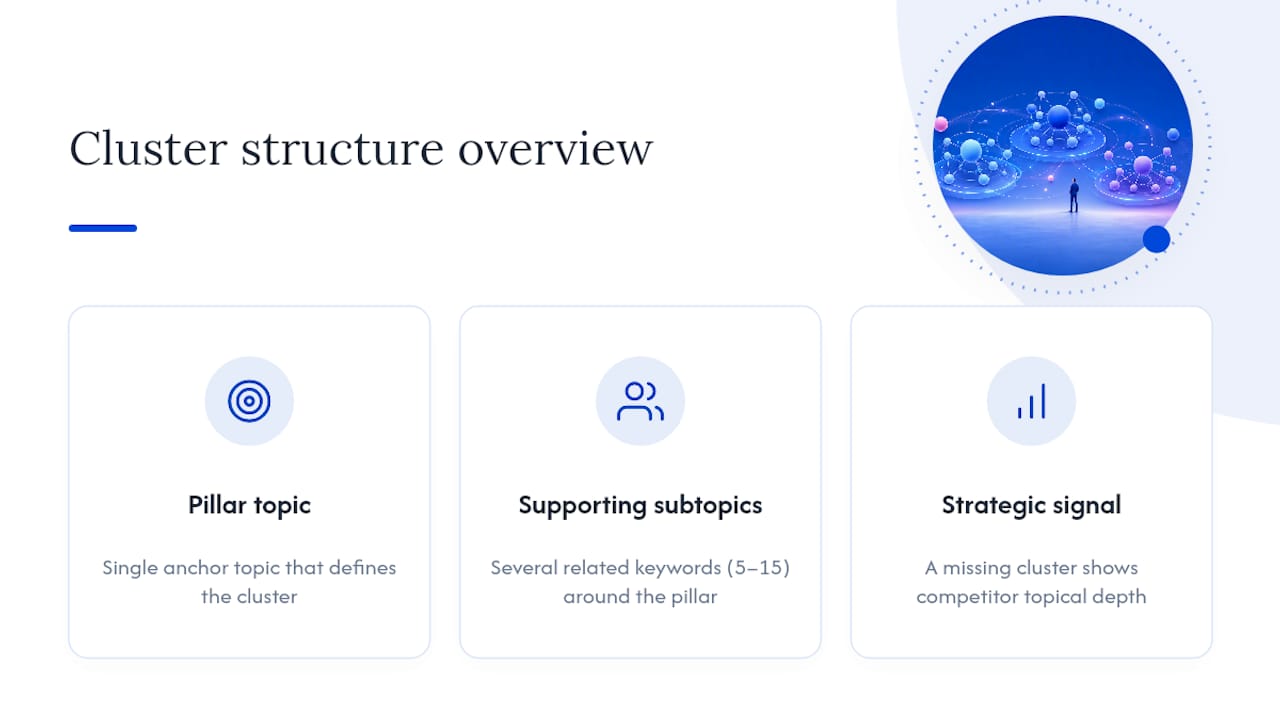
This is where the analysis becomes a plan instead of a list. Related terms sharing a common searcher intent group into a cluster of 5 to 15 keywords, anchored by one pillar topic and several supporting subtopics. A missing cluster is a bigger strategic signal than any single missing keyword. It tells you the competitor built topical depth in an area where you have none, and closing it takes a coordinated pillar-plus-supporting-post plan, not one blog post squeezed in between other priorities.
Step 5: Set production specs from top-ranking pages
For each cluster, open the top three ranking pages and reverse-engineer their specs: word count, format (list, guide, comparison, tool), media used (screenshots, video, calculators), and internal linking depth. Training resources on gap-driven content strategy recommend translating these signals directly into a production brief, including structural targets like H2 count and image density. Don’t copy the top page. Match its baseline, then add the one thing it’s missing, whether that’s a case study, an original data point, or a narrower angle for a specific reader segment.
Pro Tip: When the top three ranking pages are already comprehensive and hard to out-produce, don’t try to out-write them. Narrow the angle instead, targeting a specific segment like “for five-person marketing teams with no dedicated SEO hire.” Specificity routinely faces weaker competition than broad coverage, even on well-covered topics.
How to Audit Competitor Content and Score It
Reading a competitor’s top-ranking page tells you whether it’s actually beatable. Work through the same checklist every time so scores stay comparable across a whole cluster:
- Depth: Does it answer follow-up questions or stop at the surface?
- Format: Does the format match what the SERP is already rewarding?
- Angle: Is there a distinct point of view, or is it generic coverage?
- Freshness: When was it last updated, and does it show?
- Evidence: Original data, screenshots, or examples versus recycled claims.
- Internal linking: Does it sit inside a visible topic cluster on the competitor’s site?
- UX and structure: Scannable headers, table of contents, logical flow.
Score each dimension 0 to 3, where 0 means absent and 3 means executed well. A cluster averaging under 1.5 across competitor pages is a strong production target: you can likely outrank it with standard effort. A cluster averaging 2.5 or higher needs a genuine differentiator, not just more words. Authority still counts here, too: pages holding the top position typically carry a stronger backlink profile than pages sitting lower on the same SERP, so a high content score paired with a thin backlink profile is often your most realistic opening.
Once you have a score, convert it directly into a production spec. A depth score of 1 means your brief calls for the missing subtopics by name. A freshness score of 0 means your content calendar schedules a refresh at month four, not month twelve.
How to Prioritize Clusters and Build an Editorial Plan
Not every gap deserves a pillar page. Score each cluster on three dimensions before committing production resources: volume potential (aggregate search demand across the cluster’s keywords), competitive difficulty (the audit scores from the previous step), and strategic fit (how closely the cluster maps to what you actually sell). A scoring model weighing these three factors keeps teams from chasing high-volume clusters that have nothing to do with the business.

Plot clusters on a simple quadrant: high strategic fit paired with low competitive difficulty is your early-win bucket, and it should fill the next production cycle first. High fit paired with high difficulty goes on the roadmap but gets a longer timeline and a bigger resource envelope. Low fit clusters get dropped regardless of volume.
Sequencing follows a fixed pattern once priority is set:
- Build the pillar page first; it defines the cluster’s core terminology and anchors internal links.
- Publish supporting posts second, each targeting one subtopic and linking back to the pillar.
- Link supporting posts to each other where the subtopics naturally connect, not just up to the pillar.
A resourcing rule of thumb: a pillar cluster typically needs one long-form pillar page, one supporting data piece or case study, and two to four supporting posts to reach competitive depth.
How to Execute: Briefs, KPIs, and Cadence
Standardize the brief before the first writer touches a cluster. A workable template needs seven fields:
- Target intent (informational, comparison, transactional)
- Primary and supporting keywords from the cluster
- Format (guide, comparison table, tool page, checklist)
- Call to action
- Internal links in and out
- Owner
- Due date
KPIs should match content type instead of defaulting to traffic alone. Track visibility (rankings, impressions) for top-of-funnel pieces, engagement (time on page, scroll depth) for mid-funnel guides, and conversions plus assisted backlinks for bottom-funnel and pillar pages.
Run the full cycle every 90 days, with a lightweight monthly check for new competitor posts entering your priority SERPs. A quarterly cadence keeps the cluster map current without turning the process into a full-time job, since most SERPs don’t shift dramatically inside a single month.
How Semdash Fits Into This Workflow
Every step above maps to a specific tool rather than a generic capability. Semdash’s feature set covers the technical backbone of the process:
- Keyword and SERP exports for building the competitor footprint in Step 2
- Content-gap research for isolating true gaps in Step 3
- Semantic clustering for grouping gap keywords into topic clusters in Step 4
- Backlink discovery for scoring authority during the audit in Step 5
- SERP tracking to monitor cluster performance once content ships
Leonid, who covers SEO strategy and tooling for Semdash, built this playbook around a pattern seen across dozens of content programs: teams that treat competitive analysis as a recurring, cluster-scored process outperform teams that run it once and file the results away. The SERP analysis guidance referenced throughout this piece reflects that same operational bias, toward structured, repeatable steps over one-off audits.
Why Cluster Discipline Beats Tool Collection
Most teams treat competitive content analysis as a research phase, something you do once before a content calendar gets built and never revisit. That’s the conventional approach, and it’s the reason so many gap analyses produce a spreadsheet nobody acts on six months later. The research holds up here: prioritized, scored clusters get built; unscored keyword lists get shelved.
The advice worth pushing back on is the idea that more tools or more data produce better output. They don’t. A team with a modest keyword export and a disciplined scoring rubric will out-execute a team drowning in six overlapping SEO platforms and no clustering logic. The bottleneck was never data volume. It was always the translation step, turning a gap list into a pillar-and-supporting-post plan with a due date attached.
If you take one thing from this piece, make it the 90-day cadence. A single analysis ages fast in a SERP landscape where competitors publish constantly. Build the review into your calendar before you build the first brief, or the whole exercise becomes a one-time event instead of the operating rhythm it’s meant to be.
— Leonid
Get the Data Your Cluster Plan Actually Needs
Running this workflow by hand across five competitor domains and dozens of clusters eats a full week before you write a single brief. Semdash compresses that into a single interface built for exactly this sequence: export keyword footprints, filter true gaps, cluster them semantically, and check backlink authority on the pages you’re trying to beat, all without stitching together exports from four separate tools.
That matters most for teams without a dedicated data analyst on staff, agencies juggling multiple client accounts, and in-house marketers who need a cluster map by Friday, not by the end of the quarter. Semdash’s competitor analysis tool handles the SERP export and gap isolation directly, while the keyword research module turns the output into scored clusters ready for a brief. Pair it with the backlink research tool to score competitor authority during your audit step. Start a Semdash trial and run your first true-gap export against three competitor domains this week.
Sources
- Competitive Content Analysis: Reverse-Engineer Your Rivals
- Seozilla
- Content Gap Analysis Framework for B2B SEO
- MarketMuse training and resources
FAQ
What Is Competitive Content Analysis?
It’s the process of comparing your content footprint against competitors ranking in your target searches to find topic clusters they cover and you don’t, then converting those gaps into a prioritized production plan.
What Are the 4 P’s of Competitive Analysis?
Definitions vary across marketing disciplines, so there’s no single agreed-upon “4 P’s” specific to competitive content analysis. Most practical frameworks instead score gaps on volume, difficulty, and strategic fit, as covered in the prioritization step above.
What Are the 5 Steps of a Competitive Analysis?
Build a competitor list, export and filter their keyword footprints, isolate true gaps, group those gaps into topic clusters, and set production specs by auditing the top-ranking pages for each cluster.
What Is Comparative Content Analysis?
It’s a close synonym for competitive content analysis, referring specifically to the side-by-side comparison of content depth, format, and structure between your pages and a competitor’s on the same topic.
How Often Should You Run a Content Gap Analysis?
Run a full analysis every 90 days, with a lighter monthly check for new competitor content entering your priority search results, since SERPs shift gradually rather than overnight.