%20(1)-B86R08ZzwhPzS6UZbG3mSxRWPCwGwn.png)


Most SEO competitive intelligence advice starts with the wrong deliverable: a quarterly competitor export. A spreadsheet showing who ranks today won't tell you whether a rival is building a durable topic cluster, testing new URLs, accumulating relevant links, or earning visibility inside AI-generated answers. By the time the report reaches an editorial meeting, the SERP may have moved on.
I treat competitive intelligence as a longitudinal operating system for SEO. It connects competitor behavior to page briefs, refresh decisions, outreach targets, and SERP feature opportunities. Historical competitor datasets now extend month to month back to January 2012 across keyword overlap, organic rankings, estimated traffic, and competitor positioning in markets including the U.S., U.K., Canada, Australia, France, Italy, Germany, Spain, and Brazil, as documented in this gap analysis guide. That history lets me investigate how an advantage was assembled, not merely observe who has it.
Table of Contents
- What SEO Competitive Intelligence Really Is
- The Gap Analysis Framework That Drives Decisions
- Key Metrics I Track and the Thresholds That Matter
- A Real Workflow Running Competitive Intelligence
- Why AI Overviews Change the Whole Game
- Putting It All Together Into a Weekly Routine
What SEO Competitive Intelligence Really Is
SEO competitive intelligence is a continuous feedback system, not a one-time audit. A gap report is useful only when it changes what someone does next. If a competitor appears for an important cluster and your site doesn't, the output should become a page decision. If several rivals earn links from the same relevant publication, it should become an outreach decision. If a competitor's URL wins a citation in an AI Overview, it should become a content-format and entity-consistency decision.
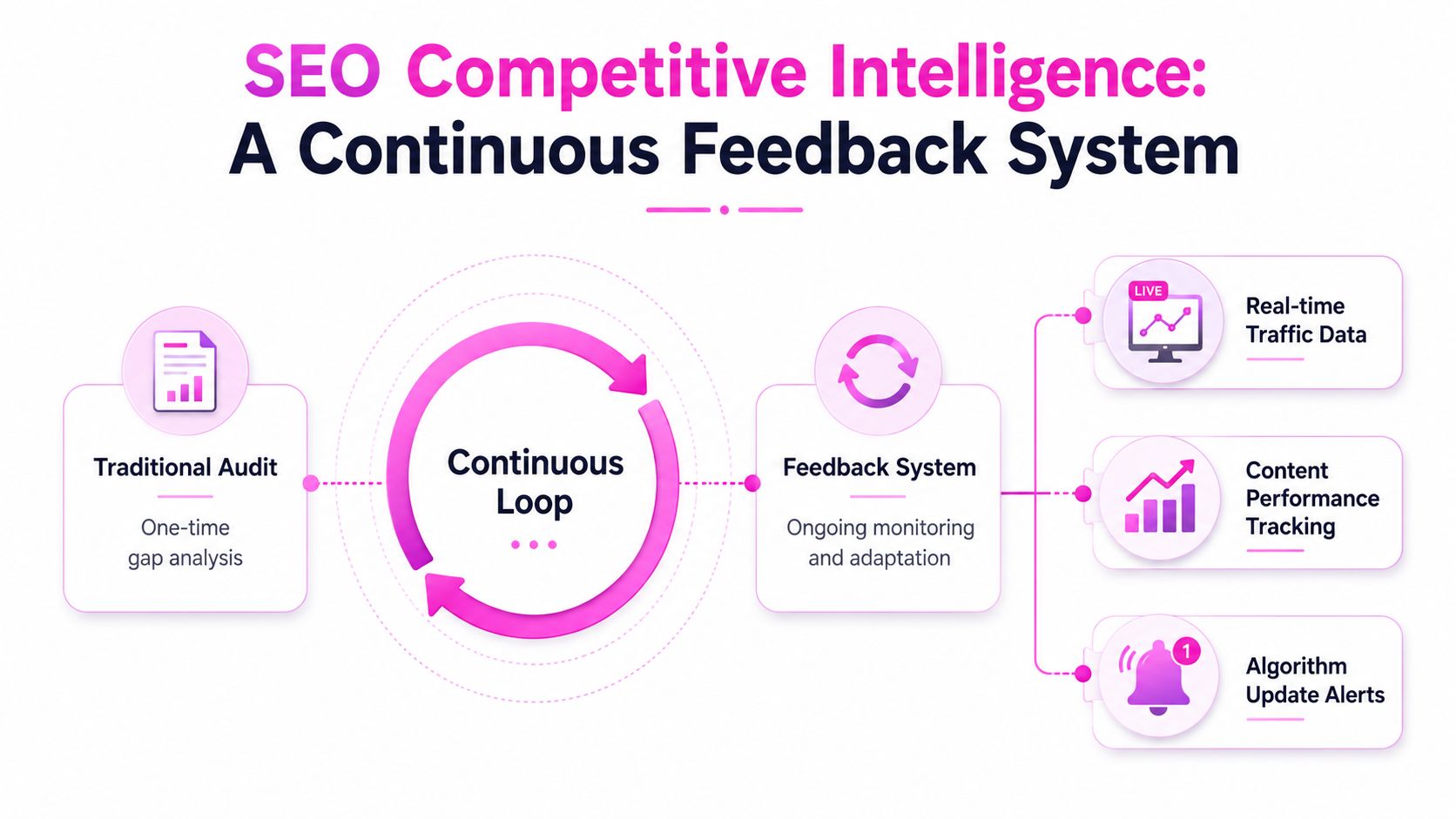
Stop treating the SERP as a photograph
The common workflow is familiar. Someone identifies a few competitors, exports keywords and backlinks, adds a chart to a deck, and revisits the same exercise months later. That process produces plenty of data but weak timing. It misses the difference between a stable content advantage and a temporary ranking fluctuation.
A rival's movement is a signal, but the signal needs context. A new content cluster, a change in internal linking, a concentrated link campaign, or a URL migration can produce very different outcomes. I want to know which exact page moved, which intent group changed, whether other competitors moved too, and whether the movement persisted.
SERP analytics makes this especially clear. Only 16.5% of ranking positions kept the same URL over a two-week period, according to independent SERP volatility research. A domain-level average can look steady while the actual page serving a query changes underneath it. That's why I map keywords to URLs and monitor movement at the query level.
Make every observation operational
My working definition is simple:
Practical rule: No competitor insight leaves the analysis queue without an owner, a proposed URL, and a decision date.
The decision might be to create a page, improve an existing page, pursue a referring domain, defend a ranking, or ignore the opportunity because the SERP is too unstable. AI Overview citations belong in the same system. For informational queries, a competitor can gain exposure even when classic rankings barely change, so citation presence, cited URL, and topic-level citation share deserve their own tracking field.
Teams that need a broader audit foundation can use this SEO audit guide from AI Website Detector alongside competitive analysis. I use resources like that for baseline checks, but the competitive layer still needs recurring monitoring tied to execution.
The Gap Analysis Framework That Drives Decisions
I use two primary pillars, keyword gap analysis and backlink gap analysis, then add URL mapping and intent classification before making a recommendation. The point isn't to collect every missing term or every competitor link. The point is to identify a small queue of opportunities that the team can execute.
Pillar one is the keyword gap
Start with the domains that compete for your commercial searches, then add SERP competitors that win informational queries. Compare the terms where competitors rank strongly against your own keyword footprint. I separate the results into three groups:
- Absent coverage: Competitors rank in the top 10, while your domain has no meaningful ranking presence. These terms may require a new page.
- Weak coverage: You rank, but a competitor owns a stronger position or a better-matched URL. These usually become refresh, consolidation, or internal-linking tasks.
- Intent mismatch: Your domain ranks with a blog post for a transactional query, or with a product page for an informational query. The issue isn't always missing content. Sometimes the wrong page is serving the searcher.
I then group terms into page-level clusters. A raw keyword list encourages teams to create too many overlapping URLs, which creates cannibalization and makes later performance analysis harder. The winning unit is usually the cluster-to-page decision, not the individual keyword.
For each cluster, I record the leading competitor URLs, the intent, the content format, the strength of the competing pages, and the business action. A term with attractive relevance but an entrenched SERP may belong in a longer-term plan. A cluster where several competitors have shallow coverage may deserve immediate attention.
Pillar two is the backlink gap
The backlink gap asks a different question: which relevant domains link to competitors but not to you? I prioritize domains linking to multiple competitors, because repeated support suggests topical relevance or an established editorial relationship. I still inspect the actual referring pages, anchor context, link placement, and whether my site has a credible asset to offer.
A backlink gap isn't an automatic outreach list. Low-relevance directories, syndicated pages, and weak sites create noise. The useful output is a ranked set of prospects with a reason to contact each one, such as a missing resource, a broken reference, an unlinked mention, or a data point your content can improve.
Before exporting, attach an action to every row. A content gap needs a target URL and brief. A weak existing page needs a refresh hypothesis. A link gap needs a prospect, pitch angle, and owner. This content gap analysis workflow is useful for structuring that transition from comparison to production.
| Gap Type | Signal | Threshold | Action |
|---|---|---|---|
| Keyword | Competitor ranks, your site doesn't | Top 10 competitor result with relevant intent | Create or assign a target page |
| Keyword | Your URL ranks below the best-matched competitors | Clear intent match and meaningful business value | Refresh, consolidate, or improve internal links |
| Backlink | A relevant domain links to multiple competitors | Repeated competitor support with a credible asset fit | Add to an outreach queue |
| URL | Competitor pages change while average visibility stays stable | Material query-level movement | Track the exact URLs before reacting |
| Citation | Competitor URL appears in an AI Overview | Repeated presence across a topic cluster | Improve extractability and citation eligibility |
The framework fails when the team celebrates the report instead of assigning the work. A gap is only strategically valuable when it becomes a decision.
Key Metrics I Track and the Thresholds That Matter
Metrics become useful when they tell me whether to act, investigate, or wait. I don't want a dashboard full of movement without a clear response. These are the thresholds I use as operating rules, not as universal laws.
Traffic share sets the competitive context
I calculate non-branded organic traffic share by dividing my site's non-branded organic visits by the category leader's. I track the ratio monthly, because a single month can reflect seasonality, publishing timing, or a temporary ranking event.
A gap above 3x means I'm in catch-up mode. I need to focus on structural coverage, the strongest commercial clusters, and the pages most likely to change business outcomes. A gap below 1.5x means the fight is local. I can investigate specific pages, links, intent mismatches, and SERP features instead of rebuilding the entire content system.
Share of voice is a useful companion to this view. Transactional LLC's SOV strategy provides helpful context for connecting visibility measurement to competitive positioning, but I still segment branded and non-branded terms before drawing conclusions.
The keyword gap ratio exposes structural weakness
The keyword gap ratio is the number of terms where competitors rank in the top 10 and you don't, divided by your total ranking keywords. Above 25% signals a structural content deficit. I don't respond by publishing pages for every missing term. I look for repeated clusters, commercial relevance, intent consistency, and a realistic path to compete.
A high ratio across one topic suggests a topical blind spot. A high ratio across many topics suggests a broader information architecture or authority problem. Those require different roadmaps.
Backlink quality matters more than the raw count
For backlink gaps, I weigh referring domains by domain rating and relevance. Anything below DR 30 is noise for this decision model unless the site has unusual topical value or a strong audience fit. A competitor having more links doesn't automatically mean I need more links. I want to know whether the missing domains support the exact pages that rank, whether those links are editorially earned, and whether my content gives the publisher a reason to cite it.
SERP volatility tells me when not to overreact
I track week-over-week movement across my top 50 commercial keywords. Sustained volatility above 4 positions usually means an algorithm shift or a competitor push. I check whether movement affects multiple sites, one topic cluster, or one URL before changing a page.
| Metric | What It Measures | Watch Threshold | Act Threshold |
|---|---|---|---|
| Traffic share | Your non-branded organic visits relative to the category leader | Gap between 1.5x and 3x | Gap above 3x |
| Keyword gap ratio | Missing competitor top-10 terms as a share of your ranking terms | Rising toward 25% | Above 25% |
| Backlink gap | Relevant referring domains competitors have that you don't | DR 30 and below | Prioritize stronger, relevant domains |
| SERP volatility | Week-over-week movement on top commercial terms | Movement below 4 positions | Sustained movement above 4 positions |
| AI citation share | Your cited URLs relative to competitors for informational queries | Isolated citation changes | Repeated competitor citation dominance |
For AI Overview queries, I add citation share as a fifth metric. It isn't a substitute for traffic, but where generated answers occupy attention, it gives me a more direct view of source visibility than a blue-link position alone.
A Real Workflow Running Competitive Intelligence
I start a client engagement by defining five competitors across two tiers. The first tier contains direct product competitors. The second contains SERP competitors that win informational queries but may not sell the same product. Leaving out the second tier hides the publishers that shape topic expectations and earn citations.
Kickoff inputs determine the quality of the analysis
I collect the client's priority markets, non-branded conversion themes, existing URL inventory, known product categories, and current technical constraints. Then I select seed URLs from both the client and competitors. For each competitor, I use 5 to 10 seed URLs in SemDash to ground the analysis in the pages that compete, rather than relying only on domain-wide averages.
The keyword gap comes first. I classify terms by intent, map each term to its ranking URL, and group related queries into page-level clusters. I then layer the backlink gap, filtering the initial review to referring domains above DR 40. That filter isn't a claim that lower-rated domains never matter. It keeps the first pass focused when the team has limited outreach capacity.
Outliers reveal page-level opportunities
One pattern I look for is a competitor winning 20% or more of its traffic share from a single page. That outlier deserves manual inspection. It may reveal an unusually well-matched landing page, a strong internal-link position, a narrowly defined use case, or a content asset that attracts links across several related queries.
I don't copy the page. I break down its search intent, section structure, evidence, internal links, conversion path, and cited sources, then write a brief for a stronger or more appropriate resource. If the competitor page ranks for several intents, I decide whether one page should cover them or whether the client needs a clearer cluster.
The best competitor page isn't a template. It's a diagnostic sample.
Authority deltas determine the delivery horizon
At the first checkpoint, I divide opportunities into 90-day work and 12-month work. The shorter horizon contains pages with close authority conditions, clear intent, manageable content depth, and a realistic internal-linking or outreach path. The longer horizon contains broad commercial terms dominated by materially stronger domains, topics requiring several supporting pages, or opportunities dependent on sustained authority building.
I export the keyword and backlink findings into a shared sheet, but the sheet isn't the deliverable. The deliverable is a prioritized queue with a target URL, action type, owner, deadline, and reason the opportunity is winnable.
| Stage | Input | Tool | Decision Rule |
|---|---|---|---|
| Competitor selection | Product rivals and SERP publishers | Search results and domain review | Keep both commercial and informational competitors |
| Keyword discovery | 5 to 10 seed URLs per competitor | SemDash keyword gap analysis | Group terms by intent and target URL |
| Link discovery | Competitor referring domains | Backlink gap analysis | Start with relevant domains above DR 40 |
| Outlier review | Pages with concentrated traffic share | Top Pages and URL-level analysis | Turn unusual winners into page briefs |
| Prioritization | Authority, intent, content depth, resources | Shared action sheet | Separate 90-day wins from 12-month investments |
| Execution | Approved briefs and prospects | Editorial and outreach workflow | Assign an owner and due date to every gap |
What failed in earlier versions of this workflow was exporting too early. A large file creates the illusion of progress. I now force the strategic decisions before the export, while the evidence is still visible and the team can challenge the assumptions.
Why AI Overviews Change the Whole Game
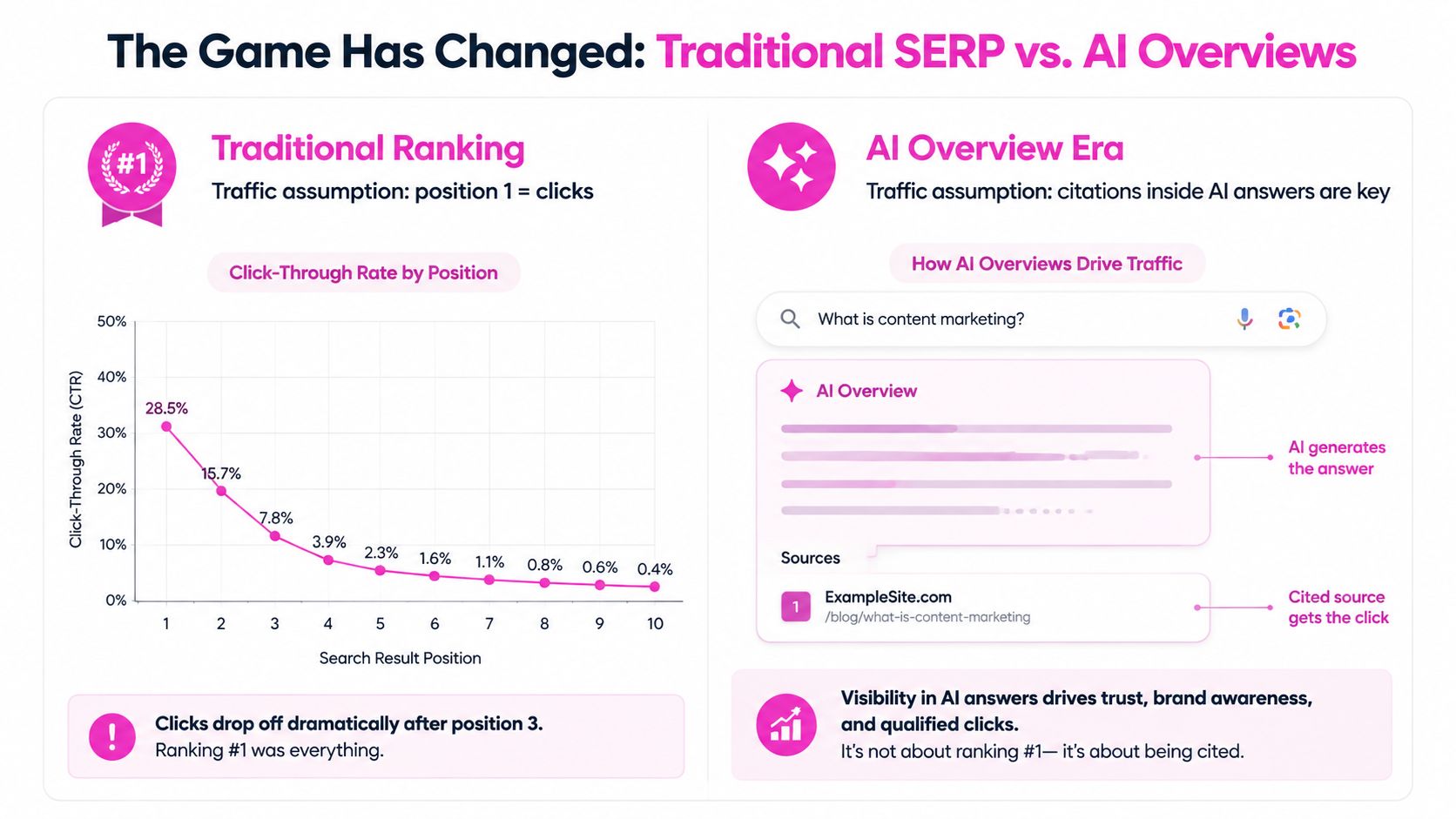
AI Overviews broke the simple assumption that position one equals the most valuable visibility. A page can rank well and still compete with a generated answer that satisfies part of the query before the searcher visits a result. At the same time, a page outside the classic first page can still appear as a cited source.
The pattern is not hypothetical. One Semrush-based study found AI Overviews on 6.49% of keywords in January 2025, near 25% in July, and 15.69% in November, while the query mix shifted from 91.3% informational in January to 57.1% by October as commercial and navigational triggers increased. The same AI Overviews study also reported a 61% CTR decline for informational queries when AI Overviews were present, while another analysis found zero-click behavior didn't always worsen and sometimes improved slightly for the same keywords after AI Overviews appeared. The practical conclusion is that CTR effects vary by query, so I measure citation presence rather than assuming every overview produces the same traffic loss.
Citation gaps need their own audit
I track three fields beside classic rankings:
- Cited URL: Which exact page supplies the source.
- Topic citation share: How often each competitor appears across the tracked cluster.
- Mention type: Whether the answer references a brand, product, definition, comparison, or supporting evidence.
The citation mix proves why domain averages aren't enough. A large AI Overview citation study found 76.10% of cited pages ranked in Google's top 10, 9.50% ranked in positions 11 to 100, and 14.40% didn't rank in the top 100 at all, according to Ahrefs' AI citation analysis. Another analysis reported that 97% of AI Overviews cited at least one source from the top 20 organic results, as detailed by seoClarity's research. Classic rankings remain a major input, but they don't fully explain citation visibility.
A separate study of 1,000 AI Overviews found an average of 4.2 citations per overview, with a range of 2 to 9. Only 8% cited more than 7 domains, and the median was 4, according to this citation pattern study. I optimize to become one of the clearly useful sources, not to produce vague coverage across every possible page.
Optimize for extractable evidence
I put the direct answer, definition, comparison, or proof near the top of the page. One study found 55% of AI Overview citations came from the top 30% of page content, compared with 24% from the middle 30% to 60% and 21% from the bottom 40%, as reported in CXL's citation-source analysis. That supports concise answer blocks, clear headings, structured comparisons, consistent entities, and supporting evidence that a system can interpret without hunting through the page.
I use SemDash's AI Overview Checker to inspect which tracked keywords trigger domain mentions and which exact URLs receive citations. Rank tracking alone won't expose that layer.
The tactical trade-off is real. You shouldn't flatten every page into a short answer just to become extractable. Strong pages still need depth, original explanation, useful internal links, and a reason to visit. I place the answer high, then earn the click with detail the overview can't fully replace.
Putting It All Together Into a Weekly Routine
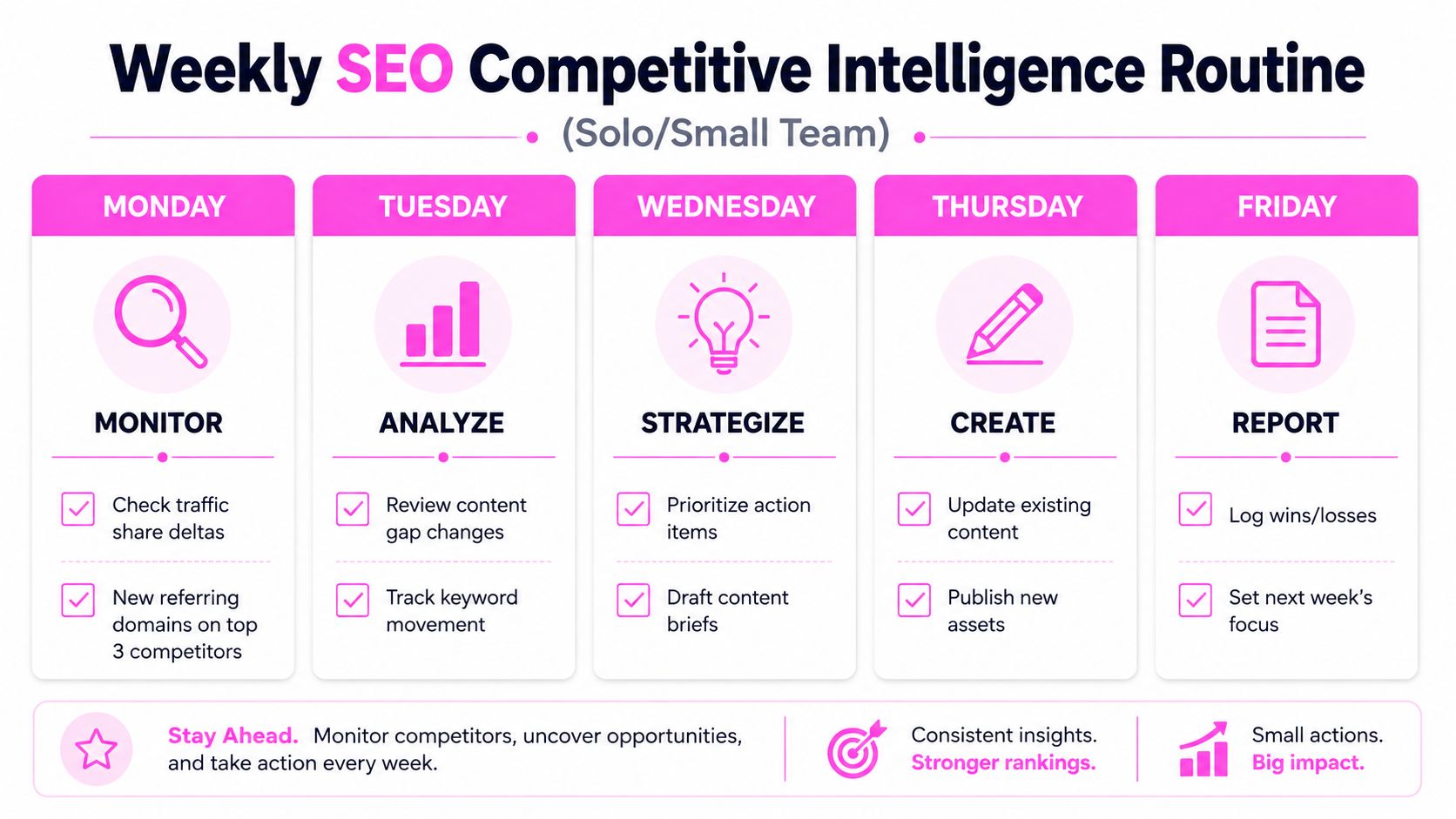
A small team doesn't need a full competitive audit every day. It needs a short monitoring loop that catches meaningful changes and turns them into assigned work. I keep daily checking limited to the highest-value terms and the competitors most likely to affect the current roadmap.
Monday is for monitoring
I check traffic share deltas, new referring domains on the top three competitors, and SERP volatility for the ten highest-value keywords. I'm not looking for a reason to change strategy every week. I'm looking for an unusual movement that deserves investigation.
A competitor gaining visibility across one cluster is more actionable than a small change scattered across unrelated terms. A new referring domain is useful only when the linked page, context, and relevance suggest a repeatable opportunity.
Wednesday is for refreshing the gaps
I rerun keyword and backlink gap pulls, compare new wins and losses, and flag pages that lost two or more positions. That loss threshold is a triage trigger, not proof of an algorithm update. I check the exact URL, intent, competing pages, and SERP composition before editing anything.
The Wednesday review also catches newly published competitor pages and changed ranking URLs. If the same competitor repeatedly appears with a new page for a cluster, I add the page to the content and internal-link review rather than treating every keyword as a separate threat.
Friday is for execution
Friday turns findings into tasks. Every item gets one line with the action, owner, target URL, and due date. A content gap becomes a brief. A ranking loss becomes a diagnostic ticket. A referring-domain opportunity becomes an outreach prospect with a specific asset and pitch angle.
| Day | Focus | Output |
|---|---|---|
| Monday | Monitor traffic share and competitor movement | Short list of anomalies |
| Tuesday | Review content gap changes and keyword movement | Validated signals |
| Wednesday | Prioritize opportunities and draft briefs | Approved action queue |
| Thursday | Update pages or publish assets | Completed execution |
| Friday | Log wins and losses | Next week's focus |
I synthesize AI Overview citation share monthly, because citation patterns need enough observations to distinguish a recurring source from a one-off answer. I reserve a deeper competitive review for the quarterly planning cycle, when I reassess the competitor set, topic clusters, authority differences, and the balance between 90-day opportunities and longer investments.
Operating principle: Weekly intelligence should reduce uncertainty, not create a new reporting ritual.
The system works when the loop stays small enough to run and strict enough to produce action. Start with your five most consequential competitors, the pages tied to your commercial priorities, and the informational clusters where AI-generated answers are already changing visibility. Use SemDash to connect keyword gaps, backlink intersections, URL-level SERP history, traffic-share views, and AI Overview citations in one research workflow, then turn the highest-confidence findings into assigned content and outreach tasks.