Earned Links: How to Build Natural Backlinks in 2026

Earned links are backlinks you receive because another site genuinely finds your content worth referencing — no payment, no direct request, no reciprocal arrangement. Also called natural or editorial links, they represent the purest signal of content quality that search engines recognize. Google’s algorithm treats them as votes of confidence: when an authoritative, topically relevant site links to yours without any incentive, that endorsement carries real weight in ranking decisions.
What makes earned links distinct from other backlink types:
- No transaction involved. The linking site chose to reference your content on its own editorial judgment.
- Contextual placement. They typically appear within body content, surrounded by related text, not in footers or sidebars.
- Natural anchor text. The link text reflects what the linking author actually wanted to say, not a keyword you negotiated.
- Topical alignment. The linking page and your page share subject matter relevance.
- Genuine referral potential. Because the link appears in context, readers of the linking site may actually click through.
In 2026, earned links also do something paid or self-created links cannot: they position your brand within entity-based knowledge graphs and AI ranking systems. Search engines and large language models increasingly interpret consistent editorial endorsements as signals of topical authority, not just domain authority. That shift makes the case for earning links stronger than it has ever been.
Why earned links matter more than any other link type
The SEO value of a backlink has never been purely about the link itself. It has always been about what the link signals. Earned links signal trust, relevance, and editorial judgment simultaneously, which is why they outperform paid placements and self-created directory submissions in every meaningful ranking metric.

Top-ranking pages consistently have significantly more referring domains than those ranked 4–10. That gap reflects not just quantity but the quality and diversity of sites willing to cite them. A page that earns links from varied, authoritative sources across its topic cluster tells Google something a page with purchased links from unrelated sites cannot.
Here is why the SEO community keeps returning to earned links as the foundation of any serious strategy:
- Algorithm resilience. Natural backlink profiles built through genuine content merit are far more resistant to Google penalties and manual actions than profiles padded with artificial links. When the next core update rolls out, sites with earned link profiles tend to hold or improve; sites relying on link schemes tend to drop.
- PageRank transfer. Dofollow editorial links pass PageRank from the source page to yours. When that source page has high authority, the transfer is meaningful and compounds over time as your own authority grows.
- Referral traffic. An earned link on a high-traffic industry publication does not just help rankings. It sends real visitors who are already interested in your topic, which improves engagement signals and can directly drive conversions.
- Brand context for AI systems. Backlinks now signal topical authority for AI overviews and large language models, not just for traditional search. Every editorial mention places your brand in a semantic neighborhood that AI systems use to understand what you are about.
- Long-term link stability. Paid links can be removed when contracts expire. Earned links, placed because the author found your content genuinely useful, tend to persist as long as the linking page exists.
The contrast with paid or self-created links is not subtle. Paid links require ongoing spend and carry penalty risk if Google identifies them. Self-created links in forums, comment sections, or low-quality directories contribute almost nothing to authority and can actively harm your profile if they accumulate in volume.

Key benefits of earning backlinks naturally
Shifting your link strategy toward natural acquisition produces compounding returns that transactional link building simply cannot replicate. These are the primary benefits, in order of SEO impact:
-
Higher authority transfer per link. One high-quality link from a relevant, authoritative source outweighs many low-quality links. The math is not linear — a single editorial placement on a domain with strong topical authority can move rankings more than dozens of directory submissions.
-
A backlink profile that survives algorithm updates. Google’s spam systems are designed to identify and devalue unnatural link patterns. A profile built on earned links looks exactly like what Google wants to reward: steady acquisition, diverse anchor text, varied referring domains, and topical coherence. That profile does not need to be cleaned up after every core update.
-
Referral traffic with genuine intent. Visitors who arrive via an editorial link on a relevant site are pre-qualified. They clicked because the context made your content look relevant to what they were already reading. That traffic converts at higher rates than cold organic traffic and sends positive engagement signals back to Google.
-
Brand trust and E-E-A-T reinforcement. When respected publications in your niche cite your work, it builds credibility with human readers and with Google’s quality evaluators. E-E-A-T (Experience, Expertise, Authoritativeness, Trustworthiness) is not just a checklist item — it is a framework Google uses to assess whether a site deserves to rank for competitive queries.
-
Contextual relevance signals for AI-driven search. As AI overviews and entity-based ranking become more prominent, the semantic context surrounding your earned links matters. A link embedded in a paragraph about your specific topic tells AI systems something precise about your brand’s area of authority.
-
Reduced long-term cost. Building a piece of original research or a genuinely useful tool requires upfront investment. But once that asset earns links, those links persist without ongoing spend. The cost-per-link drops toward zero over time, unlike paid placements that require continuous budget.
-
Compound authority growth. Each earned link increases the likelihood of earning the next one. As your domain authority grows, journalists and bloggers are more likely to find and cite your content, creating a self-reinforcing cycle that paid link strategies cannot replicate.
Practical strategies to earn links without paying for them
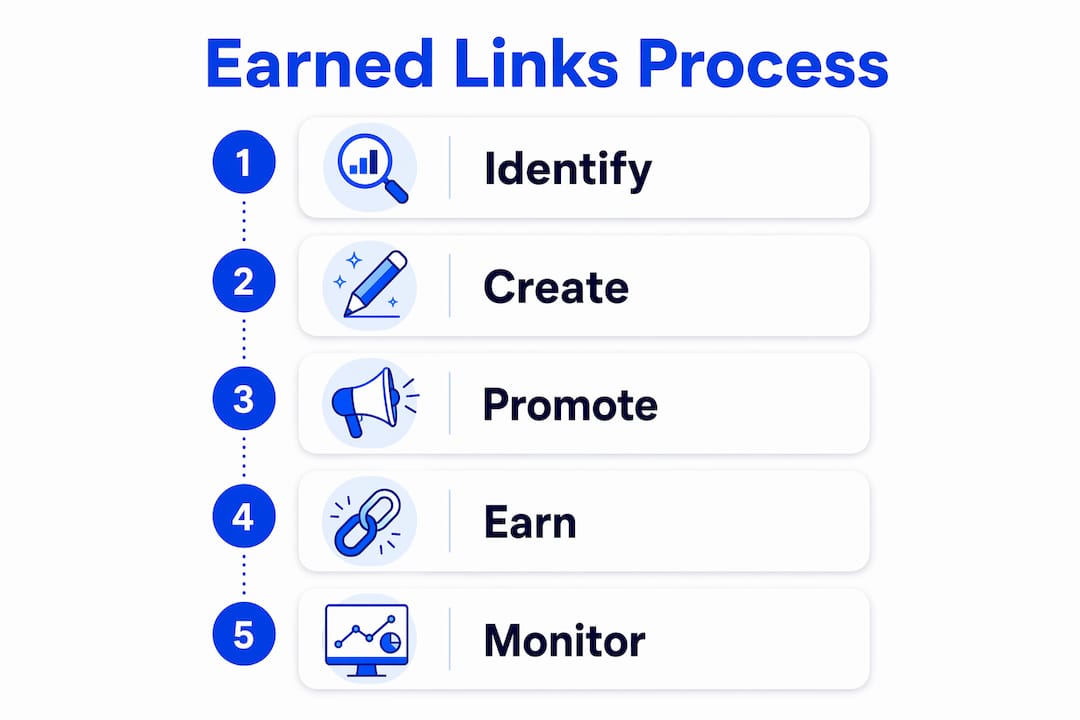
Earning links at scale is not passive. It requires deliberate content creation, strategic promotion, and consistent relationship-building. Successful link earning programs prioritize sustainable relationships and consistent, high-value content over rapid, transactional outreach. Here is how to build that system:
-
Create linkable assets. Original research, data studies, calculators, and comprehensive reference guides are the assets that earn the most links over time. Journalists and bloggers need data to support their arguments; if your site publishes that data, they cite you. A well-designed ROI calculator or an annual industry survey can accumulate links for years after publication. The key is filling a gap: produce something that does not already exist in your niche, or produce a substantially better version of what does.
-
Execute digital PR campaigns. Digital PR means getting your content, data, or expert commentary placed in publications your audience reads. Respond to journalist queries on platforms like HARO (Help a Reporter Out) or Qwoted with specific, original insights rather than generic commentary. Consistent, specific pitching to relevant reporter queries can result in authoritative editorial links and brand mentions that compound over time.
-
Publish guest content on authoritative sites. Guest posting on genuinely relevant, high-authority publications in your niche still works when done correctly. The distinction is intent: write to provide real value to the host site’s audience, not purely to place a link. A well-researched guest article on a respected industry blog earns the link and builds your brand’s credibility simultaneously.
-
Reclaim unlinked brand mentions. If someone mentions your brand, product, or content without linking to you, that is a warm outreach opportunity. Use a backlink tracking tool to monitor brand mentions across the web. When you find an unlinked mention, a brief, polite message to the author asking them to add a link converts at a high rate because the endorsement already exists.
-
Build broken link replacement campaigns. Find pages in your niche that link to dead URLs, create content that replaces what the dead page offered, and notify the linking site. This approach works because you are solving a problem for the webmaster, not asking for a favor.
-
Host webinars, events, and expert interviews. Industry webinars and live events generate links from attendees, sponsors, and industry publications covering the event. Upload recordings and create a permanent resource page for each event so the link-earning potential extends beyond the event date. Interview formats work similarly: the interviewee typically links to the published piece from their own site and social channels.
-
Develop topic cluster content that becomes the default reference. When you cover a subject comprehensively across a cluster of interlinked pages, your content becomes the go-to reference for that topic. Writers covering adjacent subjects naturally cite the most thorough resource available. This is the long game, but it produces the most durable earned links.
Pro Tip: Before launching any outreach, check whether your target publications have already linked to your content or mentioned your brand. Semdash’s backlink discovery feature surfaces these existing relationships, so you can prioritize warm contacts over cold ones and dramatically improve your response rate.
What actually makes a link “earned” and worth having?
Not every link you receive without paying for it is genuinely valuable. Understanding what separates a high-quality earned link from a weak or accidental one helps you focus your content strategy on assets that attract the right kind of attention.
A high-quality backlink in 2026 is defined by authority, topical relevance, placement within body content, and natural anchor text. Here is what that looks like in practice:
- Topical relevance. The linking page covers a subject closely related to your page. A link from a cybersecurity blog to your cybersecurity guide carries far more weight than a link from a general lifestyle site, even if the lifestyle site has higher overall traffic.
- Editorial placement in body text. Links embedded within the main content of a page, surrounded by relevant prose, carry more weight than links in sidebars, footers, or author bios. Google’s quality signals treat contextual placement as evidence of genuine editorial intent.
- Natural, varied anchor text. A natural backlink profile includes diverse anchor texts: branded terms, partial matches, generic phrases, and bare URLs. A profile where every link uses the same exact-match keyword phrase looks manufactured and can trigger algorithmic scrutiny.
- Domain authority and trustworthiness. The linking domain should have a clean history, genuine traffic, and real editorial standards. Links from sites that exist primarily to sell links, or from domains with more outgoing than incoming links, contribute little and can actively harm your profile.
- Dofollow status and indexation. The link should be crawlable by Google and not carry a nofollow or sponsored attribute. The linking page itself should be indexed and capable of earning organic traffic.
- Realistic link velocity. Earning a handful of strong links per month looks natural. Acquiring hundreds of links in a two-week window, regardless of quality, raises flags. Steady, consistent acquisition over time is what a genuinely authoritative site looks like.
- Absence of manipulative patterns. Link exchanges, private blog networks, and paid placements that are not disclosed violate Google’s spam policies. Even if individual links in these schemes look clean, the overall pattern is detectable and penalizable.
The practical test for any link you receive: would a knowledgeable editor at the linking publication have chosen to include that link on its own merits, without any prompting from you? If the honest answer is yes, it is an earned link worth having.
What current research says about earned link quality in 2026
The definition of link quality is shifting. Authority is no longer measured purely by the number of referring domains pointing at a site. Modern SEO focuses on Entity SEO, where brands build consistent signals across earned links, unlinked mentions, and topical associations to enhance relevance for both search engines and AI systems. A brand that appears repeatedly in editorial contexts related to its core topic builds a semantic footprint that influences rankings beyond what any single link can achieve.
This has a direct implication for how you think about your link earning strategy. Unlinked brand mentions, citations in AI-generated content, and consistent topical associations all contribute to the entity signals that modern search algorithms use. Earning links and earning mentions are increasingly two sides of the same coin.
Statistic callout: Top-ranking pages have on average 3.8 times more referring domains than pages ranked 4–10, but the quality and topical coherence of those domains matters as much as the count.
The practitioner consensus in 2026 aligns with what the research has been showing for several years: one well-placed editorial link from a genuinely authoritative, topically relevant source does more for your rankings than dozens of links from marginal sites. The SEO community’s shift away from volume-based link building toward quality-focused link earning reflects this reality.
Pro Tip: Use Semdash’s competitor analysis features to identify which content types in your niche attract the most referring domains. That data tells you exactly what kind of linkable assets your audience already wants to cite, before you invest in creating them.
What this means for your content calendar: prioritize depth and originality over frequency. A single original data study or comprehensive reference guide that earns 20 editorial links from relevant publications will outperform 50 thin articles that earn nothing. Long-term, consistent content quality and relationship-building consistently outperform short bursts of aggressive link acquisition for sustained SEO performance. That is not a philosophical preference; it is what the data on algorithm-resilient sites consistently shows.
The link building definition itself has expanded in this environment. Where it once meant acquiring hyperlinks, it now encompasses the full spectrum of editorial endorsements: links, mentions, citations in AI overviews, and topical associations in knowledge graphs. Earned links sit at the center of all of it.
Key Takeaways
Earned links are the most durable SEO asset you can build because they reflect genuine editorial endorsement, which search engines and AI systems are specifically designed to reward.
| Point | Details |
|---|---|
| Quality beats quantity | One high-quality editorial link from a relevant, authoritative source outweighs many low-quality links in SEO impact. |
| Natural profiles resist penalties | Backlink profiles built through genuine content merit are more resilient to Google algorithm updates and manual actions. |
| AI search amplifies link value | Earned links now position brands in entity-based knowledge graphs and AI ranking systems, beyond traditional PageRank transfer. |
| Linkable assets drive scale | Original research, tools, and comprehensive guides earn links passively over time, reducing long-term cost per link. |
| Diversity signals authenticity | A natural backlink profile includes varied anchor text, diverse referring domains, and steady acquisition velocity. |
FAQ
What is an earned link?
An earned link is a backlink another website gives you voluntarily because your content is genuinely useful or worth referencing, with no payment or direct request involved. These are also called natural or editorial links and are considered the highest-quality backlink type by search engines.
What are the three types of links in SEO?
The three main link types are earned links (editorially given without payment), built links (acquired through outreach, guest posting, or link exchanges), and self-created links (added manually to directories, forums, or comment sections). Earned links carry the most algorithmic weight because they reflect genuine editorial judgment.
Are backlinks still relevant in 2026?
Yes. Backlinks remain a core ranking signal in 2026, and top-ranking pages have on average 3.8 times more referring domains than pages ranked 4–10. Quality and topical relevance now matter more than raw link count, and earned links also contribute to entity signals that influence AI-driven search results.
Is buying backlinks illegal?
Buying backlinks is not illegal, but it violates Google’s spam policies and can result in algorithmic devaluation or a manual penalty that removes your site from search results. Paid links that are not disclosed with a nofollow or sponsored attribute are treated as an attempt to manipulate PageRank, which Google actively works to detect and penalize.
How do you start earning links if your site is new?
Start by creating one genuinely useful linkable asset, such as an original data study, a free tool, or a comprehensive reference guide on a topic your niche lacks. Promote it through relevant communities, respond to journalist queries with specific insights, and use a backlink tracking platform like Semdash to monitor who mentions or links to you so you can build on those early relationships.