%20(1)-B86R08ZzwhPzS6UZbG3mSxRWPCwGwn.png)



Most SEO teams think a gap analysis ends when they export competitor keywords. That's the part that creates the illusion of progress. A CSV can show thousands of differences between domains, but it can't tell you which gaps are commercially useful, technically feasible, or worth assigning to a writer, developer, or outreach specialist.
I've seen teams spend an entire planning cycle cleaning exports that never became published pages, internal links, or earned mentions. The useful deliverable isn't a spreadsheet full of differences. It's a defensible shortlist with a target, a diagnosis, an owner, a deadline, and a measurement plan.
Table of Contents
- Why a Gap Analysis Is Not the Export
- Freeze the Baseline and Define a Real Target
- Pulling a Keyword Gap That Tells You Something
- Finding Backlink Gaps Worth Pitching
- Prioritizing When the List Is Too Long
- Closing the Gap and Proving It Stuck
Why a Gap Analysis Is Not the Export
A gap analysis is a structured comparison between the current state and a defined future state. In SEO, that could mean comparing organic visibility with a target, keyword coverage with a relevant competitor, or referring domains with comparable businesses. The arithmetic is simple:
gap = desired performance − current performance
The difficult work begins after the export. I need to decide whether each difference represents a genuine opportunity, a tracking problem, an irrelevant query, or a target the business should ignore. A useful gap analysis ends with decisions, owners, and measures, not a large spreadsheet.

Three ways exports waste time
The first is choosing the wrong competitors. A large publisher may rank for thousands of terms unrelated to your commercial model. A marketplace may have far greater authority and a completely different conversion path. I select competitors using search overlap, audience, offer, and page type, rather than brand familiarity.
The second is treating search volume as business value. A broad informational query can attract attention without producing qualified leads. A narrower product or service query may support a page with a clear commercial role. Volume estimates demand. It does not establish usefulness.
The third is skipping the future state. Without a target, every keyword difference appears equally important, and the CSV becomes a queue nobody can defend. The gap-analysis workflow at Bacentric recommends establishing a baseline, defining a measurable desired state, diagnosing causes, creating an action plan, and conducting a follow-up assessment at 90 days. Published guidance on the five-stage gap-analysis workflow gives that sequence a practical shape. It also prevents a competitor's advantage from being treated as an automatic priority. Demand, ranking difficulty, content capacity, authority, and time still determine whether the opportunity can pay back.
The post-export test is simple: can the row be tied to a target, an action, an owner, and a review date? If not, it is still research.
Practical rule: If a row cannot answer “which target does this support, by when, and who owns the next action?”, it is not ready for prioritization.
I use a short audit example such as this praktinis SEO audito pavyzdys when aligning stakeholders on the evidence an SEO deliverable should contain. A useful report connects findings to pages, likely impact, and a specific action. It makes the next decision easier instead of forcing the team to search through an unfiltered export.
Freeze the Baseline and Define a Real Target
A gap analysis becomes useful before the competitor export. I first freeze the current state, choose one business objective, record its source and date, and agree on the result that would count as success. Possible objectives include organic traffic, non-brand conversions, organic revenue, or referring-domain growth. The right metric reflects the business constraint, not the number that looks strongest in a presentation.
A worked example shows the calculation. A site with 40,000 monthly organic visits and a target of 60,000 monthly organic visits has an absolute gap of 20,000 visits. The relative gap is 33.3% of the target, calculated as the difference divided by the target. This is a hypothetical 40,000-to-60,000-visit scenario that demonstrates the standard gap formula, not a forecast for every site.
The baseline worksheet I use
I lock these fields before collecting opportunities:
- Metric: The precise measure, such as monthly organic visits or non-brand trials.
- Current value: The observed baseline and its date.
- Target value: The intended result.
- Target date: The deadline that sets the planning horizon.
- Data source: Analytics, Search Console, a CRM, a backlink index, or another agreed system.
- Owner: One person responsible for moving or validating the metric.
- Confidence: High, medium, or low, based on data quality and definition clarity.
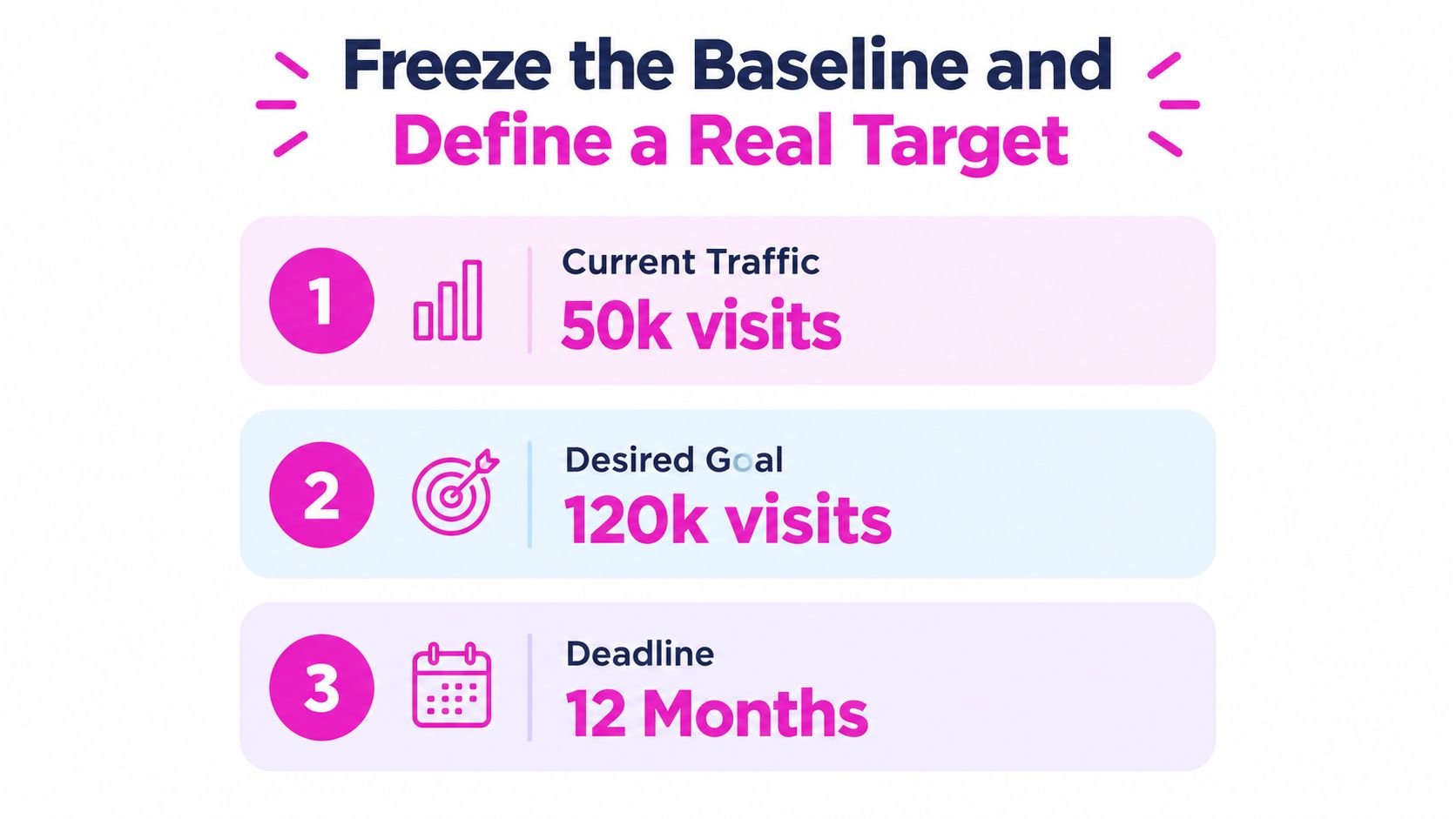
The target must be measurable and time-bound. “Improve visibility” cannot guide a decision because the team has no agreed finish line. “Increase qualified organic demand by the target date” is workable only after the team defines how qualified demand will be measured.
Record the assumption supporting the target as well. It may depend on new category pages launching, sales capacity remaining available, or a product line staying in market. If that assumption changes, the team can separate a performance gap from a definition gap instead of judging results against an obsolete plan.
This discipline prevents false precision. A reliable current number paired with an aspirational target nobody approved creates a tidy gap, not a decision-ready one. A project-management framework also recommends quantitative data, a SMART goal or OKR, root-cause analysis, owners, and deadlines in its practical gap-analysis process. Those controls make the later keyword list easier to defend, assign, ship, and review.
Pulling a Keyword Gap That Tells You Something
A keyword gap becomes useful only after the export is cut down to opportunities a team can serve. I compare the domain in SemDash with two to four genuine competitors, chosen for shared customers and search intent. A marketplace-led business or editorial publisher may reveal useful topics, but it should not automatically set the content agenda.
I review the results before exporting. Remove branded competitor terms, irrelevant informational queries, and rows where the competitor ranks with a forum, aggregator, or another format the site cannot realistically reproduce. A large reported difference often becomes a much smaller working set after cleanup. That reduction improves the decision because every retained row must support the target and have a credible route to publication or optimization.
The filters that change the decision
Four fields determine whether a row deserves attention:
- Intent: Classify the query as informational, commercial, transactional, navigational, or local. Intent points to the required page type, such as a guide, comparison, category page, service page, or local landing page.
- Keyword Difficulty: Treat difficulty as a feasibility signal. Compare it with the site's authority, topical coverage, available expertise, and ability to produce a stronger result.
- Ranking URL: The competitor's page shows whether the opportunity belongs on an existing page, a new page, or a broader topic hub.
- Ranking position: A relevant page ranking strongly demonstrates proven coverage. A weak ranking with partial relevance may indicate an incidental match rather than a priority.
| Keyword Gap Filter Pass | Why it matters | Action on the row |
|---|---|---|
| Intent | Keeps traffic ideas separate from commercial priorities | Keep, redirect to another queue, or exclude |
| Difficulty | Tests whether the opportunity fits available resources | Score feasibility |
| Ranking URL | Connects the query to a page-level decision | Map to an existing or new URL |
| Competitor position | Separates proven coverage from weak incidental visibility | Inspect the SERP before briefing |
I tag every retained row with intent, difficulty bucket, target URL, business value, and likely cause. The cause determines the work. Missing coverage may require a new page, while poor intent alignment, weak internal links, or an underperforming existing page calls for a different fix. A keyword with attractive volume but no credible business path belongs in a lower queue, not at the top of the roadmap.
The export is not the strategy. The strategy starts when each retained keyword has a page, a purpose, and a reason to exist.
Teams that want the workflow in plain language can use this keyword gap analysis guide. If the opportunity depends on improving the destination rather than publishing another article, Polish for conversion-ready landing pages can support that page work.
The deliverable is a working sheet that content, SEO, and product teams can assign and ship. I run this pass in SemDash because domain comparisons, ranking URLs, difficulty signals, clustering, and SERP context sit in one workspace.
Finding Backlink Gaps Worth Pitching
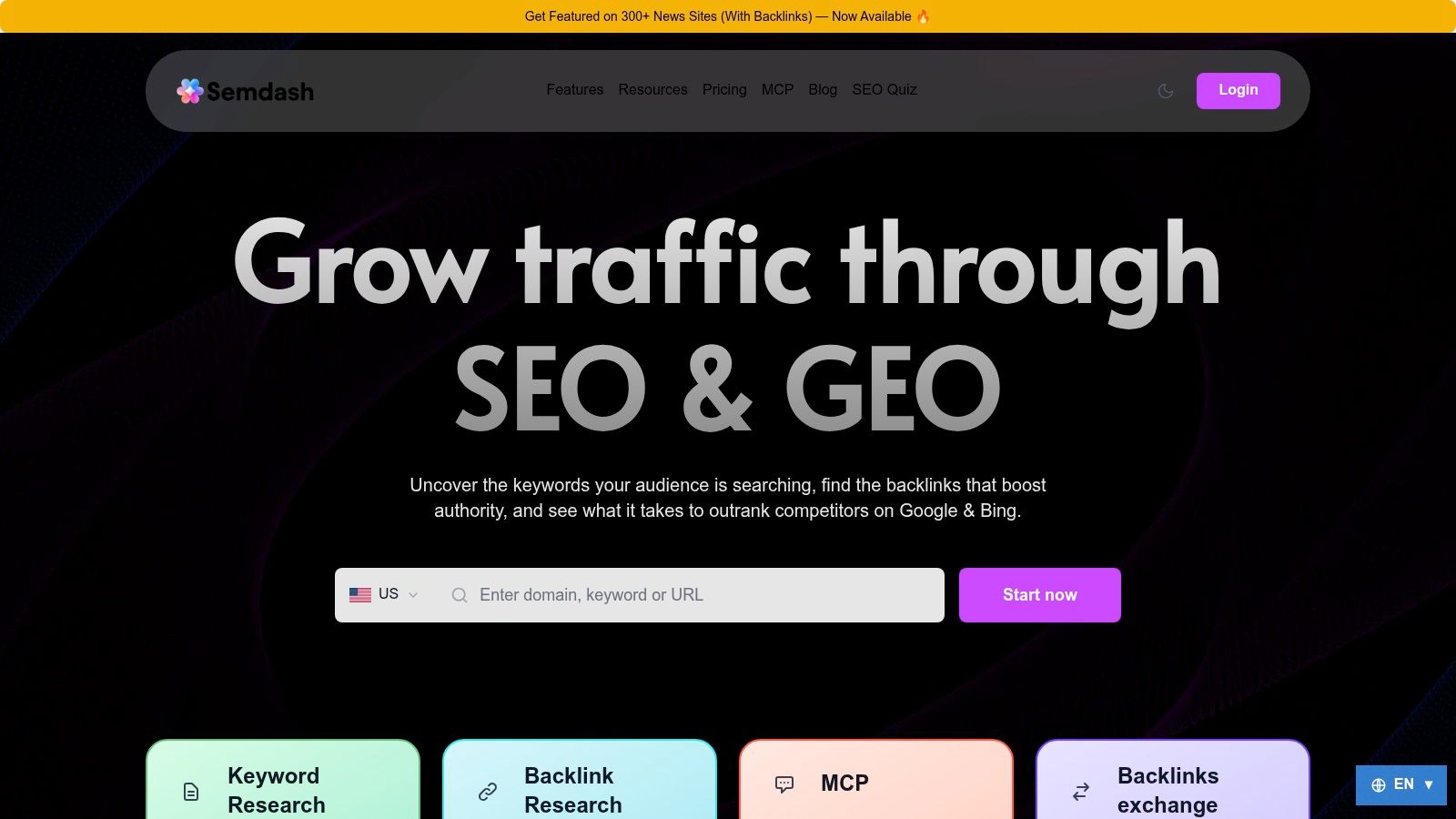
Keyword coverage shows where competitors appear. A backlink gap shows which referring domains support that visibility. I run the Backlink Gap workflow by comparing my domain with relevant competitors, then filtering for domains that link to multiple peers but not to us.
The raw list is rarely an outreach list. A national news site that links to every company in a category may be difficult to influence and poorly aligned with a specific campaign. A niche publisher, professional association, resource page, or trade site that links to two comparable businesses gives me a more actionable lead.
Read the context, not just the domain
For every prospect, I inspect:
- Topical relevance: Does the site serve the same audience or adjacent professionals?
- Linking page: Is the link in a resource guide, comparison, editorial article, partner page, or unrelated roundup?
- Anchor context: Does the surrounding text describe the same problem, category, or use case?
- Competitor pattern: Did the publisher link to one peer once, or does it consistently cite several?
- Destination fit: Which page on my site would genuinely improve the reader's experience?
A link from a page about “best CRM tools” creates a different pitch from a mention on an unrelated list. The first may support a comparison or product page. The second may not be worth pursuing at all.
I add three columns before contacting anyone: likely angle, proposed destination, and concrete ask. “Please link to us” is not an angle. “Your guide compares workflow tools, and our updated implementation checklist fills the documentation gap in the section on onboarding” gives the editor a reason to evaluate the suggestion.
The practical workflow is documented in this competitor backlink analysis guide, but the principle applies regardless of the platform: use competitor links to identify patterns, then validate the prospect manually.
Why focused outreach wins
I'd rather send a small, researched campaign than blast generic templates at an enormous list. Personalization doesn't mean adding the recipient's first name. It means understanding why the page exists, what it currently lacks, and why my proposed resource belongs there.
I also separate link acquisition from link repair. Unlinked brand mentions, broken competitor references, and outdated resources can produce more relevant opportunities than a broad “guest post” campaign. The final list should be short enough that each prospect gets a credible reason to respond, and each proposed link points to a page that already deserves to be cited.
Prioritizing When the List Is Too Long
After filtering, the list will still be larger than the team can ship. I use one rubric across keyword, content, technical, and backlink gaps: business value, feasibility, and causality.
Each axis gets a score from 1 to 3.
- Business value: Does closing the gap support revenue, pipeline, qualified demand, retention, or a clearly defined strategic objective?
- Feasibility: Can the team create, improve, promote, or technically enable the required asset with its current resources?
- Causality: Do we understand why the gap exists and how the proposed action should affect the target?
I add the three scores, then place the row into one of three planning buckets:
| Bucket | Typical score | Planning decision |
|---|---|---|
| Ship next | 8 to 9 | Assign an owner and start the next available sprint |
| Ship this quarter | 6 to 7 | Add to the roadmap with dependencies and a deadline |
| Revisit | 3 to 5 | Keep evidence, but don't consume current capacity |
These scoring ranges are a planning device, not an industry benchmark. The value comes from forcing the same questions for every row.
Business value comes before volume
A keyword with 10,000 monthly searches may be less useful than a bottom-of-funnel term with a much smaller audience if the first query attracts broad research and the second supports trials or sales conversations. I don't award priority for volume alone. I ask what page would rank, what action the visitor could take, and whether that action supports the agreed target.
Feasibility needs equal scrutiny. A technically easy fix with no meaningful business connection shouldn't outrank a valuable page that requires coordination. Conversely, a high-value keyword that needs a new product capability shouldn't be promised as a quick content win.
Causality is the safeguard against vanity work. If the diagnosis says “competitor has the keyword, so publish an article,” the row isn't ready. The cause might be an existing page with weak intent alignment, missing internal links, insufficient authority, or a target query that doesn't belong in the strategy.
A gap earns priority when the team can explain its value, its cause, and the action that should change the metric.
This rubric turns a planning meeting from a debate about the most threatening competitor into a decision about the next controllable improvement. Every selected row should leave the meeting with one owner, one next action, one deadline, and one evidence source.
Closing the Gap and Proving It Stuck
A gap closes only when the change ships and the target metric moves. I use a 30, 60, and 90-day follow-up cadence because implementation and effectiveness answer different questions.
At 30 days, I verify that the planned work is live. For content, the correct URL must be published, indexable, internally linked, and aligned with the intended query. For link work, I check whether relevant prospects were contacted and whether new referring domains appeared. I also record early signals, including impressions, internal-link changes, and crawl or indexing status.
At 60 days, I review rankings for the targeted terms and organic sessions to the new or updated pages. Early movement is a diagnostic, not a success verdict. I look for evidence that the page is entering the right SERPs, matching search intent, and receiving enough internal support.
At 90 days, I compare the current state with the frozen baseline and assess the trajectory toward the target. The published gap-analysis guidance also includes a 90-day follow-up in a complete workflow.
My closure log records:
- Original condition
- Action taken
- Evidence of implementation
- Effectiveness result
- Closure date
- Owner and next review
A temporary improvement followed by a stall sends the item back for review. A completed ticket shows that someone performed the action. It does not show that the SEO gap disappeared in production.
The same evidence standard applies to link work. A sent email is not an earned link, and a published page is not a ranking. Log the live URL, referring domains gained, ranking movement, qualified organic activity, and progress toward the business target. If those signals do not support the target, revise the page, links, or original diagnosis rather than protecting a tidy completion report.
SemDash brings keyword gaps, backlink gaps, ranking URLs, SERP context, and competitor research into one workflow. Visit SemDash to inspect competitor coverage, map opportunities to pages, and track the gaps selected for closure.