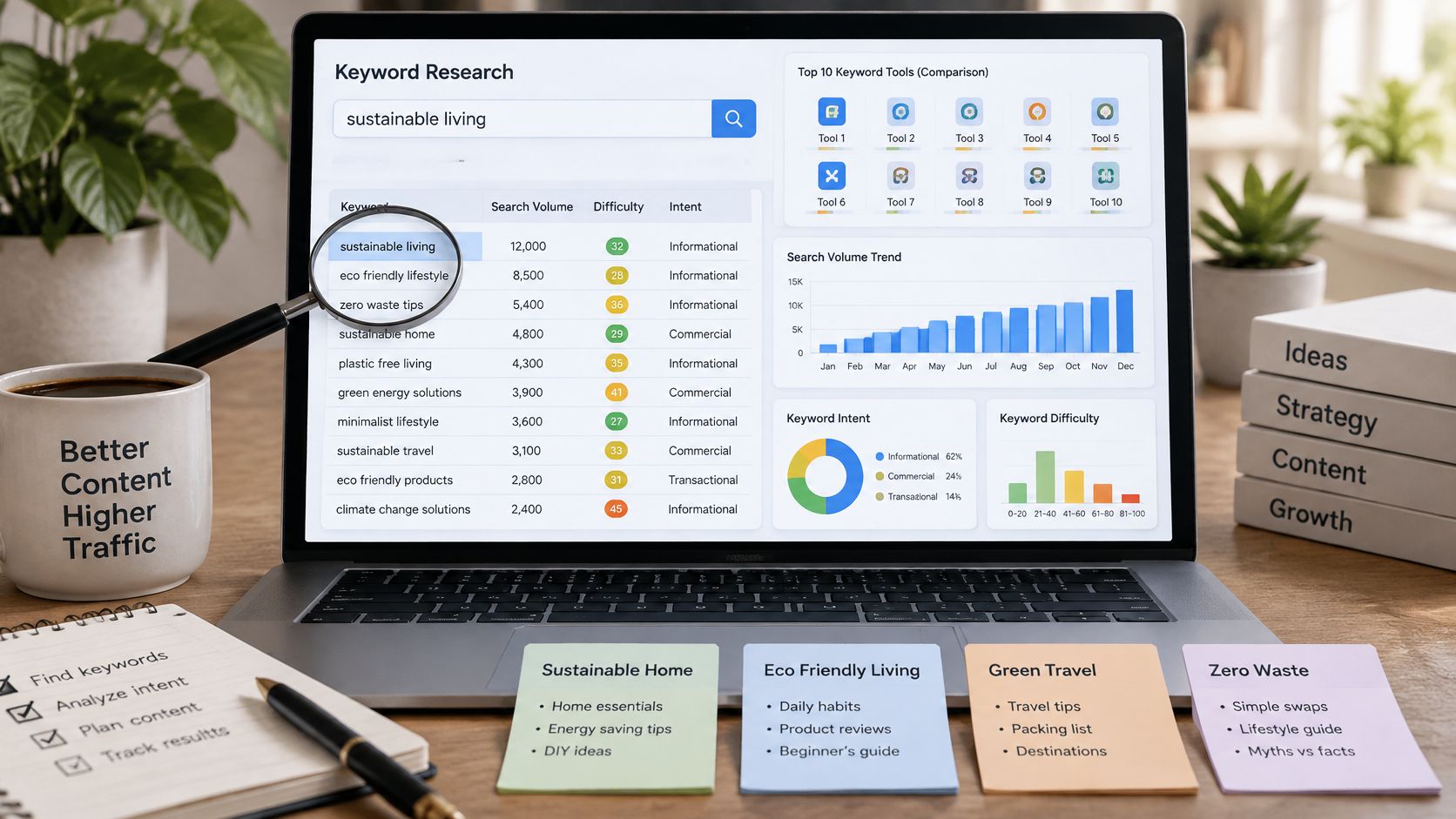
You've researched a topic, built a keyword list, and commissioned a strong article. Then a competitor's page appears above yours for queries you never included in the brief. The frustrating part is that those terms often aren't mysterious. They're variations, questions, and commercial phrases already visible in the search results.
I've seen this pattern repeatedly in content audits. Traditional keyword research gives you a market-wide list, but it doesn't show which opportunities a competing site has already validated. A keyword gap analysis changes the starting point. Instead of asking only what people search for, I ask which relevant queries competitors capture, which pages rank for them, and whether my site can close the gap without creating another competing URL.
Table of Contents
- Introduction to Keyword Gap Analysis
- Understanding the Key Concepts
- Benefits of Gap Analysis
- Domain Level Gap Analysis Workflow
- Page Level Keyword Mapping Techniques
- Using Results for Content and Link Strategy
- Common Mistakes and Edge Cases
- Conclusion and Next Steps
Introduction to Keyword Gap Analysis
Keyword gap analysis is most useful when a content plan feels complete but organic visibility still looks thin. I once reviewed a site with well-written guides targeting obvious head terms. The missing opportunities were in the supporting queries, such as comparison phrases, implementation questions, and use-case variations that competitors had grouped into their pages.
The discovery didn't automatically justify publishing dozens of articles. It gave me a better question: which missing terms belong on an existing page, and which represent a new topic? That distinction prevents wasted production and keeps the site architecture coherent.
A useful analysis turns competitor visibility into decisions. You compare ranking portfolios, remove irrelevant terms, assess intent and difficulty, then cluster the remaining gaps into page-level opportunities. The output isn't a spreadsheet full of keywords. It's a prioritized content and optimization roadmap.
Understanding the Key Concepts
What is a keyword gap analysis? In practical SEO terms, it's the process of comparing your site's ranking keywords with competitors' rankings to identify queries they capture and you don't. As competitive search datasets expanded, the method became a standard workflow. Current industry guidance frames it as the difference between your search performance and the pages or domains outranking you, often using competitor positions in the top 10 or top 20 as filters for useful opportunities (Search Engine Land's gap analysis guide).
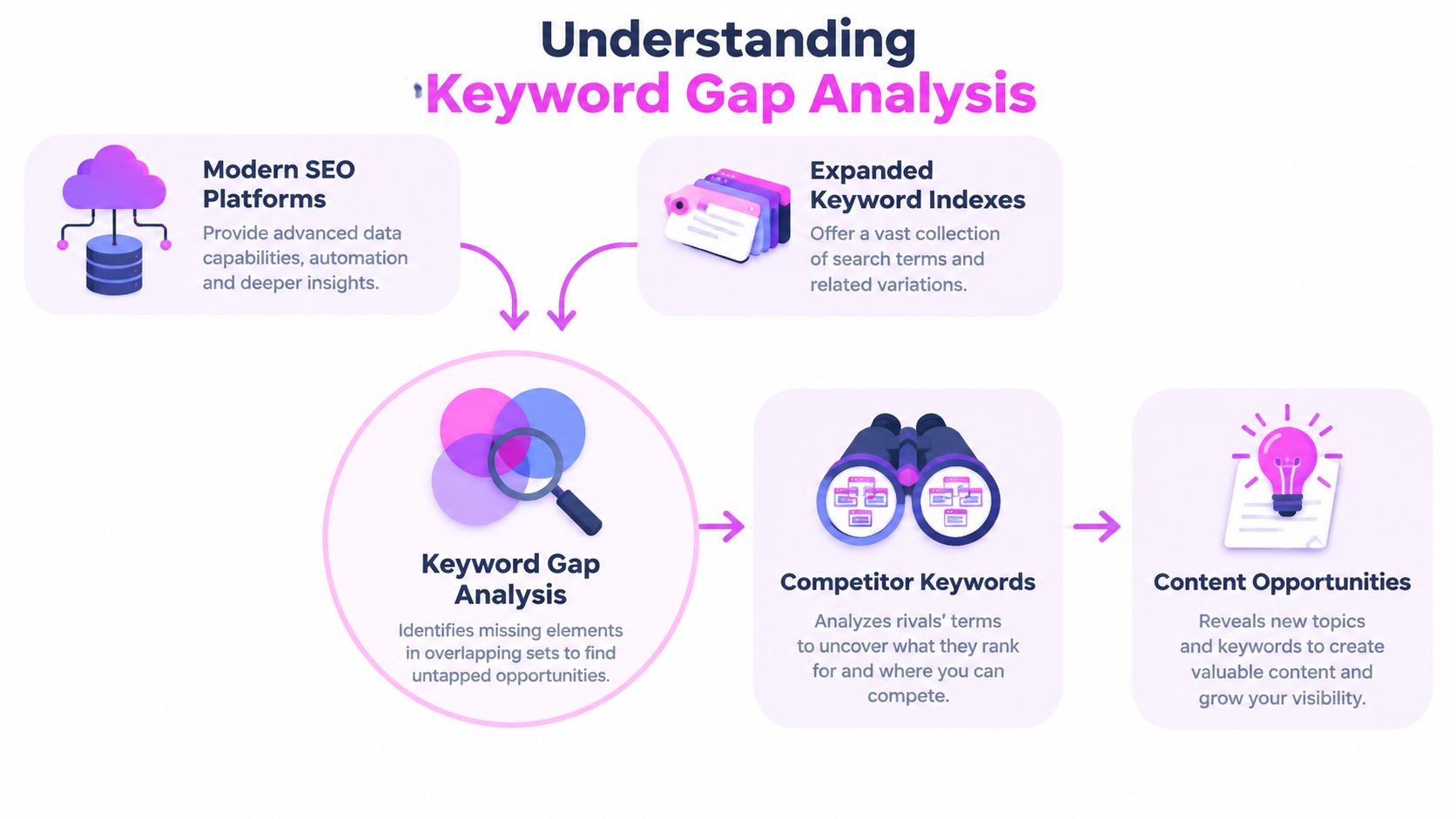
I separate the data into three working groups:
- Shared keywords: Both sites rank, but one competitor may hold a stronger position.
- Unique competitor keywords: A competitor ranks while your site has no meaningful visibility.
- Your unique keywords: Your site owns demand the selected competitors haven't captured.
That last group matters because a gap report isn't automatically a competitor-copying exercise. Your own strengths can reveal topics worth expanding, while competitor-only terms need relevance checks before they enter the plan.
The historical shift is tied to platform capability. Modern SEO tools maintain expansive keyword indexes, making domain-to-domain comparison practical at a scale that manual review can't match. Still, the software only exposes the difference. You need to apply intent, business value, ranking feasibility, and page context before publishing anything. A concise overview of the broader method is available in this gap analysis explanation.
Benefits of Gap Analysis
The strongest benefit is focus. A conventional keyword list can contain attractive terms that have little connection to your offer or sit beyond your current ability to rank. A competitor gap gives you evidence that a relevant site is already earning visibility for the query, then lets you judge whether the opportunity fits your resources.
Long-tail terms are especially useful in this process. A 2026 SEO statistics report says long-tail keywords face about 80% less competition than short-tail terms. The same report says 25% of keywords are low difficulty and 45% are medium difficulty, so the realistic opportunity often sits between broad, difficult head terms and extremely narrow searches (SEO keyword research statistics).
That doesn't mean every long-tail gap is valuable. I still check whether the query expresses a problem my business solves, whether the SERP contains pages similar to the page I could create, and whether the term belongs in an existing cluster. A low-competition query with weak commercial relevance is still a poor use of editorial time.
The adoption trend reinforces the practical value. The same report found that 68% of businesses track competitor keywords, up from 45% in 2021. Gap analysis has become mainstream because it ties content planning to observable demand and competitor visibility rather than intuition alone.
Domain Level Gap Analysis Workflow
I begin with my own domain. That sounds obvious, but starting with a competitor produces an interesting keyword report rather than a meaningful gap. The gap only exists relative to the site I'm trying to improve.
Establish the comparison set
I normally select 2 to 5 true competitors. These aren't necessarily the biggest brands in the market. They're sites competing for the same topics, audience, and search intent. A marketplace, publisher, and software vendor may all rank for related terms, but their pages often serve different purposes.
One documented workflow compares a baseline domain with up to 5 competitor domains and separates shared from unique keywords, which captures the core mechanics of gap discovery (KWFinder's keyword gap workflow).
Export before interpreting
I export the ranking terms instead of reviewing them only inside the platform. The export lets me add columns for:
- Intent: informational, commercial investigation, transactional, or navigational.
- Relevance: how closely the query matches the product, service, or audience.
- Difficulty: whether the competing results appear realistically challengeable.
- Page status: existing URL, optimization candidate, or net-new topic.
- Cluster: the broader page-level theme.
I filter competitor positions to the top 10 or top 20, then remove branded terms, unrelated countries, and queries whose SERP intent doesn't match my site. I also exclude ultra-competitive phrases when the ranking pages have a level of authority or depth my site can't reasonably match.
A competitive keyword analysis workflow can help organize this comparison, but the strategic judgment still happens after the export.
Prioritize the shortlist
The raw list is not the deliverable. I sort the remaining terms by a combination of demand, intent, difficulty, and business value. A competitor ranking for many closely related queries usually signals one topic cluster, not a reason to create a separate page for every phrase.
Practical rule: If I can't explain the searcher's intent and the page that should satisfy it, the keyword isn't ready for production.
Page Level Keyword Mapping Techniques
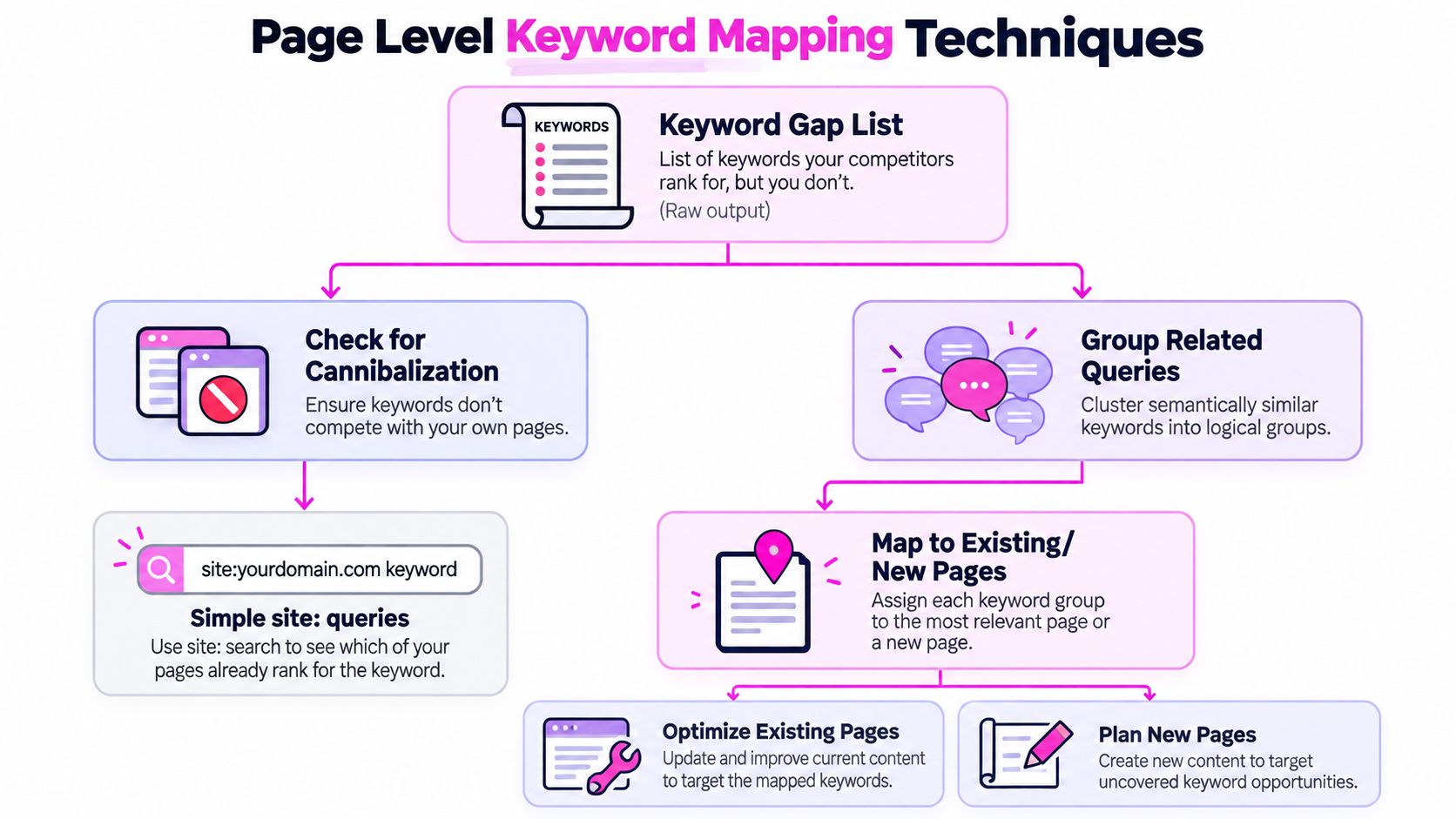
A domain report tells me where visibility is missing. Page-level mapping tells me what to do about it. I don't assign every gap to a new brief because that approach quickly creates overlapping pages and weakens the site's topical organization.
Check for existing ownership
Before creating a page, I search Google using site:yourdomain.com keyword. This simple check reveals whether several URLs already discuss the same subject. The technique is specifically tied to identifying cannibalization before publishing another page (keyword cannibalization guidance).
If two pages target the same intent, I decide whether to merge them, redirect one, or differentiate their purposes. A competitor gap may disappear after consolidating existing content, because the problem was poor targeting rather than missing coverage.
Cluster by intent and SERP overlap
I group terms when they share the same underlying need and appear to be served by similar result types. For example, a primary query about conducting a keyword gap analysis might sit with closely related process terms on one guide, while a query focused on software comparison may deserve a separate commercial page.
The ranking URL is an important clue. If one competitor URL ranks for many related variations, I treat that pattern as evidence for a cluster. I don't copy the competitor's structure automatically, but I do inspect whether the search results reward one in-depth resource or several narrower pages.
Choose the right page action
A term already generating impressions for my site usually deserves attention before a new article. Google Search Console's Queries report includes searches that produced impressions even without clicks, so I export 12 months of performance data, isolate terms in positions 4 to 10, and inspect the top 20 to 30 near-page-one opportunities for competing pages (Search Console competitor research workflow).
| Situation | Recommended action |
|---|---|
| Existing page has the right intent and near-page-one visibility | Improve relevance, coverage, headings, and internal links |
| Existing pages overlap heavily | Consolidate, redirect, or retarget |
| No suitable page exists and the cluster is relevant | Create a focused new page |
| Competitor ranks for an unrelated intent | Discard the gap |
The result should be one clear primary URL for each meaningful cluster.
Using Results for Content and Link Strategy
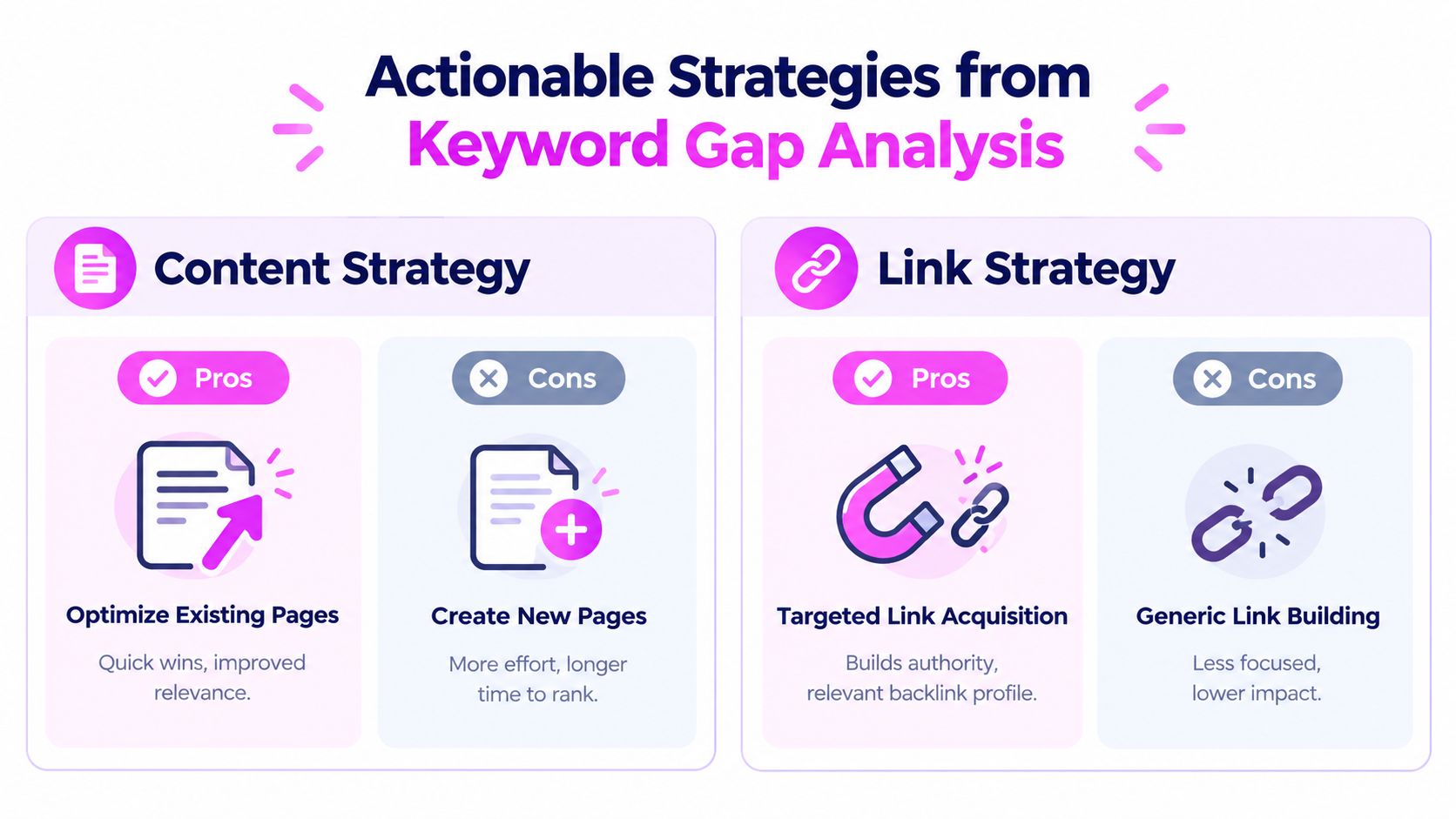
A useful gap analysis informs two connected plans. The first closes missing topical coverage. The second investigates why competitor pages earn stronger authority. Treating these as separate spreadsheets loses the relationship between relevance and promotion.
Build the content plan around page decisions
For an existing page, I compare the competitor URLs against my own page at the section level. I look for missing definitions, use cases, objections, process details, and intent variants. I don't add sections merely because a competitor includes them. I add them when they help the same searcher complete the task.
A net-new brief needs a tighter foundation. I define the primary intent, assign the keyword cluster, list supporting questions, identify the conversion path, and specify the internal links the page should receive. The fundamentals of this process are laid out in basics of content marketing, particularly the connection between useful content and a broader marketing objective.
The trade-off is speed versus coverage. Updating an existing relevant URL can be faster and safer, while a new page gives a distinct intent room to rank without forcing unrelated topics together.
Turn competitor authority into a prospect list
For each priority page, I inspect competitor backlinks and identify referring domains that link to comparable resources. The point isn't to copy a backlink profile or send a generic request. I record the linking page, the context of the existing link, the type of asset it references, and the reason my new or improved page would be useful.
My outreach angle changes according to the gap:
- A missing resource: Offer a page that answers a question the linking article already raises.
- An outdated reference: Suggest a current replacement when my content improves accuracy or usability.
- A stronger format: Provide a template, comparison, research summary, or practical guide that better serves the reader.
- A broken path: Recover a relevant broken backlink when the replacement page matches the original intent.
Generic link building usually fails because it ignores editorial context. A competitor backlink is a clue about relevance, not a guarantee that the same publisher will link again.
A gap becomes a promotion opportunity only when the page offers a clear reason for another site to reference it.
I keep the content and link queues connected. A page with strong intent and a credible prospect set may outrank a page with larger theoretical demand but no realistic distribution angle. That's one of the most useful judgments a raw keyword export can't make.
Common Mistakes and Edge Cases
The most common failure is treating every competitor as equally relevant. Large competitor sets produce noisy gaps, especially when the sites target different audiences, business models, or countries. One practical workflow recommends using 3 to 10 relevant competitors, then filtering by search volume and position before acting (Keyword Everywhere's gap analysis workflow).
I prefer a smaller peer group when the market is mixed. I verify that competitors rank for the same problem, attract the same type of buyer, and publish pages with comparable intent. A site that ranks because of brand strength or a different product model may still provide SERP insight, but it shouldn't define my content roadmap.
Other edge cases need manual review:
- Branded queries: These can inflate a competitor's apparent opportunity without creating a transferable topic.
- New markets: Language, location, and product terminology can change intent substantially.
- SERP features and AI-generated answers: A ranking URL may receive less traditional click exposure, while another page may be surfaced or cited in a generated result.
- Near misses: A page already receiving impressions may need optimization, not a new URL.
The data is valuable, but only after I test its relevance against the actual result page.
Conclusion and Next Steps
A keyword gap analysis compares your ranking coverage with relevant competitors, but the real work starts after the comparison. I filter by intent, difficulty, relevance, and business value, then cluster related queries into page-level opportunities. Before publishing, I check for cannibalization and decide whether to improve, consolidate, redirect, or create.
My first-pass checklist is simple:
- Set my domain as the baseline.
- Choose a small set of true search competitors.
- Export competitor-only and shared keywords.
- Filter out irrelevant, branded, and unrealistic terms.
- Check existing URLs and Search Console near misses.
- Cluster the remaining gaps by intent and SERP overlap.
- Assign one clear page action to each cluster.
- Connect priority pages to a focused link acquisition plan.
I revisit the analysis during SEO sprints rather than treating it as a one-time report. Competitor pages change, search intent shifts, and a page that once needed a new brief may later become an optimization opportunity. The discipline is to keep the roadmap tied to pages, not just phrases.
SemDash combines domain and page-level keyword gap analysis with ranking URLs, keyword clustering, backlink research, and SERP data for competitive content planning. Visit SemDash to compare your site with relevant competitors and turn raw keyword gaps into prioritized pages.