%20(1)-B86R08ZzwhPzS6UZbG3mSxRWPCwGwn.png)


Keyword Seasonality: How to Spot and Plan for Search Cycles

Keyword seasonality is the predictable, recurring rise and fall in search demand for a query tied to a calendar event, weather pattern, or business cycle. The tactical move is simple: confirm the pattern with two to five years of historical data, then start planning content and campaigns three to six months before the expected peak. Wait until the peak arrives, and you’ve already lost the ranking window to competitors who published in the shoulder season.
A few examples make this concrete: “Christmas gift ideas” spikes hard in late November, “AC repair near me” climbs every June and July across the southern United States, and “Q4 budget planning” surges among B2B searchers every September and October. These aren’t hunches. They’re patterns you can measure, model, and act on before your competitors even notice the trend line moving.
- Validate seasonality with at least two to three years of query data, not one
- Publish core landing pages three to six months ahead of peak
- Refresh existing pages four to six weeks before each year’s peak returns
Statistic Callout: Seasonal categories can experience dramatic swings in monthly search volume, varying widely depending on the vertical, as noted in Search Engine Land’s seasonality guide.
Key Takeaways
Keyword seasonality only becomes actionable once you validate it with multi-year data and back-calculate your publish deadline from the confirmed peak date.
| Point | Details |
|---|---|
| Validate before you plan | Confirm any seasonal pattern across two to five years of data before committing a content calendar to it. |
| Publish early, refresh yearly | Launch core pages three to six months before peak and refresh them four to six weeks before each return. |
| Know your seasonal type | Holiday spikes are sharp and short; weather and fiscal-cycle patterns run longer and shift by region. |
| Use forecasting tools for scale | Prophet and ARIMA can decompose trend from seasonality once you have two to three years of clean data. |
| Semdash speeds detection | Semdash’s keyword research and clustering tools consolidate volume history and long-tail demand in one view. |
What Is Keyword Seasonality, Really?
Keyword seasonality describes a repeating cycle. A trending query, by contrast, spikes once and either fades or plateaus at a new baseline. “Ugly Christmas sweater” returns every December like clockwork. “ChatGPT” spiked once in late 2022 and never fully receded. Confusing the two leads teams to build permanent infrastructure for a one-time event, or worse, to abandon a genuinely seasonal keyword because it looks dead in the off-months.
Secular growth complicates the picture further. A keyword can be seasonal AND growing year over year, meaning each peak sits higher than the last one. You need to isolate the cyclical wave from the upward trend line before you can plan around either one.
Data requirements matter here. A single year of Google Trends data tells you almost nothing reliable, since one anomalous spike (a viral moment, a news event, an algorithm update) can masquerade as a pattern. Search Engine Land recommends validating seasonal patterns across multiple years before committing budget. Three years is the practical minimum; five is better if the vertical has volatile timing.
Common diagnostic pitfalls include:
- Mistaking a single viral spike for a recurring seasonal pattern
- Using monthly resolution when the real peak window is a two-week span
- Ignoring regional variation and averaging away a sharp local peak
- Failing to separate a growing baseline from the seasonal swing on top of it
Types of Seasonal Keywords Every SEO Should Recognize
Seasonal keywords cluster into a handful of recognizable patterns, and knowing which type you’re dealing with tells you how sharp the peak will be and how much runway you need.
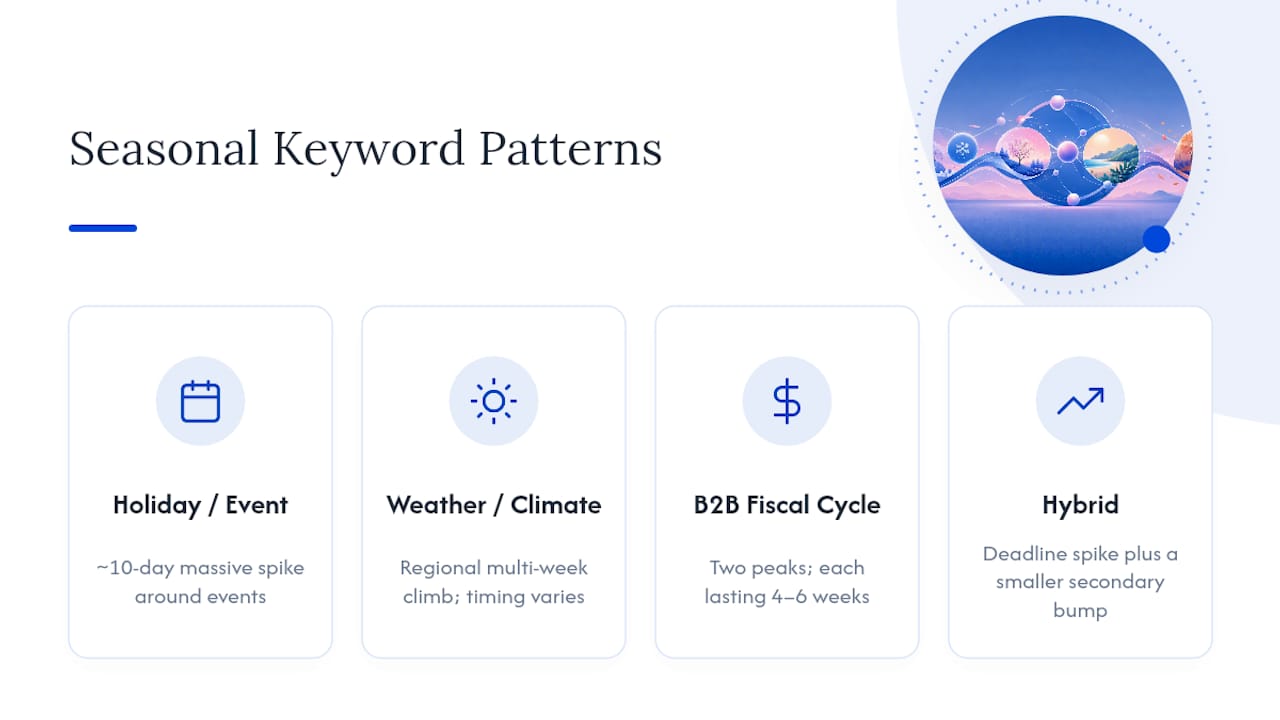
Holiday and event-driven keywords produce the sharpest, shortest peaks. “Black Friday deals” can go from near-zero to massive volume in a ten-day window, then collapse just as fast. Event-driven terms tied to the Super Bowl, elections, or awards shows behave the same way: intense, brief, and unforgiving of late publishing.

Weather and climate-driven keywords move on a slower, regional clock. “Furnace repair” climbs through fall in northern states weeks before it moves in the South. “Pool maintenance” mirrors the reverse pattern. These keywords reward geo-segmented content calendars rather than one national publish date.
B2B fiscal-cycle keywords run on business calendars, not the Gregorian one. “Enterprise software procurement” and “annual budget templates” often peak twice: once near fiscal year-end and again at the start of Q1 planning. These peaks stretch over four to six weeks rather than collapsing in days, giving teams a wider window to capture demand.
Hybrid patterns combine drivers. “Tax software” spikes around filing deadlines but also carries a secondary bump when extensions come due. E-commerce categories illustrate the magnitude well: garden furniture searches have been tracked climbing significantly at seasonal peak, a swing that would blindside any team planning inventory or content on a flat monthly average, per EcomSEO’s analysis.
Statistic Callout: Category-level averages routinely mask peaks this dramatic, which is exactly why relying on a single “average monthly search volume” figure from a keyword tool can lead you to under-resource your biggest opportunity of the year.
How to Find Seasonal Keywords in Your Own Data
Detecting seasonality isn’t guesswork. It’s a repeatable process that starts with your own site data and gets confirmed against external market signals.
- Export query timelines from Google Search Console and GA4. Pull impressions and clicks by date for your top queries over the longest window available, ideally 16 months or more, and look for repeating bumps at the same calendar point each year.
- Cross-check with Google Trends using the five-year view. Set the timeframe to five years and apply geo filters relevant to your market. A pattern that repeats across five separate years is far more trustworthy than one that shows up once. Google Trends also lets you compare related terms side by side, which often reveals that two similar-looking keywords peak weeks apart.
- Layer in internal sales or transactional data. Search interest that doesn’t convert to revenue at the same time might indicate research-phase behavior rather than true seasonal buying intent, so match the search curve against your actual sales curve before betting budget on it.
- Track search velocity for zero-volume and emerging queries. Many keyword tools report “zero volume” for low-frequency terms simply because they fall below the tool’s measurement floor, not because nobody searches them. Search Engine Journal recommends clustering these long-tail variants together and watching the rate of change in impressions rather than waiting for a database update to confirm demand exists.
Pro Tip: Don’t trust a single data source. A keyword that looks flat in Google Trends can still show a clear seasonal bump in your own Search Console impressions data, especially for niche or local queries that don’t generate enough national search volume to register as a visible trend line.
Turning Seasonal Keywords Into Content and Campaign Timing
Knowing the pattern is only half the job. The other half is building your publishing and paid media calendar around it, and this is where most teams still get the timing wrong.
Publish core landing pages three to six months before peak. This gives Google enough time to crawl, index, and build ranking signals before the demand window opens. Supporting content, like blog posts and comparison guides that feed into the core page, should go live even earlier, since these pages often need more time to accumulate the backlinks and engagement signals that help the money page rank when it matters. KeyGroup’s seasonal keyword guide backs this same three to six month runway and adds a refresh window: update existing seasonal pages four to six weeks before each year’s peak to recapture rankings that may have drifted during the off-season.
Decide between year-agnostic and year-specific URLs early. A year-agnostic URL like /best-gift-guide accumulates authority across multiple seasons and avoids the need to rebuild link equity every year. A year-specific URL like /gift-guide-2026 can rank faster for users explicitly searching a current year, but it starts from zero authority each cycle. Most evergreen seasonal categories are better served by a year-agnostic page that gets refreshed annually, with year-specific content reserved for genuinely time-locked events.
Time paid search to ramp ahead of peak, not during it. Start bidding two to four weeks before the seasonal window opens, using this shoulder period to test ad copy and refine targeting at lower cost per click before competition intensifies. A reasonable budget split looks like:
- Early/shoulder period: roughly 15 to 20% of seasonal budget, spent testing and building Quality Score
- Ramp-up window: roughly 25 to 30%, as competition and CPCs start climbing
- Peak weeks: the remaining 50 to 60%, concentrated where conversion volume is highest
Use internal linking to elevate category pages before demand arrives. Point supporting blog content at your seasonal category or landing pages weeks before the peak so crawlers and algorithms register rising relevance ahead of the search spike, not after it.
Pro Tip: If your CMS supports it, build a “seasonal content cluster” template now, the same skeleton of hub page plus three or four supporting articles, so you’re not rebuilding the structure from scratch every single year.
Forecasting Tools: Google Trends, Search Console, and Time-Series Models
Google Trends remains the fastest free validation method. Set a five-year lookback, apply geographic scoping to your actual market, and compare two or three related terms in the same chart to spot timing differences that a single-keyword view would hide. Google Trends shows relative interest, not absolute volume, so pair it with real numbers from Search Console or a keyword research tool before making budget decisions.
For teams ready to move beyond visual pattern spotting, time-series forecasting models add real predictive power:
- Prepare your data first. Export a simple two-column CSV: date and search volume (or impressions). Weekly resolution reveals weekday and short-term patterns; monthly resolution smooths noise but hides sharp peaks, so choose based on how abrupt your seasonal spike actually is.
- Facebook’s Prophet handles missing data gracefully and automatically decomposes a series into trend, seasonality, and holiday effects, which makes it a practical starting point for marketers without a statistics background.
- ARIMA models require cleaner, more stationary data but can outperform Prophet on series with complex autocorrelation, making it a better fit for teams with a data scientist on hand.
- Both approaches need at least two to three years of historical data to reliably detect yearly seasonality, per KeyGroup’s forecasting notes.
A basic implementation checklist:
- Pull 24 to 36 months of query data at weekly resolution
- Clean gaps and flag any known anomalies (site outages, algorithm updates, viral events)
- Run the model and inspect the seasonal decomposition chart for a repeating annual wave
- Cross-reference the model’s predicted peak week against Google Trends’ peakDate field
Weekly-resolution scraping tools can sharpen this further. As Thirdwatch’s research on Trends data notes, weekly timeline arrays and peakDate detection let you pinpoint the exact week of highest interest rather than settling for “sometime in November,” which matters enormously when you’re timing a publish date or a paid ramp.
Building a 12-Month Seasonal Content Calendar
Once you’ve confirmed a keyword’s seasonal pattern, back-calculate every deadline from the peak date itself, not from today’s date. If a keyword peaks in mid-November, your core landing page needs to be live by August at the latest, with supporting cluster content published through June and July.
A repeatable checklist for each seasonal keyword group:
- Confirm the peak month and week using multi-year Trends and Search Console data
- Set the core page publish deadline at three to six months pre-peak
- Schedule supporting cluster content four to eight weeks ahead of the core page
- Build internal links from cluster content to the core page as each piece goes live
- Launch paid search campaigns two to four weeks before the seasonal window opens
- Set a refresh reminder for four to six weeks before next year’s peak
- Segment timing by region if the keyword shows geographic variation
| Timing Milestone | Recommended Action |
|---|---|
| 6 months before peak | Publish or finalize the core landing page |
| 2–3 months before peak | Publish supporting cluster content and build internal links |
| 2–4 weeks before peak | Launch paid search ramp at reduced budget |
| During peak weeks | Shift 50–60% of seasonal budget to top-performing terms |
| 4–6 weeks before next peak | Refresh existing content and update on-page signals |
Measuring Seasonal Performance Without Fooling Yourself
Year-over-year comparison is the only reliable measurement frame for seasonal keywords. Comparing November of this year against October of the same year tells you almost nothing useful, since you’re mixing a seasonal effect with normal month-to-month noise. Compare the same calendar window against last year’s identical window instead.
Before crediting a traffic swing to seasonality, rule out other causes. Check whether a Google algorithm update landed during the same period, since Search Engine Land flags algorithm timing as one of the most common sources of false-positive seasonality readings. A ranking drop that looks like an “off-season decline” might actually be a core update.
Track these KPIs specifically during peak windows:
- Impressions and click-through rate changes versus the same period last year
- Conversion rate shifts, since seasonal traffic often converts at a different rate than baseline traffic
- Ranking volatility across your target cluster, not just the single head term
- Weekly Google Trends movement as a leading indicator that can flag an early or delayed peak before your own analytics catch up
Statistic Callout: The same Search Engine Land guide identifies content cannibalization and mistimed publishing as two of the most common seasonal SEO risks, both of which show up first in a YoY impressions comparison before they show up in rankings.
How Semdash Supports a Seasonal SEO Workflow
Running this playbook by hand across dozens of keyword clusters gets unwieldy fast. Semdash’s keyword research tool pulls historical search volume trends alongside SERP and competitor data in one interface, which cuts down the manual export-and-cross-reference work described above.
Three practical ways to use it for seasonal planning:
- Pull multi-month volume history for a keyword cluster to spot the peak window before committing to a publish date
- Use semantic clustering to group long-tail and near-zero-volume variants together, surfacing hidden demand the way Search Engine Journal recommends
- Run competitor content-gap analysis ahead of a seasonal window to see which pages rivals are refreshing before their own peak arrives
| Workflow Step | How Semdash Helps |
|---|---|
| Detect seasonal patterns | Historical volume data surfaces recurring peaks by keyword |
| Validate long-tail demand | Semantic clustering groups zero-volume variants into measurable clusters |
| Plan ahead of competitors | Content-gap analysis flags pages rivals are preparing pre-peak |
The Gap Between Seasonal Theory and Seasonal Execution
Most seasonal SEO advice stops at “publish early,” which is true but incomplete. The harder discipline is refusing to act on a single year of data. A one-year spike is a coin flip; a pattern that repeats across three or five years is a plan you can actually build a calendar around. Teams that skip multi-year validation end up chasing noise, building entire content clusters around what turns out to be a one-time news event.
The other place conventional advice falls short is treating “seasonal” as binary. Real keyword sets are messier: a fiscal-cycle term riding on top of secular growth, or a weather-driven query with a regional offset most national calendars ignore. Forecasting tools like Prophet exist precisely because decomposing trend from seasonality by eye is unreliable once a keyword has more than one driver stacked on it.
If you take one thing from this, prioritize the back-calculation habit. Find the peak date first, then count backward three to six months to your publish deadline. Everything else, the tool you use, the model you run, the budget split you choose, is secondary to getting that one date right.
Get Ahead of Seasonal Demand With Semdash
Spotting a seasonal pattern manually across Search Console exports, Google Trends charts, and spreadsheet formulas takes hours you probably don’t have during a busy content calendar. Semdash puts historical keyword volume, competitor tracking, and semantic clustering into one dashboard, so you can confirm a seasonal pattern and build your publish calendar in the same sitting instead of stitching data from three separate tools.
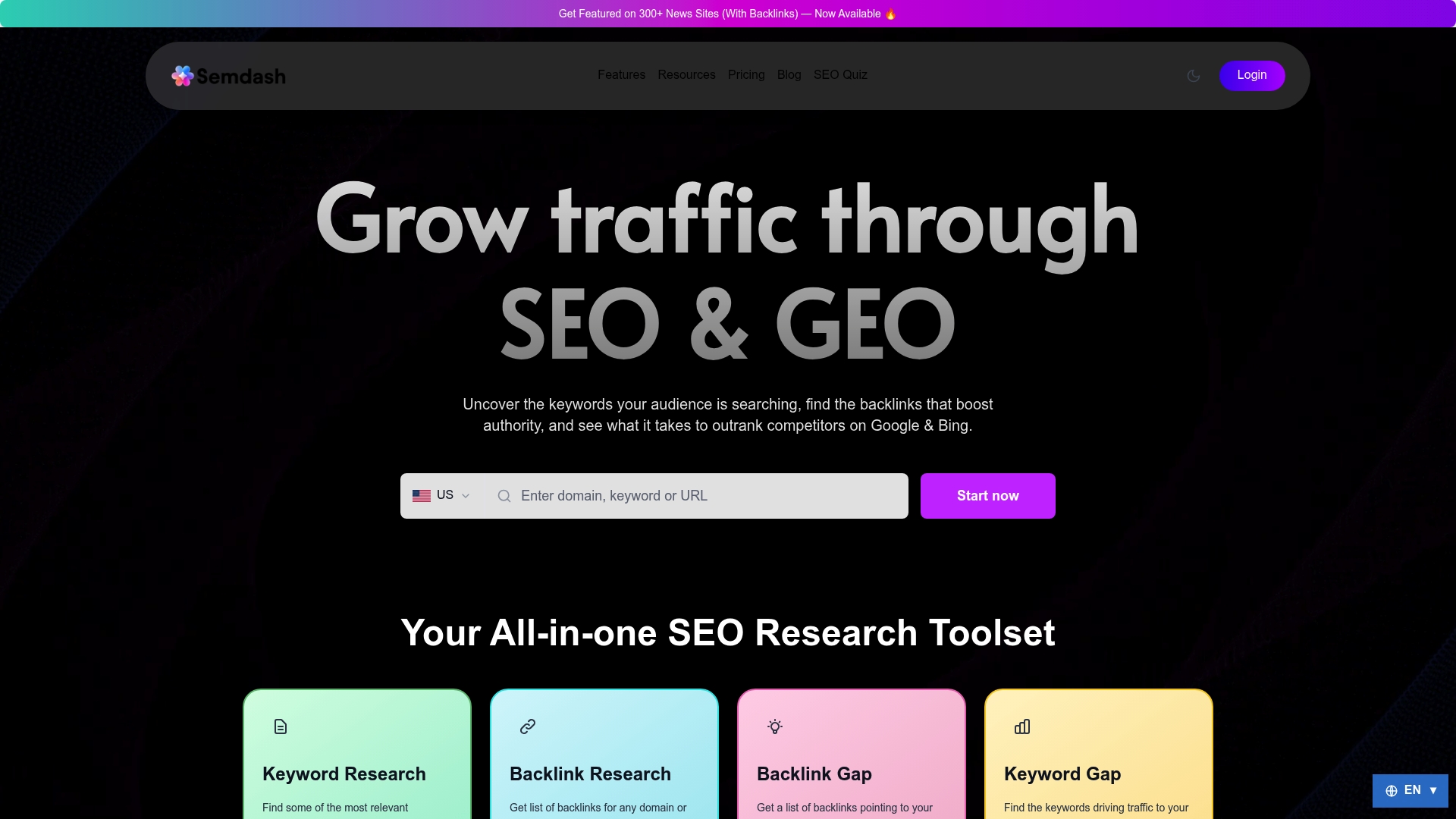
The keyword research tool shows volume trends and related term data side by side, which makes the “is this actually seasonal or just a one-time spike” question much faster to answer than manually cross-referencing five years of Trends screenshots. Pair it with the SEO competition analysis tool to see when competitors are refreshing their own seasonal pages, giving you a real deadline to beat rather than a guess. If you want to test the waters first, the free SEO tools let you run a quick seasonal check before committing to a subscription. Start with a keyword cluster you already suspect is seasonal and see what the data actually shows.
Sources
- SEO seasonality explained: strategies, trends & optimization tips
- Google Trends
- Research Seasonal Demand Patterns with Google Trends Data
- Why you should target zero search volume keywords
FAQ
What is the 80/20 rule in SEO seasonality?
What is the definition of seasonality in search behavior?
Seasonality is a predictable, recurring fluctuation in search demand tied to a calendar event, weather pattern, or business cycle, confirmed by comparing the same period across multiple years rather than a single spike.
What are the four main types of keywords by seasonality driver?
The four common patterns are holiday and event-driven, weather and climate-driven, B2B fiscal-cycle, and hybrid keywords that combine two or more of these drivers at once.
How can I identify seasonal trends in my own keyword data?
Export query timelines from Google Search Console and GA4, then cross-check against a five-year Google Trends view with geo filters; a tool like Semdash’s keyword research platform can consolidate this into one historical volume view.
How far in advance should I publish seasonal content?
Publish core landing pages three to six months before the expected peak, and refresh existing pages four to six weeks before each year’s peak returns, based on KeyGroup’s seasonal timing guidance.