%20(1)-B86R08ZzwhPzS6UZbG3mSxRWPCwGwn.png)


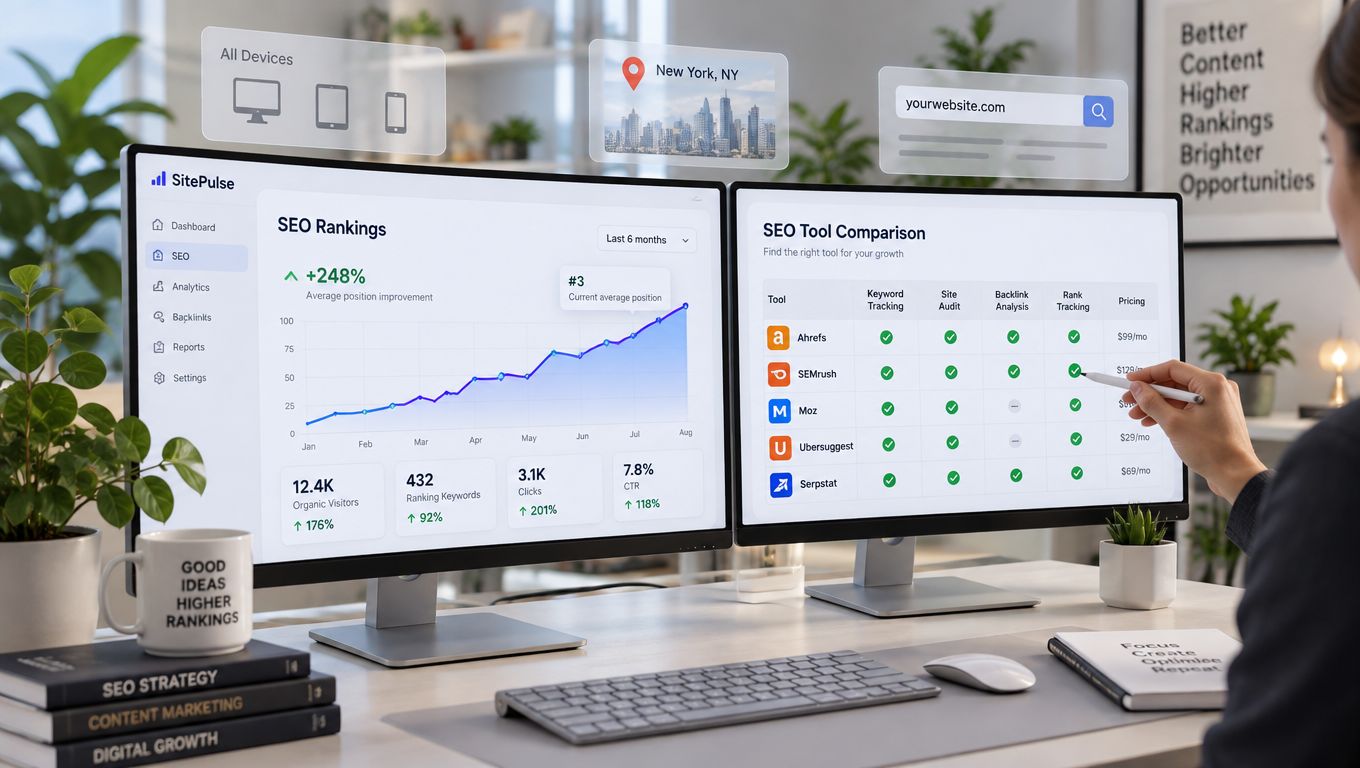
The longest feature list doesn't make a rank tracker the best choice. A tool can show thousands of positions and still leave you unable to explain why a page moved, whether the movement matters, or what to change next. I judge rank tracking software by the workflow it supports, not by the number of boxes it ticks.
This comparison looks at ten platforms through practical scenarios: small-site monitoring, agency reporting, local search, enterprise portfolios, and research-led SEO. Before trusting any dataset, I check the exact keyword, location, device, search engine, SERP features, historical movement, and URL ranking for the query. A recorded position is only a starting point. Useful diagnostic context shows whether the page gained a featured result, lost a Local Pack placement, switched with another URL on the same domain, or moved because the whole SERP changed.
That distinction matters more now because rank tracking has developed from simple position checking into longitudinal visibility analysis. One major provider says it has collected ranking data on hundreds of millions of keywords since 2006 and can display 18 years of ranking history, including clicks and position changes across that period (SpyFu's ranking history overview). I'd rather have a narrower dataset I can interpret than a large dashboard that encourages false precision.
Table of Contents
- 1. SemDash SEO Research and Analysis Tool
- 2. Ahrefs Rank Tracker
- 3. Semrush Position Tracking
- 4. AccuRanker
- 5. STAT Search Analytics by Moz
- 6. SE Ranking
- 7. Nightwatch
- 8. ProRankTracker
- 9. Advanced Web Ranking
- 10. SERPWatcher by Mangools
- Top 10 Rank Tracking Tools Comparison
- Choose the Tracker You Can Act On
1. SemDash SEO Research and Analysis Tool
SemDash is the strongest option here when rank tracking needs to lead directly into competitive research, content planning, and link acquisition. I'd use it when a ranking change needs an explanation, not just an alert. Its workspace connects keyword discovery, competitor pages, backlink gaps, SERP history, URL-level ranking data, and content actions in one workflow.
The practical advantage is the connection between the keyword and the page that ranks. If a target term drops, I can check whether the intended URL lost visibility or whether another page on the same domain replaced it. That distinction is essential for diagnosing cannibalization. SemDash also provides Keyword Gap and Backlink Gap reports, so the next action can be a page revision, a content cluster adjustment, or a focused outreach list rather than a vague recommendation to “improve SEO.”
Where SemDash earns its place
The platform combines a 6.6 billion-keyword database with a 2.7 trillion-link index, giving research-led teams substantial depth for competitor reverse-engineering. Its rank workflow includes 12 months of SERP history, trend and volatility signals, search-intent classification, keyword clustering, PAA and PASF discovery, and AI Overview citation tracking. Those features help me investigate not only where a page ranks, but how Google is presenting the query and which URL is being referenced.
I particularly value the recovery workflows. Unlinked brand mentions and broken backlinks can turn ranking analysis into recoverable authority, while clustering helps prevent several pages from competing for the same intent.
Practical rule: When a ranking falls, inspect the ranking URL and the surrounding SERP before rewriting the page.
The trade-off is that SemDash may be more capability than a hobby site needs, and its 12-month history won't satisfy teams that require multi-year trend analysis. For agencies, content teams, and competitive markets, the speed and action-oriented context outweigh that limitation.
2. Ahrefs Rank Tracker
Ahrefs works best when rank tracking sits beside serious backlink and keyword research. I'd choose it for an SEO team that already relies on Ahrefs to investigate competitor links, identify content opportunities, and assess whether a ranking change has an off-page explanation. The Rank Tracker keeps desktop and mobile positions, country-level tracking, SERP-feature history, competitor comparisons, and visibility trends in the same broader suite.
The setup is relatively straightforward. I can define a keyword set, assign locations and devices, add competing domains, then return to historical charts when a page moves. That continuity is useful when a content refresh and a link campaign happen close together. Instead of exporting position data into another system before investigating, I can examine the surrounding keyword and backlink evidence in the same workspace.
Where the trade-off appears
Ahrefs is a good fit for broad international work and teams that want rank data connected to a substantial link index. Its reporting tools can support scheduled client updates, although agencies should test the required report volume, API access, and account limits before standardizing the platform.
The weakness is commercial rather than functional. You're buying into the wider Ahrefs suite, so the economics make less sense if you only need a narrow rank-monitoring job. It also isn't my first choice for a highly specialized local grid workflow or a reporting pipeline that demands maximum control over every extracted field.
I'd recommend Ahrefs when the question is, “How did our rankings change, and what happened across keywords, content, and backlinks?” I'd look elsewhere when the question is only, “Give me the most granular local rank data at the lowest operational overhead.” Explore the Ahrefs Rank Tracker if integrated research matters more than specialist-only tracking.
3. Semrush Position Tracking
Semrush Position Tracking is built for reporting-heavy teams. I've found that its strongest use case is an agency or in-house department that needs daily visibility data, competitor comparisons, share-of-voice views, SERP-feature ownership, and polished client-facing reports without assembling the reporting layer from scratch.
The campaign structure supports multi-location and multi-device tracking, while integrations with GA4, Google Search Console, and Looker Studio make it easier to connect rankings with traffic and reporting destinations. Semrush also supports competitor tracking, with up to 20 competitors per campaign according to the supplied product specification. That's helpful when a client wants to see not just whether visibility improved, but which rival domains gained or lost ground for the same keyword set.
What I'd validate first
Semrush is strong when stakeholders need clear visuals and recurring PDF reports. It's less attractive when the team only wants a lightweight rank tracker, because add-ons, usage limits, and higher tiers can increase the total cost. Some AI and LLM visibility features may also depend on plan availability or product maturity, so I'd test the exact workflow rather than assume every account includes every feature.
I use volatility context to avoid overreacting to one isolated movement. Semrush explains the concept in its guide to SERP volatility, and the practical lesson is simple: compare a site's movement with broader SERP movement before assigning blame to a page.
A report should help a client decide what to do next, not merely prove that a line moved.
Choose Semrush when reporting, integrations, and campaign governance are central. Choose a specialist tracker when you need deeper raw SERP control or a smaller, more predictable toolset. Visit Semrush Position Tracking to assess the broader suite alongside the tracking workflow.
4. AccuRanker
AccuRanker is the specialist I'd test first when accuracy, refresh control, local coverage, and segmentation matter more than all-in-one SEO research. Its interface is designed around rank data rather than audits or content ideation, which keeps the operational path short. I can filter a keyword set quickly, inspect SERP features, refresh data on demand, and export the result for reporting or analysis.
Local tracking is a major reason to choose it. The platform supports precise location settings, Local Pack and Maps monitoring, and an option to ignore local results when they would distort a conventional organic comparison. That distinction matters for a service business where a map result and a blue-link position answer different business questions.
A strong agency workflow
I'd use AccuRanker to segment keywords by intent, location, device, landing page, and SERP feature. Its full-SERP exports, share-of-voice views, intent fields, CTR models, and BI connections make it suitable for agencies that need to push structured data into Looker Studio or BigQuery. Higher tiers offer broad API access, which can turn the tracker into a reporting data source rather than a dashboard someone checks manually.
The trade-off is deliberate narrowness. AccuRanker doesn't try to replace a full backlink database or competitor research suite. Pricing also follows tracked-keyword volume, so a large portfolio can become expensive even when the workflow is efficient.
Accuracy check: Keep the device, location, and local-result setting consistent before comparing one date with another.
For teams deciding between a broad suite and a specialist, AccuRanker is the better fit when rank measurement itself is the core deliverable. Its approach to SERP tracking also reflects the right mindset, capture the result context, not just the ordinal position. See AccuRanker for the specialist workflow.
5. STAT Search Analytics by Moz
STAT Search Analytics is aimed at teams that operate beyond ordinary project dashboards. I'd put it on an enterprise shortlist when the SEO program covers very large keyword portfolios, multiple brands or product lines, and reporting that must feed business intelligence systems. The platform focuses on daily Google tracking, SERP context, competitive visibility, and portfolio-level analysis.
Its useful distinction is the attention paid to where visibility appears on the page. SERP-feature data and pixel-level fields help explain why a stable organic rank may still produce a weaker business result, especially when prominent features occupy more of the visible page. Share-of-voice and market reporting can then organize those observations across a portfolio rather than leaving each keyword as an isolated row.
Who should avoid it
STAT isn't the obvious choice for a freelancer who needs a quick rank chart and a few client PDFs. Pricing is custom and quote-based, and the platform is primarily Google-focused. I'd expect to pair it with separate keyword research, backlink, and broader search tools rather than treat it as a complete SEO suite.
That separation can be a strength. Enterprise teams often need a dependable measurement layer that feeds their own taxonomy, dashboards, and governance processes. A specialist platform may fit better than a general suite when different teams already own research, content, and BI workflows.
I'd choose STAT when the organization needs scale, SERP depth, and standardized portfolio reporting. I wouldn't choose it merely because the dashboard looks polished. The buying question is whether the organization has the reporting infrastructure and keyword volume to justify an enterprise measurement system. Explore STAT Search Analytics for that use case.
6. SE Ranking
SE Ranking is the practical all-rounder for freelancers, small agencies, and in-house teams that want rank tracking inside a broader SEO workspace without moving immediately to enterprise tooling. Its Rank Tracker covers daily desktop and mobile updates, locations, SERP-feature flags, competitor comparisons, Local Pack and Maps tracking, and live SERP checks.
I like the project organization for smaller teams. A consultant can keep keyword groups, competitor sets, local locations, reports, and connected analytics in one place without building a complicated data model. White-label reporting and agency options make it easier to turn the data into a recurring client deliverable, while integrations with GA4, Google Search Console, and Looker Studio support a more complete performance view.
What works and what doesn't
SE Ranking offers a sensible path to expansion. A small team can start with core monitoring, then add agency, API, or local capabilities when the workflow proves useful. That flexibility is more valuable than a large feature catalog if the team has limited time to configure and maintain projects.
The compromise is that data caps and feature availability vary by plan. Its research and backlink breadth is also lighter than the strongest top-tier suites, so I'd avoid choosing it on the assumption that every adjacent SEO task will be covered equally well.
I'd use SE Ranking when the brief is dependable daily tracking plus approachable project management. I'd move to AccuRanker or STAT when precision at specialist or enterprise scale becomes the primary concern. Visit SE Ranking if value and a unified workflow matter more than maximum research depth.
7. Nightwatch
Nightwatch makes sense for agencies managing local visibility across many client locations. Its core strength is location-precise tracking, including city, ZIP, Local Pack, Google Maps, and map-grid views. That level of geographic detail helps explain a common client complaint: “We rank well when I search, but customers nearby don't see us.”
I'd configure separate keyword groups for organic results, Local Pack terms, and Maps discovery rather than combine everything into one average. Device settings should also remain explicit. A mobile local result and a desktop organic result aren't interchangeable signals, even when they use the same query.
The agency trade-off
Nightwatch supports white-label reports and agency workflows, and its pricing model doesn't charge per seat. That can simplify collaboration when strategists, account managers, and clients all need access. Its documentation also emphasizes the methodology behind location accuracy, which is something I'd inspect before trusting any local tracker with client-facing claims.
The limitation is scope. Nightwatch has a narrower research suite than an all-in-one platform, and API access plus some advanced features sit on higher plans. Teams will likely need another tool for extensive backlink discovery, content research, or technical auditing.
I'd choose Nightwatch when a local agency needs granular geographic evidence and clean client reporting. I'd avoid it as the only SEO platform for a research-led content team. Its strongest job is measuring local visibility accurately, not replacing every other part of the SEO stack. Review Nightwatch if city-level and map-based tracking are central to the account.
8. ProRankTracker
ProRankTracker is a sensible choice for agencies that need client-ready reporting across a broad roster without paying for a research suite. It tracks Google desktop and mobile rankings, local and Google Business Profile results, and YouTube visibility. That mix is useful when the agency reports on video and local discovery alongside conventional organic search.
The reporting layer is the main reason I'd shortlist it. White-label PDF, CSV, and XLSX exports, live shareable links, and a client mobile app make it easier to give each account a usable view of progress. Agency plans also provide API access, which can support custom reporting once a standard template no longer covers every client.
Where it fits
I'd use ProRankTracker when the recurring workflow is straightforward: maintain keyword groups, monitor movement, produce branded updates, and let clients check results between meetings. Keyword discovery and suggestion tools add convenience, but I wouldn't expect the platform to replace a deeper competitor or backlink research environment.
The interface is utilitarian, and advanced capabilities are gated by agency tiers. That isn't automatically a problem. A simple interface can be an advantage when account managers need to find a report quickly, but it becomes limiting when an SEO analyst wants deep SERP diagnostics inside the same screen.
I'd pick ProRankTracker for flexible multi-client reporting and broad tracking formats. I'd pick AWR or AccuRanker when the analyst needs more detailed SERP investigation before explaining a change. See ProRankTracker if reporting flexibility is more important than an integrated research workflow.
9. Advanced Web Ranking
Advanced Web Ranking, or AWR, is for practitioners who want to inspect the SERP rather than reduce it to a rank column. It supports scheduled daily, weekly, biweekly, and monthly updates, as well as on-demand refreshes. That scheduling range is useful when stable projects don't need daily collection, while launch periods or suspicious changes justify fresher data.
AWR's reporting goes beyond position. SERP Movements, pixel height, click-share estimates, Top Sites reports, custom alerts, and historical comparisons help me separate a real visibility problem from a normal change in the surrounding results. I can alert on rank movement, SERP-feature changes, or visibility shifts instead of notifying a team about every minor fluctuation.
A tool for investigation
This is the kind of platform I'd use after a major content update or an unexpected competitor gain. I can compare the historical pattern, inspect which SERP features changed, and check whether the page moved in a crowded result layout. That context is more useful than treating position four today and position six yesterday as equivalent business events.
The learning curve is steeper for the deepest reports. On-demand refreshes and advanced functions are also limited by plan, so I'd test the exact alert and export workflow before committing a large account.
AWR fits agencies and international teams that need nuanced SERP context, scheduled collection, and precise alerts. It isn't the simplest recommendation for a small site with a handful of keywords. Explore Advanced Web Ranking if investigation quality matters more than a minimal dashboard.
10. SERPWatcher by Mangools
SERPWatcher is the cleanest fit for a freelancer, blogger, or small business that wants dependable monitoring without an enterprise implementation. It sits inside the Mangools bundle with KWFinder, SERPChecker, LinkMiner, and SiteProfiler, so users get basic research and link context alongside rank tracking.
The interface is easy to understand, which reduces the setup mistakes I see in smaller projects. I can define a keyword list, select location and device settings, review visibility trends, and create a simple report without training a wider team on a complex platform. The Performance Index gives a consolidated view, while the Looker Studio connector supports a more structured reporting destination.
The cadence matters
SERPWatcher provides daily updates on its top tier and weekly tracking on lower plans. That difference should drive the buying decision. Weekly monitoring can suit a stable small site, but it isn't appropriate if the team is evaluating a live content launch, reacting to volatility, or reporting daily local movement.
The platform is lighter on enterprise features and integrations than Ahrefs, Semrush, STAT, or AWR. That limitation is also the reason it feels approachable. I wouldn't buy it expecting deep API governance, large-scale portfolio segmentation, or advanced SERP diagnostics.
Choose SERPWatcher when the project needs clear essential monitoring and a low-friction interface. Choose a more powerful platform when ranking data must trigger detailed content, competitor, or BI workflows. See SERPWatcher by Mangools if simplicity and price-to-value are your main criteria.
Top 10 Rank Tracking Tools Comparison
| Tool | Core features | UX / Quality (★) | Value & Price (💰) | Target audience (👥) | Unique selling points (✨) |
|---|---|---|---|---|---|
| SemDash – SEO Research & Analysis Tool 🏆 | 6.6B keywords, 2.7T backlinks, 12‑mo SERP history, Keyword/Backlink Gap, AI briefs, URL‑level mapping | ★★★★☆ speed‑focused UI, consolidated workspace | 💰 Mid–High, high data density for teams | 👥 Agencies, competitive in‑house SEO teams, SMEs | ✨ AI Overviews & citation tracking, unlinked‑mention recovery, huge datasets |
| Ahrefs – Rank Tracker | Daily/weekly ranks, SERP‑feature history, integrated keyword & backlink context | ★★★★☆ reliable charts, broad coverage | 💰 Mid–High (suite pricing) | 👥 SEOs and agencies wanting integrated link+keyword data | ✨ Best‑in‑class backlink & keyword datasets, robust reports |
| Semrush – Position Tracking | Daily tracking, visibility/share‑of‑voice, competitor tracking, GA4/GSC integrations | ★★★★☆ mature workflows, client‑ready visuals | 💰 Mid–High; add‑ons can raise cost | 👥 Agencies, multi‑location teams, enterprise | ✨ Deep reporting, strong integrations, growing AI features |
| AccuRanker | Accuracy‑focused ranks, on‑demand refresh, local/Maps, API & BI integrations | ★★★★☆ ultra‑fast and precise | 💰 Mid, priced by tracked keywords | 👥 Agencies and high‑volume tracking teams | ✨ Granular local/Maps coverage, high refresh speed, API scale |
| STAT Search Analytics (Moz) | Enterprise daily tracking, SERP context, share‑of‑voice, BI exports | ★★★★☆ enterprise‑grade accuracy | 💰 High, custom/quote pricing | 👥 Enterprises, large portfolios & agencies | ✨ Scales for very large keyword sets, deep SERP parsing |
| SE Ranking | Daily multi‑location/device ranks, Local Pack, API, white‑label reports | ★★★☆☆ clear UI, easy project org | 💰 Good value, built for small teams | 👥 Freelancers, small agencies | ✨ All‑in‑one workspace with Local grid and add‑ons |
| Nightwatch | Location‑precise tracking, Local Pack/Maps, SERP‑feature monitoring, white‑label | ★★★★☆ accurate local simulation | 💰 Competitive, no per‑seat charges | 👥 Agencies needing granular local visibility | ✨ City/ZIP map grid tracking, agency reporting tools |
| ProRankTracker (PRT) | Desktop/mobile, YouTube & local tracking, white‑label reports, client app | ★★★☆☆ utilitarian UI, shareable links | 💰 Budget‑friendly for agencies | 👥 Agencies managing many clients | ✨ Extensive white‑labeling, mobile client app, live share links |
| Advanced Web Ranking (AWR) | Scheduled/on‑demand updates, pixel‑level SERP metrics, alerts, Top Sites reports | ★★★★☆ deep SERP context, strong alerting | 💰 Mid–High, advanced tiers for pro features | 👥 Agencies needing nuanced SERP analysis | ✨ Pixel/CTR models, sophisticated alerting & historical comparisons |
| SERPWatcher (Mangools) | Daily/weekly updates, Performance Index, bundle with KWFinder/LinkMiner | ★★★☆☆ simple, clean reporting | 💰 Affordable, strong price‑to‑value | 👥 Freelancers, small sites & solopreneurs | ✨ Easy UI, lightweight bundle for essential research |
Choose the Tracker You Can Act On
There isn't one universal winner because rank tracking software serves different operating models. A local agency needs precise geographic evidence and white-label reporting. An enterprise SEO team needs portfolio governance, API access, SERP context, and dependable exports. A content-led team may care more about competitor pages, keyword clustering, URL mapping, and the connection between ranking changes and editorial work.
Choose a specialist tracker when precision is the central requirement. AccuRanker is a strong fit for granular local data, refresh control, segmentation, and API-led reporting. Nightwatch is particularly relevant when local and map visibility dominate the account. AWR suits teams that need detailed SERP diagnostics and alerts, while STAT is better aligned with enterprise-scale portfolio measurement.
Choose an all-in-one suite when rank data must connect directly to keyword research, backlink analysis, competitor discovery, and content planning. Ahrefs, Semrush, SE Ranking, and SemDash all support that broader model, but they emphasize different levels of research depth, reporting maturity, and operational complexity. SemDash is especially useful when the ranking URL, SERP history, competitor gap, content brief, and link opportunity need to sit in one research workflow.
Favor a simpler platform when the project only needs dependable monitoring and a report that people will read. SERPWatcher can be enough for a small site, while ProRankTracker can cover agencies that value flexible branded outputs more than deep analysis.
Before trusting any platform, I'd implement the workflow in this order:
- Define locations and devices: Record the exact country, city, ZIP or postal area, desktop or mobile setting, and search engine for every important keyword.
- Map keywords to target URLs: Check which page ranks, not just which domain appears. A different URL can reveal cannibalization, an intent mismatch, or a successful page transition.
- Verify SERP features: Separate blue-link positions from Local Pack, Maps, featured result, PAA, video, and AI Overview visibility.
- Connect reporting destinations: Send data to the system stakeholders already use, whether that's Looker Studio, BigQuery, scheduled PDFs, spreadsheets, or an internal BI layer.
- Set a baseline: Capture the initial keyword set, ranking URLs, SERP features, competitors, and visibility context before making changes.
- Investigate anomalies: Compare a sudden movement with historical SERP behavior and broader volatility before rewriting, redirecting, or removing a page.
The source of the data should match the decision. Google Search Console is useful for impressions, clicks, and query performance, but its average positions, lack of competitor tracking, and limited daily location-level detail make it unsuitable as the only rank tracker. Third-party platforms are better for controlled keyword, device, location, competitor, and SERP-feature comparisons. Direct SERP checks still matter when a client disputes a result or when the query has an unusual layout.
Search is also harder to judge through rank alone. Recent coverage reports that 68% of US Google searches end without a click, and that informational queries can see a 61% CTR drop when an AI Overview appears (Technova Partners' rank-tracker analysis). Those figures shouldn't make rankings irrelevant. They should make the reporting model more complete. Track position, URL, SERP feature ownership, clicks, conversions, and AI citation visibility together.
Finally, remember that collection methods can affect trust. Industry reporting says Google's removal of the 100-results-per-page parameter in September 2025 can force tools to make about 10 requests instead of one, increasing collection cost and making deep-result tracking less dependable (Visualping's explanation of rank-position data). For long-tail queries and deep results, I'd treat small movements cautiously and validate important changes with the tool's SERP snapshot or a direct check.
SemDash connects rank tracking with keyword gaps, competitor URLs, SERP history, AI Overview citations, content briefs, clustering, and backlink recovery workflows. If you want ranking data that leads to a specific page-level action, visit SemDash and test the research workflow against your own priority keywords.