%20(1)-B86R08ZzwhPzS6UZbG3mSxRWPCwGwn.png)


The most popular advice about a People Also Ask tool is also the least useful: export every question, paste the list into a content brief, and add an FAQ section. I've watched that workflow produce bloated articles, overlapping pages, and briefs that answer questions nobody on the buying journey needs answered.
PAA data works better as a live intent map. Google's question choices reveal how a topic branches, but the branches change with the market, language, query depth, and the way AI-generated answers appear on the results page. My job isn't to collect the largest list. It's to identify which questions belong together, which deserve their own page, and which should be discarded.
Table of Contents
- Why Most Teams Use People Also Ask Tools Wrong
- How PAA Actually Works on Modern SERPs
- My Workflow for Mining PAA Questions in SemDash
- Turning PAA Insights Into Content Briefs and Clusters
- Common PAA Mistakes and How I Avoid Them
- A Real Example From a Recent Content Plan
- Building a Repeatable PAA Process
Why Most Teams Use People Also Ask Tools Wrong
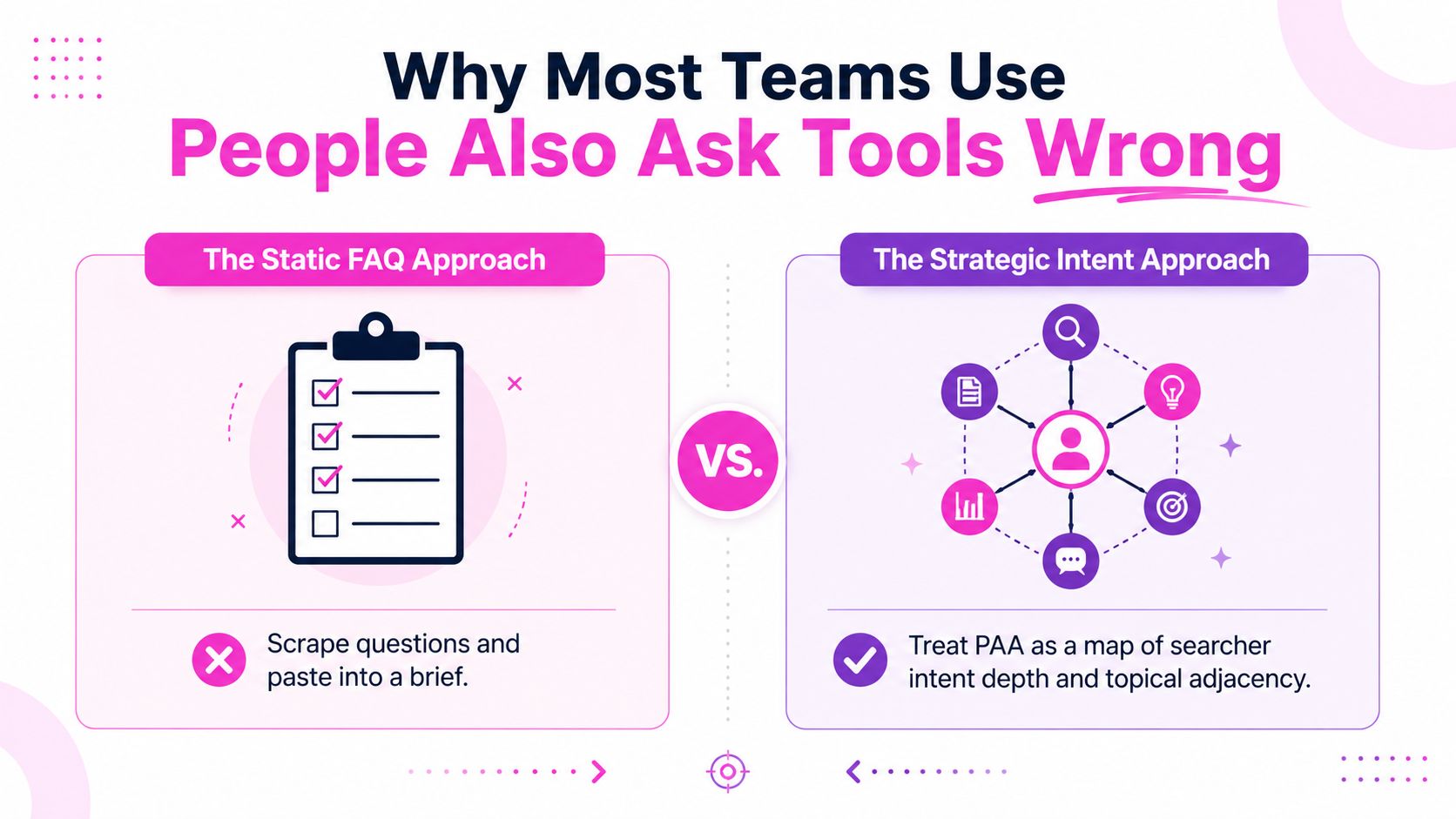
Teams treat PAA as a static FAQ generator. They enter a seed keyword, scrape the visible questions, and hand writers a spreadsheet. That approach confuses data collection with search analysis.
PAA behaves more like a branching graph. A box usually starts with 1 to 4 related questions, and expanding a question can reveal further questions and a linked source page, as documented in GetStat's explanation of PAA expansion. The new questions aren't automatically children in a content hierarchy. Some deepen the original intent, some introduce a comparison, and others drift into an adjacent use case.
The export-and-publish trap
A raw export creates three predictable problems:
- Thin pages: Teams turn every question into a short answer instead of developing one useful resource.
- Cannibalization: Several pages target near-identical questions because nobody mapped the relationships first.
- Intent dilution: A commercial page gets loaded with beginner definitions, while an educational page suddenly tries to sell a product.
I use each question as a prompt for a decision, not as a mandatory heading. Does it describe the same problem as the page's primary query? Does it require the same format and level of detail? Would a reader expect the answer before or after evaluating a solution?
The market's scale makes this workflow worth designing carefully. Google introduced PAA in 2015, and independent measurements have found it in roughly 43% of queries in Ahrefs data and 51.85% of searches in Semrush Sensor data from August 2024, with the variation reflecting different datasets and measurement methods (SearchOS's PAA history and analysis). PAA isn't a curiosity to check occasionally. It's a recurring search surface that can expose intent across informational, commercial, and navigational queries.
Practical rule: Never ask, “How many PAA questions did we find?” Ask, “What search journey do these questions describe, and which page should own each branch?”
The strongest workflows preserve the question's context, expansion level, location, language, answer format, and competing URLs. That turns a list into a model you can revisit when the SERP changes.
How PAA Actually Works on Modern SERPs
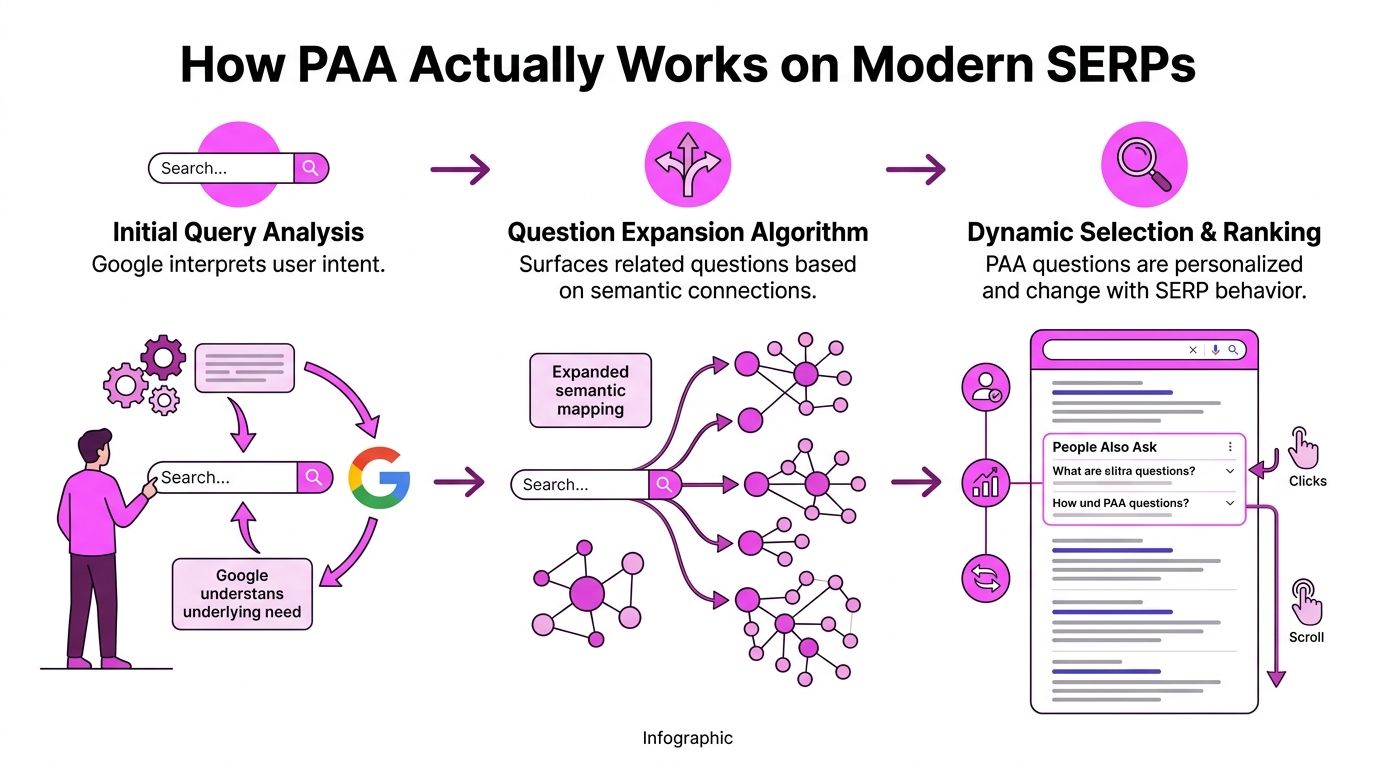
PAA is an accordion-style feature. A searcher expands a question in place and sees an answer that resembles a featured snippet, along with more related questions. The box therefore acts as a low-friction branch point in the search journey, because the user can explore without submitting a new query, as described in Nielsen Norman Group's overview of SERP features.
Google doesn't select questions from a fixed master list. It interprets the original query, evaluates related intent, and chooses questions that fit the surrounding results. The visible set can change by country, language, device, personalization, and the depth of expansion. A question that appears useful for a broad educational query may disappear for a product-led query.
Expansion changes the evidence
The first PAA layer tells me what Google associates with the seed query. The next layers show how the search journey branches after a user explores one idea. That distinction matters. A follow-up about implementation may belong in a buying guide, while a follow-up about terminology may belong in a foundational explanation.
PAA also sits close to other answer surfaces, including featured snippets. I use the SemDash guide to Google featured snippets when I need to compare the answer format and page structure shown for a question, rather than assuming PAA and featured snippets behave identically.
AI has added another layer of volatility. Search Engine Land reported that Google began showing AI Overviews within PAA in November, and that 12.6% of answers across more than 8.4 million English-language PAA results were AI-generated by 2025 (Search Engine Land's analysis of AI-generated PAA answers). That doesn't make PAA useless. It changes what I record. I now capture whether the answer is classic or generated, whether a URL is cited, and whether the question still represents a click opportunity.
Semrush's study found PAA in 49.37% of desktop results and 52.27% of mobile results within a 1,000,000-keyword dataset, with 75% of appearances in the top 3 results (Semrush's PAA opportunities study). These figures show prominence, not guaranteed visits.
Impressions aren't clicks
Search Console counts a PAA impression when the searcher expands the question and a link to the page appears. A click requires the searcher to click that link, and the position within the expansion sequence doesn't change whether the URL can count as an impression, according to Search Engine Journal's explanation of PAA Search Console data.
I separate expansion visibility from traffic in reporting. A page may earn exposure in PAA while the visible answer satisfies the searcher, especially when an AI Overview answers the question directly.
My Workflow for Mining PAA Questions in SemDash
I start with a seed keyword that represents a real business topic, not a random question. The seed should connect to a page type, audience, or product category we can support. “Project management software” is more useful as a planning seed than an isolated question such as “What is project management?”
Step 1, capture the initial SERP context
I run the seed through SemDash and record the country, language, device, current SERP features, ranking pages, and visible PAA questions. SemDash's keyword research environment combines question discovery with SERP and keyword context, so I don't have to treat the question list as detached from rankings.
The first pass is a snapshot, not a content plan. I label every question by likely intent:
- Informational: definitions, processes, causes, and education.
- Comparative: alternatives, differences, pros and cons, and evaluation.
- Transactional: pricing, providers, implementation, and purchase readiness.
- Navigational: brand, platform, documentation, or destination requests.
I also mark the answer format. A short definition, ordered process, comparison table, and product recommendation create different brief requirements.
Step 2, expand the branches selectively
I expand the most relevant questions through several levels, but I don't treat depth as a quality score. A branch stops when the questions become repetitive, unrelated, or too far from the original business problem. The point is to discover meaningful adjacency, not to create the largest possible tree.

Step 3, filter before clustering
I remove duplicate wording, generic questions that don't support the audience, and branches that require a separate intent. I also compare the questions with keyword metrics such as search volume and difficulty where available, but I don't let metrics override relevance. A question with apparent demand still belongs in the discard pile if the answer would distract from the page's promise.
For writers who need help converting research into structured briefs, SEO writing tools for creators can support the drafting workflow after the intent decisions are made. I wouldn't use an AI writing feature to decide page ownership. That decision needs editorial and SERP judgment.
Step 4, identify recurring questions
Questions that appear across multiple related seeds deserve attention. Repetition can indicate a central concern, but it can also reflect Google's tendency to reuse a common question. I check the wording, answer format, ranking URLs, and intent stage before assigning priority.
Step 5, connect questions to ranking pages
Finally, I compare the PAA branches with competitor URLs and existing pages. If several questions fit one page and competitors answer them shallowly, I add them to a consolidated brief. If one branch demands a different audience or conversion path, I create a separate brief and link the pages intentionally.
Turning PAA Insights Into Content Briefs and Clusters
A PAA question becomes useful only after I assign it to a page with a clear job. The central question is not, “Where can we insert this phrase?” It's, “What should the reader be able to do after this page answers it?”
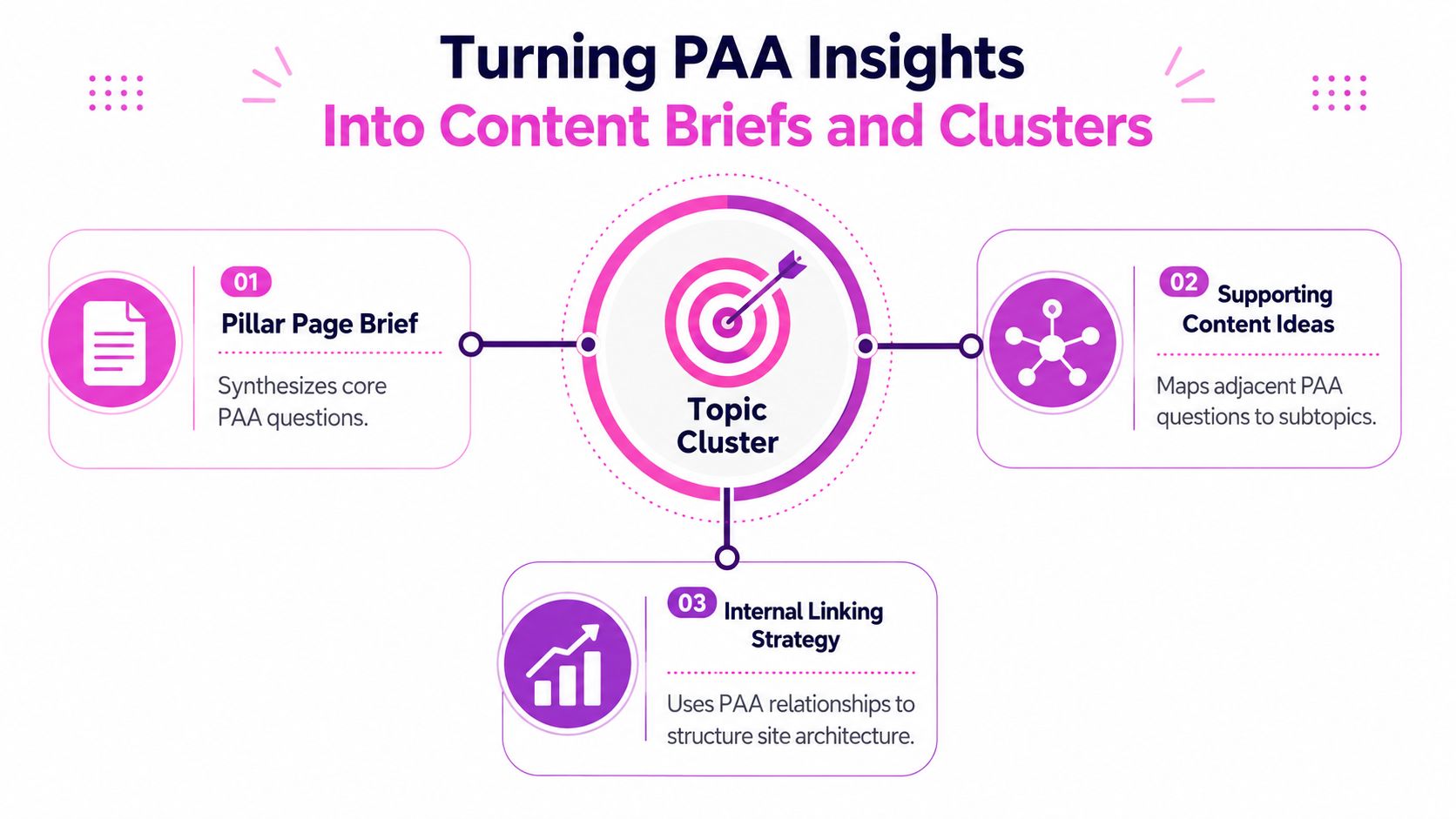
I usually map questions across a topic cluster with three layers:
- Pillar coverage: The main page explains the category, core definitions, primary workflow, and major decision criteria.
- Supporting coverage: Separate articles handle adjacent problems, detailed comparisons, implementation issues, or audience-specific scenarios.
- Conversion coverage: Commercial pages address product fit, alternatives, use cases, and next steps without pretending to be neutral educational guides.
Give each page a distinct boundary
Suppose a cluster concerns customer relationship management software. The pillar might explain what CRM software does and how teams evaluate it. A supporting page could compare CRM implementation approaches. Another could address CRM workflows for a specific team. A product page should explain how the actual platform handles those needs.
The questions may overlap semantically, but the pages shouldn't compete for the same primary intent. I write a one-sentence ownership rule into every brief:
This page owns the problem of choosing a CRM for a growing sales team. It supports implementation questions but doesn't become an implementation tutorial.
That sentence prevents writers from turning every brief into a miniature encyclopedia.
Build the brief around intent stages
Within each page, I order questions by the reader's likely progression. Informational questions establish the problem. Comparative questions help the reader evaluate approaches. Transactional questions clarify fit, constraints, and action.
SemDash's clustering and page-level mapping help expose where multiple seed keywords produce the same question family. I use that overlap to merge redundant drafts before production. I also record the internal links that should connect the pillar, supporting articles, and relevant commercial page. PAA relationships can inform site architecture, but they don't replace judgment about navigation or conversion.
The finished brief includes the primary intent, excluded questions, supporting questions, preferred answer formats, competing URLs, internal-link targets, and the evidence the writer needs. That's more valuable than a long list because it tells the writer what not to cover.
Common PAA Mistakes and How I Avoid Them
PAA is a live intent map, not a ready-made content plan. Its questions shift by market, result depth, and the presence of AI Overviews, so I review the SERP conditions behind each question before treating it as an opportunity.
| Mistake | Practitioner Fix |
|---|---|
| Reading repeated questions as separate demand | Compare the wording, answer URL, and intent. Repeated branches often reflect one underlying need, not several content opportunities. |
| Treating AI Overview questions as durable topics | Check whether the generated answer already satisfies the query. If the SERP resolves the need without a click, require a clear reason for creating or expanding content. |
| Equating PAA impressions with traffic | Use Search Console to separate visibility from visits. An appearance in an expanded result does not prove that the searcher reached the site. |
| Trusting one market's question set | Recheck priority questions in the target market and device context. A useful branch in one SERP may be absent or commercially irrelevant elsewhere. |
| Ignoring answer-URL instability | Record which pages answer the question, then review changes over time. A rotating answer set can indicate unstable intent or a SERP still testing interpretations. |
| Forcing every question into FAQ copy | Choose the format that fits the task. A comparison table, process, example, or short definition may answer the intent better than an exact-match heading. |
| Keeping questions that attract the wrong reader | Remove branches that do not support the page's audience or outcome. Extra topical coverage can dilute the brief and attract weak-fit visits. |
The loop problem
Google can surface repeated or near-repeated questions as the tree expands. I treat repetition as evidence about how the SERP groups intent, then inspect the relationship between the questions and their answer URLs instead of counting each appearance as new demand.
AI-generated answers make that review more important. A question may appear because it helps the SERP elaborate on a topic, while offering little standalone value for a site. I flag those branches when the answer is generic, the source pages keep changing, or the generated response closes the task without a clear next step.
Deletion remains the hardest editorial decision. If a question conflicts with the page's primary intent, belongs to another funnel stage, or produces a weak answer for the audience, I remove it. A smaller brief with clear ownership gives the writer more room to explain what matters and makes later performance easier to interpret.
A Real Example From a Recent Content Plan
I recently built a B2B SaaS content plan from one competitive product-category seed. SemDash surfaced more than 80 PAA questions across four expansion layers, which I filtered into 22 high-intent questions, grouped across five supporting articles and one pillar page.
The initial export looked promising but unfocused. It mixed category education, implementation concerns, buyer comparisons, and questions triggered by surrounding AI-generated content. I tagged every question by intent and then reviewed the answer URL and SERP context. That eliminated branches that looked commercially relevant in isolation but didn't describe the product category we were planning to cover.
What changed the cluster
The strongest opportunity was a comparison cluster. Competitors had content around the broad category, but they hadn't addressed the specific evaluation questions that appeared when users explored alternatives. Those questions became a supporting article because they shared a comparison intent and needed a structured evaluation framework rather than scattered FAQ answers.
The pillar page absorbed the foundational questions. Implementation questions became separate support content because readers needed more detail than the pillar could provide without losing focus. The commercial page received internal links from the educational and comparison resources, but I kept the buying decision on the page designed for it.
What failed
Some questions appeared high-value because they were visible in the expanded tree. After reviewing the results, I found that several were being pulled into the experience by unrelated AI Overview content. They didn't consistently align with the seed topic or the audience's likely needs.
That failure changed my process. I now record the exact SERP context before approving a question, including whether the answer is generated, which URL appears, and whether the branch persists across related seeds. I also avoid treating a one-time appearance as a durable content opportunity.
The useful output wasn't the export. It was the set of decisions that turned an unstable question graph into six pages with non-overlapping jobs.
Next time, I'd time the research closer to the briefing and validate volatile branches again before publication. PAA is a moving input, so the brief should preserve the reasoning behind inclusion and exclusion, not just the questions themselves.
Building a Repeatable PAA Process
A PAA tool creates value only when the team treats its output as a living signal. I use a recurring review for priority clusters, comparing new captures with earlier snapshots and flagging branches that have changed intent, answer format, or AI Overview treatment.
The workflow is simple:
- Refresh priority clusters: Re-pull the important seeds and inspect new branches.
- Review intent drift: Check whether informational questions have become comparative or commercial.
- Audit generated answers: Flag questions where an AI Overview now satisfies the answer or changes the citation pattern.
- Update ownership: Move questions between pillar, support, and conversion pages when the search journey changes.
- Log decisions: Record which PAA questions became briefs, which were merged, and which were rejected.
Teams that want a wider content-planning framework can pair this process with Contesimal's SEO content playbook, then use the SemDash guide to People Also Ask tracking to formalize SERP monitoring. I'd assign one owner to review the log, because unowned research quickly becomes another abandoned spreadsheet.
Start by auditing one existing content cluster. Run its core seeds through your people also ask tool, map the branches to current pages, and identify where the questions expose genuine gaps rather than filler. Then set a review cadence and measure the quality of your PAA-to-brief decisions, not just the number of questions collected.
Use SemDash to expand PAA branches, connect questions with keyword and SERP data, and organize them into page-level content clusters. Visit SemDash to test the workflow on one priority topic and turn a changing question graph into a focused content plan.