

Most comparisons ask which tool is better, and that framing usually wastes the budget conversation. Similarweb and Ahrefs aren't competing on the same measurement job. One is built to estimate total visits across channels, the other is built to infer organic search traffic from rankings, search volume, and CTR, so the fundamental question is which model answers the question you're trying to solve (Ahrefs traffic estimation method).
I've run both on client accounts where the same domain looked “wrong” in both tools, and the mistake was almost always the same. Someone tried to reconcile panel-based market estimates with crawler-based organic estimates as if they should match. They don't, and once you stop forcing parity, the workflow gets cleaner, the reporting gets faster, and the team stops arguing about which dashboard is “right.”
| Decision point | Similarweb | Ahrefs |
|---|---|---|
| Measurement job | Total market context across channels | Organic search execution |
| Best for | Channel mix, share of voice, audience overlap, market benchmarking | Keywords, backlinks, content gaps, SEO diagnostics |
| Data model | Clickstream/panel-based estimation | Crawler and SERP-based organic inference |
| Common failure mode | Noisy on smaller properties and easy to overread as exact truth | Ignores non-organic demand entirely |
| Practical takeaway | Use it when you need breadth | Use it when you need depth |
Table of Contents
- Introduction to the Similarweb vs Ahrefs Decision
- How Similarweb and Ahrefs Measure Traffic
- Data Coverage and Accuracy Benchmarks Compared
- Pricing Models and Plan Value
- Best Use Cases for SEO Teams and Agencies
- Recommendation Framework for Choosing Your Tool
- Migration and Workflow Integration Tips
Introduction to the Similarweb vs Ahrefs Decision
The fastest way to make a bad call is to compare Similarweb and Ahrefs as if they were twins with different interfaces. They're closer to two instruments measuring different layers of the same market. Similarweb is the better fit when you need a broader view of traffic sources and market share, while Ahrefs is the better fit when you need organic search detail you can act on.
Start with the question, not the vendor
When I audit stacks for agencies or in-house teams, I start by asking what decision the tool has to support. If the answer is “show me how a competitor splits traffic across paid, organic, referral, display, affiliates, and social,” Ahrefs is the wrong first tool. If the answer is “which keywords, backlinks, and pages are driving organic visibility,” Similarweb is usually the slower route to the same outcome.
That distinction sounds simple, but it prevents a lot of wasted reporting time. Teams often compare the same domain in both tools and panic when the numbers don't line up. They're looking for agreement between a total-visits model and an organic-only model, which is a category error.
Practical rule: Don't ask which platform is more accurate in the abstract. Ask which one is closer to the business decision in front of you.
How I test the fit in practice
My usual workflow is blunt. I'll run competitor domains through both tools, compare keyword sets, inspect backlink gaps, and then check whether the output helps the team make a better decision. For a growth team, that might mean validating content priorities. For an agency, it might mean proving market share pressure before a pitch.
The result is rarely “pick one and forget the other.” It's usually a split like this, Similarweb for market context, Ahrefs for execution. Once that boundary is clear, the rest of the evaluation becomes practical instead of ideological.
How Similarweb and Ahrefs Measure Traffic
The biggest difference between these tools is the measurement engine. Similarweb uses clickstream-based panel data to estimate traffic across channels, while Ahrefs estimates organic search traffic only by combining ranking keywords, search volume, and CTR (Ahrefs traffic estimation method). The same domain can look materially different in each dashboard without either one being broken.
Why the update cadence changes the experience
Similarweb's SEO comparison materials lean on freshness, including a last 28 days view and a 12-month average view, which helps when a client wants recent movement without waiting for quarterly reports (Similarweb vs Ahrefs comparison). Ahrefs comes from a crawl-first heritage, so its strength is in mapping pages, links, and keyword footprints rather than modeling every channel. That difference shows up in day-to-day workflow fast.
I use Similarweb first when I need to sanity-check market movement, especially if a stakeholder asks why a competitor's traffic appears to shift before it shows up in owned analytics. I use Ahrefs first when the job is to find the pages and keywords behind organic gains or losses. The same account can support both, but the order matters.
Scale sets the expectation
Modern SEO buyers also judge tools against huge platform numbers. The SemDash business context cites 6.6B Google keywords refreshed in the last 30 days, 2.7T backlinks with 15B+ crawled in the last 24 hours, and 600M SERPs refreshed monthly, which is the kind of coverage benchmark users now expect when they compare platforms like Ahrefs and Similarweb. Ahrefs, for its part, says its methodology spans 170 countries (Ahrefs traffic estimation method).
The practical takeaway is simple. Similarweb is estimating market behavior at the channel level, while Ahrefs is inferring organic demand from search signals. If you import a Similarweb total-visits number into an Ahrefs organic report, you're mixing two different statistical questions. For teams that want to compare organic visibility against another SEO stack, a SemDash vs SpyFu comparison can be useful as a secondary reference point. For workflow teams that need a repeatable way to capture SERP changes, the SERP scraping API guide is a practical companion.
Data Coverage and Accuracy Benchmarks Compared
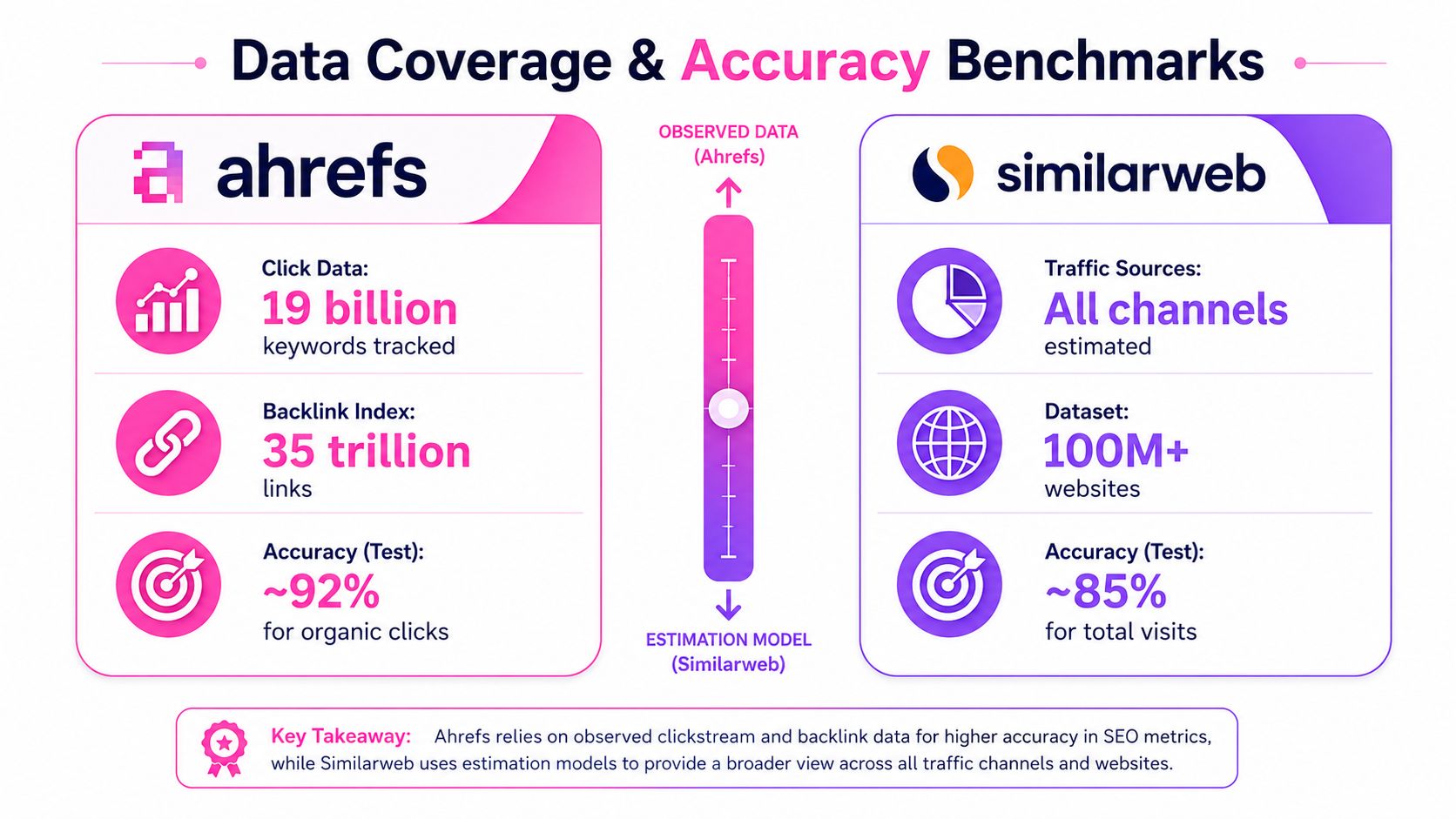
The cleanest way to explain the split is to start with what each tool is trying to measure. Ahrefs infers traffic from the keywords a site ranks for, then combines search volume, ranking position, and CTR across 170 countries. Similarweb is built for broader market intelligence, so it looks at organic vs. paid traffic, channel breakdowns, audience overlap, and engagement signals.
The key difference is the statistical target
That target matters more than the feature list. Ahrefs is solving for organic search traffic, which makes it strong for keyword-level and page-level SEO work. Similarweb is estimating total visits across channels, which makes it more useful when you need competitive context, channel mix, or a market-share view.
I've watched teams treat Similarweb's traffic estimate like a replacement for analytics, and that is where the confusion starts. It is not first-party measurement, and it is not meant to be. It is a market model. Ahrefs is not a full-funnel traffic model either, because it leaves paid, social, email, and referral demand outside the estimate.
What independent comparisons suggest
Published comparisons point in the same direction. Analysts have found Similarweb can be the more accurate traffic estimator in some test sets, and one analysis reported small average variation for Similarweb compared with larger variation for Ahrefs and Semrush. That does not make one tool universally better. It shows that each one is tuned to a different statistical problem.
Use the lens that matches the question. If you need total-market framing, Similarweb is often the better fit. If you need SEO execution, Ahrefs is usually the sharper tool.
Field note: I trust neither tool as a source of truth for my own site. I use them as directional instruments, then calibrate against first-party data when the decision matters.
For teams collecting SERP evidence around these workflows, the SERP scraping API guide is a practical companion because it helps separate observed search results from estimated traffic models.
I also point teams to SemDash's Ahrefs vs SpyFu comparison when they are choosing between SEO-focused research stacks, because the trade-offs around keyword depth and competitor analysis come up in the same buying conversation.
Pricing Models and Plan Value
I do not recommend judging these tools by sticker price alone. List prices shift, and the actual cost depends on usage pattern and workflow fit. A team that pays for broad market intelligence and then uses it only for keyword checks is wasting budget. A team that buys deep organic diagnostics but expects channel mix and audience overlap is buying the wrong job.
Match plan value to the work you actually do
Start with channel need. If your reporting has to cover paid, organic, referral, display, affiliates, and social, Similarweb's broader model makes more sense. If your day-to-day work lives in keyword difficulty, backlink gaps, and content opportunities, Ahrefs is the better fit because its SEO stack goes deeper where practitioners spend time.
Execution depth matters too. Ahrefs is more specialized for SEO diagnostics because its Keywords Explorer surfaces intent, clicks-per-search, keyword difficulty, and parent-topic signals, while its backlink stack goes into historical DR and UR patterns, anchors, and link-intersect work (The Search Monitor comparison). Similarweb is stronger for fresh demand tracking and cross-platform coverage, which makes it more useful when timing and channel context matter.
That split changes what value looks like on the invoice. Similarweb can save time for teams that need a fast read on where traffic is coming from across channels, while Ahrefs can save time for teams that live inside organic execution and need clearer next steps from the data.
How I decide whether a team should upgrade
I usually audit how many people will touch the data and what they will do with it. A solo consultant can often get by with one focused tool if the deliverable is narrow. An agency that has to produce client-facing market-share narratives may need broader channel coverage, especially if reporting cadence is tight and stakeholders want a clean story.
The workflow also matters. A tool with more surface area only helps if the team has time to interpret it. Smaller teams often do better with a single, sharper stack because they spend less time reconciling dashboards. Larger teams can absorb the overhead if they are feeding sales, strategy, and client reporting from the same source.
If I am building a recommendation, I ask three things:
- Which channels must be visible: Organic only, or total mix as well.
- Which outputs matter most: Backlink gaps, keyword targeting, or market-share context.
- Who consumes the report: A technical SEO lead, a CMO, or a client stakeholder.
If the answer is that the team needs both breadth and depth, then a combined stack can make sense. If not, paying for extra surface area just increases noise.
For teams that are comparing reporting workflows, the guide to SEO client reporting is useful because it shows how tool choice affects the way findings are packaged for clients.
Best Use Cases for SEO Teams and Agencies
The tool choice gets clearer once you map it to the job. Similarweb is better for the story above the SERP, and Ahrefs is better for the work inside the SERP. I've watched that split matter most in agency pitches, in-house reporting, and content planning meetings where the audience doesn't care about methodology, only the decision.
Where Similarweb earns its keep
When I'm helping an agency prepare a market-share narrative for a CMO, Similarweb is usually the first stop. Its ability to segment paid, organic, referral, display, affiliates, and social makes it useful for share-of-voice benchmarking and channel-mix comparisons (Opnily comparison). That's the kind of output leadership can understand without needing a crawl tutorial.
It also helps when the question is competitive positioning rather than page-level optimization. A brand team may want to know whether a rival is winning through paid acquisition, content, or a stronger referral ecosystem. Similarweb can answer that at a level Ahrefs doesn't try to model.
Where Ahrefs fits the operator's day
Ahrefs is the tool I reach for when the brief is “fix the organic problem.” Its Keywords Explorer, backlink reports, and content-gap workflows are built for that. I've used it to identify page clusters that needed consolidation, backlinks that justified outreach, and query groups that belonged on a single page rather than spread across thin assets.
For client reporting, I also like pairing Ahrefs outputs with a structured dashboard process, and this guide to SEO client reporting is a good companion when the deliverable has to land cleanly with non-specialists.
Who should use which tool
- Agencies: Similarweb for positioning decks, Ahrefs for delivery work.
- In-house SEO teams: Ahrefs for everyday execution, Similarweb when leadership wants market context.
- SMBs and startups: Ahrefs is usually enough unless you need channel benchmarking or broader competitive intelligence.
- New content clusters: Ahrefs for query and page design, Similarweb only if you need broader demand context.
One more thing I've learned the hard way. Similarweb's strength is breadth, not always precision on small sites, while Ahrefs is narrower but often more useful when the question is purely SEO execution. That's why the same tool can be a great fit for one team and a poor fit for another.
Recommendation Framework for Choosing Your Tool
The choice gets easier once you separate the measurement method from the job you need to do. Similarweb is built on panel-based estimates, so it is stronger for total market context, channel mix, and competitive framing. Ahrefs is built around crawl and search data, so it is stronger for organic execution, keyword work, and backlink analysis. The mistake I see most often is forcing one tool to answer both questions with the same level of confidence.
Use site size as a reality check
Small sites expose the limits of panel estimates quickly. Similarweb can be directionally useful on larger properties, but once traffic gets thin, the noise gets harder to ignore, especially for startups, niche publishers, and fast-changing content clusters. In those cases, a traffic read that looks clean in a dashboard can still be too loose to guide a decision, which is why Trust Traffic comparison is useful as a reality check.
Ahrefs has the opposite limitation. It does not try to model paid, social, referral, or email traffic, because it is focused on organic search. If those channels matter to the business, Ahrefs alone will give you a partial picture, even if the organic layer is accurate.
A simple self-audit before you choose
I use a short checklist with teams before they buy, renew, or reassign licenses.
- List the audience. If leadership needs the report, channel mix and market share matter more. If SEO operators are the audience, keyword depth and backlink detail matter more.
- List the channels you need. If organic is the only lens you care about, Ahrefs is usually enough. If you need to explain how traffic is split across channels, Similarweb has the better fit.
- Decide how much variance you can live with. If you only need a directional estimate, Similarweb can work. If you need cleaner execution data, Ahrefs is the safer choice.
- Check the site stage. Early-stage sites, volatile categories, and low-traffic properties tend to make panel estimates harder to trust.
- Compare against your workflow, not the feature page. If your team spends most of its time in briefs, decks, and market scans, a broader tool saves more time than a crawl-first tool. If your work is fixing pages, expanding queries, and cleaning backlinks, the SEO-focused stack is the better fit.
- Review alternatives before renewing. If the current tool leaves too much blind spot in either direction, a SemDash alternatives guide can help you sanity-check whether another stack matches your reporting style better.
How I'd choose in common scenarios
For an SMB that needs to publish content, track backlinks, and close keyword gaps, I would start with Ahrefs. It gives the operator's view without much waste.
For an enterprise team reporting to marketing leadership across multiple channels, Similarweb earns its place faster because the reporting question is broader than organic search. For a startup in a small or volatile market, I would be careful about trusting either tool as the final word on traffic and would use the one that matches the main decision being made.
The cleanest rule is still simple. Use Similarweb for market context and trend detection. Use Ahrefs for SEO execution and the work that follows from it.
Migration and Workflow Integration Tips
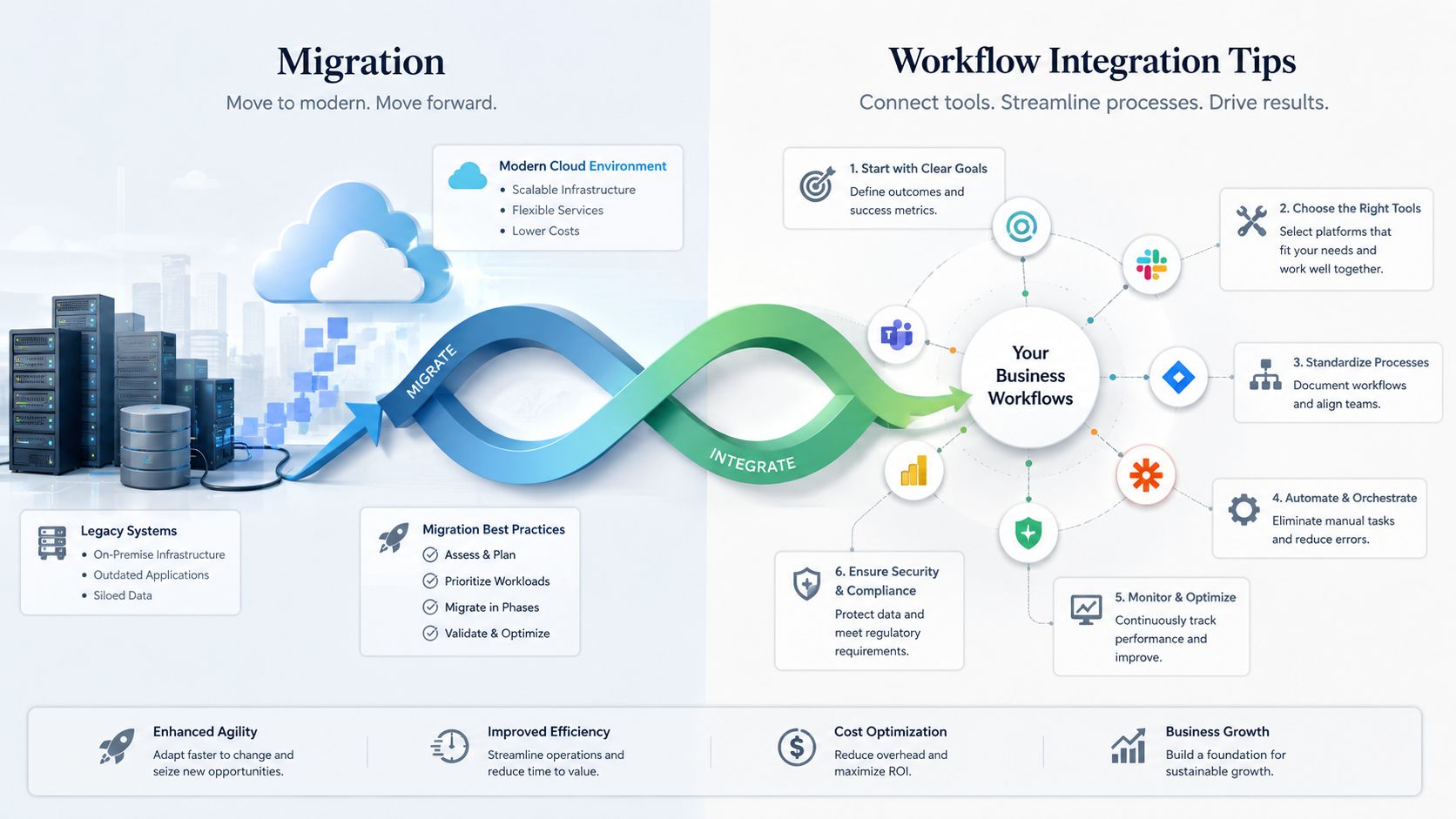
When I've moved teams from a solo Ahrefs workflow into a combined stack, the biggest win came from stopping people from reconciling the numbers line by line. Panel data and crawl data are not supposed to match. Once the team accepted that boundary, reporting stopped being a debate and started being a process.
A workflow that actually holds up
My practical split is consistent. I export Ahrefs organic keywords into a market-context document, then use Similarweb to frame channel mix and competitive positioning around that list. That keeps the organic execution layer separate from the broader market layer, which is exactly how the tools are built.
For refresh cadence, I lean on Similarweb's last 28 days view when I'm watching trend shifts or recent SERP movement, then use Ahrefs for backlink gaps and keyword-level work. That combination is useful when a client wants both the story and the to-do list without two separate research cycles.
What I tell teams not to do
- Don't reconcile totals: A Similarweb total-visits estimate is not a substitute for Ahrefs organic traffic.
- Don't duplicate reporting: Use one tool for market framing and the other for SEO execution.
- Don't force one dashboard to do everything: That's how teams end up with reports nobody trusts.
I've also found that a light process document helps. One page that says “Similarweb for channel mix, Ahrefs for backlinks and keywords” saves more time than any fancy integration I've seen. That clarity is worth more than a perfect-looking spreadsheet.
If you want a cleaner way to compare SEO tools without getting trapped in feature bingo, use SemDash to review keyword discovery, backlink research, SERP history, and competitor gap analysis in one workspace. It's built for the same kind of practical decisions covered here, where the key question is which data source fits the job, not which vendor sounds bigger.