
You can publish every week, build links, and refresh old pages, then still watch the same competitor sit above you. That's the part that frustrates teams most, because the work is real, but the visibility into what's missing isn't. When I run into that pattern, I usually find the problem isn't effort, it's that the team is looking at isolated tasks instead of the gap between current performance and the target they need to hit.
That's where what is gap analysis stops being a definition exercise and becomes a practical SEO workflow. I use it to move from vague underperformance to a ranked list of missing keywords, weak pages, and authority deficits, then I tie each one to a page, an owner, and a next action. In other words, the point isn't to make a prettier audit, it's to build a closure plan that tells you what to fix first and what to ignore.
Table of Contents
- Introduction Why Your SEO Feels Stuck Despite Doing Everything Right
- What Gap Analysis Really Means Beyond the Textbook Definition
- The Three SEO Gaps That Actually Move Rankings
- Why Gap Analysis Matters More Than Another Keyword List
- How I Run a Practical Gap Analysis Using Domain and URL Reports
- Turning Gaps Into a Ranked Plan You Can Actually Execute
- Common Mistakes That Make Gap Analysis Useless and How to Avoid Them
Introduction Why Your SEO Feels Stuck Despite Doing Everything Right
I've seen teams with strong content cadence and decent link acquisition hit a wall because they're measuring effort, not coverage. They know what they published this month, they know a few competitors they dislike, and they know traffic isn't moving the way they want. What they usually don't know is which part of the market they're missing, or whether the issue is targeting, content depth, or authority.
That's why a gap analysis matters more than another keyword export. The gap framework comes from a long history of structured current-state-versus-target-state thinking, not from SEO alone. In business, it's a way to compare actual performance with desired performance and turn the difference into measurable shortfalls and actions, and in SEO that same logic helps you compare your site against competitors, SERP leaders, and the pages that win clicks.
In practice, I treat gap analysis as a diagnostic, not a report. I want to know whether a missing ranking is caused by the wrong query set, a page that doesn't satisfy intent, or a site that lacks enough supporting links to compete. Once I know that, the work gets a lot simpler, because the next move isn't “write more,” it's “fix the right layer.”
The fastest way to waste a month is to build content for a gap you haven't diagnosed.
That's the mindset shift this guide is built around. I'll walk through the workflow I use when I'm looking at domain reports and URL-level reports, then I'll show how to turn the findings into a closure plan that names owners and metrics instead of leaving you with a spreadsheet nobody opens again.
What Gap Analysis Really Means Beyond the Textbook Definition
At its simplest, gap analysis follows a clean formula, Gap = Target State - Current State. That formula matters because it forces the analyst to define a measurable metric before trying to close anything, which is exactly where weak SEO audits fall apart. If you can't name the current state and the desired state in a way that produces a real delta, you don't have a gap analysis yet, you have a wish list.
From abstract delta to SEO measurement
In SEO, the current state might be your ranking, organic visibility, traffic share, indexed coverage, or referring domains. The target state might be a competitor's URL, a SERP position you need for a commercial query, or the page coverage required to satisfy intent. The useful part is the delta, because it turns “we're behind” into a concrete shortfall you can rank, assign, and work through.
That structure comes from more than one field. The U.S. Geological Survey's Gap Analysis Project grew out of conservation work that compared where species and habitat existed against where protection was needed, and it was launched in 1989 after earlier pilot work in the 1980s. That history matters because it shows the method was built as a repeatable way to compare a real state against a desired state, not as a vague planning slogan. The same logic later spread through strategic planning and management practice, where teams use it to compare actual performance with desired performance and define measurable shortfalls instead of hand-wavy problems. You can see that broader business framing in the historical overview of gap analysis as a structured method for current-state versus target-state comparison from Bacentric's gap analysis guide.
Why the method gets more useful when it gets more granular
The more specific the measurement, the more actionable the gap becomes. In project and performance work, teams often choose dimensions like cost, time, customer satisfaction, or capability, then benchmark current performance against a target to isolate the exact shortfalls that need action. In SEO, that means I'm not satisfied with “we need more traffic.” I want to know whether the shortfall sits at the keyword level, the page level, or the authority level.
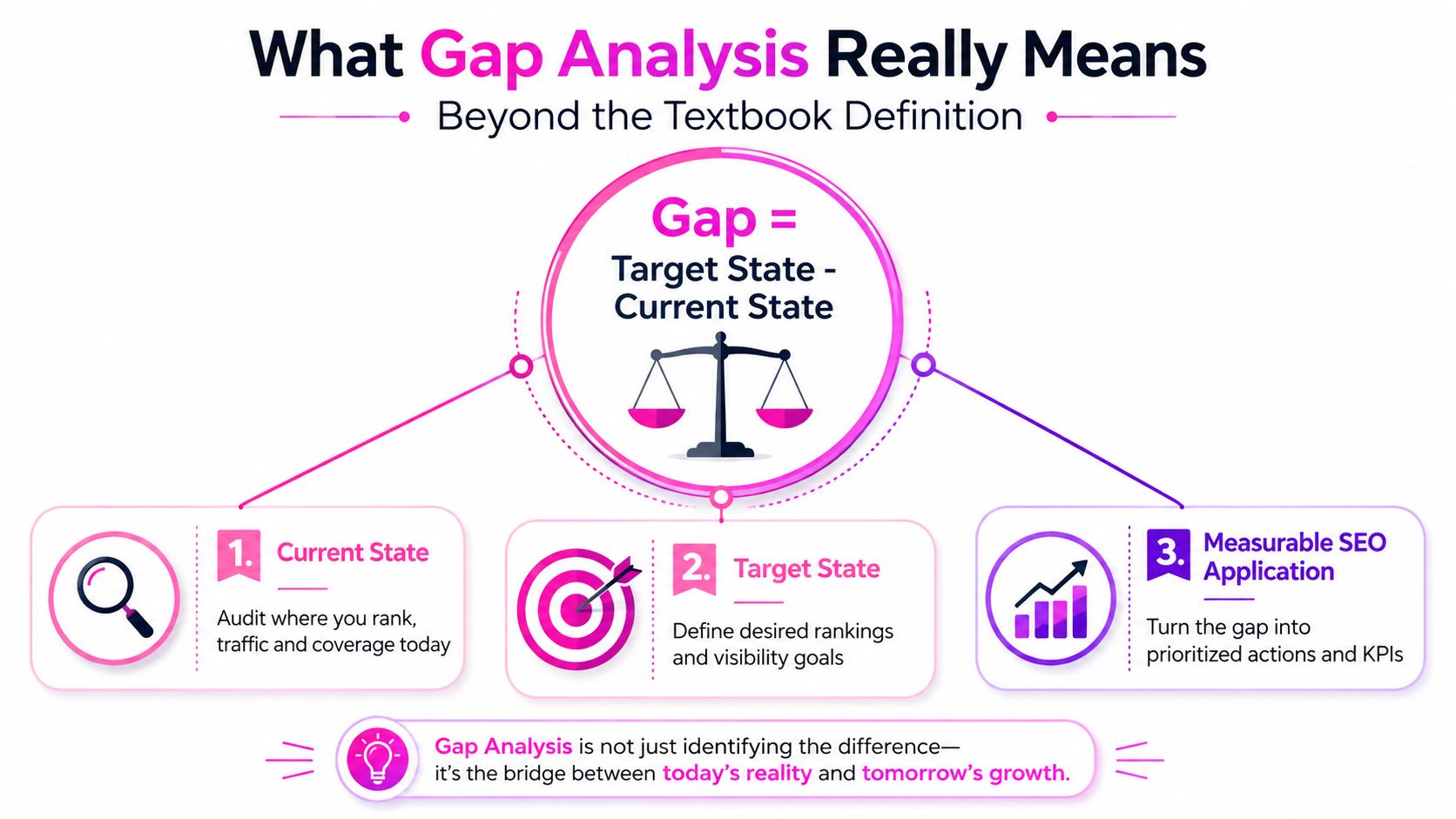
The practical win is prioritization. Once I know the delta, I can rank the gaps by impact, then decide whether each one needs new content, content consolidation, internal linking, or a backlink push. That's the point where gap analysis stops being a definition and starts functioning like a control process.
The Three SEO Gaps That Actually Move Rankings
Not every gap has the same cause, and I've wasted enough time in the past trying to solve the wrong one. The cleanest way to think about it is to separate keyword gaps, content gaps, and backlink gaps, because each one answers a different question about why a competitor outranks you.
Keyword gap
A keyword gap tells you which queries competitors get visibility for that you don't. It's the fastest way to surface missed demand, especially when the competing page is already earning traffic for a term you never targeted. If I'm looking at market entry or category expansion, I usually start here because it gives me the broadest map of missing coverage.
Content gap
A content gap is about topical coverage and intent satisfaction. You might already rank for some terms, but still lose because the page doesn't address the angle users want, the questions SERP features imply, or the supporting detail that makes the page feel complete. I end up checking whether the issue is a missing subsection, a weak comparison angle, or a content format mismatch.
Backlink gap
A backlink gap surfaces referring domains that support competitors but not your site. If the query is competitive, authority still matters, and link gaps often explain why a page with decent content can't break through. In my workflow, backlink gaps are especially useful when the page is already good enough to rank, but not strong enough to hold position against better-supported rivals.
| Gap type | What it tells you | Best use case |
|---|---|---|
| Keyword gap | You're missing demand | Expand market coverage |
| Content gap | You're missing intent coverage | Improve relevance and depth |
| Backlink gap | You're missing trust signals | Strengthen authority |
These gaps overlap, but they're not interchangeable. A page can have the right keyword target and still lose because it doesn't satisfy the query. Another page can be well-written and still underperform because it lacks links from the domains that keep showing up around the SERP.
If I'm mapping competitors, I'll often use a competitive discovery view first, then move to page-level analysis once I know which URLs matter. SemDash's SEO competitive intelligence workflow fits that sequence well, because domain discovery and page-level mapping belong in the same investigation, not in separate spreadsheets.
Don't confuse “we don't rank” with “we need content.” Sometimes you need a better target, sometimes you need better proof, and sometimes you need more authority.
The decision is which lens gives you the clearest next move. If the problem is visibility, keyword gap usually comes first. If the problem is relevance, content gap leads. If the problem is trust, backlink gap is the one that changes the outcome.
Why Gap Analysis Matters More Than Another Keyword List
A keyword list tells you what exists. A gap analysis tells you what's missing and why that miss matters. That difference sounds small until you've watched a team produce a huge list of terms, then spend months creating pages that never move because nobody checked whether the page, the intent, or the authority profile could win.
Prioritization beats volume
The biggest practical advantage of gap analysis is that it forces prioritization. Instead of chasing every term with search volume, I can rank opportunities by whether they align with business intent, whether the SERP is realistically beatable, and whether the site already has enough supporting assets to compete. That's how you avoid the trap of building content for terms that look attractive in a dashboard but don't change revenue.
I also use the gap lens to avoid cannibalization. If two pages are already competing for the same query family, the answer isn't another article, it's usually consolidation, re-optimization, or a clearer page map. Gap analysis helps me see that because I'm comparing the target query set to the URLs that already own those themes, not blindly adding more pages into the mix.
The metric and owner problem
A gap without a metric isn't operational. A gap without an owner isn't actionable. That's the lesson I keep coming back to in SEO projects, especially when the team gets excited about a list of missing keywords but never defines how success will be measured or who's responsible for moving the needle.
If no one owns the page, the gap stays theoretical.
That's why I like to attach each opportunity to a page type, a target metric, and a decision owner. If the task is content refresh, the owner is the editor or strategist. If the task is link acquisition, the owner is the outreach lead. If the task is target refinement, the owner is the person who can change how the query set is defined. The point is to connect diagnosis to execution.
A practical way to do that is to pair keyword gap findings with a competitive view, then use a page-level roadmap to decide what gets created, updated, merged, or promoted. SemDash's competitive landscape mapping is relevant here because it helps turn a broad market view into a set of concrete pages and domains to work from.
The better your gap analysis, the less time you spend arguing about whether SEO is “working.” You can point to the exact shortfall, the exact page, and the exact next move.
How I Run a Practical Gap Analysis Using Domain and URL Reports
I start at the domain level because it tells me where the market is clustered. Competitor domains and domain keywords show which sites own the space, which themes they keep repeating, and which query families matter enough to anchor a plan. That first pass isn't about copying them, it's about locating the territory they've already mapped and deciding where the missing edges are.
From market map to missing terms
Once I've got the domain view, I move into keyword gap and filter hard. I'm looking for terms competitors rank for that we don't, but I'm also watching the cases where both sites rank and the competitor gets the stronger result. Those mixed cases often matter more than pure misses because they show a page that's close but under-supported.
I always sanity-check for branded noise and intent mismatches. A competitor might own a branded term that doesn't matter to your funnel, or a keyword might look valuable but serve a different intent than your site can satisfy. That's where keyword clustering helps, because it keeps me from turning one query family into five competing pages.
URL-level mapping is where the work gets real
The most useful step is drilling into URL-level mapping. I want to know which competitor page is ranking, what format it uses, and what intent it serves. A blog post ranking for a commercial query often means the query has enough informational ambiguity that a better structured guide or comparison page can win. A product page ranking for a guide-style query often means the site has strong authority, but the content format is doing the work.
The page that ranks tells you more than the keyword does.
That's also where backlink gap earns its keep. I look for high-value referring domains already linking to competitors, then check anchor context before I decide whether outreach is even worth it. A link from a relevant domain that repeatedly supports category pages is more useful than a random mention with no topical fit.
What I exclude before I build the plan
I've learned to ignore “thin” gaps that look big but won't pay off. Some terms are too weak, too broad, or too disconnected from commercial value to justify content creation. Others look promising until you see the live SERP and realize the actual competition is video, forums, or a format you don't want to chase.
A tool like SemDash can save time by combining domain keywords, keyword gap, backlink gap, and URL-level mapping in one workspace. That makes it easier to move from broad market discovery to page-level action without exporting and reimporting the same data all afternoon.
The output I want is simple, missing terms, target URLs, intent notes, and a short reason why each opportunity belongs on the roadmap. If I can't write that in one line per gap, I'm not ready to act on it yet.
Turning Gaps Into a Ranked Plan You Can Actually Execute
The analysis only matters if it turns into a closure plan. I've seen too many clean audits die in a folder because nobody ranked the work, named an owner, or checked whether the fix was worth the effort. The right plan starts by sorting gaps into what should be created, updated, merged, redirected, or pushed with links.
A simple prioritization matrix
I usually sort opportunities into four buckets:
| Impact | Effort | Typical action |
|---|---|---|
| High | Low | Update a strong existing page |
| High | High | Build a new page or content hub |
| Low | Low | Tuck into a later sprint |
| Low | High | Usually skip |
That matrix keeps the team honest. A lot of keyword gaps land in the “high effort, low impact” box once you account for intent fit and SERP reality. On the other hand, some modest-looking URL updates can produce real movement because the page already has the right foundation.
Close the loop with owners and checks
I like to attach each gap to a page owner, a target metric, and a review date. That lines up with the more implementation-focused gap analysis workflows used in project and business analysis, where identification gets followed by prioritization, recommendations, stakeholder approval, implementation, and ongoing monitoring. The analysis isn't done when the spreadsheet is exported, it's done when the plan is moving and the measure is being watched.
The hardest part is usually deciding whether the fix is structural or tactical. If the target is wrong, the right move might be to re-baseline. If the page is fine but the topic cluster is weak, the fix is usually content architecture. If the page is strong but underlinked, the next move is authority building. That decision matters because the wrong fix wastes a cycle and makes the team think SEO is slower than it really is.
What I want in the final roadmap
A good roadmap doesn't list every gap. It names the handful that can move the business. I want the page, the owner, the action, the metric, and the check-in date, all tied together. If a gap can't survive that level of specificity, it isn't ready for execution.
The same logic also keeps reporting cleaner. When the closing plan is tied to a measure, the team can see whether the intervention is doing its job instead of guessing from rank noise. That's the difference between a tidy analysis and a usable operating plan.
Common Mistakes That Make Gap Analysis Useless and How to Avoid Them
The most common mistake I see is treating every gap as if it deserves the same response. It doesn't. Some gaps come from bad targeting, some from stale assumptions, and some from pages that are never going to win without a structural change.
The root-cause check most teams skip
When a shortfall shows up, I ask four questions about the plan behind it, the owner, the metric, and the assumptions. If the target is wrong, the gap is partly self-inflicted. If the owner can't move the page, the gap is organizational, not tactical. If the metric is too vague, the whole exercise turns into noise.
That diagnostic habit matters more now because search results change fast. A gap that looked real in one month can be caused by a format shift, a stronger competitor page, or an intent change on the SERP. If you don't keep monitoring, you end up closing yesterday's problem while tomorrow's one grows underneath it.
The mistakes I'd avoid first
- Chasing branded terms: If a competitor's branded traffic looks tempting, that's usually a bad opportunity for your site.
- Treating a one-time export as strategy: A gap list without a follow-up plan just becomes archived evidence.
- Ignoring intent mismatch: A term can be present in the keyword report and still be wrong for the page type you've got.
- Never rechecking the target: If the market moved, the target may need to move too.
The cleanest takeaway is simple. Use gap analysis to diagnose the problem, not to decorate a deck. Tie each gap to a metric, an owner, and a change you can make, then keep watching the result after the fix goes live.
If you want a faster way to compare domain gaps, page gaps, and backlink gaps in one place, SemDash brings those reports together so you can move from discovery to action without stitching data across tools. I use that kind of workflow when I need to see whether a ranking problem is really about targeting, content, or authority, then turn the answer into a plan the team can execute.