
Most ahrefs vs moz advice gets the buying decision backward. People compare feature lists, then wonder why two tools with similar labels produce different answers in the same campaign. In practice, the divide is database scale, data freshness, and coverage depth, because those are the things that decide whether you trust the tool for tactical work or use it mainly for slower strategic analysis.
| Workflow Need | Ahrefs | Moz | What Actually Matters |
|---|---|---|---|
| Broad keyword discovery | Stronger for large-scale discovery | Smaller corpus | More long-tail and niche query coverage |
| Backlink investigation | Deeper recall and filtering | Good for lighter monitoring | Whether the link picture is complete enough to act on |
| Fast reaction to change | Near-live in parts of the product | Average refresh around 3 days | How quickly ranking or backlink shifts become visible |
| Team learning curve | More complex | Easier to adopt | Whether your team can use the data without extra explanation |
| Competitive gap work | Up to 10 websites in content gap comparisons | Up to 3 | How wide a competitive net you can cast |
I've used both across client work, and the pattern is consistent. Ahrefs tends to become the default when the team needs breadth and depth, while Moz stays useful where simplicity and guided workflows matter more.
One practical resource I often send people early in the evaluation process is the SubmitMySaas guide to SEO tools, because it helps frame tool choice around workflow instead of brand loyalty. That framing matters here more than a spec sheet ever will.
Table of Contents
- Why Feature Lists Miss the Point in This Comparison
- Keyword Database Scale and What It Means for Discovery
- Backlink Index Recall and Competitive Link Intelligence
- SERP Tracking and Data Freshness for Tactical Decisions
- Pricing Structures and Return on Investment by Team Size
- When to Choose Ahrefs and When to Choose Moz
- Migration Strategies and Using Both Tools Together
Why Feature Lists Miss the Point in This Comparison
The usual ahrefs vs moz comparison assumes that if two tools both have keyword research, backlink data, and rank tracking, they're basically interchangeable. That's the wrong starting point. Two platforms can share the same feature name and still give you very different outcomes because the underlying index size and refresh cadence determine how much of the market you see.
The difference shows up in the work, not the menu
I've seen teams choose a tool because the dashboard looked cleaner, then discover that it missed the very terms or links they needed for a client report. That's not a UI problem, it's a coverage problem. Ahrefs' much larger keyword index and broader competitive discovery surface change how much of the search field you can map, while Moz's simpler structure changes how quickly a newer teammate can understand the output.
That's also why database size matters more than people admit. In the data I trust for this comparison, Ahrefs was reported to track 28.7 billion keywords, while Moz tracked 1.25 billion, a gap of roughly 23x in coverage (GetSpike comparison). One independent comparison reached the same scale difference, which reinforces that this isn't a marginal gap, it's a structural one (Eesel comparison).
Practical rule: if the question is “what exists in the market?”, coverage depth matters more than interface polish.
The same logic applies to refresh speed. If a ranking dropped yesterday, or a backlink disappeared during a campaign launch, stale data can make you act too late. Moz's database refresh is described as averaging around 3 days, while Ahrefs is described as much more frequent in different parts of the product, including near-live and daily refresh behavior (SEO Swarm comparison). That difference changes whether I trust the tool for a tactical decision or only for retrospective analysis.
For a broader perspective on how these trade-offs are evaluated in tool selection, I also like the operational framing used in a recent comparison of SEO platforms in Process Street's Ahrefs and Moz breakdown. The useful takeaway is simple. Feature lists tell you what the software claims to do. Coverage, freshness, and recall tell you whether the answer is dependable enough to act on.
Keyword Database Scale and What It Means for Discovery
Where the larger corpus changes outcomes
The 23x keyword coverage gap is not a vanity metric. It changes what appears in research when you start from a seed term and expand into adjacent topics, long-tail variants, or lower-volume commercial queries. Ahrefs' larger corpus makes it more likely that smaller opportunities appear before they are obvious in the market, while Moz's smaller index can miss them.
That difference shows up in three places. First, zero-volume and very low-volume keywords, where the platform has to decide whether a query is worth surfacing at all. Second, non-English and localized research, where the smaller corpus tends to fall off faster. Third, emerging topics, where the query set has not stabilized yet and missing suggestions can leave a content plan too narrow. Practitioners have pointed to those coverage gaps as the practical divide between the tools, especially outside major English-language research (Style Factory's Moz vs Ahrefs analysis).
Moz is still useful for keyword work. It holds up when the niche is well defined and the search vocabulary is stable. For a solo consultant working one local service site, the smaller corpus may still cover the market adequately. For an agency managing dozens of pages across several countries, missing a low-volume variant can leave a content gap unaddressed for months.
What this means for content planning
The biggest mistake I see is treating keyword database size as if it only affects volume estimates. It shapes discovery, cluster expansion, and gap analysis. If I am building a topic map for a SaaS client, I want the tool that can surface the awkward subtopics competitors are winning with, because those pages often produce the easiest wins.
Ahrefs is the safer discovery engine when the brief is broad. Moz is fine when the target set is already known and you are validating, not exploring.
The independent comparison from GetSpike also notes that Ahrefs' content gap tool can compare up to 10 websites, while Moz's equivalent is limited to 3 (GetSpike comparison). That matters when you are comparing competitors in a crowded space, because a wider comparison usually exposes patterns a narrow three-site view cannot. For teams that want a second operating layer, SemDash's comparison with Ahrefs is useful for seeing how another platform frames the same discovery workflow.
For agencies, that is often the deciding factor. The workflow is not “find a few keywords.” It is “find every relevant angle a client can realistically own.” Ahrefs is built for that larger search space. Moz can still support the final shortlist, but it is less likely to reveal the full set of options in the first pass.
Backlink Index Recall and Competitive Link Intelligence
Why missing links distorts the strategy
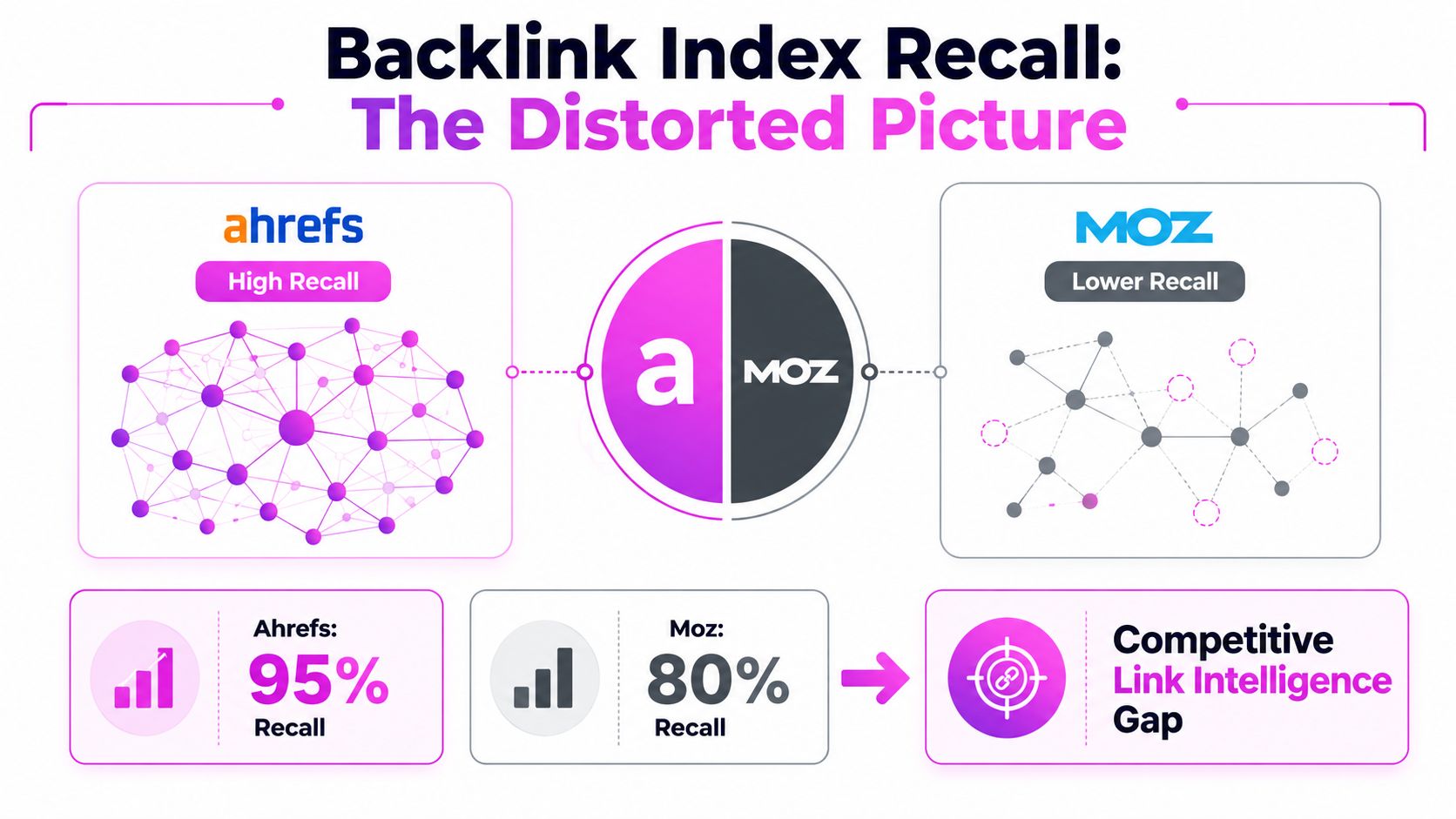
Backlink analysis only works if the index sees enough of the link graph to be useful. If the tool undercounts a competitor's links, the gap you think you're seeing can be smaller or larger than reality. Independent testing found Ahrefs identified an average of 46.2 of 50 known backlinks per site, or 92% recall, while Moz identified 34.7 links, about 69% recall (Thimpress testing summary).
That difference changes the call you make in client work. When I'm doing backlink gap analysis, I am not just counting links. I am deciding which domains are worth outreach, which competitors are carrying more authority than they appear to, and whether a broken-link opportunity is worth the time. Lower recall can hide the exact links that explain why one site keeps winning in a niche.
The same testing also reported Moz producing 42% fewer referring domains and 48% fewer backlinks than the Ahrefs baseline. I treat that as operationally meaningful because it changes the shape of the strategy. A thinner index can point outreach at the wrong domains or cause you to miss a cluster of links that explains a competitor's position.
What I've seen go wrong in practice
I have seen teams underestimate a competitor because the backlink profile looked weak in a smaller index, then find later that the competitor had several links from relevant industry publications the first tool never surfaced. I have also seen broken-link recovery campaigns miss easy wins because the referring domains were not visible in the first report. In those cases, the issue was not outreach quality, it was incomplete intelligence.
Moz is still usable for links. For routine monitoring, basic domain checks, and lighter competitive review, it can be enough. The problem starts when the work is acquisition-focused and every missed referring domain lowers the odds of a good pitch.
For teams that want a broader comparison of link research workflows, SemDash's comparison of Ahrefs and Semrush is a useful companion piece because it shows how another platform approaches the same investigative work. The same principle applies here. If the index is incomplete, the strategy built on top of it gets noisy.
Rule of thumb: use the deeper index when link acquisition changes the business outcome. Use the lighter one when you only need a directional check.
SERP Tracking and Data Freshness for Tactical Decisions
The biggest latency mistake I see is teams using stale rank data to make urgent decisions. If a title tag change, lost backlink, or launch-day ranking shift happens faster than the tool refreshes, the report can look calm while the campaign is moving. Moz's average 3-day refresh cadence and Ahrefs' much more frequent updates in parts of the product create very different risk profiles.
Tactical monitoring and monthly reporting are not the same job
For tactical work, freshness is the whole game. If I'm watching a new campaign or reacting to a competitor's sudden page update, I want the data to show change fast enough that I can respond before the volatility settles. In that scenario, Ahrefs is the better fit because near-live or daily refresh behavior matters more when the decision window is short.
Moz can still work when the cadence is slower. If you're doing a monthly reporting cycle, verifying general trend direction, or checking whether a page is broadly stable, a few days of lag usually won't hurt the decision. The mistake is paying for freshness you do not need, or trusting a slower system to catch short-lived changes that matter.
Match the tool to the decision window
A practical way to think about it is this.
- Use Ahrefs for urgent reaction: ranking drops, lost links, competitor title changes, fast-moving SERP volatility.
- Use Moz for slower analysis: monthly summaries, stakeholder reporting, long-view visibility checks.
- Do not mix the cadence: a tool can be excellent for one tempo and weak for another.
Ahrefs' faster refresh behavior also fits modern SERPs better, where intent can shift quickly and AI-driven result layers keep changing the page makeup. The comparison material I trust on this point notes that Ahrefs tracks AI Overviews visibility and cited URLs, while Moz stays focused on a simpler workflow (YouTube comparison referenced in the brief). That matters because a ranking report that ignores visibility shifts can send attention to the wrong optimization priority.
When I audit a client workflow, I ask one blunt question. Are we making decisions before the month ends, or after it? If the answer is “before,” freshness matters enough to shape the tool choice. If the answer is “after,” the simpler platform may be enough.
Pricing Structures and Return on Investment by Team Size
A cheap SEO tool isn't automatically cheaper in practice. If the database misses keywords, the backlink index misses referring domains, or the refresh cadence is too slow for your workflow, you end up paying for the tool and then paying again for supplements. That's why I judge ROI by actionable insight per workflow, not by sticker price alone.
Why team structure changes the math
Ahrefs' model tends to fit agencies and heavier SEO operators better because the value compounds when you're using the tool for discovery, gap analysis, link research, and competitive review across multiple projects. Moz's simpler structure often fits smaller teams because the learning curve is lighter and the reporting workflow is easier to hand off. The right answer depends on who has to use the output and how often they need it.
I've seen content-heavy teams burn through a lot of time compensating for missing breadth in a smaller database. I've also seen lean teams overbuy a deeper tool they barely exploit. Both mistakes are expensive in different ways.
| Workflow Type | Ahrefs Fit | Moz Fit | Key Consideration |
|---|---|---|---|
| Agency link building | Strong | Adequate for lighter review | Completeness of backlink intelligence |
| Content planning at scale | Strong | Mixed | Whether the keyword corpus reveals enough long-tail opportunities |
| In-house monthly reporting | Good | Strong | Simplicity and stakeholder readability |
| Local SEO for a small portfolio | Good | Strong | Ease of use and basic campaign tracking |
| Competitive gap research | Strong | Moderate | Breadth of comparison and depth of discovery |
The hidden cost is usually the supplement
If the core platform doesn't surface enough keywords or links, the team often adds another tool or falls back to manual checks. That hidden cost doesn't show up on the pricing page, but it shows up in hours. A platform that gives me the answer in one place is often cheaper than a lower-cost tool that needs two more systems to fill in the gaps.
For teams comparing tool stacks, the SemDash overview of Ahrefs alternatives is useful because it reminds you to price the workflow, not just the subscription. That's the right lens here too. If the platform changes how much manual verification your team has to do, the cost shifts fast.
My short version is this. If your work is discovery-heavy and cross-client, Ahrefs usually earns its place. If your work is smaller, steadier, and easier to explain, Moz can deliver better practical value.
When to Choose Ahrefs and When to Choose Moz
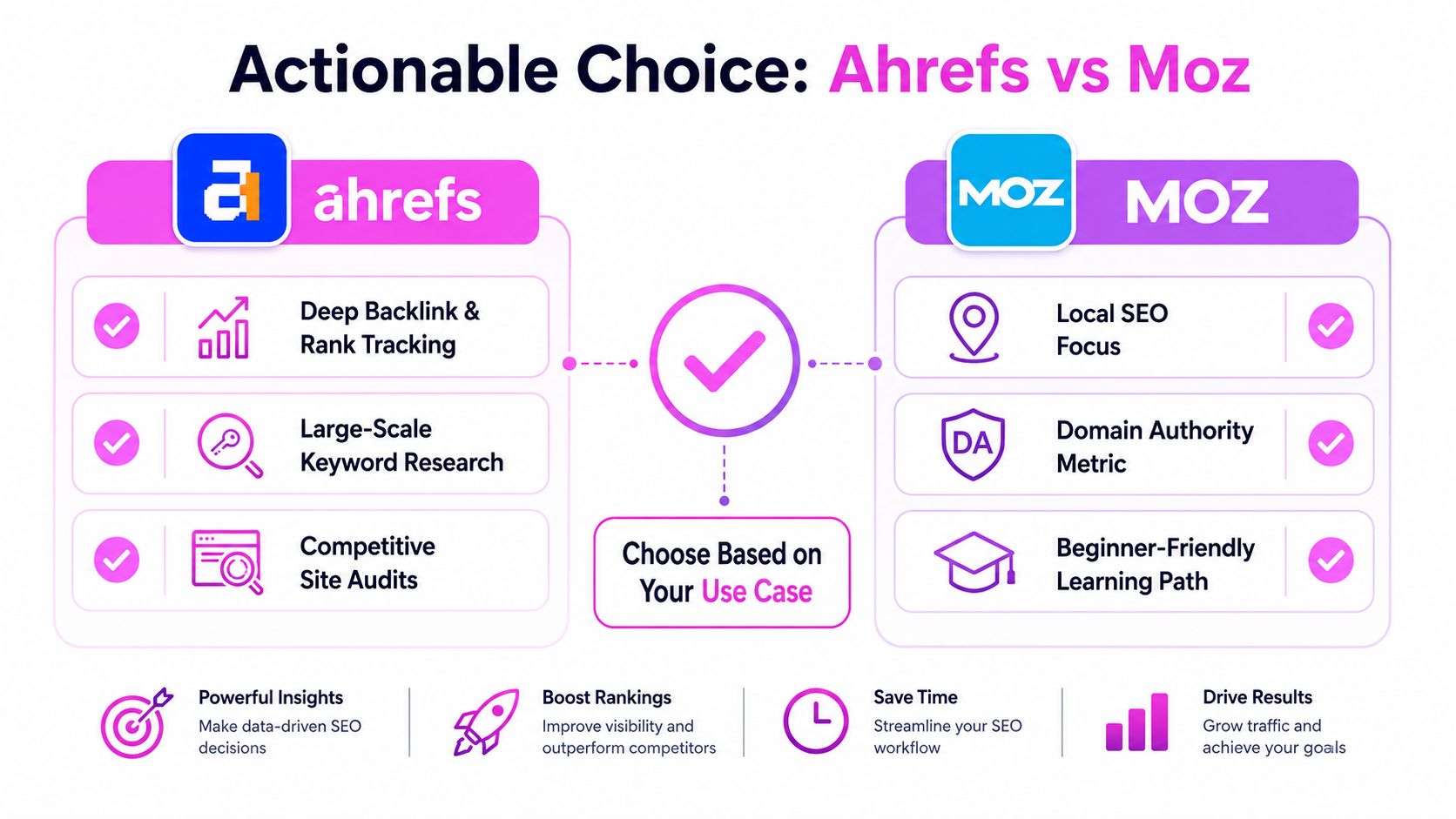
The cleanest way to choose is to start with the job, not the brand. If the job needs broad discovery, deeper backlink intelligence, and faster reaction to change, Ahrefs is the better fit. If the job needs approachable reporting, a gentler learning curve, and simpler ongoing monitoring, Moz is easier to operationalize.
Pick the tool that matches the workflow
For agency link building, Ahrefs is the first pick because the backlink recall and filtering make prospecting more reliable. For in-house content planning, Ahrefs also tends to win when the team needs long-tail discovery and gap expansion across a big topic map. For local SEO, Moz can be perfectly workable if the campaign is narrow and the team values straightforward reporting more than exhaustive research.
For e-commerce keyword research, Ahrefs usually has the edge because larger catalogs produce more niche query opportunities, and those are exactly the terms a smaller index is more likely to miss. For competitive monitoring, Moz can be enough if the main question is whether a target set of pages is generally stable and visible over time.
If I'm choosing one tool for tactical decision-making, I choose the one that sees change sooner. If I'm choosing one tool for monthly reporting, I choose the one the whole team can actually use.
There are also edge cases where neither platform is the perfect fit. Very advanced AI visibility workflows, broader marketing stacks, or separate search-engine coverage needs may push teams toward a different platform or a layered setup. In those cases, the smarter move is often to pair a core SEO tool with a specialist tool instead of expecting one subscription to solve everything.
The practical test I use is simple. Run one keyword expansion, one backlink gap check, one competitor review, and one rank change investigation. The tool that gives you the clearest next action with the least manual cleanup is the one that fits your workflow.
Migration Strategies and Using Both Tools Together
A lot of teams don't really “switch” from Moz to Ahrefs or vice versa. They keep both around for a while, then slowly decide which one owns discovery, which one owns reporting, and which one gets retired. That's usually the safest way to move because you avoid breaking historical comparisons overnight.
How I handle a Moz to Ahrefs move
The first thing I export is the reporting history that matters to the client. I rebuild the keyword sets, competitor set, and tracked pages in the new platform, then I verify that the same decision points still exist. What you lose in a move is often not raw data alone, but the continuity of how a team interpreted that data.
That means SOPs matter. If the old workflow said “check these 25 terms every Monday,” the new workflow needs the same trigger, the same owner, and the same review threshold. Otherwise, the platform change creates a process change, and those are easy to confuse.
How teams split the stack without duplicating work
I've seen agencies use Ahrefs for discovery and gap analysis, then keep Moz in place for a smaller set of recurring reporting tasks that non-specialists already understand. I've also seen in-house teams do the reverse during budget transitions, where Moz becomes the lighter reporting layer while Ahrefs is reserved for deep research and new campaign planning. The key is to assign one system as the source of truth for each task.
A clean split usually looks like this.
- Ahrefs owns exploration: keyword expansion, backlink prospecting, content gap analysis.
- Moz owns familiar reporting: repeatable monitoring, stakeholder-friendly views, simpler team onboarding.
- Shared responsibility stays limited: only the metrics that need cross-checking.
I've found that mixed stacks work best when the team doesn't try to compare every score across both tools. DA and DR, keyword counts, and link totals are not the same thing, so forcing them into one mental model creates confusion. Use one platform to explore, the other to simplify, and keep the handoff narrow.
If you're building a broader SEO operations stack, SemDash gives you keyword discovery, backlink research, SERP history, and AI-assisted briefs in one workspace, which can help when you want a different system for competitive discovery and content planning. I'd use that kind of platform when the goal is to reduce tool sprawl rather than argue over which index is slightly cleaner.
If you're deciding between Ahrefs and Moz for a live workflow, start with the job that's costing you the most time right now, then test the tool against that exact task. If you want a consolidated SEO research layer for keyword gaps, backlink analysis, and SERP tracking, visit SemDash and compare it against the way your team works.