
Competitive Keyword Analysis: A Step-by-Step Guide

Competitive keyword analysis is the process of identifying keywords your competitors rank for in Google that you don’t, then using that gap to prioritize content and close visibility deficits. It’s not just about knowing what your rivals target. It’s about understanding why those keywords convert, how hard they are to win, and which ones you can realistically claim with focused effort. Done right, this process reveals your most direct path to organic traffic growth.
The core inputs are straightforward: keyword overlap, search volume, keyword difficulty, and competitor ranking positions. When you layer in enrichment data like CPC and 12-month search trends, you move from a simple gap list to a prioritized content roadmap. The technique goes by several names in the industry, including keyword gap analysis and competitor keyword research, but the underlying logic is the same: find what’s working for others in your niche and build a smarter plan around it.
Here’s what a solid competitor keyword analysis surfaces:
- Keyword gaps: Terms multiple competitors rank for that your site doesn’t target at all
- Overlap count: How many of your submitted competitors share a given keyword gap, which signals relevance and opportunity strength
- Search intent alignment: Whether a gap keyword is informational, transactional, or navigational, which shapes how you respond to it
- Content expansion opportunities: Existing pages you can optimize versus net-new content you need to build
- Prioritization signals: Search volume, keyword difficulty, and CPC combined tell you where effort meets payoff
How to conduct competitive keyword analysis step by step
The process is more systematic than most guides suggest. Rushing competitor selection or skipping enrichment data leaves you with a gap list that’s long but not useful. Follow these steps to get a gap analysis you can actually act on.
Step 1: Identify your true SEO competitors
Your SEO competitors are not always your business competitors. A direct business rival might rank for branded terms only, while a content-heavy blog dominates the informational queries your buyers use. Start by searching your core target keywords in Google and noting which domains consistently appear. If you’re unsure who your organic competitors are, tools with a competitors finder feature can surface them automatically from your own domain, ranked by relevance.
Step 2: Input domains into a keyword gap tool
Enter your domain as the baseline, then add competitor domains. Effective gap analysis tools allow you to input multiple competitors at once, which gives you a much richer picture than a one-on-one comparison. The tool fetches each competitor’s full ranking keyword set, subtracts the keywords you already rank for, and returns the difference sorted by overlap count.

Step 3: Choose the right comparison mode
Most gap tools offer two modes. “Compare Websites” works at the domain level and surfaces gaps across your entire site. “Compare Webpages” takes specific URLs and runs a head-to-head comparison for a single topic page. Use the domain mode for a broad audit; switch to the page mode when you have a specific article or landing page you want to improve against a direct competitor page.
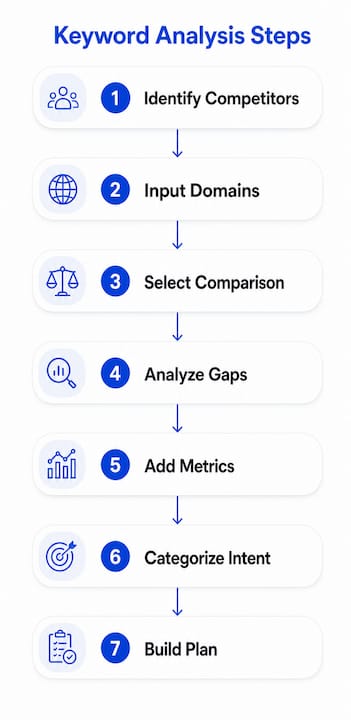
Step 4: Analyze the gap list by overlap count and metrics
Keywords ranked by multiple competitors are stronger opportunities than single-competitor outliers. A keyword that five of your top ten competitors rank for is almost certainly relevant to your audience. Sort by overlap count first, then filter by search volume and keyword difficulty to separate quick wins from longer-term plays. Pay attention to “Best Position” as well: a keyword where the leading competitor sits at position 2 is a harder gap to close than one where the best competitor ranks at position 28.

Step 5: Enrich with CPC, competition scores, and trend data
Enrichment data like CPC and 12-month trends transforms a raw gap list into a prioritization matrix. High CPC signals commercial intent. A rising 12-month trend means the topic is gaining momentum. Flat or declining trends are a warning: the keyword may not be worth the content investment even if the volume looks attractive today.
Step 6: Categorize by intent and assign to content types
Group your gap keywords by search intent before you assign them to pages. Transactional gaps (keywords with “buy,” “pricing,” or “best”) belong on product or comparison pages. Informational gaps belong in blog posts or guides. Branded competitor keywords, where searchers are looking for a specific rival by name, are a separate category worth tracking but rarely worth targeting directly.
Step 7: Build your content and optimization plan
Map each prioritized keyword to either an existing page that needs optimization or a new content brief. Pages that already rank on page two for a gap keyword are your fastest wins: a targeted update often moves them to page one faster than building something new. New content should be planned around clusters, not isolated keywords, so each piece reinforces your topical authority in the niche.
Pro Tip: Run your gap analysis with at least four or five competitors simultaneously. A two-competitor input gives you a narrow view; five or more competitors reveal the keywords that define your niche’s content landscape, not just one rival’s strategy.
Which tools give you the best competitor keyword research?
The right tool depends on what you’re trying to accomplish, your budget, and how deep you need to go. Here’s a breakdown of the main options and what each one actually does well.
-
Semdash combines keyword gap analysis, SERP tracking, backlink discovery, and semantic keyword clustering in a single platform. Its credit-based subscription model makes it accessible for solopreneurs and agencies alike, and its AI Overview monitoring is a feature most tools don’t offer yet. For teams that want one interface covering the full competitive research workflow, it’s a strong fit.
-
SpyFu is built around PPC competitor intelligence. It excels at showing you which keywords rivals have been bidding on in Google Ads for years, which makes it particularly useful if paid search overlaps with your organic strategy. Its historical data goes back further than most tools.
-
Ubersuggest, developed by Neil Patel, offers a free tier that covers basic competitor keyword lookups and domain-level traffic estimates. It’s a practical starting point for teams with limited budgets who want to check competitor keywords free before committing to a paid plan.
-
MozBar is a browser extension rather than a full platform. It surfaces domain authority and page authority scores directly in the SERP, which helps you quickly gauge how competitive a keyword gap actually is before you invest in content. Pair it with Moz’s competitive research suite for a fuller picture.
-
Ahrefs is widely regarded as one of the most accurate tools for organic keyword data and backlink analysis. Its Site Explorer lets you pull a competitor’s full ranking keyword set and filter by traffic value, keyword difficulty, or SERP features. The depth of its index makes it a go-to for enterprise-level competitor website keyword analysis.
-
Neil Patel’s resources, including the NeilPatel.com blog and his Ubersuggest platform, provide both free tools and detailed methodology guides for competitor keyword research. His content is particularly useful for marketers who want to understand the strategic reasoning behind the data, not just the numbers.
-
Keywords Everywhere offers a free keyword gap analysis tool that fetches ranking keyword sets for your domain and up to ten competitors, then diffs them. The gap discovery itself is free; enrichment data like search volume, CPC, and 12-month trends requires a paid plan. It’s one of the most accessible options for teams looking for a competitor keyword analysis tool free of charge at the core level.
Pro Tip: No single tool covers everything perfectly. Use a primary platform for depth (Semdash or Ahrefs) and a free tool like Keywords Everywhere’s gap analyzer for quick spot-checks when you want to validate a specific opportunity without burning credits.
How to interpret keyword gap data with real examples
Raw gap data only becomes useful when you know how to read it. Here’s how the key metrics translate into decisions.
The table below shows a sample keyword gap output for a hypothetical SaaS company in the project management space. Each row represents a keyword at least one competitor ranks for that the target site doesn’t.
| Keyword | Found on (competitors) | Best position | Search volume | CPC | 12-month trend |
|---|---|---|---|---|---|
| project management software for teams | 5 | 3 | High | — | Rising |
| free project tracker online | 4 | 7 | Medium | — | Stable |
| agile task management tool | 3 | 12 | Medium | — | Rising |
| kanban board for remote teams | 2 | — | Low | — | Stable |
| project timeline template free | 1 | 24 | High | — | Declining |
The first row is the clearest priority. Five competitors rank for it, the best position is 3, the CPC is high (signaling commercial intent), and the trend is rising. That combination tells you the keyword is both relevant and monetizable. The last row, by contrast, has only one competitor ranking for it, the best position is 24, and the trend is declining. Cut these without mercy from your priority list.
Overlap count is the single most reliable signal in a gap analysis. A keyword shared by many top competitors confirms that the topic is relevant to your audience and that the competitive bar is one you can plausibly clear, since others already have. Single-competitor gaps are worth noting but rarely worth prioritizing over shared ones.
Branded competitor keywords deserve a separate look. If searchers are typing a rival’s product name alongside a generic modifier like “pricing” or “alternatives,” those queries often carry high commercial intent. You won’t rank for the branded term itself, but you can create comparison or alternatives content that captures the intent behind it.
Pro Tip: When you add enrichment data to your gap results, sort first by “Found on” count, then filter to keywords where the best competitor position is 10 or lower. Those are the gaps where the topic is both proven and actively contested, giving you the clearest signal of where content investment pays off.
How Semdash powers advanced competitive keyword analysis
Semdash is built for the full competitive research workflow, not just a single step in it. Its platform integrates keyword gap analysis, SERP tracking with historical data, backlink discovery, semantic keyword clustering, and AI Overview monitoring in one interface, which means you’re not stitching together five separate tools to get a complete picture.
The gap analysis inside Semdash supports both domain-wide and page-level comparison modes, mirroring the “Compare Websites” versus “Compare Webpages” logic described earlier. You can input multiple competitors simultaneously, and the results include enrichment data like CPC, competition scores, and 12-month search volume trends without requiring a separate tool or account. For teams running keyword research for SEO at scale, that consolidation saves real time.
Key capabilities that set Semdash apart for competitive analysis:
- Semantic keyword clustering groups gap keywords by topic, so you can plan content clusters rather than isolated pages
- Backlink profile integration lets you cross-reference keyword gaps with link-building opportunities, connecting content strategy to authority building
- AI Overview monitoring tracks when competitor content appears in Google’s AI-generated summaries, a signal most tools don’t surface yet
- SERP tracking with historical data shows how competitor rankings shift over time, not just a snapshot of today
- Featured snippet and People Also Ask tracking reveals which gap keywords trigger rich results, where a well-structured answer can leapfrog traditional rankings
Semdash’s credit-based subscription model means you pay for the depth of analysis you actually need. Lighter plans work for solopreneurs and small teams; higher tiers unlock deeper competitor indexing and more simultaneous competitor inputs. The platform is positioned as an affordable alternative to enterprise-tier tools, with comparable functionality at a lower cost point.
A comprehensive competitive keyword strategy doesn’t stop at the initial gap list. It requires ongoing monitoring of competitor rankings, backlink profiles, and SERP dynamics to adapt as the competitive environment shifts. Semdash’s integrated tracking makes that ongoing work practical rather than a manual quarterly exercise.
Pro Tip: Use Semdash’s semantic clustering on your gap keyword list before you write a single brief. Clustering reveals which gaps belong to the same topic and can be addressed in one authoritative piece, rather than ten thin articles that dilute your topical authority.
How to track changes in competitor keywords over time
A one-time gap analysis is a snapshot. The real competitive advantage comes from treating keyword monitoring as a continuous process, not a quarterly audit.
Competitor rankings shift constantly. A rival might publish a new pillar page and jump from position 15 to position 3 for a cluster of keywords within weeks. Without ongoing tracking, you won’t know until the traffic loss shows up in your analytics. Set up rank tracking for your priority gap keywords so you see movement as it happens, not after the fact.
Watch for new keyword entries in your competitors’ profiles. When a competitor starts ranking for a keyword they didn’t rank for last month, it often signals a new content push or a page update. That’s your cue to evaluate whether the keyword belongs in your own content plan. Tools that track competitor keyword sets over time, rather than just pulling a current snapshot, make this pattern visible.
Backlink velocity is a useful secondary signal. When a competitor earns a spike in referring domains pointing to a specific page, that page is likely gaining ranking momentum. Cross-referencing backlink growth with keyword ranking changes tells you whether a competitor’s gains are organic or link-driven, which shapes how you respond. Semdash’s backlink tracking and SERP history features support exactly this kind of cross-signal analysis.
Seasonal keyword shifts are easy to miss if you’re only looking at average monthly volume. The 12-month trend sparkline in enrichment data shows whether a keyword peaks in Q4, dips in summer, or grows steadily year-round. Building your content calendar around those patterns, rather than flat averages, puts you in position to rank before the traffic surge arrives. Keyword placement strategy applies across contexts, from ATS resume keywords to SaaS product pages, and timing always matters.
Semdash gives you the competitive edge without the enterprise price tag
Most SEO teams know they should be doing competitive keyword analysis consistently. The gap between knowing and doing usually comes down to tool cost and workflow friction. Semdash closes both.
Where enterprise platforms charge hundreds of dollars per month for features most teams use only partially, Semdash delivers keyword gap analysis, SERP tracking, backlink discovery, semantic clustering, and AI Overview monitoring in a single credit-based subscription. You get the depth of a full competitive research platform without paying for seats and features you’ll never touch. Agencies running analysis across multiple client domains will find the tiered model particularly practical: scale up when you need more competitor depth, scale back when you don’t.
The platform covers the complete competitive keyword workflow from initial gap discovery through ongoing rank monitoring, so you’re not exporting CSVs between tools or reconciling data from three different dashboards. For SEO professionals who want to spend time on strategy rather than data wrangling, that consolidation is the real value. Start your competitive analysis today at semdash.com.
Key Takeaways
Competitive keyword analysis works best when overlap count, enrichment data, and ongoing tracking are combined into a repeatable workflow rather than treated as a one-time audit.
| Point | Details |
|---|---|
| Overlap count is the top signal | Keywords shared by multiple competitors are stronger opportunities than single-competitor gaps. |
| Enrichment data sharpens priorities | CPC, competition scores, and 12-month trends separate high-value gaps from low-return ones. |
| Two comparison modes serve different needs | Domain-wide analysis suits broad audits; page-level comparison targets specific content improvements. |
| Ongoing tracking beats one-time snapshots | Monitoring competitor keyword shifts and backlink velocity reveals emerging opportunities before traffic is lost. |
| Semdash unifies the full workflow | Semdash combines gap analysis, SERP tracking, backlink discovery, and AI Overview monitoring in one platform. |
FAQ
What is competitive keyword analysis?
Competitive keyword analysis is the process of identifying keywords your competitors rank for in Google that your site doesn’t, then using that data to prioritize content creation and SEO optimization. The goal is to close visibility gaps and capture search traffic your rivals are currently winning.
What are the key steps in a keyword gap analysis?
The core steps are: identify your SEO competitors, input your domain and competitor domains into a gap analysis tool, review the gap list sorted by overlap count, enrich results with search volume and CPC data, then map prioritized keywords to new or existing content. Sorting by how many competitors share a gap keyword is the most reliable way to find high-relevance opportunities.
What is an example of a competitor keyword?
A competitor keyword is any search term a rival ranks for that you don’t. For a SaaS company, an example might be “project management software for teams,” a keyword five competitors rank for on page one while your site doesn’t appear at all. That gap, especially with a high CPC and rising trend, signals a clear content opportunity.
Can I find competitor keywords for free?
Yes. Tools like Keywords Everywhere offer free keyword gap discovery, where you can input your domain and up to ten competitor domains and see the full gap list at no cost. Enrichment data like search volume, CPC, and 12-month trends requires a paid plan, but the core gap list is accessible without one.
How does Semdash support ongoing competitor keyword tracking?
Semdash combines SERP tracking with historical data, backlink monitoring, and keyword gap analysis in one platform, making it practical to track competitor keyword shifts over time rather than running manual audits. Its semantic clustering and AI Overview monitoring add competitive signals that most standalone gap tools don’t provide.