

A dofollow backlink is an ordinary hyperlink with no nofollow, sponsored or ugc attribute, and it is a hint for ranking, not a guarantee. Chasing the attribute alone is poor SEO advice because it ignores why the link exists, where readers encounter it, and whether the destination deserves the recommendation.
I'd rather earn a relevant editorial reference than collect followed links from pages nobody would reasonably use. When evaluating do follow backlinks, I start with purpose and placement, check the implementation, and measure outcomes beyond a backlink counter.
Table of Contents
- Dofollow Is Just a Normal Link, Not a Ranking Switch
- What a Dofollow Link Can and Cannot Guarantee
- How to Judge a Link Before You Ask for It
- Sponsored and Traded Links Need a Different Goal
- What Actually Earns a Dofollow Link
- Measuring What a Dofollow Link Really Delivers
- Audit Your Existing Links Before Chasing New Ones
Dofollow Is Just a Normal Link, Not a Ranking Switch
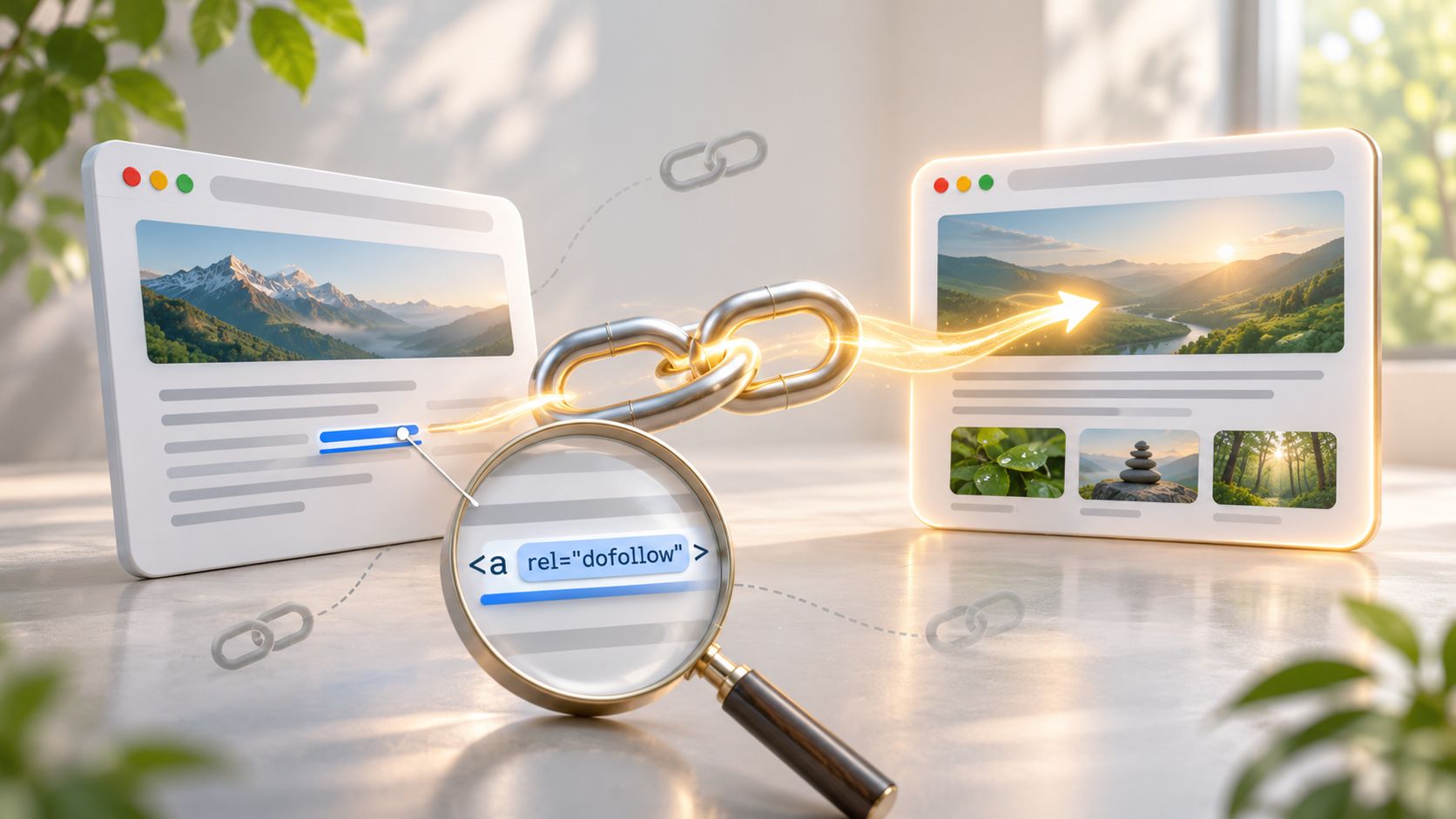
Dofollow isn't an HTML attribute. You don't need to add rel="dofollow" to make an ordinary hyperlink eligible for link-based evaluation. Without a qualifying rel value, you already have what SEO tools generally label a followed link.
That distinction matters when you're inspecting links manually. Searching the source code for the word dofollow can miss the very links you're trying to identify.
Link attributes and how Google treats them
| Link type | rel value | Ranking treatment | When to use it |
|---|---|---|---|
| Dofollow (default) | None | Ordinary link, no qualifier, can contribute to ranking | Editorial links a site owner chose to give |
| Nofollow | nofollow |
Hint, generally not followed for ranking | Links you don't want to vouch for |
| Sponsored | sponsored |
Hint, generally not followed for ranking | Ads, sponsorships and other paid placements |
| User-generated | ugc |
Hint, generally not followed for ranking | Comments, forum posts and other user content |
On September 10, 2019, Google's announcement about evolving nofollow introduced sponsored and ugc and made those attributes, alongside nofollow, hints for ranking rather than absolute commands; on March 1, 2020, that hint treatment extended to crawling and indexing.
Don't interpret those changes as permission to ignore link qualification. You're declaring the relationship behind a link, not choosing exactly how a search engine must process it.
Inspect the anchor, not the tool label
Right-click the visible link, choose Inspect, and locate the <a> element. Read its href destination and its rel attribute.
- No qualifying value: Treat the link as ordinary or followed.
- A qualifying value: Record whether it's nofollow, sponsored, ugc, or a combination.
- Other values: Don't confuse security-related values such as
noopenerwith ranking qualifiers.
An anchor can contain multiple rel values, so don't classify it from the first token alone. If your backlink export and the rendered page disagree, inspect the live implementation before asking anyone to change it.
I'd also record the surrounding sentence and placement. A spreadsheet containing only domain names and followed status strips away the context you need to make a defensible decision.
Practical rule: Label links by the reason they exist, not by whether you'd prefer ranking credit.
What a Dofollow Link Can and Cannot Guarantee
A clean followed link can support discovery and link-based evaluation. It can't force Google to crawl a page, include it in the index, or rank it above a better result.
Under Google's guidance for qualifying outbound links, nofollow, sponsored and ugc links are generally not followed, but a destination can still be discovered through other links or sitemaps. Don't mistake a qualified link for an invisible page, or an unqualified link for guaranteed indexing.
Check the implementation before assigning value
I'd use these checks before approving a placement:
- Find a real anchor with an
href. A clickable<div>with an event handler isn't equivalent to a conventional HTML link. If navigation only happens after an interaction, a crawler may not reach the destination through it. - Test the destination response and canonical URL. Expect a normal
200response from the intended page. A link to a redirect chain or an obsolete URL adds avoidable uncertainty. - Compare source and rendered HTML. Confirm the link is visible and usable in the rendered page. JavaScript-generated anchors can be processed, but a link injected only after a button click is a weaker implementation than a readily available anchor.
- Check indexability. Review robots directives and the selected canonical. A destination carrying
noindexwon't become indexable merely because you've earned a good backlink. - Inspect the placement beyond the individual page. A footer link repeated throughout a site isn't the same editorial recommendation as a contextual citation. Don't count template repetition as independent endorsements.
Separate technical eligibility from editorial weight
The 1998 PageRank paper by Larry Page, Sergey Brin, Rajeev Motwani and Terry Winograd established a model in which links from important pages carry greater weight. That foundation explains why raw link totals are an inadequate proxy for value.
You should also account for manipulation. If you acquire links primarily to manufacture ranking signals, you can lose the credit you expected from them, regardless of how clean the HTML looks.
A technically clean link is a prerequisite for a reliable implementation, not proof of SEO value.
How to Judge a Link Before You Ask for It
The rel attribute is the last thing I'd check, not the first. Before outreach, I want to know whether the proposed reference helps a reader complete the task that brought them to the page.
Use this checklist to separate a useful editorial opportunity from a placement that merely looks attractive in an export.
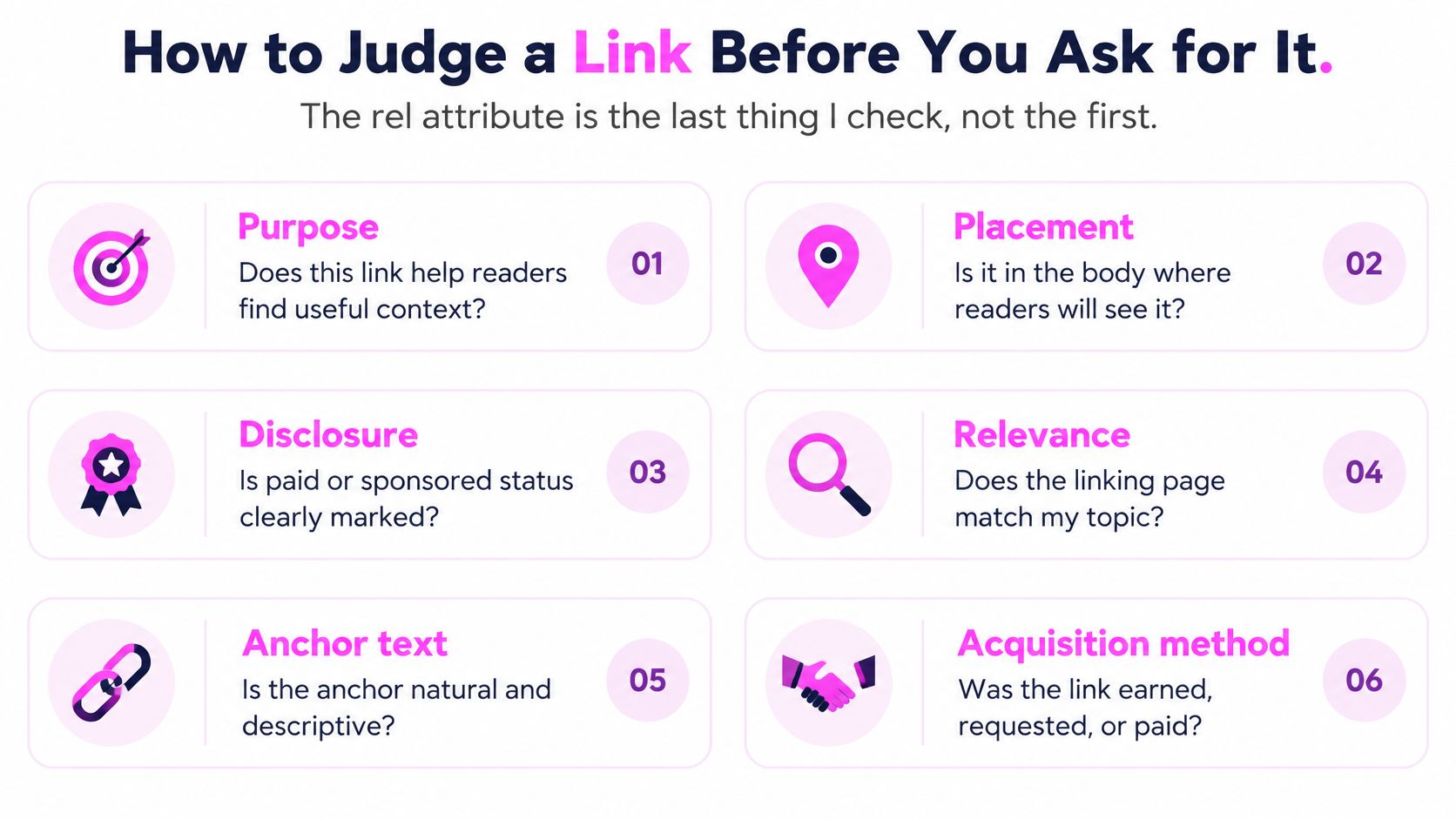
Six criteria for judging a link before outreach
| Criterion | What to check | Red flag |
|---|---|---|
| Purpose | Would a reader have a useful reason to click? | The link exists only to pass value to a listed page |
| Placement | Body copy within the main content | Sitewide footer, sidebar or repeated template links |
| Disclosure | Whether a paid or commercial relationship is stated | Paid placement with no sponsored qualification and no disclosure |
| Relevance | Whether the linking page topic matches your target page | Unrelated niche, mass-produced directory or link farm |
| Anchor text | Descriptive, natural wording | Repeated exact-match phrases across many domains |
| Acquisition method | Whether the site owner chose the link | Bought, traded in bulk or requested through reciprocal schemes |
Apply the framework to the actual sentence
Say you're editing a legal explainer comparing impaired-driving terminology. A reference to the license consequences of impaired driving from The Law Offices of Attorney Angel Lugo gives readers a relevant next step. The same reference inserted into an unrelated software tutorial wouldn't have that justification.
Now compare an unpaid guest contribution on a specialist site with a sitewide footer link from an unrelated directory. I'd consider the contribution if the editor independently accepts the reference, the destination supports the argument, and the anchor reads naturally. I wouldn't approve it merely because you wrote the surrounding article.
The directory footer fails the placement and relevance checks even if a backlink tool marks it followed. A prominent domain metric doesn't repair that mismatch.
Use pass or fail, not a flattering average
Mark each criterion pass, revise, or fail, and write a short reason. For commercial links, follow Google's outbound-link qualification guidance rather than treating an editorial-looking sentence as sufficient disclosure.
Any unresolved red flag in disclosure or acquisition method overrides the rest. Don't average away an undisclosed payment because the page looks relevant.
Sponsored and Traded Links Need a Different Goal
Treating every paid placement as a dofollow asset confuses advertising with editorial endorsement. You can buy access to an audience without buying permission to influence rankings.
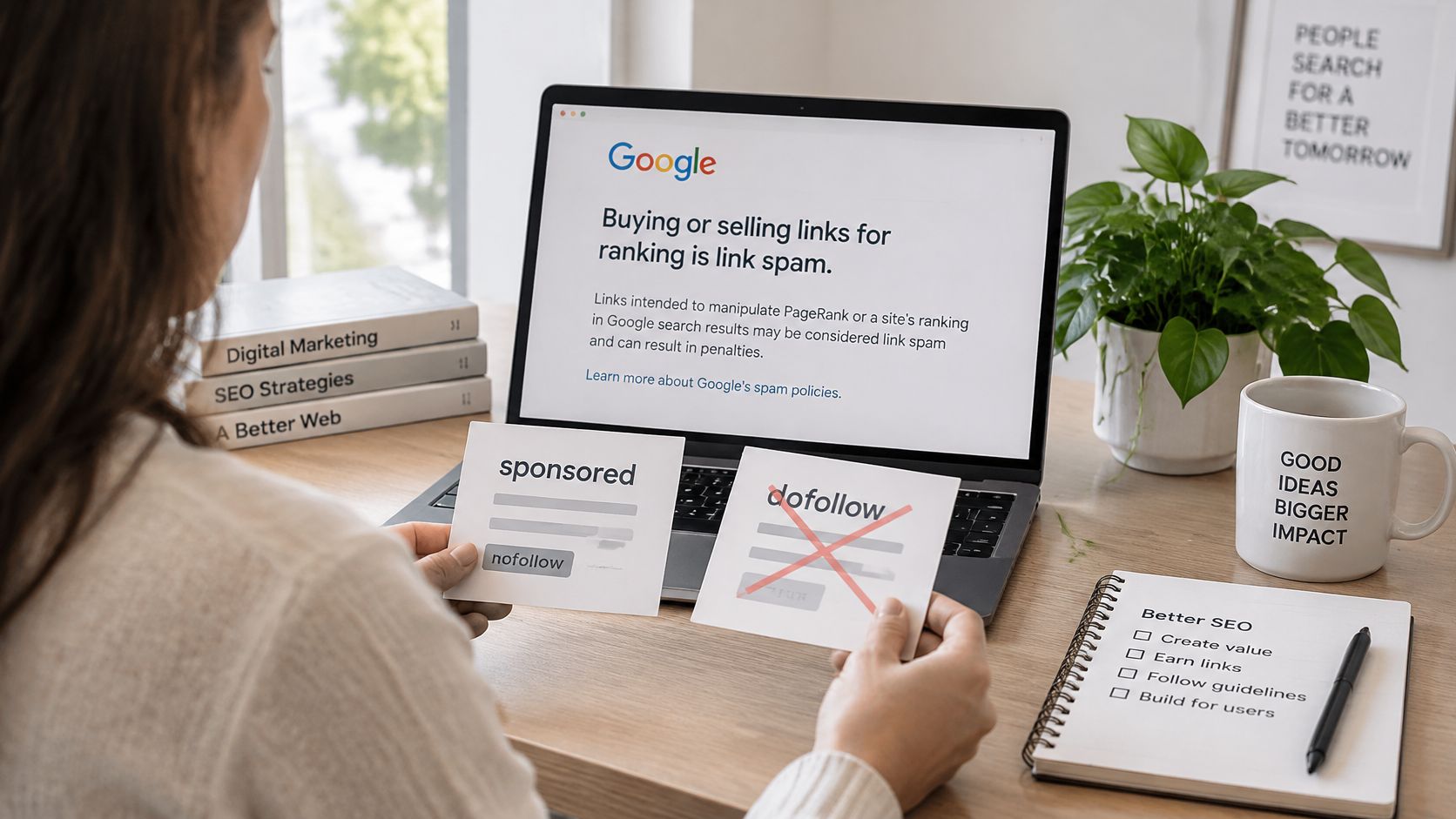
Google's spam policies identify buying or selling links for ranking purposes as link spam, including exchanging money for links or posts containing links. The examples also include excessive reciprocal exchanges and partner pages created mainly for cross-linking; qualifying commercial links with sponsored or nofollow avoids the unqualified paid-link problem.
Keep that distinction visible when reviewing offers.
Evaluate the audience you're buying
Say you sponsor a relevant industry newsletter that also publishes an online edition. A properly qualified link could bring qualified visits and purchases. You'd evaluate the offer using audience fit, placement, referral activity and conversion quality, not an assumed transfer of PageRank.
I'd ask for these conditions before approving a commercial placement:
- Qualification: Use
rel="sponsored"for paid and affiliate links, with nofollow an accepted alternative for paid placements. - Disclosure: Make the commercial relationship understandable to readers. An HTML attribute isn't a reader-facing disclosure.
- Measurement: Agree on a destination and use campaign tracking where appropriate.
- Editorial boundaries: Don't require keyword-heavy anchors or an unqualified link as a condition of payment.
Comment and forum contributions need a different classification. Use ugc for user-generated links rather than treating discussion participation as a route to unqualified backlinks.
Don't disguise a transaction as outreach
A requirement to link back, provide a product, or supply a service can create a commercial arrangement even without an invoice. I'd record what changed hands before judging the placement.
Not every mutual reference is an exchange scheme. You can naturally cite another useful site that also happens to cite you. The warning sign is making reciprocal linking the purpose or condition of the arrangement.
If money or goods changed hands for the link, budget it as advertising.
Leaving a paid link unqualified adds policy risk without giving you a ranking benefit you can count on. If an offer becomes unattractive once ranking credit is removed from the sales pitch, I'd decline it.
What Actually Earns a Dofollow Link
Stop treating followed status as a scarce prize. In 2024, an Ahrefs analysis of backlinks pointing to the top 110,000 websites, reported by Spiralytics, found 10.6% were nofollow, implying approximately 89.4% were followed.
That describes the analyzed backlink profiles, not your probability of earning a placement. For outreach, the useful question is what you can publish that gives an editor a reason to cite you.
Build something worth referencing
I'd prioritize these assets:
- An original benchmark with a published method. Explain the sample, exclusions and limitations so a writer can judge whether the finding supports their point.
- A free tool that completes a specific task. A focused calculator or validator gives readers something they can use, rather than another introduction to the topic.
- A documented process with real interface screenshots. Show the settings, decisions and failure cases. Don't replace implementation detail with generic illustrations.
- A commentary roundup with named practitioners. Ask a narrow question and preserve meaningful disagreement. A collection of interchangeable endorsements offers little reason to cite it.
Use the principles behind earned links to choose the asset before building the prospect list. A competitor's citation reveals a reader need, not an entitlement to the same link.
Make the request easy to evaluate
For a hypothetical outreach batch, I'd shortlist twenty pages already referencing a competing resource. Open each message with a specific paragraph or claim on the page, and explain in the same sentence how your asset helps.
For example: your troubleshooting paragraph explains the symptom, while my resource provides a reproducible diagnostic process that could support it. That's a stronger request than asking for a backlink because you published something detailed.
I'd send one follow-up about a week later, then stop. That's a working cadence, not a proven response-rate formula.
I'd exclude guest-post networks, indiscriminate paid directory submissions and comment drops from this workflow because they don't establish a defensible editorial reason for the citation. A legitimate specialist directory can still help users, but payment for inclusion belongs in a different evaluation.
Aim for main-content placement, topical fit and descriptive anchor text. Given otherwise comparable opportunities, I'd choose a relevant resource-page reference over an unrelated footer link on a larger site.
Measuring What a Dofollow Link Really Delivers
Domain authority scores and backlink counts don't tell you whether a placement delivers useful visits, supports discovery or contributes to sales. You need separate measures because those outcomes don't necessarily move together.
A study covering 900 U.S. adults and 68,879 Google searches, described by Forbes Advisor, found traditional-result clicks in 15% of visits without an AI Overview versus 8% with one, while links inside AI Overviews received clicks in only about 1% of visits. Don't assume visibility automatically becomes a website session.
Backlink outcomes, metrics and healthy signs
| Outcome | Metric to track | Where to check | Healthy sign |
|---|---|---|---|
| Discovery | Crawl or index date of the linked page | Search Console URL Inspection | Linked page indexed without manual submission |
| Rankings | Target-page rankings for the link's topic | Rank tracker or SERP history | Target page improves for its query after links arrive |
| Referral visits | Referral and engaged sessions from the linking page | Analytics referral report | Steady visits from the linking page |
| Assisted conversions | Conversions where the linking site appears earlier in the path | Analytics conversion-path report | Conversions show the referrer in the path |
| Brand visibility | Branded-search lift and AI answer citations | Search Console branded queries, AI answer checks | Branded impressions rise after coverage |
| Link persistence | Whether the link is still live and still qualified | Backlink monitor | Link remains live at a planned six-to-twelve-month review |
Establish a baseline before outreach
For a sample campaign, I'd record referral sessions, engaged sessions and target-page rankings for sixty to ninety days beforehand. That's a planning window, not a claim about how quickly links work.
Check discovery first, then rankings, referral engagement and conversion paths. Review branded queries and citation visibility separately, and revisit the placement to confirm it hasn't disappeared or changed destination.
Say a broad news reference sends few sessions but precedes discovery of a new product page. Treat that as a possible discovery benefit, not proof that the backlink caused indexing. A smaller niche blog might send consistent commercial traffic and prove more useful to the business.
Separate correlation from attribution
Record page edits, internal-link changes and other campaigns alongside link acquisition dates. Without that change log, you can easily credit a backlink for improvements caused elsewhere.
An AI answer citation isn't a visit, and an assisted conversion isn't automatically attributable to the referring site alone. Keep visibility and commercial outcomes distinct.
I'd retain and maintain a policy-compliant placement when it contributes to at least one useful outcome. Don't demand that every link win every metric.
Audit Your Existing Links Before Chasing New Ones
Start with links you already have. I'd resolve broken destinations and classification errors before spending more time on prospecting.
Keep the audit organized around evidence rather than a single quality score.
Work through a repeatable checklist
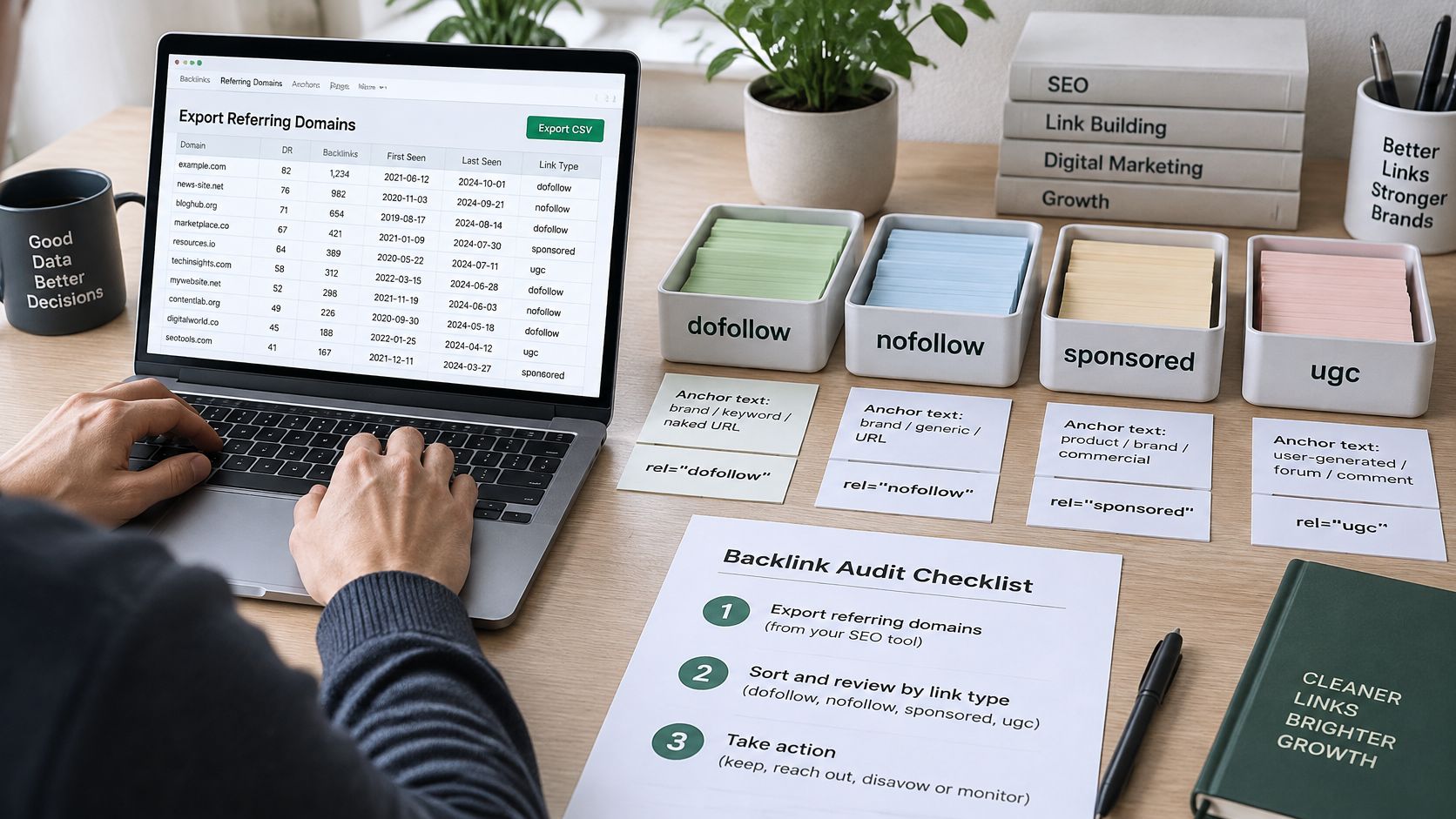
- Export referring domains, source pages and anchors. Keep the linked destination beside each source URL so you can evaluate the relationship, not just the domain.
- Classify the live attributes. Separate followed, nofollow, sponsored and ugc links. Preserve combined values instead of forcing every link into a misleading single category.
- Flag commercial arrangements. Record paid, affiliate and traded placements, then identify missing qualification. Changing your spreadsheet doesn't fix the publisher's HTML, so request the actual correction.
- Score editorial references. Apply purpose, placement, disclosure, relevance, anchor text and acquisition method. Keep a written reason for any rejection or repair request.
- Repair broken destinations. Restore useful content or redirect to an equivalent live page. Don't send every dead URL to the homepage, because you'd discard the context that earned the reference.
- Prioritize competitor gaps by relevance. Look for publishers with a credible reason to include your resource. A competitor's backlink isn't automatically an opportunity you should copy.
Our SemDash Backlink Gap tool finds domains linking to competitors but not to your site, helping identify new link-building opportunities. Our broken-backlink detection identifies dead links pointing to your site so you can fix or redirect them, while our Anchors report shows why people link to a page.
Use the backlink analysis workflow to keep your classification, repair decisions and prospect notes consistent. For a practical walkthrough, use the video below.
This week, take your top five gap domains, inspect the relevant source pages, and document why your destination would help their readers. Draft outreach only after those checks pass.
Use our backlink research, gap analysis and broken-link detection to separate useful editorial opportunities from links that merely look attractive in an export. Visit SemDash to review your existing backlinks, identify relevant competitor gaps and build your next outreach list around reader value rather than followed status alone.