

You've exported your backlink profile, sorted it by domain rating, and you're still staring at the same question. Which of these links does anything for the pages that earn revenue? That's where most audits stall, and it isn't a data problem. It's a sorting problem.
The honest answer to how to do backlink analysis is that the job is mostly triage. Build one clean inventory, cut it down to the links that can change a decision, and tie what remains to traffic and rankings. Every section below follows that order, because a profile you can't defend to a client isn't worth the export it came from.
Table of Contents
- How to Build Your Backlink Inventory Step by Step
- Backlink Metrics That Actually Matter
- Classifying Links by Intent and Risk
- Finding Competitor Gaps and Link Opportunities
- Reclaiming Lost Equity and Deciding When to Disavow
- Measuring Link Impact Against Traffic and Rankings
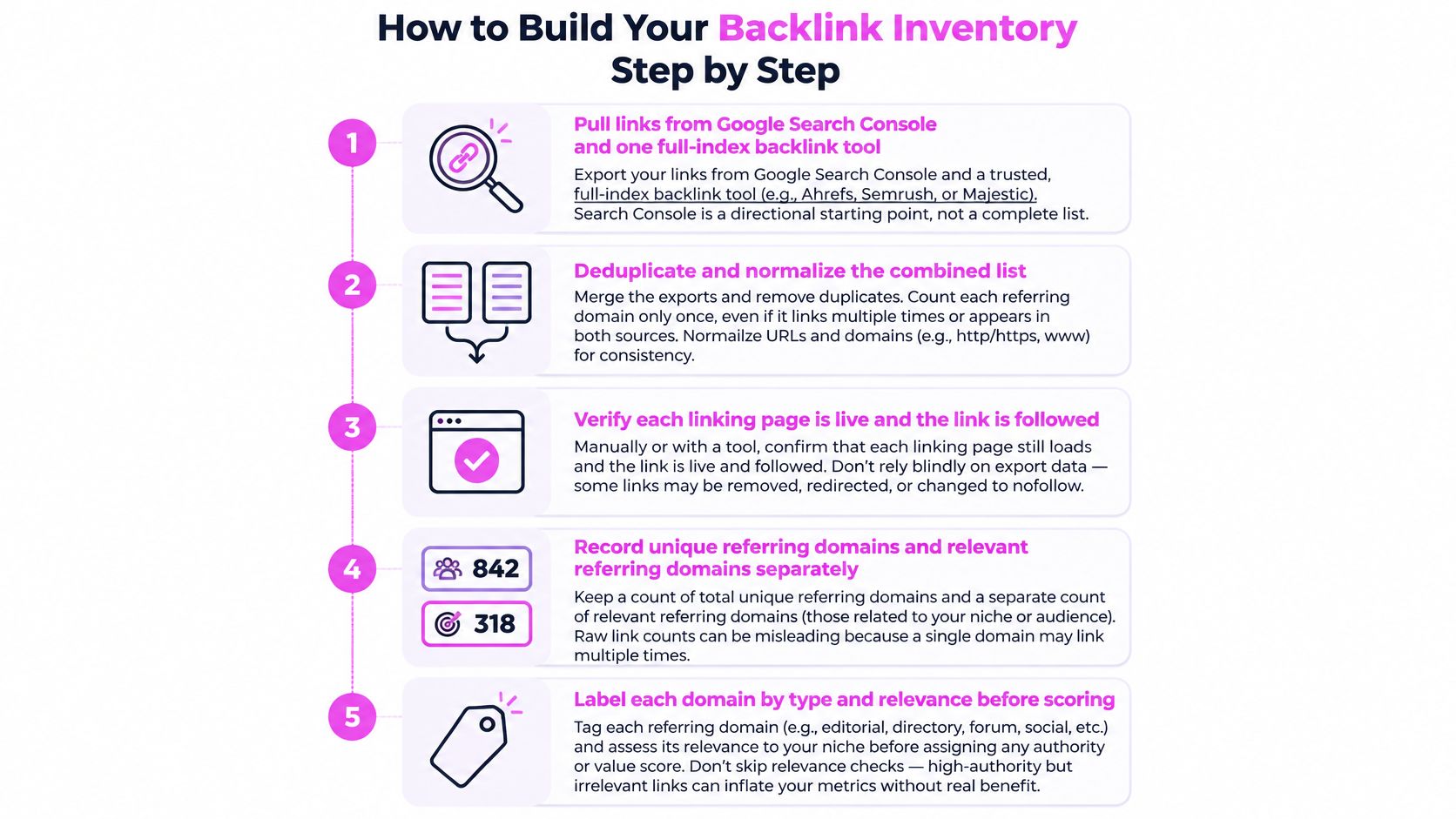
How to Build Your Backlink Inventory Step by Step
Every audit starts with the same mess. Two exports that disagree, half the rows already stale, and a column of scores nobody trusts. Build the inventory properly once and the rest of the analysis gets faster and more honest. Here's the order I use and the mistake that shows up at each stage.
Pull two sources, not one. Export the Links report from Google Search Console and a full-index export from one backlink tool. The slip is treating Search Console as the whole picture. Google's Links report documentation warns that links may have been removed or the linked page may no longer exist, and the report doesn't tell you whether a link is nofollow. It's a directional sample, so keep it as one input.
Deduplicate at two levels. Merge on source URL first, then count referring domains as their own figure. The error here is celebrating link volume. 500 links from one sitewide footer are one endorsement, and a tool that reports them as 500 is reporting inventory, not support.
Check the status code and canonical of every destination. A 301 chain means the link still resolves somewhere, so track it as a redirect instead of writing it off as lost. Analysts skip this because the export's URL field looks clean, and that field is often months out of date.
Record the decision fields in one worksheet. Target URL, source URL, anchor text, rel attribute, placement on the page, topical relevance, first seen, last seen. Pulling only the tool's default columns means returning to the same source three times for the same link.
Separate crawlable HTML anchors from everything else. Google's guidance on crawlable links states that a crawlable link generally needs a link element with an href attribute. Buttons, script-driven calls to action and image-only links don't behave the way analysts assume when they add them to a count.
Group rows by referring domain and build a review queue. One domain per row, every link to that domain nested underneath. That single view is what makes the next decision possible: keep, investigate, or ignore.
What a clean inventory looks like
One row per link, every referring domain counted once, a status on every destination URL, and a first-seen date you can defend. Get those four right and you can answer almost anything a stakeholder asks in under a minute. Miss one and every number you report after this carries an asterisk.
Backlink Metrics That Actually Matter
| Metric | What It Measures | How to Read It | Trap to Avoid |
|---|---|---|---|
| Referring domains | Unique sites linking to you | Count unique domains, not links | Treating 500 sitewide links as 500 endorsements |
| Total backlinks | Every linking URL | Use for inventory, not scoring | Inflated by footers and shared templates |
| Anchor text distribution | Share of link phrases | Brand and natural phrases should lead | Exact-match commercial anchors dominating the profile |
| Dofollow and nofollow mix | Links that can pass ranking signals | Check the attribute on each link | Removing nofollow links as spam by default |
| Linking page traffic | Visits the source page receives | Real readers mean referral potential | Judging by domain metrics alone |
| Lost referring domains | Domains no longer linking | Track monthly against a baseline | Blaming ranking drops on lost links without checking |
| Link age | First-seen date per link | Sudden spikes need an explanation | Old links that point to dead URLs |
Two rows on that table get misread more than the rest. Total backlinks is a raw inventory figure, meaning every linking URL in the index, including the same footer placement repeated across thousands of pages on a partner site. Sort by it and you'll spend a week chasing a domain that gave you one real endorsement and a template.
Referring domains is the number people think they're looking at when they quote link counts. Deduplicate before you evaluate it, and be strict about what qualifies. A domain linking from thirteen pages is one domain. Skip that step and the profile looks healthy while the number of independent sites vouching for you stays flat.
The Stanford information retrieval textbook chapter on PageRank explains why the graph beats the tally. The original model combined textual similarity and term proximity with a score derived from the web's hyperlink structure, which means a link is evidence about relevance, not a point on a scoreboard. Google frames its own version of the same idea plainly: links help its systems discover pages and act as signals when determining relevance, and most new pages it finds each day are discovered through links.
The three numbers I check first
- Unique referring domains. The breadth of independent sites, after deduplication.
- Brand versus exact-match anchor share. How much of the profile uses your name versus a commercial phrase.
- Lost referring domains since the last crawl. The direction of travel, not the snapshot.
Paste those three into a sheet with a date stamp and you'll understand a profile in ten minutes better than a domain rating column explains it in an hour. One more field earns its place: the linking page's own traffic. Domain-level authority is a proxy for value. The page's referral potential is closer to the truth.
Classifying Links by Intent and Risk
| Attribute or Type | Intended Use | Action in Audit |
|---|---|---|
| Editorial followed link | Natural endorsement inside content | Keep and track as core equity |
| rel=sponsored | Ads and paid placements | Confirm the label, never count as earned |
| rel=ugc | Comments and forum posts | Low weight, judge by page traffic |
| rel=nofollow | Untrusted source or publisher opt-out | Not a removal target, assess value only |
| Unlabeled paid placement | Bought link with no attribute | Request qualification and flag as manipulative risk |
A paid placement inside an article is still a paid placement. The common classification mistake is bucketing links by where they sit on a page rather than by how they were acquired. The attribute is a disclosure of the commercial arrangement, not a verdict on editorial quality.
Google's spam policies documentation names the patterns it treats as manipulation, and the list is worth memorizing because it gives you categories to measure. Buying or selling ranking-passing links, excessive reciprocal exchanges, automated link creation, low-quality directory links, keyword-rich links in widgets, widely distributed footer or template links, and optimized links in guest posts or press releases. Google also announced in July 2021 that its link-spam update was designed to detect and nullify link spam across multiple languages, which means a manipulative link can already be worthless while still sitting in your export.
Three calculations cover most of the risk screen: the share of links using exact-match or commercial anchor text, month-over-month spikes in referring domains, and clusters that share a template or network footprint.
Worked example of a flagged cluster
Say an export shows 60 new referring domains in one week, all pointing at the same commercial page, all using the same commercial anchor, and 40 of them sitting in author bios on sites built from the same theme. That isn't a campaign. It's a cluster, and the anchor concentration is what triggers the review, not any single domain's score.
Google's guidance on qualifying outbound links is precise about the labels: sponsored for advertisements and paid placements, ugc for user-generated content such as comments and forum posts, nofollow when the publisher doesn't want to be associated with the linked page. Multiple values combine in one rel attribute, and the destination can still be found through other links or sitemaps, so treat the attribute as context rather than as a switch.
Practical rule: a link is earned when the publisher would have linked to you without being asked or paid.
Then hold two things in your head at once. A high-authority link can be strategically weak if it's irrelevant, bought to pass credit, or part of a repeating pattern. A modest link on a page with an actual readership can outperform it on referral sessions, audience discovery and brand recognition. Keep the editorial links, investigate the anomalous clusters, request qualification on paid placements, and write down the context while you still remember it.
Finding Competitor Gaps and Link Opportunities

Prospect selection is where link campaigns fail. In 2025, 66% of link builders reported that identifying effective backlink tactics was a challenge, according to a Citation Labs and BuzzStream survey of more than 300 SEO professionals. The fix is rarely a better email template. It's a shorter, better-qualified list.
Pick three to five competitors that rank for your target queries, not the companies you compete with in sales meetings. A sales rival may have a blog nobody links to, while a publisher you'd never call a competitor owns the resource pages your audience reads. Good competitor backlink analysis starts from the SERP and works backwards into the link graph.
Normalize before you compare. Unique referring domains, relevant referring domains, links pointing at ranking URLs, new versus lost domains per month, and anchor concentration. Raw totals hide the difference between a competitor earning links steadily and one that ran a single campaign two years ago and coasted on it since.
Four checks that remove most prospects
For every domain that links to a competitor but not to you, open the exact linking page and answer four questions.
- Is the link editorial? A mention inside body copy on a relevant topic survives. A listing in a directory of 40 peers is noise.
- Is the page still indexed? Check the live URL, not the tool's cache. Dead source pages are the single biggest waste in a prospect list.
- Does the topic match the page you'd promote? A perfect domain pointed at the wrong page produces a link that helps nothing you care about.
- Does the site have a real audience? Look for traffic on the linking page itself and signs of human readers, not just a domain score.
Most candidates fail at least one check, which is the point. A competitor appearing in a niche resource roundup on a site with active readers is a strong target. A competitor appearing in a sponsored directory alongside forty other tools is a line you delete.
Close the exercise with a scored list, and tie every prospect to the specific page you'd pitch. "They link to our competitor" is not a reason. "They link to a competitor's pricing comparison, we have a better one, and the page still gets traffic" is.
Reclaiming Lost Equity and Deciding When to Disavow
| Situation | Check | Action |
|---|---|---|
| Link removed from live page | Source page loads and the link is absent | Ask for restoration or offer a more useful updated resource |
| Link now redirects | Redirect destination matches the original page's topic | No outreach needed, confirm the link still passes value |
| Link changed to nofollow | Attribute now rel=nofollow | Decide by value, editorial links rarely justify a fight |
| Unresolved manual spam pattern | Links match Google's link spam categories | Document the pattern, then disavow |
Lost links are the cheapest equity available, and many never look. For every link that disappeared from the last crawl, load the source page and decide what happened before you email anyone. Removed, redirected, devalued with an attribute, or the page is gone entirely. Each one needs a different response, and guessing wrong wastes the one message you'll get.
The size of the opportunity is larger than most audits assume. Ahrefs link research data reports that 66.5% of links to more than 2 million domains since 2013 were dead. Some of those point at your pages. When you do reach out, offer the closest updated destination rather than asking for a generic replacement, because a request naming the right page is far easier to approve than one asking a publisher to go hunting.
Then check the internal side. Every page you care about should receive at least one internal link, so route new external equity to stable, relevant URLs instead of letting it land on an orphan page that can't pass anything along.
Why disavow comes last
A disavow file is a slow, limited-control recovery mechanism, not an instant deletion request. Google's announcement of the disavow tool describes a plain text file with one URL per line, links Google will typically ignore while retaining discretion, and a requirement that those URLs be recrawled and reindexed before the disavow takes effect. That can take multiple weeks.
Before uploading anything, preserve the existing file, verify you're on the correct property, and document representative URLs with their acquisition history. Never add a domain because a third-party score looked high. A domain-level entry suppresses the legitimate links from that domain along with the manipulative ones, and a mistaken upload removes useful signals from consideration with no undo button.
I'd treat link reclamation as the default move and disavow as the exception. Track the submission date, the representative URLs and any manual-action evidence afterwards, and don't expect the Links report to change the next morning. Evidence-based cleanup comes first. The file follows it.
Measuring Link Impact Against Traffic and Rankings

67% of SEO professionals said organic traffic was the most important metric for evaluating backlink quality, according to a 2025 survey of link-building practice reported by FATJOE. That matches what the work demands. A link that sends nobody is a row in a spreadsheet, whatever its authority score says.
Links don't arrive with a receipt, so build the record when you acquire the link rather than reconstructing it at the end of the quarter. Six fields do the job:
- Target URL and discovery date. The page you meant to lift and the day the link first appeared. Everything else is measured against these two.
- Link type and qualification. Editorial, sponsored, ugc or unlabeled. You can't attribute an outcome to a link you classified wrong.
- Referral sessions and assisted conversions. Pulled from analytics, not from the backlink tool.
- Ranking movement for the target page. Position on the specific queries that page targets, tracked weekly.
Compare the page against its peers
Take a page that earned three links this quarter and set it beside a similar page on the same site that earned none. Compare organic clicks and average position across the same weeks. If the linked page pulled ahead while the control page held steady, you have something worth crediting. If both moved together, something else moved them.
The confounders are always the same four: a content refresh, seasonality, an algorithm update, and a brand campaign. Each one produces the ranking change you were about to attribute to a link, and each takes two minutes to rule out and roughly zero minutes to forget.
Report by campaign and by referring domain, not by links won. Regained referring domains, qualified links, target-page rankings, organic clicks, conversion impact. That's the version of the report that survives a budget conversation, and it's the version that tells you which publisher relationships to renew.
Keep the lost-link check on a monthly calendar reminder, because links disappear whether or not anyone is watching. If assembling the gap list by hand takes longer than the outreach that follows, SemDash's Backlink Gap tool lists domains that link to your competitors but not to you, and its broken-backlink detection flags dead links pointing at your pages so you can fix or redirect them.
The analysis only pays off when it turns into a decision, and that's the part SemDash is built for: backlink research across a 2.7 trillion link index, competitor gap reports, SERP history and keyword data in one workspace rather than three exports. Run your own profile and the three competitors you shortlisted, then compare referring domains, anchors and lost links side by side. You can start free at SemDash.