


Most advice on keyword cannibalization starts in the wrong place. If I see two URLs ranking for one keyword, I don't call it a problem yet, I call it a clue. The issue is usually query ownership instability, where Google keeps switching between pages, surfaces, or intents instead of settling on one clearly preferred URL.
That distinction matters because a lot of teams merge pages too early and damage coverage they needed. A query can look duplicated in a spreadsheet and still be healthy if one page owns the main intent while another serves a narrower need. The audit I trust starts by asking a harder question, which URL is winning that query over time, and is the winner stable?
Table of Contents
- Why Most Cannibalization Diagnoses Are Wrong
- Building Your Search Console Query-to-Page Map
- Layering Site Searches, Crawl, and Ranking History Checks
- Four Tests That Separate Real Cannibalization From Noise
- What a Real Audit Actually Looks Like
- Scoring and Prioritizing the Queries Worth Fixing
- Audit Checklist and What Comes After Identification
Why Most Cannibalization Diagnoses Are Wrong
The shortcut diagnosis, “two URLs rank for one keyword”, catches too much noise. I've seen teams collapse pages that were serving different intents, then spend months rebuilding long-tail traffic they could've kept. The safer definition is narrower, a query is cannibalized when ownership keeps shifting between pages over recent weeks, CTR lags what the combined impression share suggests, and no single page holds a stable position.
That's why a single snapshot is weak evidence. Search Console can show overlap without proving harm, and broad overlap is sometimes normal internal competition rather than a structural problem, especially when one URL is clearly dominant. The practical benchmark I use is whether the query shows competing URLs with similar titles or H1s, overlapping impressions, and a pattern of URL switching, not just coexisting results.
What I look for before calling it cannibalization
A clean audit separates three situations that often get lumped together:
- Intent segmentation, where two pages share a topic but satisfy different needs.
- SERP displacement, where AI features or other result types push organic URLs around.
- True cannibalization, where Google can't settle on one page because the site keeps sending mixed signals.
That framing lines up with modern Search Console workflows that export queries and pages, count distinct URLs per query, and check for alternating URL ownership over time instead of relying on one view of the data. It also matches the advice to compare stable overlap across weeks rather than a single ranking snapshot, because volatility is what exposes the underlying problem. A fast site:yourdomain.com keyword search can help, but it's only a screening step, not proof, since it shows relevance and indexation signals, not full impression or click data. As noted in the earlier guidance from Search Engine Journal, the strongest heuristic is still a query with 2 or more competing URLs, similar titles, and overlapping impressions.
Building Your Search Console Query-to-Page Map
The cleanest way I've found to identify keyword cannibalization is to start with Search Console Performance data, not a crawl export or a rank tracker. I pull the last 16 weeks of queries and pages first, because that window is long enough to catch switching behavior without dragging in stale history that muddies the pattern. If a site is large, I set a working filter at 50+ impressions so the spreadsheet stays focused on queries that can move traffic.
The mapping workflow I use
- Export queries and pages separately. I keep the raw files untouched and normalize URLs before I aggregate anything. That matters because subfolder groupings, parameter variants, and trailing-slash inconsistencies can make one page look like several.
- Build a query-to-page map. In a spreadsheet or Looker Studio, list each query and every page that received impressions for it, then add clicks, CTR, and average position. Average position alone can mislead, because a page that appears in many mixed SERPs can show a decent average while still losing ownership.
- Count distinct URLs per query. I flag queries with 2 or more URLs that receive impressions, then ignore cases where the secondary URL contributes under 5% of total clicks. That keeps benign overlap from polluting the review queue.
- Sort by click-share concentration. If no single URL owns more than 70% of clicks, I treat the query as a serious candidate.
Practical rule: if the query-to-page map keeps changing week to week, I care more than I do about the raw count of pages.
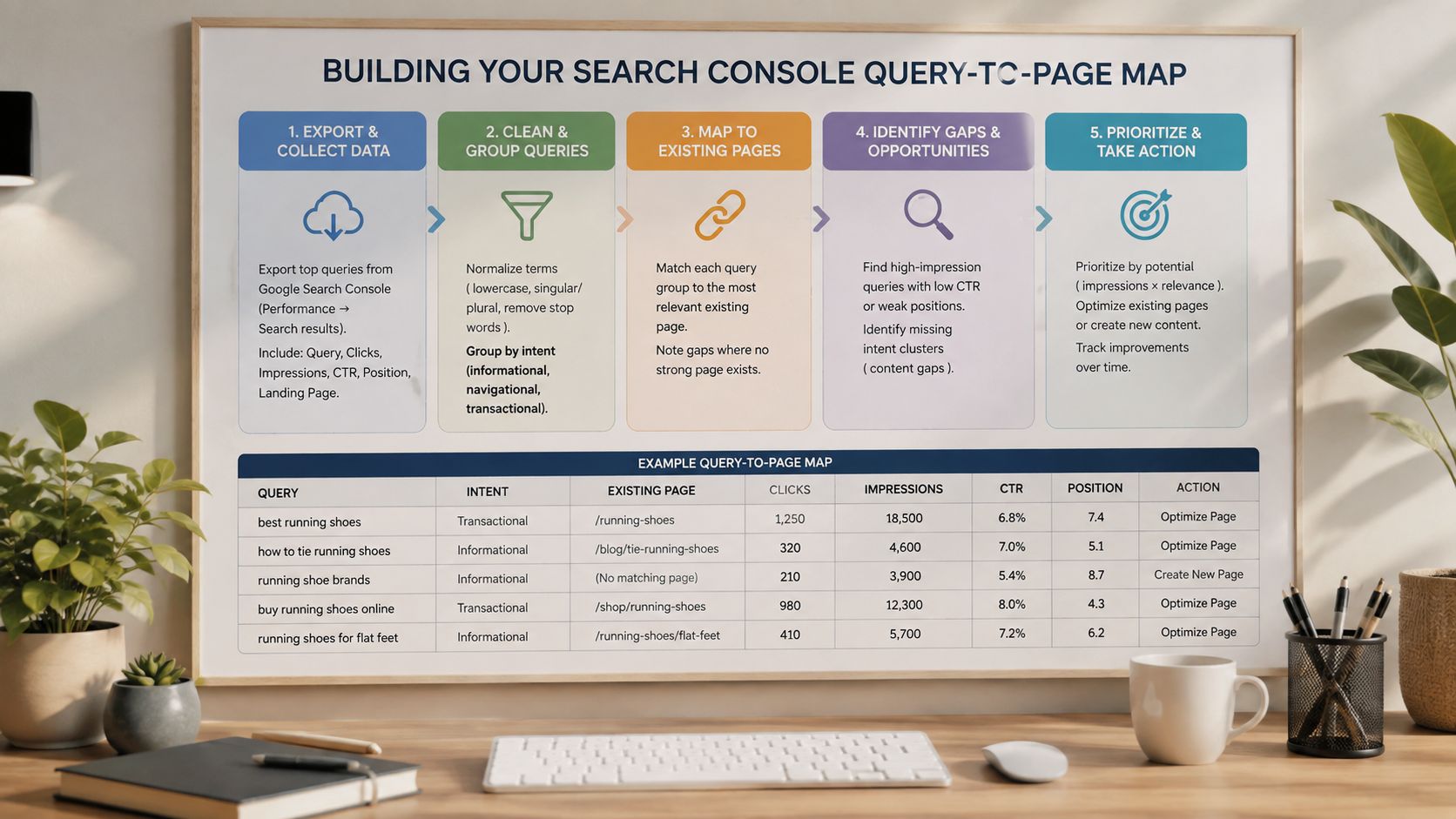
Date range matters because switching behavior is temporal. I've seen queries look clean in a 28-day snapshot and messy across a 16-week export. The broader window also helps me separate overlapping pages from legitimate format differences, like image, video, or product-result URLs that can appear alongside standard pages.
A good audit sheet should also carry a simple note field for each query, so I can record whether the overlap looks like indexation noise, content duplication, or real ownership instability. That log becomes the evidence trail when it's time to decide whether to consolidate, canonicalize, or leave the pages alone.
Layering Site Searches, Crawl, and Ranking History Checks
A GSC shortlist is only the first pass. I validate each candidate with three layers so I don't double-count the same signal in different tools. The sequence matters, because a page can look competitive in Search Console, then turn out to be a harmless overlap once I check intent, indexation, and ranking history together.
How I validate a candidate query
First, I use the site: operator for the exact query and inspect which URLs Google already associates with it. That quick search gives me a sense of snippet type, sitelinks, and whether an AI Overview or another result surface may be displacing organic clicks rather than triggering classic page-vs-page conflict. It's a screening step, not a verdict.
Second, I crawl the candidate URLs. I'm looking for thin overlap, shared template copy, hreflang duplication, and internal anchor text that pushes Google toward the weaker page. If the crawl shows the same intent cues on both URLs, I treat that as confirmation. If the pages diverge clearly, I mark the overlap as intentional and move on.
Third, I review ranking history across a rolling window. I'll use tools such as AccuRanker, Semrush, or daily Search Console pulls, and I've found the URL flip-flopping pattern matters much more than a single position drop. If the top URL keeps changing across the same query, that's a strong sign the site hasn't established clear ownership.
For teams that want a broader tracking layer, the guide to AI-powered rank tracking is useful because it frames rank movement around URL-level shifts rather than only keyword position. That's a better fit for cannibalization work than dashboards that flatten everything into a single average position.
| Layer | Tool or Source | What It Confirms | Pass Threshold |
|---|---|---|---|
| Search visibility | Google Search Console | Multiple URLs earning impressions for the same query | 2 or more competing URLs |
| Index and SERP check | site: search and live SERP review |
Which URLs Google already associates with the term, plus snippet and AI surface context | More than one relevant URL appears |
| History review | Rank tracker or daily GSC pulls | Whether ownership is stable or alternating | Repeated URL switching over time |
A candidate only moves forward if at least two of the three layers independently show active competition. That rule keeps me from overreacting to normal volatility. It also gives me a defensible note in the audit file, which matters when a client later asks why one page was left untouched and another was consolidated.
For crawl-based diagnosis, I also keep a check on index controls. The internal guidance at meta robots tag handling is relevant when the weaker page needs to stay accessible to users but not compete in search.
Four Tests That Separate Real Cannibalization From Noise
The fastest way to avoid bad fixes is to test overlap against behavior, not just against keywords. I use four checks because each one catches a different failure mode. A page can pass one test and still be a bad consolidation candidate if another test shows clear intent separation.
The four-test framework
Test 1, flip-flop frequency. I map ranking movement across 90 days and flag only queries where two URLs alternate inside the top 10 at least three times. That pattern is hard to dismiss as ordinary ranking noise.
Test 2, SERP feature correlation. I compare overlap against the live SERP. If the page loss only appears after AI Overviews or PAA boxes push organic listings down, I treat that as displacement, not cannibalization.
Test 3, intent gradient. I compare titles, H1s, and first-paragraph entity coverage. If one page is informational and the other is transactional, or one serves beginners while the other serves advanced users, the overlap may be healthy segmentation.
Test 4, CTR distribution. If impressions split between two URLs but clicks lag what a single stronger page should earn, that's wasted inventory. The problem isn't just that two pages exist, it's that neither is converting the available attention efficiently.
| Test | What It Measures | True Cannibalization Signal | Noise Signal |
|---|---|---|---|
| Flip-flop frequency | URL ownership over time | Two URLs alternate repeatedly | One URL stays dominant |
| SERP feature correlation | Organic displacement | Loss coincides with feature crowding | Overlap only mirrors SERP volatility |
| Intent gradient | Distinct user needs | Same intent, same audience, same page function | Clear informational vs transactional split |
| CTR distribution | Click efficiency | Split impressions with weak combined clicks | One URL owns clicks despite overlap |
A working example helps. For “best running shoes,” I've seen a listicle and a review both rank, but the query shifts by budget and use case. That's usually segmentation, because each page serves a different sub-intent. I'd keep both and refine their targeting.
A better cannibalization example is “how to reset iPhone.” When Apple support and a blog alternate around positions 4 and 6, and the combined CTR trails what a single stable result should capture, the site is signaling confusion. That's not a content ecosystem problem, it's a query ownership problem.
A page doesn't need to be identical to another page to cannibalize it. It only needs to keep stealing the same click opportunity without winning it cleanly.
What a Real Audit Actually Looks Like
On a mid-sized ecommerce site with roughly 2,400 product and category URLs, I start by pulling 16 months of Search Console data so seasonal demand doesn't hide the pattern. That wider view is important on ecommerce properties because a query can look stable during one buying cycle and unstable in another. I filter to queries averaging 50+ impressions per month and keep only those with 2 or more ranking URLs.
Then I pivot by query and watch which URLs appear over time. For a query like “wireless earbuds,” I tagged every URL pair by overlap duration and found a category page and a buying guide that both held top-5 positions for seven months, trading week to week. That was a real cannibalization case, because ownership kept shifting and neither page settled into a clean role.
I layered in a Screaming Frog crawl to inspect internal links next. The weaker page had more contextual anchors than it should've had, which explained part of the confusion. The stronger page was getting diluted by a navigation pattern that looked tidy in the CMS but messy in the crawl data.
The same dataset gave me a false lead on “wireless earbuds for running.” The raw export looked nearly identical, but the pages split cleanly by intent, one listicle and one product page. I abandoned the redirection plan there because consolidation would've hurt long-tail coverage and removed a useful path for shoppers with a narrower need.
For teams doing this at scale, the performing an SEO audit for agencies framework is a solid companion, because it forces the review to move from discovery into prioritization without skipping the evidence trail.
The pivot logic I used
- Keep together: same query, same intent, unstable ownership.
- Separate: same query string, different audience or use case.
- Delay action: overlap exists, but one URL owns the clicks consistently.
That last bucket is the one many teams ignore. A page that looks messy in a spreadsheet can still be functionally fine if Search Console shows one dominant URL and no meaningful ownership swapping. I've learned not to “fix” those cases just because the export looks untidy.
Scoring and Prioritizing the Queries Worth Fixing
Once the candidate list is clean, I score each query so I'm not wasting time on low-value overlap. My model uses five axes, each scored 0 to 3. The goal isn't mathematical perfection, it's to separate the queries that justify action from the ones that should stay on watch.
The scoring model I use
- Volume gate. Higher monthly impressions get a higher score because the upside is larger.
- Revenue or conversion value. A commercial query cluster matters more than a vanity informational term.
- Position volatility. More ranking swaps per month means more instability.
- CTR deficit. A wider gap versus the projected top-spot click curve means more wasted demand.
- Ease of remediation. Pages with similar content and clear link equity are easier to fix cleanly.
I bucket anything below 7/15 into monitor-only. In my experience, those queries usually fail the cost test, the recovery ceiling is too low, or the intent is too ambiguous to clean safely. Queries that score higher move into fix-now or schedule-next-sprint depending on how directly the pages can be resolved.
If you're clustering before you score, the keyword clustering workflow helps because it makes page-level topics more obvious before you start deciding which URL should own them.
| Criterion | Weight (0-3) | What to Score | Threshold for Action |
|---|---|---|---|
| Average monthly impressions | 0-3 | Demand and upside | Stronger volume raises priority |
| Revenue or conversion value | 0-3 | Business impact | Commercial value pushes toward fix-now |
| Position volatility | 0-3 | Swap frequency | Frequent swaps need attention |
| CTR deficit | 0-3 | Loss versus expected clicks | Clear deficit raises urgency |
| Ease of remediation | 0-3 | Similarity and link equity | Cleaner fixes score higher |
Using the earlier example, “wireless earbuds” would usually score high because it has commercial value, visible volatility, and a plausible consolidation path. “Wireless earbuds for running” would usually score lower because the intent split is cleaner and the business case for merging is weak. I'd rather monitor that second query than force a consolidation that blurs product discovery.
Guardrail: I don't approve any merge unless the pages share a distinct-intent overlap that's strong enough to justify losing one URL.
That one rule has saved more traffic than any scoring spreadsheet. The temptation to over-merge is real, especially when a client wants a fast win, but the wrong merge can erase useful coverage across the long tail.
Audit Checklist and What Comes After Identification
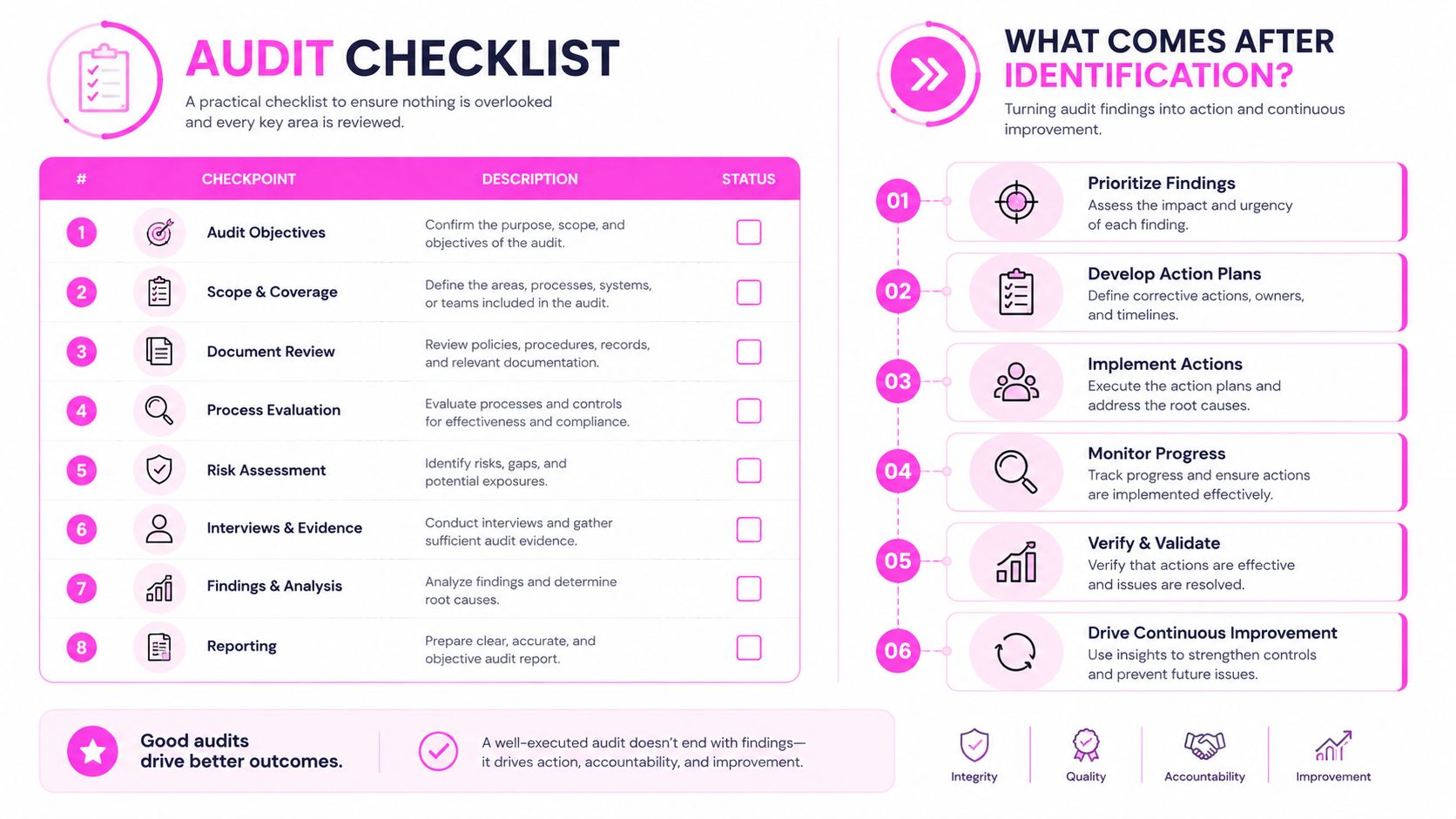
A clean identification workflow ends with a short checklist, not a pile of exports. I verify the query in Search Console, map every URL receiving impressions, check for week-to-week switching, run the site: screen, inspect the crawl, and then confirm the ranking history. If the query passes at least two of the three validation layers and scores high enough to matter, it gets a resolution plan.
The action path I use after identification
- Canonicalize near-duplicates when the pages are effectively the same and both need to exist.
- 301 redirect when one URL clearly owns the topic and the other is only weakening the signal.
- Merge content only when the pages are structurally redundant and one consolidated page can serve both.
- Consolidate internal links so the chosen page gets the strongest support.
- Re-check in 30 days inside Search Console to confirm query ownership has stabilized.
- Stop fixing when the page shows stable ownership and the overlap is intentional.
The biggest trap is treating every flagged pair like a merge candidate. That's how teams kill useful intent variants and lose long-tail coverage they didn't realize they depended on. I've had more success by fixing the queries with unstable ownership first, then leaving intentional overlap alone when the signals show it's working.
If the pattern is still messy after a 30-day review, I look again at intent and internal links before touching the content itself. Query ownership usually tells you whether the site needs restructuring or just clearer signals. Once that's stable, the problem stops being cannibalization and starts being maintenance.
If you want a faster way to spot query ownership problems across pages, keywords, and SERPs, see how SemDash maps overlapping URLs and topic clusters in one place. I use tools like that when I want to move from diagnosis to prioritization without losing the thread between Search Console, ranking history, and page-level intent.