

Most Moz vs Semrush advice starts with database size, crowns the bigger index, and pretends the decision is done. That's lazy consulting. I've run both tools across client accounts long enough to know the question isn't which one has more data, it's which one fits the way your team researches keywords, cleans up links, audits sites, and ships work without drowning in the interface.
If you only need a cleaner SEO cockpit, Moz can be the right call. If you need broader discovery, deeper link workflows, and enough surface area to keep SEO, content, and paid search in one place, Semrush is the stronger system, especially given its 27.8 billion keywords, 43 trillion backlinks, and 808 million domains compared with Moz's roughly 1.25 billion keywords as of January 2026, which makes Semrush's keyword coverage about 22x larger on that measure (Style Factory comparison). That still doesn't make Semrush the automatic winner for every workflow, because bigger data only matters when your team can turn it into better decisions.
| Criterion | Moz | Semrush |
|---|---|---|
| Keyword research | Cleaner, simpler, but narrower | Deeper discovery, stronger gap analysis |
| Backlink analysis | Usable, more manual | Broader, faster, better for gap and recovery |
| Rank tracking | Straightforward, with useful ad hoc checks | Stronger for larger tracking programs |
| Site audit | Functional, lighter-weight | More detailed, more central to technical work |
| Content tooling | Basic SEO support | Wider workflow support for content planning |
| UI and learnability | Easier to pick up | More powerful, more cluttered |
Table of Contents
- Why This Comparison Is Usually Wrong
- Feature Matrix Across the Six Criteria That Matter
- Keyword Databases and What the Scale Gap Means
- Backlink Intelligence and Link-Recovery Workflows
- Rank Tracking, Site Audits, and Daily UI Friction
- Pricing, Tiers, and What You Pay Per Workflow
- Which Tool to Pick for Your Specific Workflow
- Where SemDash Fits Against Moz and Semrush
Why This Comparison Is Usually Wrong
The usual Moz vs Semrush comparison treats database size as the deciding factor. That misses how SEO work gets done. A bigger index helps you find more queries, but it does not tell you whether the tool helps you group those queries into pages, clear out overlap, or choose what to publish first. That is what buyers feel in day-to-day work.
Workflow beats raw scale
I have seen teams buy Semrush because they wanted more data, then spend months using only the same three reports. Index size is a proxy for discovery, not execution. If your team needs simple rank tracking, a quick site check, and a handful of keyword ideas, Moz's leaner shape can be a feature, not a flaw.
Semrush starts to pay off when the work gets messy. Multi-market keyword research, backlink gap hunts, paid search overlap, content planning, and technical audits all sit better inside a broader platform. That is why I do not think the question is “Which tool is better?” I think it is “Which tool matches the grain of the work?”
Practical rule: if you spend more time stitching exports together than reading the output, the tool is fighting your workflow.
Where the simpler tool wins
Moz's smaller footprint helps when a team does not need a giant research surface. Solo SEOs, local businesses, and smaller content shops often do not want a platform that keeps surfacing extra paths they will never use. They want a fast answer, a manageable dashboard, and fewer decisions per login.
Semrush is worth the extra cost when the work is broad enough to use the added depth. Its platform is described as spanning 55+ tools across SEO, PPC, content, and competitive intelligence, and that breadth matters when one person owns multiple channels (Style Factory comparison). If you never touch those adjacent workflows, you are paying for capacity you will not use.
Feature Matrix Across the Six Criteria That Matter
I do not rank SEO tools by feature lists. I rank them by how they behave inside a real workflow. On that basis, the six criteria that matter are keyword research, backlink analysis, rank tracking, site audit, content tooling, and UI or learnability.
| Criterion | Moz | Semrush |
|---|---|---|
| Keyword research | Good for core research, narrower suggestion depth | Winner, deeper discovery and filtering |
| Backlink analysis | Fine for smaller sites, more manual at scale | Winner, faster gap and recovery workflows |
| Rank tracking | Solid, with useful ad hoc checks | Winner for larger programs and broader coverage |
| Site audit | Clean and serviceable | Winner, more diagnostic depth |
| Content tooling | Light support around SEO tasks | Winner, stronger content-planning context |
| UI and learnability | Winner for simplicity | Powerful, but heavier |
Keyword research and backlink work
Semrush wins keyword research because its database is larger and more useful for long-tail discovery. Independent comparisons put it at roughly 27.8B to 27.9B keywords versus Moz at about 1.25B, and Semrush's own entry-level reporting allowance reaches 3,000 domain analysis or keyword research reports per day. That is not a vanity metric. It changes how many angles you can test before you settle on a content plan.
Moz is easier to live with if your research process is simple. I like it for straightforward keyword checks, especially when the team already knows what it wants to target. Once you are mapping competitors, hunting gaps, and trying to avoid cannibalization, Semrush gives you more room to work. If your team wants a dedicated workflow for keyword research, that broader surface area matters.
My rule of thumb: if the research step ends in a spreadsheet full of half-used tabs, Semrush will usually save more time than Moz loses in complexity.
Rank tracking, audits, and interface
Moz still has a real advantage on simplicity. A lot of teams do not need a giant platform, they need something their junior marketer will not avoid. Moz delivers that cleaner shape.
Semrush wins the technical side because it puts more information in one place and tends to make the next action clearer. Moz can do the job, but it asks for more clicking, more context switching, and more interpretation. If you work inside client accounts every day, that friction matters.
Keyword Databases and What the Scale Gap Means
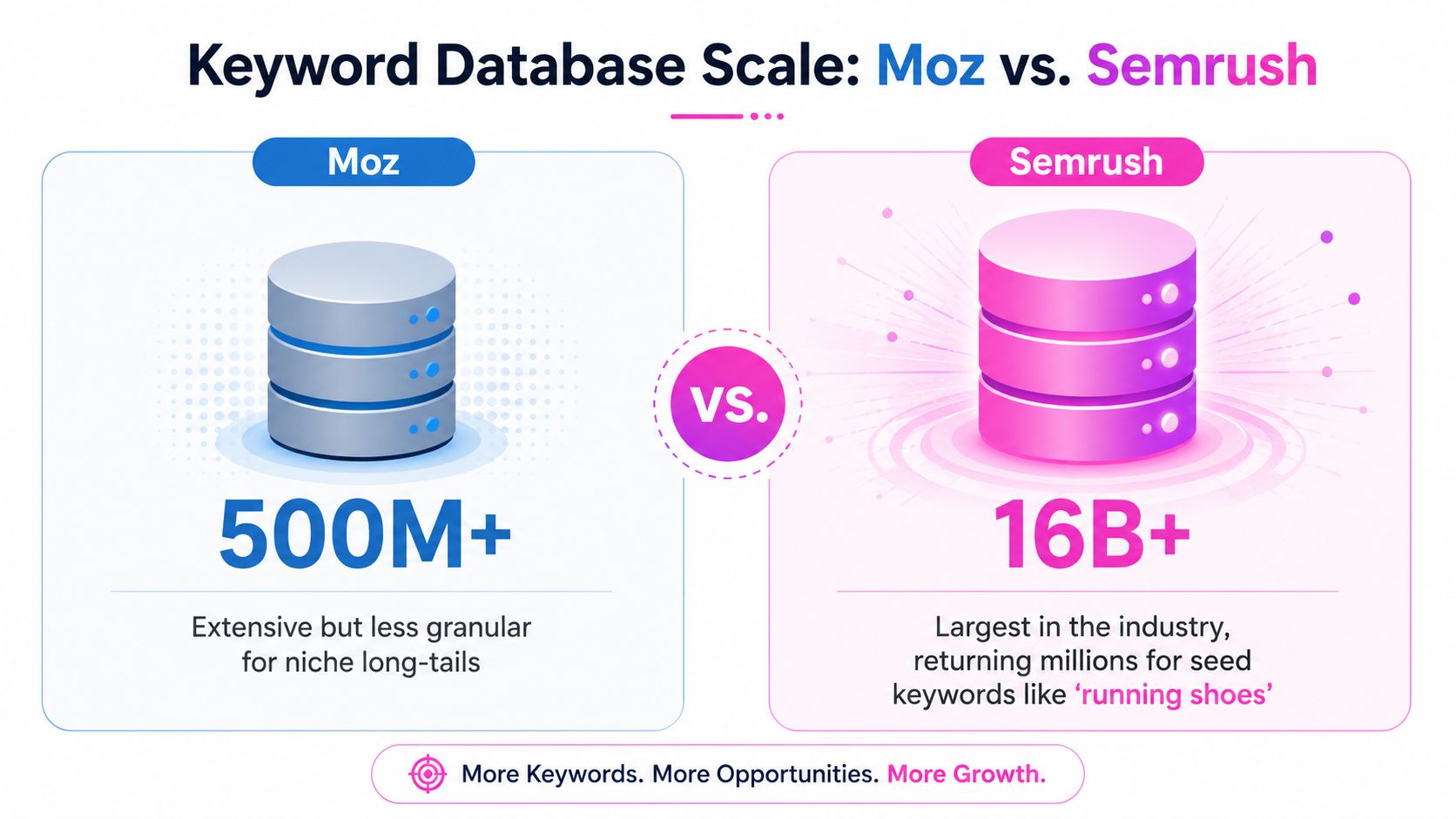
Database size is a coverage map, not a trophy. Semrush reports 27.8 billion keywords, 43 trillion backlinks, and 808 million domains as of January 2026, while Moz's keyword index sits at roughly 1.25 billion keywords in 2026 comparisons. That gap is why Semrush covers far more of the market, and why it is the better starting point for broad discovery. Moz can still do the job for tighter research, but it works from a smaller universe.
Long-tail discovery is where the gap shows up first
I care about the keyword database most on low-volume B2B terms. Semrush gives me more ideas, more variants, and a better shot at catching the odd phrasing a buyer uses. Coverage in the independent comparisons also points in the same direction, with Semrush's Keyword Magic Tool producing far more expansion paths from a single seed term than Moz's Keyword Explorer (IBTimes AU comparison).
That matters because small samples distort prioritization. If a tool only sees part of the market, it can make a niche keyword look rare when it is just under-indexed. Semrush reduces that blind spot, which is why it is the stronger choice for teams that need broad keyword research before they sort the list down.
Where Moz can still feel cleaner
Moz is still useful for narrower, more curated research passes. It throws fewer irrelevant suggestions at you, which helps when a team already has a solid topic map and only needs validation, not exploration. That simplicity can be a real advantage when the workflow is quick checks, not open-ended ideation.
For teams building keyword-led content architecture, I would still start with the larger universe and narrow it myself. That is also why SemDash fits cleanly into workflows that need topic grouping, competitor page mapping, and broader query discovery. If the job is to structure AI-first content around intent and page-level decisions, how to structure AI geo content is the kind of planning step that benefits from wider keyword coverage first.
Backlink Intelligence and Link-Recovery Workflows
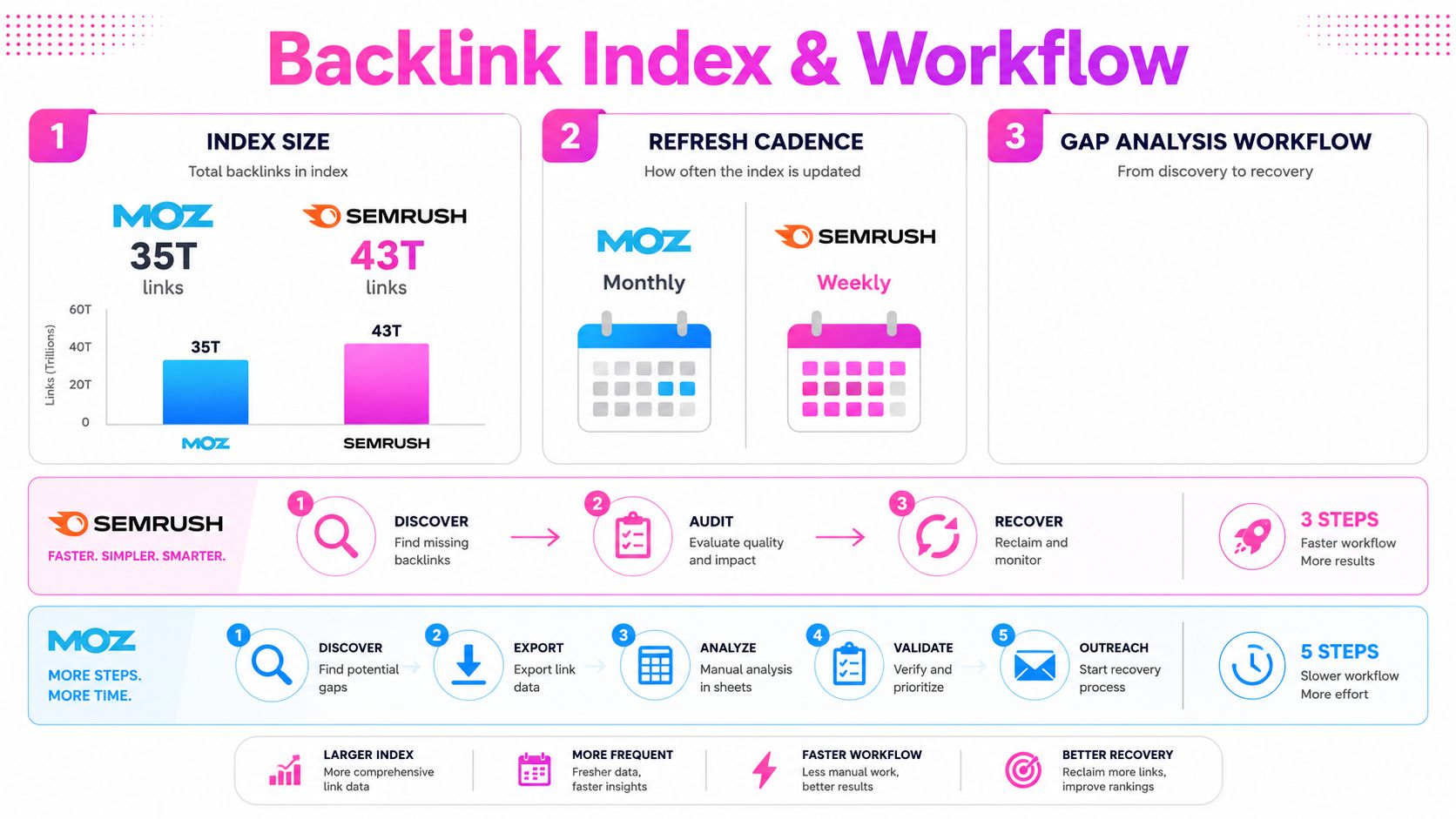
Backlink work is where the operational difference between these tools becomes obvious fast. Semrush is positioned as the higher-scale system, with cited product analyses showing a 2.7T-link index, 15B+ crawled links in the last 24 hours, and 600M SERPs refreshed monthly (Directive Consulting comparison). That doesn't just mean “more data.” It means faster discovery when a link drops, a competitor wins a placement, or you need to find opportunities at scale.
The gap analysis workflow is the real differentiator
Semrush's backlink gap and link-building workflow are faster because they're built around discovery plus action. Moz can identify overlap and provide a link intersect style report, but the workflow is more manual once you start filtering and outreach planning. In practice, that means Semrush is the better fit when you're doing recurring link-recovery or competitor-gap work across multiple sites.
I also care about link recovery because it's where stale data hurts most. If the tool misses a new referring domain or takes too long to refresh, you lose the chance to act while the opportunity is still warm. Semrush's higher crawl volume makes it easier to keep that loop moving.
Recovery work is better when the tool keeps the context together
Broken-backlink recovery and unlinked-mention workflows become much easier when discovery, prioritization, and outreach live in one place. Semrush is better suited to that because it's built to keep more of the process inside the platform. Moz can support the analysis, but you'll do more exporting and reconciling by hand.
If you're structuring AI-assisted content around link and citation recovery, the workflow guide at how to structure AI geo content is a useful adjacent read because it shows how teams can shape page architecture before outreach even starts. That kind of planning matters more than people admit. The cleaner the content structure, the easier it is to turn a backlink opportunity into a relevant page.
Rank Tracking, Site Audits, and Daily UI Friction
Teams feel these platforms every day. Moz and Semrush both cover rank tracking and site auditing, but they do not behave the same once you use them in real client work. Moz stays cleaner for short, focused sessions. Semrush is the better choice when you need deeper diagnostics and can live with a busier interface.
Rank tracking is fine in both, but the day-to-day feel differs
Moz gives you an on demand rank checker, which I still like for quick spot checks because it lets me validate a keyword without opening a full campaign workflow. That is useful for solo work and small accounts. Semrush is stronger once rank tracking becomes part of a larger reporting system, especially if you need the rankings to sit alongside other campaign data.
I have seen agencies waste time because they chose a rank tracker that looked smart in a demo but slowed everyone down in daily use. Semrush puts more context into the interface, but you often need more clicks to reach it. Moz is more direct, yet it can leave you wanting more once you start connecting ranking movement to content or link actions.
Audits favor Semrush when the site gets messy
Semrush's site audit workflow is clearer and more complete for technical SEO. It does a better job of putting the issue, the priority, and the suggested fix in one place, which matters when you are working through a queue instead of investigating a single page. Moz's crawl tools work, but they ask for more interpretation and more navigation.
If the audit output needs three follow-up exports before anyone can act on it, the tool has already lost time.
That is the biggest UI difference I see. Semrush sometimes hides reports behind too many clicks, but once you are in the right place, the information is more useful. Moz is easier to learn, and I would pick it for a junior-heavy team or a freelancer juggling a small roster. Semrush is better for the person who has to turn audit findings into work for other people.
Pricing, Tiers, and What You Pay Per Workflow
Headline pricing does not tell you much. The cost shows up when you hit reporting limits, project caps, or team-seat friction. One comparison lists Moz's lowest credible entry tier at $79/month for Standard versus $139.95/month for Semrush Pro, while another comparison notes Moz starting around $49/month and Semrush Pro around $139.95/month (Ottawa SEO comparison). The takeaway stays the same, Moz is cheaper to get into, Semrush is priced for breadth.
What you pay for is workflow density
Semrush starts to make sense when one subscription replaces several partial tools. Its platform covers SEO, PPC, content, social, and competitive intelligence, so the price is easier to defend when a team uses those layers together (Match-vs comparison). Moz makes more sense when you only need core SEO and do not want to fund features that will sit untouched.
Moz gets expensive in a different way, through project creep. Once you start managing more sites, campaign limits become part of the buying decision, not a side note. Semrush gets expensive through underuse. If you are paying for depth but only checking a few dashboards each month, the economics get ugly fast.
My blunt recommendation on cost
For solo SEO work, Moz is easier to justify. For agencies, multi-channel teams, and companies that need keyword research, link intelligence, and content planning in one place, Semrush usually pencils out better because you stop paying for separate tools and manual cleanup. The only time I would say Semrush is the wrong buy is when the team knows it will not use the extra reach.
Which Tool to Pick for Your Specific Workflow
I don't recommend tools by abstract “best overall” logic. I recommend them by who's doing the work. If you're a solo SEO specialist, I'd start with Moz because it's easier to live with, faster to explain to clients, and less distracting when you only need the essentials.
Solo, agency, content, and e-commerce decisions
For a solo consultant or freelancer, Moz wins on simplicity and price. You'll move faster in it if your day is mostly rank checks, site audits, and basic keyword validation. That's not an insult to Semrush, it's just a poor fit for a lean workflow.
For an agency, I'd pick Semrush almost every time. The reason is not only data volume, it's operational range. Backlink gap research, keyword discovery, PPC context, and content support live together well when you're managing several clients at once.
For content teams, the answer depends on how much planning they do before publishing. If you need cleaner topic mapping, larger keyword discovery, and more protection against cannibalization, Semrush is the stronger fit. If your content operation is small and editorially focused, Moz can be enough.
For e-commerce and SaaS growth teams, Semrush is usually the right call because competitive discovery matters more than simplicity. Those teams need broad search coverage, link intelligence, and enough scale to spot gaps before rivals fill them. Moz is only the better choice if the team's scope stays narrow.
Direct advice: if SEO is one part of a broader growth stack, pick Semrush. If SEO is the whole job and the team is small, Moz is usually the cleaner buy.
Where SemDash Fits Against Moz and Semrush
SemDash fits where both incumbents start to feel heavy or incomplete. It's built around a 6.6B-keyword database, a 2.7T-link index, keyword clustering, AI Overviews visibility, and SERP history that helps with volatility checks and citation tracking, so it's especially relevant when the job is to map competitor gaps, group queries into page-level topics, and see which URLs are cited in AI-generated answers.
Where it outperforms both tools
I like SemDash when I'm trying to reduce cannibalization before it starts. Clustering and live SERP context make it easier to see whether two pages should exist separately or merge into one target. It also gives cleaner support for backlink-gap discovery and unlinked-brand-mention recovery, which is useful when the job is less “research more” and more “fix the right thing first.”
If your team lives in dashboard templates, the example library at browse Semrush dashboard templates is a useful reminder of how much time gets lost when reporting isn't structured around decisions. Good reporting should tell you what to do next, not just display metrics. That's the same standard I'd apply to any SEO stack.
How I'd stack the tools
I wouldn't replace Moz or Semrush with SemDash in every workflow. I'd use it where clustering, AI Overviews tracking, and fast gap analysis are the bottlenecks. For teams that only need one SEO suite, Semrush is still the broader platform and Moz is still the simpler one. For teams that need sharper content architecture and SERP visibility on top of research, SemDash becomes a practical complement rather than a gimmick.
If you're evaluating a cleaner alternative to a heavy SEO suite, take a look at SemDash as a Semrush alternative, then test it against one live client brief instead of a generic demo. That's the fastest way to see whether the workflow fits.
If you're choosing between Moz and Semrush right now, don't start with the price page. Start with your workflow, your team size, and how much of SEO you want inside one system. If you want a platform you can keep using every day without wrestling the interface, try SemDash on a real keyword gap and backlink workflow, then decide whether you need the broader suite, the simpler stack, or a tighter tool for the job.