Beyond “SpyFu vs. X,” the better question is which part of your workflow you need to replace. SpyFu is still useful for a quick look at competitor ad copy and keyword history, but once you need backlink depth, page-level SEO, or a clearer picture of how search visibility is shifting, the tool starts to feel narrow. I've made the mistake of hunting for a one-to-one replacement before, and it usually leads to disappointment.
What works better is treating SpyFu alternatives as a stack decision. Some tools are better at keyword discovery, some at link intelligence, and some at market-level traffic analysis. The market has clearly moved toward broader suites, with comparison guides now putting Semrush and Ahrefs at the top because they combine keyword research, backlink analysis, gap analysis, and rank tracking in one workflow, while SpyFu stays more focused on competitor keywords and PPC intelligence. That shift matters because modern SEO teams need both paid and organic visibility, not just a keyword spy.
After years of testing tools for agencies and client work, I've learned to compare them by the job they replace best. If you're choosing a new platform, start there, not with brand loyalty.
Table of Contents
- 1. SemDash
- 1. SemDash
- 2. Semrush
- 3. Ahrefs
- 4. SE Ranking
- 5. Serpstat
- 6. Moz Pro
- 7. Mangools
- 8. SISTRIX
- 9. Similarweb
- 10. Ubersuggest
- Top 10 SpyFu Alternatives Comparison
- My Final Verdict Which Tool Should You Choose
1. SemDash
SemDash is the tool I'd pick when a team needs to stop bouncing between keyword research, backlink analysis, and SERP review in separate tabs. It stands out because it turns competitor data into something usable for briefs, link prospecting, and content decisions without a lot of cleanup. In practice, that matters more than a long feature list. Tools that look good in a demo often slow you down once real client work starts.
Why SemDash Replaces SpyFu for Agency Workflows
SemDash makes the most sense for agency teams that need one workspace for research and execution. The dataset scale is useful in real workflows. SemDash says it covers 6.6 billion Google keywords, 2.7 trillion backlinks, and 600 million SERPs refreshed monthly, which helps when you are looking for low-competition gaps or trying to map the exact URL ranking for a keyword. I care about URL-level mapping because it reduces the common mistake of targeting the wrong page type, and that is where a lot of keyword work falls apart.
It also goes beyond basic research. The platform includes keyword clustering, People Also Ask and search suggestions, backlink gap workflows, unlinked mention detection, and broken-link recovery, so I can move from “what ranks?” to “what should we build, fix, or earn links to?” without exporting data into another system. The AI layer is useful too, especially for turning large keyword sets into cleaner topic groups. If you are comparing adjacent research suites, this SemDash vs Similarweb overview gives a clearer sense of where SemDash fits in a practical workflow: SemDash vs Similarweb.
What I like most is that SemDash feels built for day-to-day operator work. It is useful for content teams that need topic direction, SEO leads who need quick competitor checks, and agency analysts who need link opportunities without stitching together multiple tools. It is less useful if your main job is broad market traffic analysis or paid media planning. For those jobs, I would look elsewhere.
Visit the product at SemDash
1. SemDash
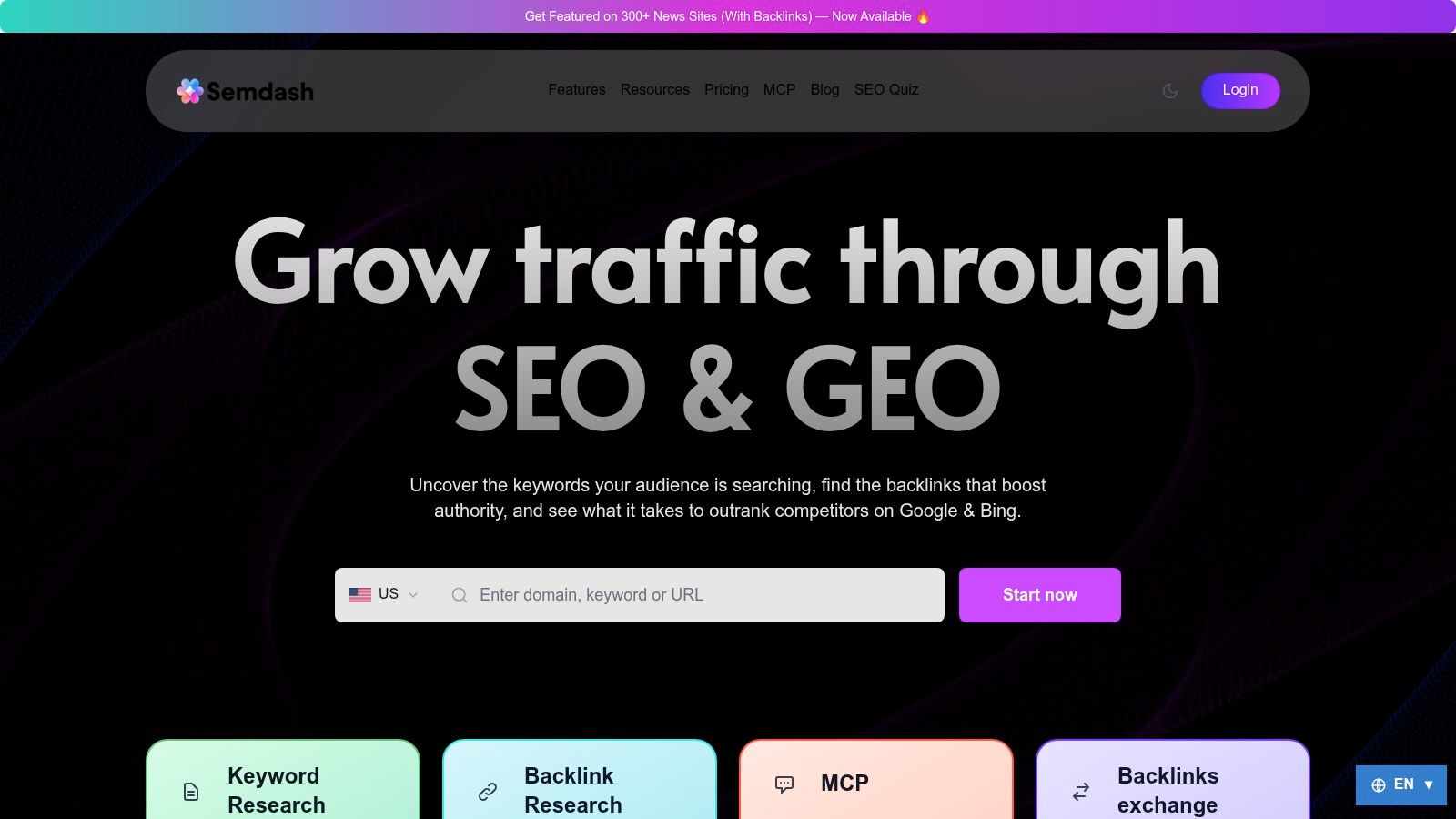
SemDash is the one I'd hand to a team that wants to stop piecing together keyword research, backlink work, and SERP review across three different tabs. The reason it stands out isn't just breadth, it's how quickly it turns competitor data into something I can use for briefs, link prospecting, and content decisions. It's also one of the few tools in this space that feels built for daily operator use instead of occasional dashboards.
Why I put SemDash at the top for most teams
The dataset scale is a real practical advantage. SemDash says it covers 6.6 billion Google keywords, 2.7 trillion backlinks, and 600 million SERPs refreshed monthly, and that kind of coverage helps when you're trying to find low-competition gaps or map the exact URL ranking for a keyword. I care about that URL-level mapping because it stops the common mistake of targeting the wrong page type, which is where a lot of keyword research dies in practice.
It also goes beyond raw research. The platform includes keyword clustering, People Also Ask and search suggestions, backlink gap workflows, unlinked mention detection, and broken-link recovery, which means I can move from “what ranks?” to “what do we build, fix, or earn links to?” without exporting data into another system. The AI layer is useful too, especially AI-assisted content briefs and AI Overviews visibility, because those features help me see whether a query is surfacing brand mentions or cited URLs in AI-generated answers.
Practical rule: if a tool doesn't tell me the exact ranking URL and the competitor gap in the same place, I end up spending too much time reconciling reports instead of acting on them.
For teams that work across languages, the English, German, Polish, and Spanish interface support is a nice operational detail, not a marketing flourish. The learning curve is also relatively gentle, and that matters when you're onboarding freelancers, analysts, or junior SEOs who need to contribute quickly.
The main trade-off is that a few advanced enterprise-style workflows still feel less mature than the biggest incumbents, and some add-ons can increase cost. Even so, for most agencies, bloggers, and in-house teams, SemDash replaces the SpyFu workflow most cleanly because it combines discovery, gap analysis, backlink research, and content planning in one place. Visit the product at SemDash.
Where SemDash beats SpyFu workflows
The biggest win is not “more features.” It's fewer handoffs. SpyFu is fine when I want a snapshot of competitor keywords or ad history, but SemDash is stronger when the work becomes operational, like building a topic cluster, checking SERP volatility, or finding the exact pages a competitor is using to win traffic.
SemDash is also a better fit when I want to reverse-engineer outcomes rather than just observe signals. If a rival is getting traffic from a page I'd never have targeted manually, the combination of top pages, traffic share, and gap analysis helps expose that opportunity faster. That's the kind of workflow that saves time in real campaigns because it cuts the number of “maybe this is worth writing” decisions.
A lot of teams search for SpyFu alternatives because they've outgrown keyword spying. SemDash is the first tool on this list that feels like it was built for that exact moment.
2. Semrush
Semrush is still the safest all-in-one recommendation when a team needs SEO and PPC intelligence under one roof. It's broad, mature, and messy in the way deep platforms often are, which is exactly why experienced teams keep it on the shortlist. I wouldn't call it the easiest tool to learn, but I would call it one of the easiest to justify when one platform has to serve multiple stakeholders.
The strongest case for Semrush is workflow coverage. Its competitive research spans organic and paid search, while the advertising toolkit extends into creatives and product listing ads. That matters if you're managing a client where search and paid teams need to share a single view of the market instead of arguing over separate exports. The platform's AI Visibility tools also make it relevant in the current search environment, where brand presence in AI results is becoming part of the reporting conversation.
I'd use Semrush when the goal is depth across a broad stack, not when the goal is a lightweight replacement. The platform's price and packaging reflect that. One comparison source places Semrush at $117.33/month billed annually in one comparison set, while another 2026 comparison frames it as a premium suite relative to lower-cost tools, which is the right mental model for most buyers. You're paying for breadth, ecosystem, and mature research flows, not just keyword lists.
If your reporting has to satisfy SEO, paid media, and leadership in one dashboard, Semrush makes sense faster than almost any other alternative.
The trade-off is complexity. Teams can waste a lot of time inside Semrush if they don't know which toolkit they need, and add-ons can push costs higher. That's why I usually recommend it for agencies, in-house growth teams, and anyone who already knows they need both SEO and PPC analysis to live together. For a narrower use case, it can be overkill.
For a closer side-by-side with another major platform, I'd point you to this Semrush versus Similarweb comparison, because that decision often comes down to whether you need deeper SEO workflows or broader market intelligence.
3. Ahrefs
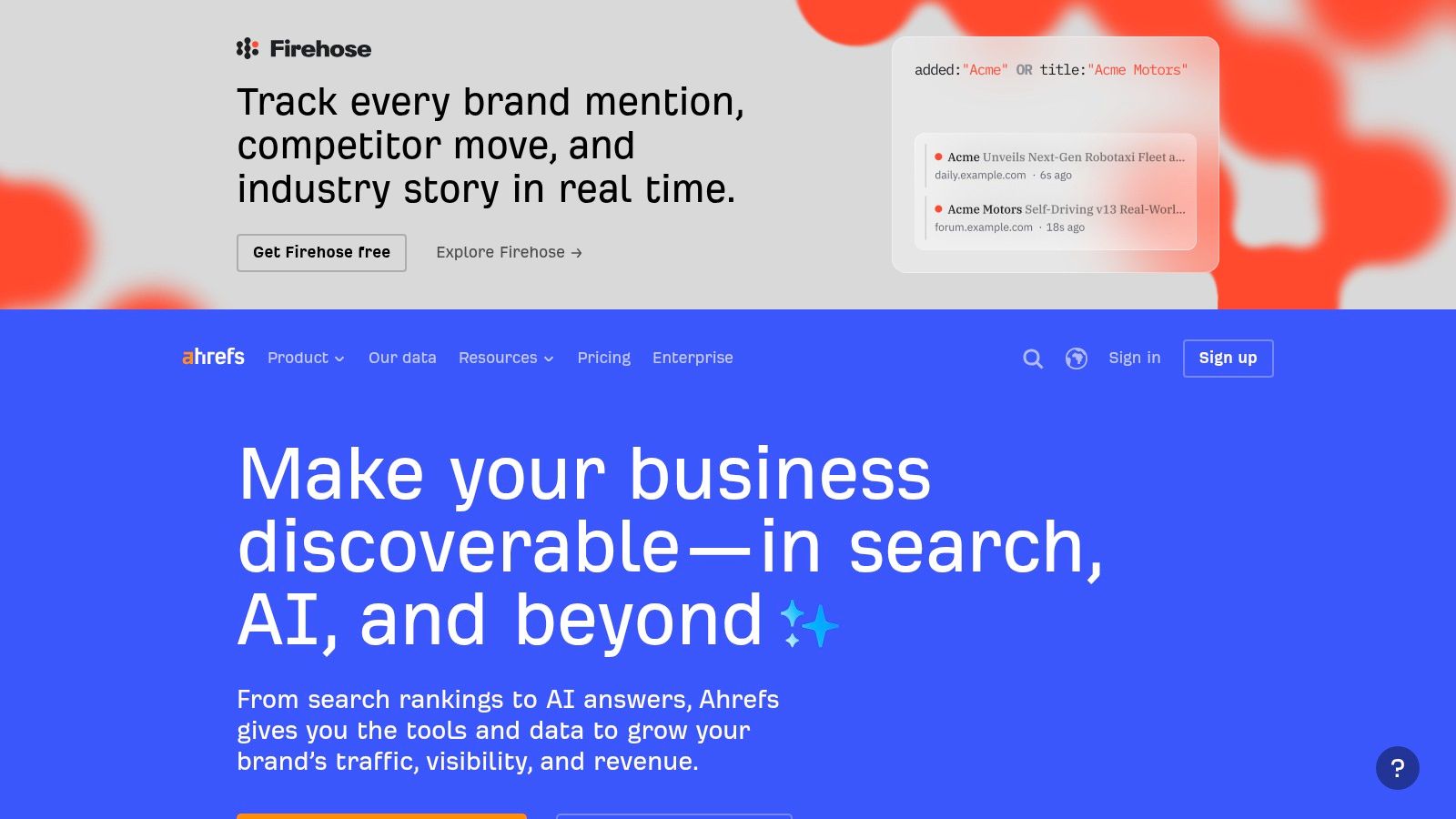
Ahrefs is the tool I reach for when link data has to be taken seriously. SpyFu can show competitor keywords and ad history well enough, but it doesn't come close to Ahrefs when the work depends on backlink intelligence, SERP history, and competitor gap analysis. That's why so many link builders and technical SEOs treat it as the default alternative.
Why backlink-first teams prefer it
The Site Explorer workflow is where Ahrefs still feels strongest. It gives you a direct path from a competitor domain to backlinks, ranking pages, and keyword opportunities, and the filtering is clean enough that I can isolate useful patterns without wrestling the interface. The broader suite, including Keywords Explorer, Content Explorer, and Site Audit, makes it workable for organic teams that don't want separate tools for research, content ideation, and crawl checks.
Ahrefs also gets cited often in comparison roundups because it pairs that depth with a fast, focused interface. When the job is to understand why a competitor is winning links or which pages keep earning citations, it's hard to beat. A 2026 comparison places Ahrefs at from $29/month in one pricing roundup, while another positions it as a premium choice for more advanced use, which matches the fact that serious users usually land on higher tiers as they scale.
I'd still be careful about one thing. Ahrefs can become credit-intensive if you use it the way you'd use a lighter tool, especially when you're running lots of exploratory checks. That's not a flaw if you're disciplined, but it is a trap for teams that love to click around without a plan.
Useful habit: open Ahrefs with a specific question. If you start with “show me everything,” you'll burn time and credits, and you still won't know what to build next.
If your core SpyFu workflow is “find who links to competitors, then build something better,” Ahrefs is the cleaner replacement. If your core workflow is paid search spying, it's not the same fit. For that reason, I usually pair it mentally with link-led content strategy rather than ad intelligence.
For deeper overlap analysis, this site overlap guide for SEO is a useful companion read, and for a direct product comparison, the Ahrefs versus SpyFu breakdown helps frame where each platform really wins.
4. SE Ranking
SE Ranking is the practical choice when a team wants a broader SpyFu replacement without jumping straight into the most expensive enterprise suite. It keeps showing up in comparison rounds because it balances competitor research, rank tracking, site audits, and on-page workflows in a way that agencies and SMBs can afford to use.
What I like most is the cadence. Independent comparison sources call out daily updates, which matters in modern search where visibility can change fast enough to make weekly data feel stale. That's especially helpful for agencies that need to spot movement early and then explain it to clients without waiting for the next report cycle. SE Ranking also includes AI visibility tracking and optional AI search add-ons, so it's positioned for the current search environment rather than an old keyword-only model.
It's also one of the cleanest budget-to-capability trades in this category. One pricing roundup places SE Ranking at $103.20/month billed annually, and another comparison notes it as one of the more practical choices for agencies that need both SEO and PPC competitor research in one system. That's not cheap, but it's often cheaper than stacking several smaller tools to cover the same ground.
The main downside is that the interface depth is still growing. In other words, it covers a lot, but the experience doesn't always feel as polished as the biggest suites. I still prefer it for teams that need reporting clarity and decent breadth without making the whole stack feel bloated.
- Best use case: agency reporting where rank tracking and competitor visibility need to stay fresh.
- What it replaces well: SpyFu keyword monitoring, daily rank review, and basic competitive analysis.
- Where it falls short: it won't feel as expansive as the highest-end all-in-one platforms.
For many small teams, that's enough. SE Ranking doesn't try to win on flash, it wins by making the day-to-day work manageable. And in real agency life, that usually matters more.
5. Serpstat
Serpstat is one of those tools that gets overlooked until you need a solid middle ground between price and capability. It's not trying to be the biggest suite in the market, but it does a respectable job across keyword research, domain-to-domain gap analysis, rank tracking, site audits, and backlink analysis. That mix makes it a sensible alternative for teams that want more structure than a lightweight keyword tool but don't want the complexity tax of the top-tier suites.
The part I've found most useful is its clustering and batch analysis workflow. When you're sorting through messy keyword lists or trying to group topics without creating cannibalization, that can save time. It's less about stunning dashboards and more about making the research output usable for planning. For budget-conscious teams, that is often the difference between a tool that sits unused and a tool that ships work.
Pricing is another reason people keep it in the conversation. Comparison roundups place Serpstat at from $44/month, which lands it in a workable middle band for freelancers, smaller agencies, and in-house marketers who need more than a basic keyword checker. The trade-off is that data depth can feel lighter in some regions, especially if you're comparing it to the biggest international databases.
I'd be honest about how I use Serpstat. I don't reach for it when I need the absolute deepest backlink index or the most expansive market intelligence. I do reach for it when I need a practical SEO toolkit that provides the essential basics well enough and doesn't punish usage as hard as some bigger platforms.
If your SpyFu replacement goal is “give me a broader research and reporting stack without overcommitting budget,” Serpstat belongs on the shortlist. It's the kind of tool that makes sense when the team is still defining what level of depth it needs.
6. Moz Pro
Moz Pro is the tool I recommend when a team wants a gentler learning curve and a familiar SEO workflow. It's built around Keyword Explorer, Link Explorer, campaign-based audits, rank tracking, and the MozBar browser extension, which makes it easy to use for people who don't live inside SEO software all day. That matters more than people admit, because adoption often fails on usability before it fails on data quality.
The strongest appeal here is clarity. Moz Pro is good at helping teams get structured about keyword and link discovery without forcing them into a heavyweight research environment. If a marketing manager or content lead needs to understand campaign health and link opportunities without a specialist sitting beside them, Moz Pro is comfortable territory. The educational ecosystem also helps teams get moving faster than they might with more intimidating platforms.
It's not the first tool I'd pick for deep PPC competitive intelligence, and I wouldn't pretend otherwise. Moz Pro is more of a classic SEO workbench than a full competitor-intelligence replacement. That said, if your SpyFu usage is mostly basic keyword research plus some domain and link checks, Moz Pro can cover enough ground to be useful.
The pricing context also matters. A 2026 roundup places Moz Pro at from $49/month, which keeps it accessible relative to the premium suites. That said, the trade-off is obvious, the database coverage is smaller than some enterprise platforms, and the competitive PPC side is limited.
Moz Pro works best when your team values training wheels that don't feel like training wheels.
I'd choose it for teams that need a stable, understandable SEO system more than a highly aggressive research stack. If the main goal is to get people using the tool consistently, that alone can make it a better decision than a more powerful platform that nobody touches after week one.
7. Mangools
Mangools is what I recommend when the team wants speed and simplicity more than depth. The suite, especially KWFinder, SERPChecker, SERPWatcher, LinkMiner, and SiteProfiler, is easy to learn and quick to use. For freelancers and small teams doing keyword-first work, that simplicity can be a real asset instead of a compromise.
Where Mangools makes the most sense
I think of Mangools as a first-step research suite. It gives you keyword ideas, SERP checks, rank tracking, and light backlink snapshots without making you manage a complicated workflow. That's useful when the work is mostly content ideation, validation, and quick competitive checks. It also shows up in budget-friendly comparison lists because the cost is approachable, with one 2026 roundup putting it at from $37.70/month billed annually.
The trade-off is clear. Mangools is not built for deep PPC intelligence, and its databases are smaller than the bigger suites. If you need heavy cross-channel competitor analysis, it'll feel limited. If you need fast answers and a clean interface, it works surprisingly well.
The best way to use it is to stay honest about the job. Don't ask Mangools to behave like Semrush or Ahrefs. Ask it to help you find long-tail keywords, inspect a SERP quickly, and keep a small site or a solo project moving. In that role, it's efficient.
I also like it for teams that are prone to overcomplicating their stack. Mangools can force better discipline because it narrows the options and gets you back to the question that matters, “What should we publish or optimize next?” For beginner SEO practitioners, that's often enough to build a workable process before graduating to a heavier platform.
8. SISTRIX
SISTRIX is the most interesting choice for teams that care about historical visibility and European search markets. Its signature Visibility Index gives it a different flavor from the usual keyword-first suites, and that's exactly why it stays on my list. Instead of only chasing raw keyword lists, it helps you understand how domain visibility changes over time.
That historical angle matters. In volatile search environments, I'm less interested in one-off screenshots and more interested in trend direction. SISTRIX's modular setup, which lets you add only the pieces you need, also makes the platform easier to justify when a team doesn't want to pay for an oversized bundle. Comparison roundups place it at €119/month annually for entry pricing, which is premium, but not random premium. You're paying for a specific way of reading the market.
SISTRIX is especially compelling if you work across Europe. The platform is frequently praised for regional coverage and longitudinal benchmarking, and that makes it valuable for agencies with mixed-market clients. It's less compelling if your work is mostly North America and you need broad PPC intelligence, because that's not where it shines.
I'd describe SISTRIX as a benchmark tool first and a tactical spy tool second. That's a useful distinction. If the decision-makers want to know how a domain is trending against competitors in a market where visibility reporting matters, SISTRIX gives you a cleaner story than a generic keyword tool does.
The downside is that it feels different from US-centric platforms in both interface and conventions. That's not a problem once you learn it, but it can slow down adoption if the team expects a familiar layout. For the right market, though, it's a serious option.
9. Similarweb
Similarweb is the tool I pull in when the question isn't just “what keywords does this competitor rank for?” but “where is their traffic really coming from?” That's a different kind of intelligence, and it's why Similarweb often belongs in the same conversation as SpyFu alternatives even though it plays a broader game. It's positioned around traffic sources, channel mix, audience behavior, and market-level benchmarking.
Why traffic intelligence changes the decision
Similarweb feels most different from purpose-built SEO tools. It's better for sizing a competitor's demand, understanding channel contribution, and comparing market share than for drilling into long-tail keyword tactics. That's why I'd use it alongside an SEO suite rather than as a pure SpyFu replacement for content teams. Comparison sources also note features like paid share-of-voice, landing-page analysis, and traffic-source mix, which makes it useful when leadership wants a bigger picture view.
Pricing is usually sales-assisted, and that alone tells you something about the product category. One 2026 comparison describes it as priced on request for enterprise buyers, while another frames it as a platform with packages that vary by need. That makes sense, because the value isn't in cheap keyword spying, it's in market intelligence.
The trade-off is granularity. If your job is traditional SEO execution, Similarweb can feel too broad and not detailed enough on keyword mechanics. If your job is strategy, benchmarking, or channel planning, it becomes much more relevant. I've found it especially useful when internal teams want a shared view of competitors beyond search alone.
Best fit: leadership reporting, market sizing, and channel planning.
Not ideal for: detailed keyword operations or backlink prospecting.
If your SpyFu pain point is that the tool doesn't tell a convincing business story, Similarweb often fills that gap better than the SEO-first alternatives. It gives you a wider lens, and sometimes that's exactly what the room needs.
10. Ubersuggest
Ubersuggest is the easiest tool on this list to understand, and that's the main reason it keeps showing up in low-friction buying decisions. It gives you keyword research, site audits, basic backlink and competitor reports, rank tracking, and content ideas without making the interface feel intimidating. For freelancers, bloggers, and small business owners, that simplicity is often the whole point.
I wouldn't use Ubersuggest for deep competitor intelligence or serious PPC analysis. That's not what it does best. I'd use it when someone needs quick keyword discovery, a lightweight audit, and a straightforward way to get from idea to draft. A 2026 comparison puts it at from $20/month, which keeps the barrier to entry very low.
The strength here is accessibility. Teams can get moving fast, especially if they're early in the SEO process and don't have a specialist on hand. The downside is equally obvious, the datasets are lighter, the controls are fewer, and the competitive depth doesn't match larger suites. That makes it a good starting point, not a destination platform for advanced teams.
If I'm being practical, Ubersuggest works best as a “get unstuck” tool. It helps people validate topics, spot obvious gaps, and keep publishing when bigger platforms feel too heavy. That's valuable, just not if you need rich ad history or strong market benchmarking. For those jobs, the tool will feel too thin.
Top 10 SpyFu Alternatives Comparison
| Tool | Core features | UX / Quality (★) | Price / Value (💰) | Target (👥) | Unique selling point (✨) |
|---|---|---|---|---|---|
| SemDash 🏆 | 6.6B keywords, 2.7T backlinks, 600M SERPs, URL-level mapping, AI briefs, backlink-gap | ★★★★☆ fast, simple | 💰 Budget-friendly; free trial; optional add-ons | 👥 Solopreneurs, SMBs, agencies | ✨ URL-level mapping + AI Overviews; massive refreshed datasets |
| Semrush | SEO & PPC toolkits, Competitive Research, Traffic & Market, AI Visibility | ★★★★★ mature, feature-rich | 💰 Premium; toolkit-based tiers | 👥 Agencies, enterprises, marketing teams | ✨ Broad SEO+PPC ecosystem, App Center integrations |
| Ahrefs | Site Explorer, Keywords Explorer, Content Explorer, Site Audit, SERP history | ★★★★★ industry-standard data | 💰 Premium; credit limits on some queries | 👥 SEO pros, agencies, link builders | ✨ Industry-leading backlink index & deep SERP history |
| SE Ranking | Rank tracking, Site Audit, Competitive research, API, optional AI add-on | ★★★★ reliable & value-focused | 💰 Affordable, scalable plans | 👥 Agencies, consultants, SMBs | ✨ Flexible pricing + API access; clear reporting |
| Serpstat | Keyword research, Domain gap, Rank Tracker, Backlinks, clustering & batch tools | ★★★★ practical for tasks | 💰 Budget-friendly; credit model | 👥 SMBs, in-house teams on budget | ✨ Strong clustering & batch analysis at affordable cost |
| Moz Pro | Keyword Explorer, Link Explorer, Campaign audits, MozBar | ★★★★ easy to learn | 💰 Mid-range plans | 👥 Teams beginning structured SEO | ✨ Trusted metrics (DA), strong educational resources |
| Mangools | KWFinder, SERPChecker, SERPWatcher, LinkMiner, SiteProfiler | ★★★★ very user-friendly | 💰 Low-cost subscriptions | 👥 Freelancers, small teams | ✨ Fast, approachable UI for keyword-first workflows |
| SISTRIX | Visibility Index, SEO & Links modules, Optimizer, historical SERP trends | ★★★★ strong historic analysis | 💰 Modular pricing (buy modules) | 👥 European agencies, analysts | ✨ Visibility Index + deep EU market coverage |
| Similarweb | Traffic & channel insights, audience, SEO & paid intelligence, AI reporting | ★★★★ macro-level insights | 💰 Enterprise / sales-assisted pricing | 👥 Market analysts, enterprises | ✨ Macro market intelligence & channel mix analysis |
| Ubersuggest | Keyword research, Site Audit, rank tracking, basic backlink reports | ★★★ beginner-friendly | 💰 Very affordable; free tier available | 👥 Freelancers, bloggers, small businesses | ✨ Low barrier to entry for quick keyword & content ideas |
My Final Verdict Which Tool Should You Choose
There isn't a single best SpyFu alternative, only the best fit for the workflow you're trying to replace. After testing these tools in real campaigns, my cheat sheet is pretty simple. For all-in-one SEO and PPC, Semrush is still the incumbent. For the strongest backlink data and link-led research, Ahrefs remains the benchmark.
For budget-conscious agencies that need daily updates and reporting without overcomplicating the stack, SE Ranking is a very strong contender. For teams that want a practical middle ground with clustering and solid keyword research, Serpstat deserves more attention than it usually gets. If your work is mostly beginner-friendly keyword discovery, Mangools and Ubersuggest are both easier to adopt than heavier suites.
My top pick for most freelancers, SMBs, and many agencies is SemDash. I'd choose it because it combines massive keyword and backlink datasets, URL-level mapping, AI-assisted briefs, and a clean workflow for keyword gaps, backlink gaps, and SERP change tracking. It's the closest thing I've found to a modern replacement for SpyFu that doesn't stop at keyword spying and helps you build the next move.
The smartest way to choose is to identify your single biggest pain point first. If SpyFu is failing you on backlinks, start with Ahrefs. If it's failing you on cross-channel reporting, look at Semrush or Similarweb. If it's failing you on speed, simplicity, and actionability, SemDash should be near the top of your trial list.
If you want a SpyFu replacement that connects keyword discovery, backlink analysis, SERP monitoring, and AI-assisted briefs in one workflow, SemDash is built for that job. It's the tool I'd test first if I wanted less guesswork and more page-level action from my competitive research. Take a look at SemDash and see whether it fits the way you run SEO.