

Most comparisons of Semrush vs Similarweb ask the wrong question. They treat two tools as if they were interchangeable products on a shelf, then try to crown a winner based on a feature checklist. That framing misses how SEO teams work, because one tool is built to help you do the work, while the other is built to help you understand the market before you act.
If you're choosing between them for client work, content planning, or competitive research, start with the job you need to finish. For AI search tracking and newer visibility workflows, I'd also keep a separate eye on browse AI search tracking tools, because the category is moving fast and the old “keyword tool only” mindset is already too narrow.
| Area | Semrush | Similarweb |
|---|---|---|
| Core positioning | SEO execution engine | Market intelligence lens |
| Best for | Keyword research, audits, rank tracking, backlinks | Traffic estimation, audience behavior, competitive sizing |
| Keyword depth | Larger keyword corpus, strong long-tail coverage | Smaller keyword corpus, still useful for competitor context |
| Audience and traffic view | Useful, but secondary | Stronger, broader, more native to the platform |
| Budget fit | Usually the lower-cost SEO default | Usually the pricier market-intelligence option |
| Best workflow | Decide what to target and fix | Understand where traffic comes from and who is winning it |
Table of Contents
- Why Semrush vs Similarweb Is the Wrong Question
- Scale and Positioning of Each Platform
- SEO Execution Features in Semrush vs Similarweb
- Market Intelligence and Traffic Analytics in Similarweb
- Accuracy and Visibility in a Volatile SERP Era
- Pricing Realities and What Each Tier Provides
- Choosing by User Type and Workflow
- Decision Framework and Common Buyer Questions
Why Semrush vs Similarweb Is the Wrong Question
The cleanest way to choose between these two is to stop treating them as if they solve the same problem. They don't. Semrush is the tool I reach for when the work has to turn into action, while Similarweb is the tool I use when I need to size a market, read a competitor's traffic mix, or sanity-check where attention is coming from.
That difference matters because weak tool buying usually starts with the wrong mental model. A content team asks for “the better SEO tool,” but what they really need is keyword discovery, clustering, and page-level prioritization. An executive asks for “competitive intelligence,” but what they need is traffic share, channel mix, and audience context.
Practical rule: if the next step is to change pages, build links, or map keywords to URLs, choose the execution tool. If the next step is to explain the market, choose the intelligence tool.
I've seen teams overbuy Similarweb because they liked the presentation layer, then still keep another SEO tool around for the actual work. I've also seen agencies stay too long in a keyword-first stack and miss the broader traffic story their clients cared about. The right question is simpler, who will use the data, what decision will they make, and how often will they need to make it?
That's why workflow fit beats brand loyalty. If you're evaluating AI search monitoring specifically, browse AI search tracking tools in the same practical bucket, because the decision is never “which logo is bigger,” it's “which tool supports the next three decisions I have to make.”
Scale and Positioning of Each Platform
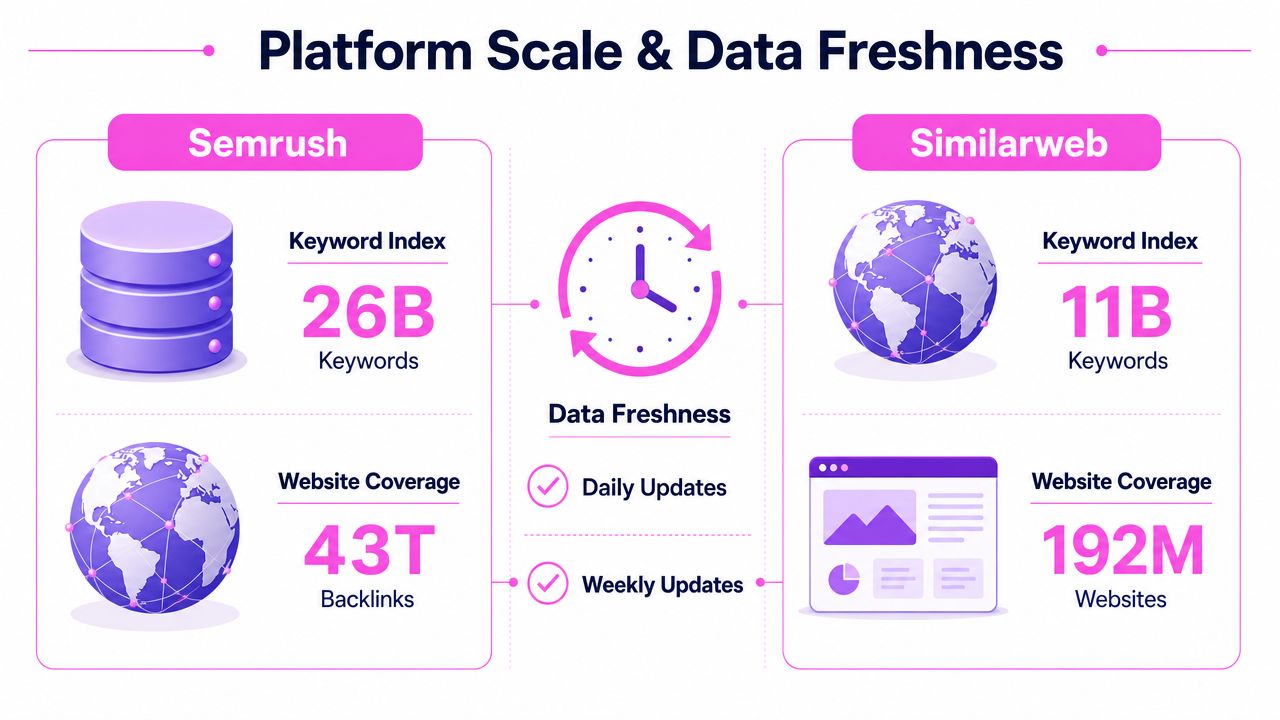
The divide is what each platform is built to answer. Semrush is the bigger SEO execution stack, the place to go when the job is keyword discovery, gap analysis, rank tracking, backlink review, and content planning. Similarweb is the broader market intelligence view, useful when the question is how traffic is distributed, which channels are driving attention, and how a competitor fits into the market. That positioning matters more than any feature checklist, because the tool should match the decision you need to make.
On scale, Semrush still has the heavier keyword corpus. Industry comparisons place it well ahead on keyword coverage, with one review putting Semrush at about 22.3 billion keywords versus Similarweb at about 6 billion, and another cited comparison space using similarly directional figures even though the exact counts differ by publication date (01net comparison). I do not read that as a vanity metric. I read it as the reason Semrush usually gives me more room to explore long-tail terms, adjacent topics, and competitor gaps before the data runs thin.
Why raw keyword scale matters in practice
I do not treat keyword volume as a quality score. I treat it as a proxy for coverage density. When the corpus is larger, I can usually find more long-tail queries, more pages worth reverse engineering, and more ways to expand a topic cluster without forcing the strategy too early.
Semrush is built around that workflow. It centers SEO planning with keyword difficulty, search intent, CPC, SERP overview, clustering, and gap analysis, while Similarweb stays closer to traffic analysis and market positioning (01net comparison). That difference shows up fast in client work. Semrush helps me move from a rough topic into a publishable brief. Similarweb helps me explain where a competitor's attention is coming from.
Why Similarweb still matters
Similarweb wins on breadth of market visibility. One industry summary says it tracks over 100 million websites and apps, which gives you a wider lens on traffic volume, device mix, traffic channels, audience interests, competitor lists, and related marketing channels (OWOX comparison). That is useful when the core question is who is getting attention, from where, and in what mix. It is less useful if you are trying to decide which specific query should become the next page.
The practical split is straightforward. Semrush is the better choice for building a keyword universe, spotting gaps, and planning pages. Similarweb is the better choice for reading traffic share, channel mix, and market shape. A stronger comparison between Semrush vs Ahrefs often makes the same point from another angle, but the same basic rule holds here. Use the SEO engine for execution, and the market lens for positioning.
SEO Execution Features in Semrush vs Similarweb
For hands-on SEO work, Semrush is the more complete execution environment. Independent comparisons describe it as a full SEO suite with keyword difficulty, search intent, CPC, SERP overview, clustering, and gap analysis, while Similarweb sits closer to market-intelligence traffic analysis (Exploding Topics comparison). That lines up with how I use the tools. Semrush is where I go to decide what to target and how to structure the page. Similarweb is where I go to understand who's winning attention overall.
Keyword research and topic expansion
Semrush clearly wins the research workflow. When I'm building a content plan, I want breadth first, then filters, then clustering. Semrush gives me that sequence cleanly, which matters when I'm moving from raw ideas to publishable briefs.
Similarweb can still support keyword visibility work, but it doesn't feel like a tool built for deep editorial planning. It's fine for a quick competitive read. It's not where I'd build a large-scale content roadmap.
Rank tracking, backlinks, and site work
Semrush also pulls ahead on rank tracking, backlink analysis, and site audits. That's consistent with the broader practitioner view that it's the stronger SEO-specialist platform, while Similarweb is better aligned to market research and traffic analytics (OWOX comparison). In practice, that means Semrush is what I use when I need to diagnose a page, inspect links, or monitor SERP movement across a campaign.
Similarweb does cover some SEO ground. It can surface competitor keyword visibility, basic rank tracking, and some backlink-oriented insights. But it feels secondary to its core mission. I can use it to answer SEO questions, yet I don't depend on it to run the full SEO workflow day after day.
My take: if the deliverable is a fix list, a keyword map, or a link prospect list, Semrush is the safer default. If the deliverable is a market readout, Similarweb is the cleaner lens.
If you want a companion perspective on where Semrush sits against other execution-first tools, this SemDash comparison with Semrush and Ahrefs is useful because it frames the same “what job are you hiring the tool to do” question from a different angle.
Market Intelligence and Traffic Analytics in Similarweb
Similarweb earns its keep when the question is not “how do I rank this page?” but “where is this market's attention going?” One major comparison describes it as tracking traffic volume, visitor device distribution, traffic channels, audience interests, competitor lists, and related marketing channels, which is exactly the kind of context I want when I'm reading a market rather than editing a site (OWOX comparison).
Where Similarweb fits better than Semrush
I use Similarweb most often for competitor sizing, channel mix checks, and audience readouts. That makes it especially useful for market research style work, and the Sota Proxy overview of market research use cases is a good example of the broader research lens it fits into. When I need to explain why a rival appears to be growing, I care less about their exact keyword list and more about where their visits likely come from and which channels seem to be carrying the load.
Semrush can also provide traffic analytics, but its reporting feels more SEO-native. It is better when I'm trying to estimate organic opportunity tied to a specific site I'm optimizing. Similarweb feels more comfortable when I'm framing a competitive narrative or sizing a category.
Where Semrush still matters in traffic analysis
Semrush's organic-traffic estimates are usually more actionable for me as an SEO because they sit closer to the work I'm doing. If I'm changing page structures, internal links, or content depth, I need estimates that connect back to ranking pages and keyword targets. Similarweb's broader view is stronger for outbound intelligence, while Semrush is stronger for inbound execution.
The gap is not about “better data” in the abstract. It's about decision shape. Similarweb helps me understand where traffic comes from. Semrush helps me decide what to do next.
For a second cross-check on Similarweb's positioning against another SEO platform, this Similarweb and Ahrefs comparison is a useful reminder that market intelligence and SEO execution often need different data models, even when the dashboards look similar on the surface.
Accuracy and Visibility in a Volatile SERP Era
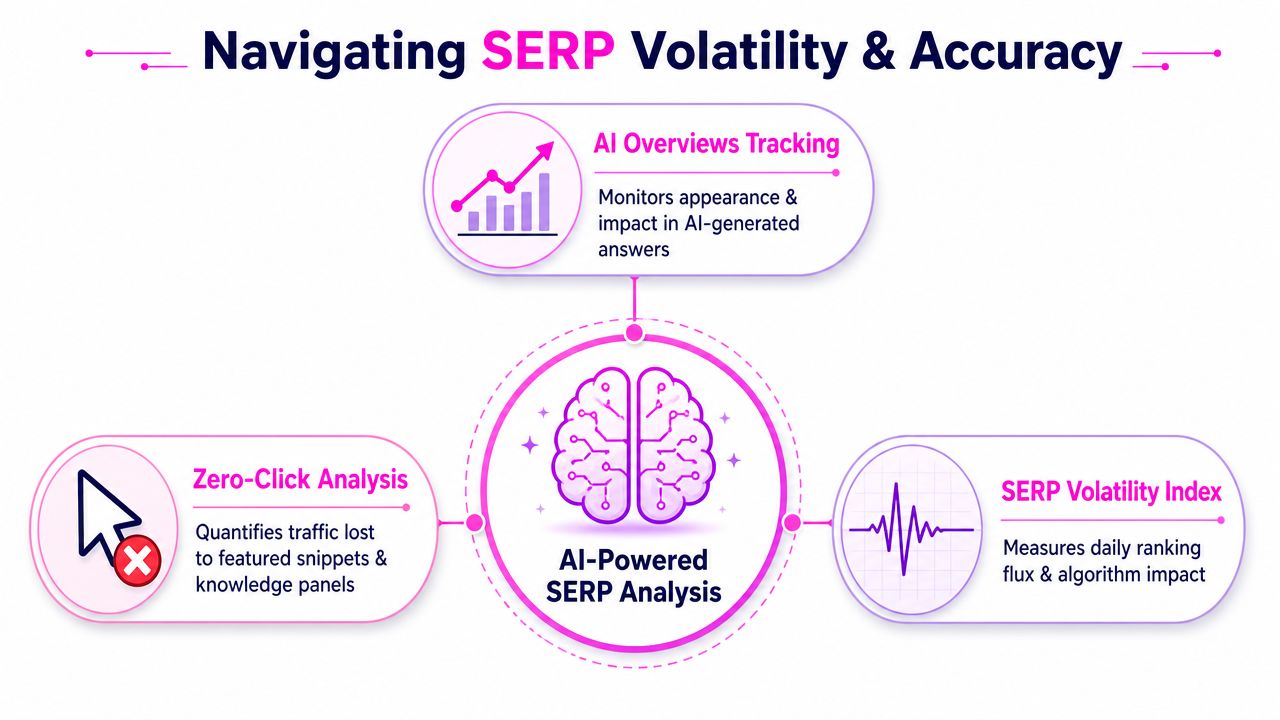
The old habit of treating rank position as a proxy for traffic is breaking down. Google's results now include AI Overviews and more zero-click behavior, which makes traditional keyword estimates less predictive than they used to be. That matters because a page can hold a decent ranking and still lose clicks if the SERP itself changes the way users interact with the result.
What I test now
When I audit a volatile query set, I look at four signals together.
- Rank stability. Does the keyword stay in roughly the same position, or does it swing sharply?
- Click-rate trends. Does the query still appear to produce meaningful click opportunity, or does the SERP absorb the demand?
- AI Overview presence. Is the query showing generated answers that can change user behavior?
- Ranking-page mapping. Which URL is being surfaced for the term, and is that still the page I want to promote?
Rankings are only half the story now. If the SERP steals the click, the position number can look healthier than the traffic chart.
Recent comparison content notes that Similarweb includes click-rate and zero-click-related metrics, while Semrush emphasizes SERP analysis, historical trends, and ranking-page mapping (CrawlWP comparison). That split matches what I see in practice. Semrush is more useful when I'm tracing page-level visibility and historical rank behavior. Similarweb is more useful when I'm trying to understand broader click loss patterns.
What that means for tool choice
If I'm diagnosing a cluster of pages after traffic drops, I want the platform that makes visibility loss easier to inspect at the keyword and URL level. If I'm trying to understand whether the whole market is shifting away from classic blue-link clicks, I want the platform that treats traffic behavior as the bigger story.
If visibility in AI answers is part of your reporting stack, this visibility-measurement guide from Algomizer is worth a look alongside standard rank tracking, because the metric problem is broader than classic SEO has been built to measure.
Pricing Realities and What Each Tier Provides
Price rarely decides the choice by itself, but it still shapes the default option. One comparison puts Semrush's entry plan at $139.95 per month, while Similarweb's basic plan is listed at $199 per month in the same general pricing discussion (DemandSage comparison). That gap matters for smaller teams, especially if the first real use case is keyword research, audits, and backlink work.
What the money usually buys
Semrush is usually the lower-cost path to hands-on SEO features. If I need research, technical checks, and competitive keyword work, it is the cleaner budget default. Similarweb tends to push more of its deeper SEO capabilities into pricier plans, which fits a buyer paying first for market intelligence and second for SEO execution.
| Platform | Entry Plan | SEO Feature Depth | Market Intelligence Depth |
|---|---|---|---|
| Semrush | $139.95/month | Deep keyword research, audits, backlinks, rank tracking | Present, but secondary |
| Similarweb | $199/month | Useful, but more limited for core SEO execution | Strong, especially for traffic and audience analysis |
The mistake I see most often is treating the entry plan as the full picture. It rarely is. Teams should price the total setup around seats, the features available at the tier they will use, and whether API access or historical depth requires a higher plan. That is where budgets tend to drift.
A smaller team can buy the cheaper plan and still end up boxed in if the workflow depends on broader data access. A larger team can justify the higher plan and still waste money if half the features never get used. The question is not which logo costs less, it is which plan matches the work your team does every week.
My simple rule of thumb
- Choose Semrush first if the primary need is keyword research, site fixes, and backlink work.
- Choose Similarweb first if the primary need is traffic intelligence, audience context, and competitive market sizing.
- Run both only if different stakeholders need both workflows, and the team will use both regularly.
Choosing by User Type and Workflow
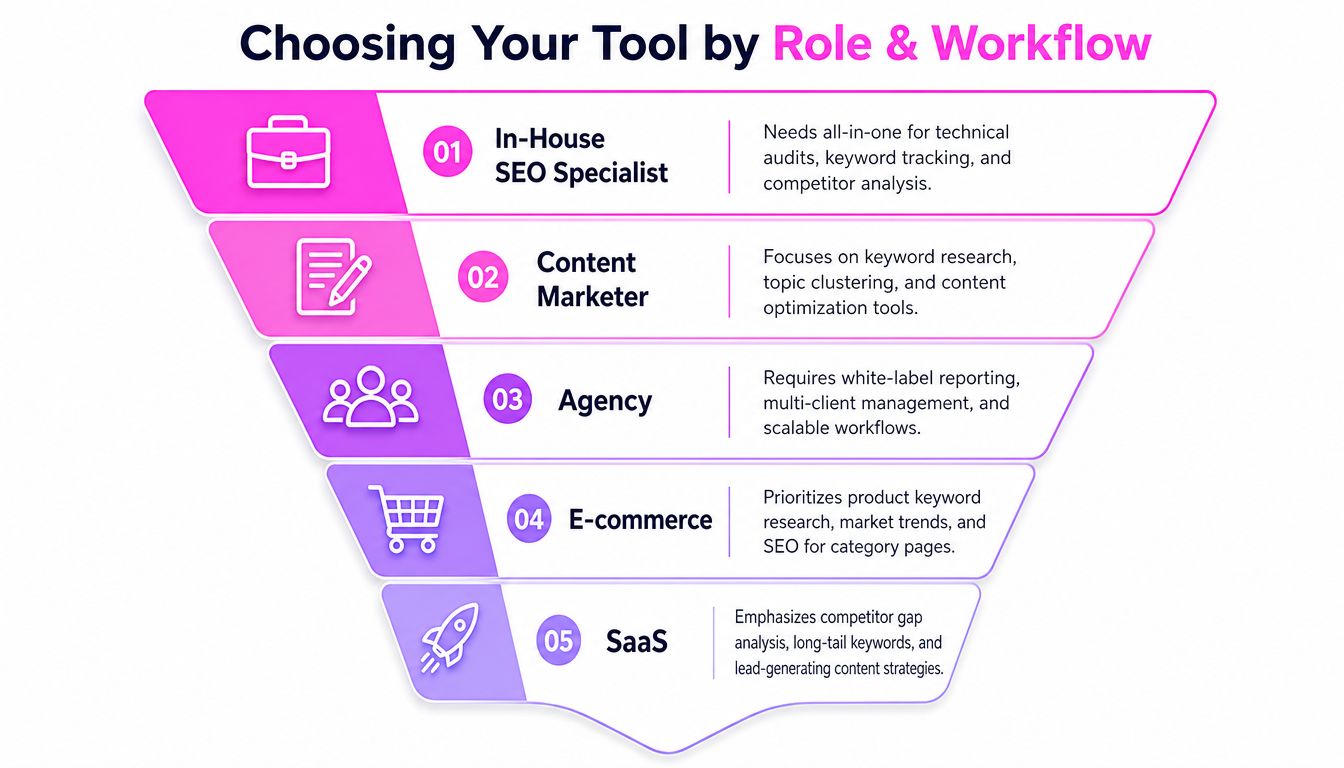
The cleanest way to separate these tools is by job role, not by feature list. An in-house SEO specialist usually needs a day-to-day execution stack, which pushes me toward Semrush. A market researcher or strategy lead usually needs a broader traffic lens, which makes Similarweb the more natural fit.
How I map the common roles
- In-house SEO specialist. Semrush usually wins because audits, ranking work, keyword mapping, and backlink review all sit in one place.
- Content marketer. Semrush is the stronger default when the work centers on keyword research, clustering, and page optimization. Similarweb helps if the brief starts with competitor traffic analysis.
- Agency. This is the most mixed case. Agencies often need Semrush for delivery and Similarweb for reporting narratives, especially when a client cares about market share as much as rankings.
- E-commerce. I lean Semrush for category and product-page SEO, then use Similarweb if I need to understand market demand and traffic mix across rivals.
- SaaS. Semrush usually handles the long-tail and competitor-gap side better, while Similarweb can help frame the situation before a launch or repositioning.
The hybrid setup is common in real accounts. One team uses Semrush for the weekly work, then keeps Similarweb around for quarterly strategy reviews. That's not redundancy, it's division of labor. If the budget is tight, I'd rather have one tool I use every week than two tools I open only when leadership asks for a deck.
Decision Framework and Common Buyer Questions
The simplest decision rule is still the right one. Keyword work and SEO execution go to Semrush, market sizing and traffic intelligence go to Similarweb, and both only makes sense when different teams need both outcomes on a regular cadence.
A few buyer questions come up every time. Which is more accurate at low traffic volumes? I'm cautious with both, but I trust Semrush more when I need the SEO workflow tied to a page and Similarweb more when I need directional market context. Can Similarweb replace Semrush for an agency? Not if the agency does real SEO delivery. Should a small team pay for both? Only if one person is using one for execution and another is using the other for strategy, and both outputs matter.
If you want the same workflow split without the bloat of an oversized stack, SemDash is built for keyword discovery, backlink research, SERP tracking, and AI Overviews visibility in one place. It's worth testing if your team cares more about getting from research to action than about collecting dashboards. Visit SemDash and see whether it fits the way you do SEO.