%20(1)-B86R08ZzwhPzS6UZbG3mSxRWPCwGwn.png)


Most affiliate guides still push the same tired formula, chase high volume, filter for low difficulty, publish fast. That's how a lot of sites end up with pages that rank, collect impressions, and never earn meaningful commissions. I've built enough niche projects to know the trap is't volume, it's mispriced intent.
The keyword that gets the most searches is often the one that teaches you the least about money. The head term “affiliate marketing” shows 165,000 global monthly searches and a $3.18 CPC in one widely cited keyword list, while related terms like “affiliate programs” show 14,800 monthly searches and “amazon affiliate marketing” shows 12,100 monthly searches (the keyword list). Those numbers tell the same story I've seen on live sites, broad terms can create reach, but commercial terms with clearer intent are usually where the page earns.
The mistake is treating search volume as the main filter. It isn't. The better workflow starts with buyer intent, then checks CPC, then looks at competition, then asks whether the SERP wants an affiliate page. If the results are informational list posts, forum threads, or pure definitions, a review page often fights the wrong battle from day one.
Table of Contents
- Why Most Affiliate Keyword Research Fails Before It Starts
- Building Your Seed List and Expanding with Intent Filters
- Scoring Keywords for Profitability Not Just Volume
- Clustering Keywords Into Page-Level Topics
- When Zero-Volume Keywords Outperform Obvious Targets
- Prioritizing Your Targets and Building a Repeatable System
Why Most Affiliate Keyword Research Fails Before It Starts
The usual failure starts with a false assumption, that more searches automatically mean more money. In affiliate work, that's often the fastest route to a bloated content calendar and a weak revenue curve. I've seen pages chase broad informational queries for months, then discover the SERP rewards educational content, not affiliate angles.
Volume attracts visitors, intent attracts buyers
A page targeting a broad phrase can still be useful, but usefulness isn't the same as monetization. The query “affiliate marketing” has scale, yet it's not naturally close to a purchase decision, so the traffic tends to be mixed and harder to convert. By contrast, commercial phrases often signal comparison behavior or product research, which is where affiliate pages can do real work.
Practical rule: if the SERP looks like it wants to teach, don't force a sales page into it.
What I check first is whether the keyword points to a problem-aware buyer or just a curious reader. If someone searches for a generic term, they're often still forming the question. If they search with modifiers like best, review, vs, alternative, or under, they're much closer to an action.
CPC tells you something volume never will
I don't use CPC as a perfect proxy for profit, but I do treat it as a useful monetization signal. A keyword with lower volume and stronger advertiser value can outperform a bigger phrase that attracts casual readers. That's why modern affiliate keyword research centers on search volume, CPC, and competition, not search volume alone (affiliate keyword list).
This is also where people waste weeks by writing for the wrong SERP intent. If the top results are guides, forums, or general explainers, an affiliate roundup may need a different angle or a different keyword altogether. I'd rather skip a shiny phrase than spend a month ranking for traffic that never clicks through.
The better question isn't “how big is the keyword,” it's “what kind of buyer behavior does this keyword reveal?”
Building Your Seed List and Expanding with Intent Filters
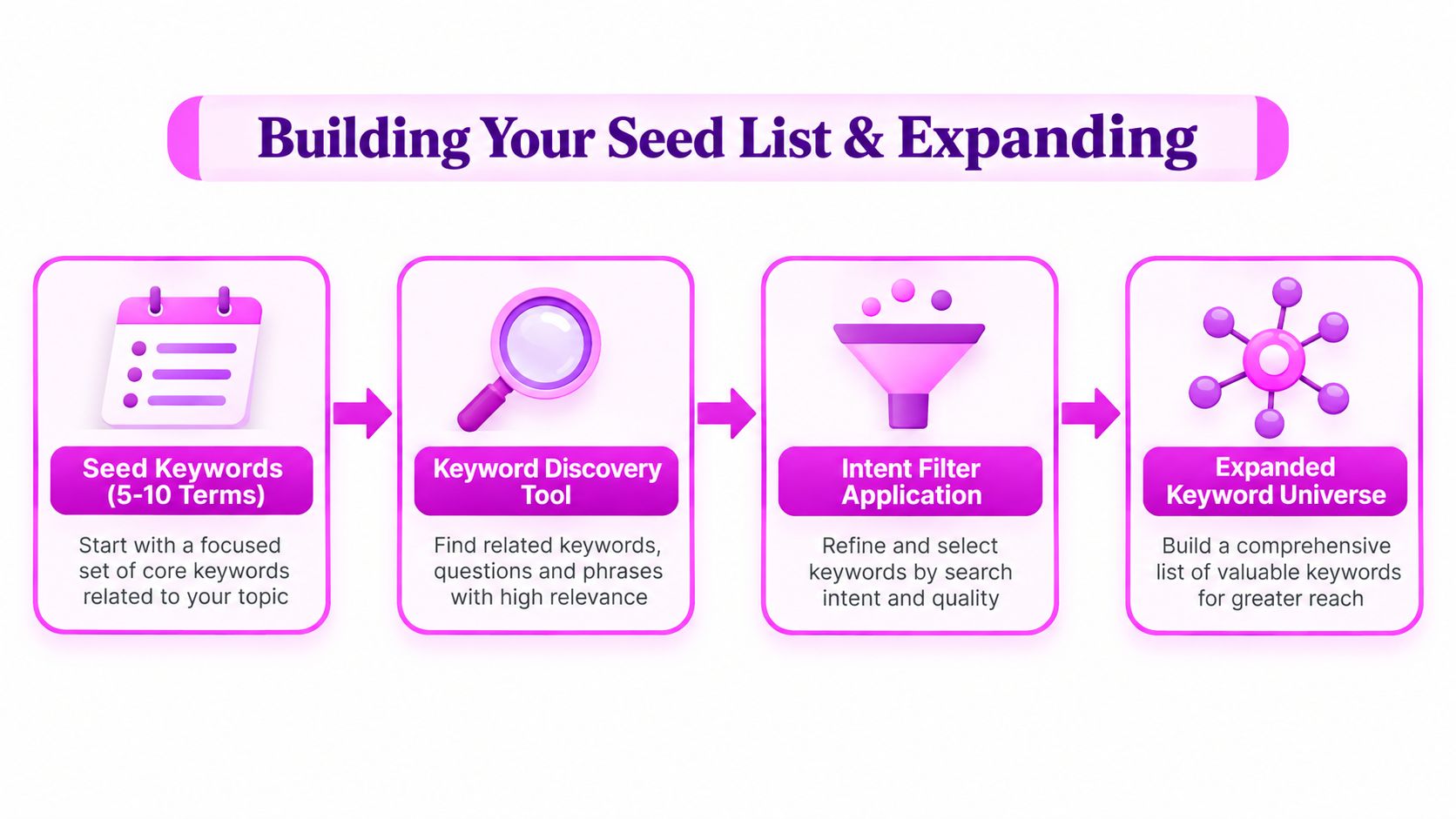
I always start small, usually with 5 to 10 seed terms, because the first list should be about direction, not completeness. If the niche is hosting, my seeds might include product categories, pain points, comparison phrases, and common modifiers. Once those are in place, I expand outward with keyword discovery tools, autocomplete, related searches, and search suggestions.
The filters I'd actually set
For newer sites, I like a tighter lane, especially when the domain has little authority. A workable starting range is 50 to 500 monthly searches, buyer modifiers such as best, review, vs, alternative, for, and under, and CPC above $1.00, which is the kind of filter stack a tool-focused workflow can surface quickly (ClickBank guidance). That range gives you enough demand to matter without forcing you into the hardest battles too early.
Established sites can stretch farther and target broader terms, including 1,000+ monthly searches when the SERP and internal link profile support it (ClickBank guidance). The same applies to a separate scoring benchmark that prioritizes lower difficulty and better volume once the site has enough trust to compete.
A practical way to keep the research tight is to filter in layers:
- Seed expansion first: start with product categories, pain points, and comparison terms.
- Intent modifiers second: look for best, review, vs, alternative, under, and for.
- Economics third: keep an eye on CPC and whether the term supports a sale path.
- Difficulty last: don't fall in love with a keyword that's clearly out of reach.
A keyword list gets useful when it starts excluding the wrong opportunities.
Long-tail suggestions matter too, but only if they're still tied to intent. I use People Also Ask and People Also Search because they reveal the language real users attach to a topic, which helps you widen a cluster without drifting into nonsense. SemDash's keyword discovery workflow is useful here because it can pull related terms from a set of seed keywords and organize them into a cleaner expansion map, and its topic resource on types of keywords is a helpful companion when you're deciding which terms belong in a commercial page set.
Scoring Keywords for Profitability Not Just Volume
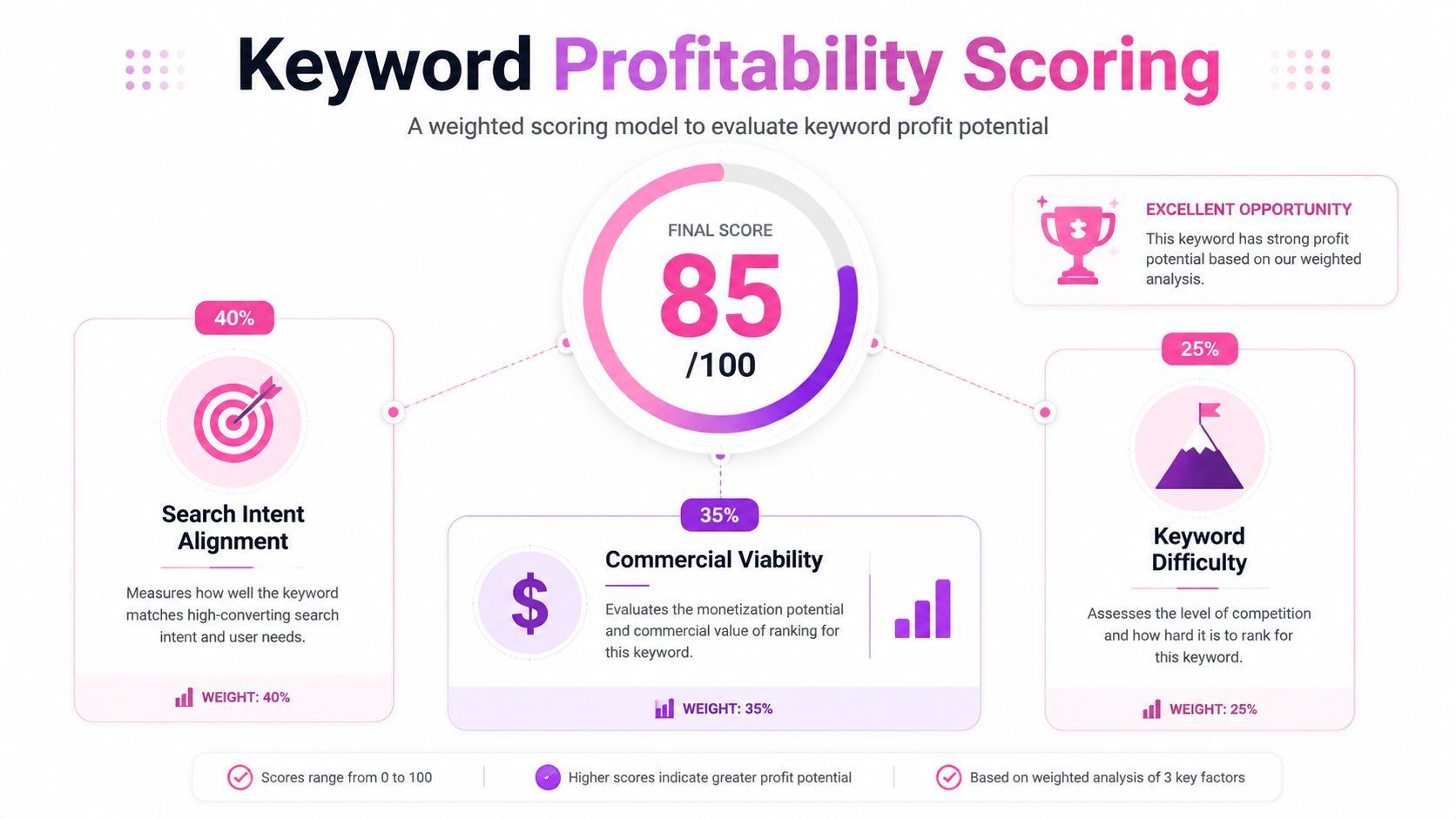
Once the list is built, I score it by revenue potential, not by vanity. My preference is a weighted model that gives Commercial Intent 40%, Competition 30%, Search Volume 20%, and Affiliate Program Quality 10%. Those weights reflect the way affiliate pages earn, because a keyword that looks good on paper can still fail if the offer is weak or the SERP intent is mismatched.
How I separate likely earners from dead ends
Commercial intent deserves the heaviest weight because it's the clearest signal that a reader is moving toward a decision. Competition comes next, because a great keyword that's impossible to rank is still a bad business choice. Search volume matters, just not enough to override the other two, and program quality closes the loop because the page has to connect to an offer that pays.
I also check the SERP history before I commit. SemDash's SERP Checker with 12-month history is useful for spotting volatility, because I don't want to build on a keyword that keeps swinging between result types. A stable intent pattern is easier to map than a query that keeps flipping between reviews, listicles, and tool pages.
Here's the part many marketers ignore. If the page type in the SERP keeps changing, the keyword itself may not be the true opportunity. Sometimes the opportunity is a narrower sibling term or a better cluster structure.
KGR still helps on newer sites
For gap analysis, I still use the KGR formula, which is allintitle results / monthly search volume = KGR. In the method described by one guide, if KGR is below 0.25, there's a realistic path toward the top 50 for a focused article (KGR guidance). That's not a magic number, but it's a strong sorting device when you need to decide what gets written first.
If you want a practical editorial example of how commercial pages can be structured, a good external reference on boost conversion with listicle pages helps explain why list formats often win when the keyword implies comparison shopping. I don't use that idea to justify every roundup, but I do use it when the search intent is clearly evaluative.
Clustering Keywords Into Page-Level Topics
Keyword cannibalization has killed more affiliate projects than weak writing ever has. Two pages can each look decent in isolation and still underperform because they compete for the same intent. Google then has to choose, and one of your pages usually loses relevance or gets split signals.
Start with one intent per page
My rule is simple, one dominant intent, one primary page. Clustering helps because it groups related terms into page-level topics instead of letting you publish a dozen near-duplicates. SemDash's clustering and gap tools are built for this kind of planning, especially when you're using keyword clustering for SEO pages as a reference point for how topic groups should stay clean.
The workflow I use is straightforward:
- Review the cluster output and check whether the grouped terms share the same search result pattern.
- Merge clusters when two groups clearly belong to the same article.
- Split clusters when the SERP intent diverges, even if the words look similar.
- Assign a content format, such as review, comparison, or informational guide with affiliate CTAs.
One thing I've learned is that clusters aren't gospel. They're a starting point. If the SERP shows a different story, I trust the SERP over the tool output every time.
Map the cluster to the page type
A comparison cluster usually wants a listicle or side-by-side review. A single-product cluster wants a focused review with deep detail and clear purchase framing. Informational clusters can still convert, but only if the article earns trust first and the CTA feels like a natural next step.
SemDash's Domain Keywords and Keyword Gap reports are useful here because they reveal terms competitors already own that you may be missing. I use those gaps to expand a cluster map, not to pad a calendar. The point is to fill real topical holes, then give each page its own lane.
Later in the process, I'll compare the cluster map against organic leaders and traffic share so I know which pages matter most. SemDash's step-by-step semantic research workflow is a good companion when you want the mechanics behind the clustering pass.
When the cluster is clean, the internal links become easier too. Each page can point upward to a broader hub or sideways to a supporting comparison without creating overlap. That's the difference between a site architecture that compounds and one that competes with itself.
When Zero-Volume Keywords Outperform Obvious Targets
The most profitable keyword I've ever published for didn't look impressive in a spreadsheet. That's the part a lot of affiliate writers never accept. Sometimes the best keyword is the one the tool barely notices, because the searcher is hyper-specific and the competition is almost nonexistent.
When low volume is rational
Recent guidance has become more open about hunting zero-volume keywords, especially when the query is narrowly transactional and the competition is minimal (2026 keyword guide). I agree with the logic, but only when the commission math and buyer intent line up. A tiny term can beat a big one if the visitor already knows what they want and the page connects to a strong offer.
That's why I don't dismiss 50 to 100 monthly searches automatically. If the query signals a ready buyer, and if the affiliate payout or product economics are healthy, that term can matter more than a broader query with mixed intent. In practice, a lot of newer sites find their first real wins.
I also like to cross-check low-volume terms with CPC when the volume estimate looks shaky. If the ad market is willing to pay for that click, the keyword often contains some commercial value even when the reported search count is tiny.
The filter stack that catches the sleepers
A clean low-volume workflow usually looks like this:
- Buyer modifiers first: prioritize terms with best, review, vs, alternative, for, or under.
- Intent validation next: use AI-assisted classification or manual SERP checks to confirm the query is transactional.
- CPC check after that: if the monetization signal is weak, move on.
- Difficulty reality check last: if the SERP is empty or thin, the page may be worth testing.
For broader long-tail strategy, I also like the way long tail keyword research for PPC success frames specificity as an asset rather than a limitation. That mindset transfers well to affiliate SEO, because the smallest query can still be the one closest to purchase.
The important distinction is this, low volume isn't the goal, profitable specificity is. If a keyword is tiny but obvious, and the page can satisfy it better than everyone else, I'd rather build that than chase a bigger phrase that pulls in browsers.
Prioritizing Your Targets and Building a Repeatable System
At this point, the list should be scored, clustered, and filtered down to pages worth making. What usually breaks the process isn't research, it's sequencing. People publish the wrong pages first, then wonder why the site feels scattered.
Build in the right order
I start with the pages that combine manageable difficulty, clean intent, and a realistic monetization path. Then I look for internal linking opportunities so each new page strengthens something else on the site. If a topic sits in isolation, it usually gets deprioritized unless the commercial upside is unusually clear.
SemDash's Competitor Domains and Traffic Share reports make it easier to see who owns the current organic market. That helps me decide which content leaders need to be displaced and which gaps are worth going after first. I also pay attention to AI Overviews visibility, because a page can rank and still lose clicks if the SERP answer format changes.
Don't ship a page until you've checked whether the intent has shifted since the last crawl.
The mistakes that undo good research
The biggest ones are boring. Publishing without reviewing SERP history. Ignoring intent drift. Leaving old pages untouched after the query changes shape. Those errors create a site that looks active but doesn't compound.
A practical checklist keeps the system honest:
- Validate the query: confirm the SERP still matches the intended page type.
- Assign the page type: review, comparison, informational guide, or hybrid.
- Brief the angle: include intent modifiers, internal links, and the offer path.
- Schedule the update loop: revisit older pages when the SERP starts shifting.
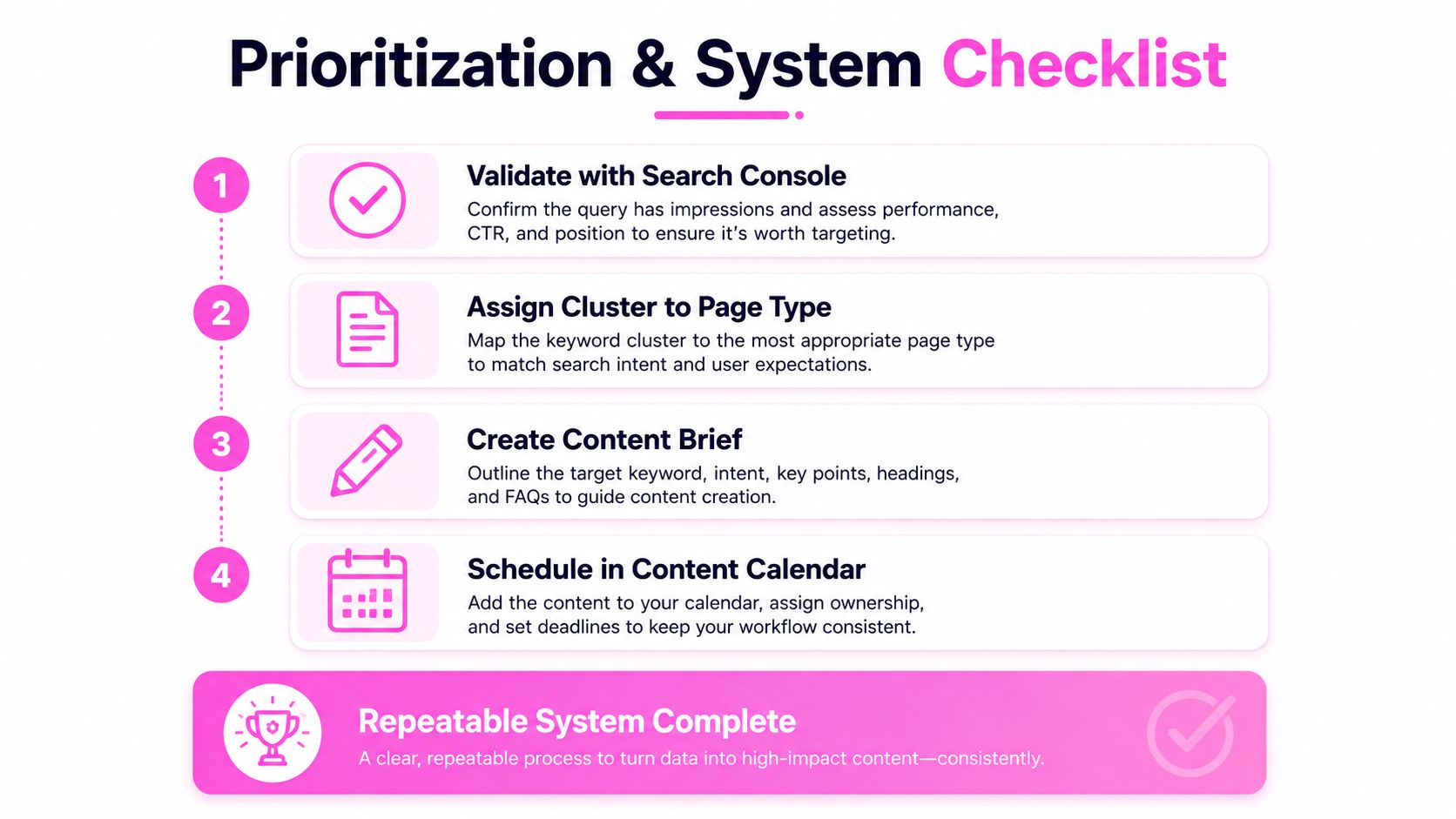
The system works when every page has a purpose before it's written. That's what turns affiliate marketing keyword research from a one-off exercise into a content engine.
If you want a cleaner way to find keywords that pay, SemDash gives you keyword discovery, SERP history, clustering, gap analysis, and intent signals in one place. I use that kind of workflow when I need to separate buyer keywords from vanity traffic, and you can see how it fits your own site by visiting SemDash.