
The most popular opening move in an analysis of competitors is also the most expensive one. Pick the three biggest domains in your category, open a research tool, export every query they rank for, and call the spreadsheet a strategy. Size tells you who already won attention. It says nothing about where a page you can sell is losing ground. A domain with a million monthly visits and fifteen shared buyer queries is a worse benchmark than a mid-sized rival that keeps beating you on the six queries that end in a signed contract. My order is deliberately unfashionable: money page first, live SERP second, rival list third, export last. That order holds up when the roadmap has to ship next month.
Table of Contents
- Start With the Money Page Not the Export
- Sort Rivals by Overlap Before You Benchmark Them
- The Scorecard for Keywords Pages Traffic and Links
- Read Traffic Share Without Copying the Leader
- Run Keywords Pages and Backlinks in One Pass
- Check Who Gets Cited When Rankings Look Weak
- Repeat the Same Rival Set Every Month
Start With the Money Page Not the Export
Take a virtual-server business planning its next quarter. The instinct is to type the category leader's domain into a keyword tool, export six thousand rows, sort by volume, and present that sheet as an analysis of competitors. The sheet answers a question nobody in the room asked. It lists what the leader ranks for, not which of those rankings sit within reach of an offer the business can sell.
The working setup I keep on screen for this pass is unglamorous: live results in one tab, one sheet, one fixed list of rivals. No dashboard tour, no feature matrix.

Before a single tool opens, I write two lines at the top of the sheet: the page that has to convert, and the intent that should land on it. For the hosting brand that page is the commercial offer with pricing, specs and a signup button, not the seventeen informational posts the leader publishes about kernel tuning. Every row that follows gets judged against that page.
Then four layers, measured on one fixed rival set: the keywords each rival ranks for, the exact URL earning each ranking, how estimated organic visits split across that set, and the referring domains behind those URLs. Keeping the layers apart is the entire discipline, because a keyword list without the winning URL is a wish, and a URL without its links is half a diagnosis.
Four layers, four shop parts: rankings are the shop window, ranking pages are the shelves, traffic share is the footfall, and referring domains are the street the shop sits on. You fix a shelf, not a neighbourhood.
This pass is a page-level worklist, not an industry essay and not a product teardown. One habit returns on every project: read the live results and the intent first, and treat search volume as the second number.
Sort Rivals by Overlap Before You Benchmark Them
Domain fame is a bad rival list. Two sites filed under the same product category can pass each other for years without meeting on a single buyer query, while a publisher with no product at all sits on the six queries that carry your revenue. Competitor presence is close to universal: Crayon's 2025 State of Competitive Intelligence report found competitors appeared in 68% of sales opportunities on average. A list that includes everyone prioritizes nobody.
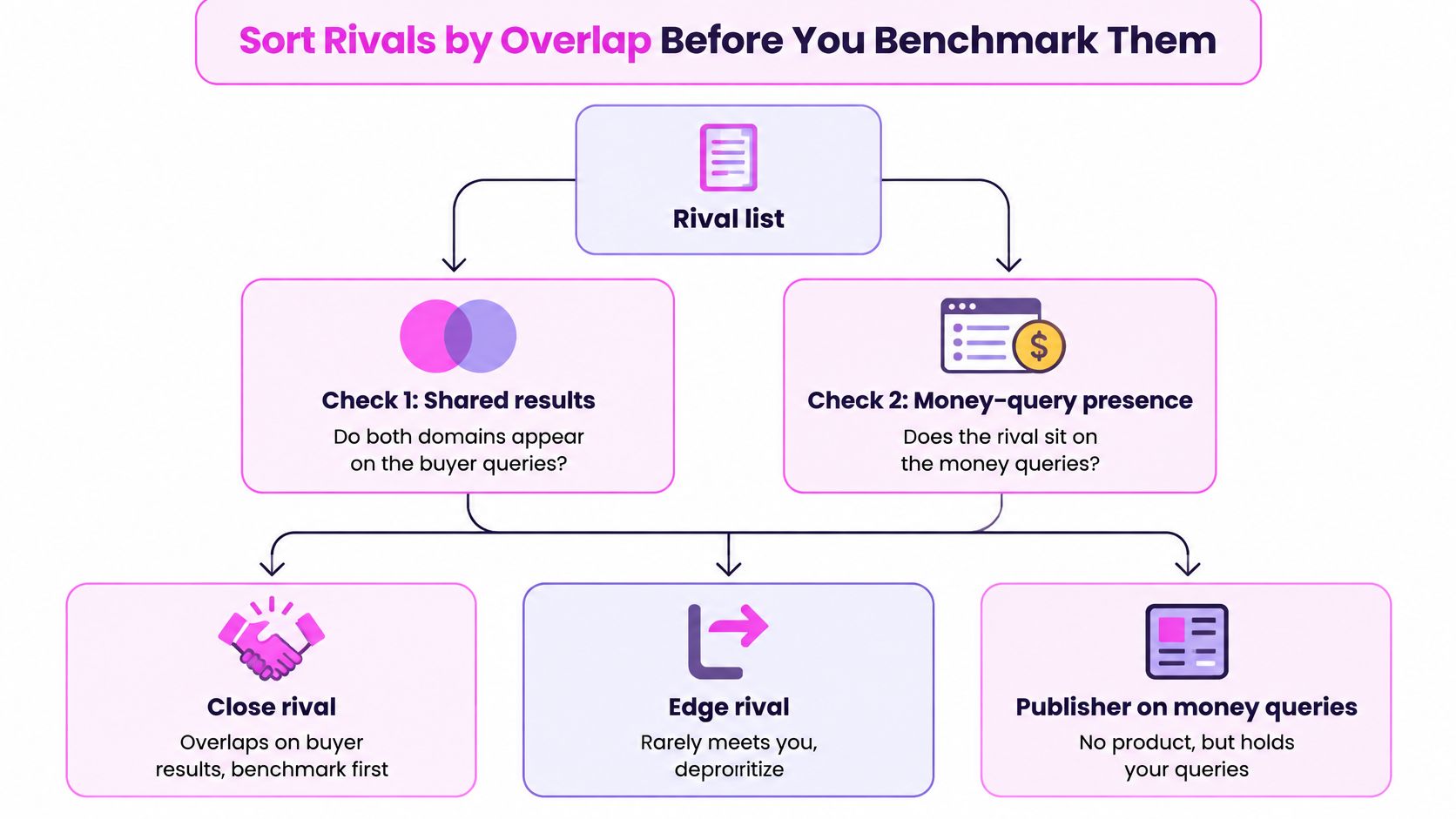
Two checks that decide the list
Market commonality is how often a rival serves the same searcher you do: shared nonbranded query clusters, overlapping positions on the buyer queries, same country in the results. Resource similarity is whether that rival can defend those positions: comparable ranking URLs per topic, a similar referring-domain pattern, and a real commercial offer instead of a glossary page.
That pairing isn't an SEO invention. A study of competitor analysis and interfirm rivalry identifies market commonality and resource similarity as the constructs that predict rivalry better than category labels, because firms matching on both perceive each other as direct threats and respond on price, distribution and features. Substitute "search visibility" for "distribution" and the model reads like a rank-tracking deck.
Three rival types and what each is worth
A close rival scores high on both checks. It appears on your buyer queries and can hold the position. That's the domain that earns a full pass, not the loudest brand in the category.
An adjacent publisher shares vocabulary but not intent. It ranks for "best VPS for WordPress" with a comparison article, has no hosting product, and will never convert that traffic. Study its page format and its internal linking. Do not inherit its keyword list, because half of it monetizes through affiliate links to someone else.
A brand giant with enormous traffic and almost no nonbranded overlap is usually noise in this context. Its traffic is navigational demand you cannot reproduce, and copying its head terms buys you a page that competes with a household name on the strength of its own brand recall.
| Rival type | Keyword overlap | What they can defend | What I do |
|---|---|---|---|
| Direct SEO rival | High on the same buyer queries | Similar URLs and link patterns, real offer | Full scorecard and a page or link action |
| Adjacent publisher | Similar words, different intent | Strong articles, weak or no product | Study the format, do not copy the keyword list |
| Brand giant | Low nonbranded overlap, huge branded traffic | Navigational demand you cannot reproduce | Exclude brand terms from the plan |
A priority score you can compute in a spreadsheet
Normalize overlap from 0 to 1, normalize similarity from 0 to 1, multiply them, then weight the result by that rival's traffic share inside the set. Multiplication matters: a domain with 0.9 overlap and 0.2 similarity is not a threat, it's a content source. The top of that list gets the deep pass. Everyone else gets a one-line watch note and nothing more.
Practical rule: a rival you cannot beat on capability is a rival you learn format from, not a rival you chase.
That cut is what stops a 2,000-row export from writing your roadmap.
The Scorecard for Keywords Pages Traffic and Links
Fill one row per rival before anyone in the room starts debating strategy, because the argument changes once the columns are populated. Three rivals are enough for a first pass. The scorecard has four working layers and one note that stays off to the side.
| Layer | What to pull | A useful reading | Action if you are behind |
|---|---|---|---|
| Keywords | Shared nonbranded queries, volume, difficulty, intent | Buyer or comparison queries, not brand navigation | Build or revise the page for that intent |
| Ranking pages | Exact URL in the top results | One clear URL per topic, not the homepage by default | Match or beat that URL |
| Traffic share | Estimated organic visits inside this rival set | Stable nonbranded share across months | Inspect the pages creating the share before copying terms |
| Backlinks | Referring domains to the ranking URL | Relevant domains linking to rivals but not to you | Pitch those domains or recover broken links |
| AI citation note | URL cited, brand mentioned, or neither | Cited even when the URL is off page one | Treat as a separate visibility layer, not as rank |
What each layer is for
Keywords means shared nonbranded queries with their monthly volume, their difficulty, and a one-word intent label: buy, compare, or learn. Strip pure brand navigation here. A rival's own name inflates its keyword count without giving you a page to build.
Ranking pages means the exact URL sitting in the results, which is not the domain and not the homepage unless the homepage ranks. This is the column most exports skip, and skipping it is why so many gap lists get abandoned. When a homepage ranks for a commercial query, you're looking at a template that works only because of accumulated brand authority. Treat it as evidence of demand, not as a design to copy.
Traffic share means estimated organic visits expressed as a percentage of this rival set only, split into branded and nonbranded, on the same country and the same month. Mix a worldwide traffic estimate with a single-country SERP and the column will lie to you with confidence.
Backlinks means referring domains pointing at the ranking URL, flagged where a domain already links to two rivals and not to you. Those flagged domains are your outreach list, already qualified by relevance.
The AI citation note is deliberately not a fifth scorecard column. It records whether an AI Overview cites that URL, mentions the brand, or does neither, and it answers a different question from rank.
Why the scorecard beats a feature matrix
Porter's 1979 Harvard Business Review article introduced the Five Forces, and his 1980 book extended it into a method for reading industry structure. The Harvard Business School summary of the five forces makes the point that competitor work should explain how value and profitability are distributed, not just compare products. A 2024 empirical check agrees: a study of 505 U.S. organizations found competitive-force intensity was associated with organizational performance and competitive advantage, and that structured internal measurement moderated that relationship. Measured layers beat narrative profiles.
"A keyword gap with no URL attached is a research artefact, not a content job."
Read Traffic Share Without Copying the Leader
A rival holding half the set's estimated organic visits is a clue, not a template. Before I trust any share, I write the market boundary on one line: country, customer segment, substitute set, month, and metric. "Project-management software worldwide" and "project-management software for ten-person agencies in Germany" will crown different leaders from the same data. Write the boundary down or the comparison is theatre.
Inside that boundary, shares convert into a concentration screen. Square each rival's percentage share and add the results. Four equal rivals land at 2,500, one firm at 50% contributes 2,500 points by itself while five firms at 10% contribute 500 between them, and a single-firm market reaches 10,000, as set out in the competition guidance published with the draft merger guidelines. The same guidance treats a reading below 1,000 as generally unlikely to raise horizontal competition concerns, and warns that any HHI level is an initial indicator rather than automatic proof of harm.
That warning cuts both ways, and it's the part analysts skip. FTC competition-economics testimony cautions that the index is built from market shares, and that shares themselves can be jointly determined with prices and output, so correlation between concentration and outcomes does not establish causation.
What to do with the number
- Report the baseline and the delta. A market at a moderate starting level can still be tilting fast toward one leader. The change matters more than the snapshot.
- Split branded from nonbranded. Branded share is audience memory. Nonbranded share is the part of the market still open to a page you can build.
- Check persistence. A one-month spike is usually a campaign, a launch, or a results reshuffle. A share that holds across several months, on nonbranded buyer queries, on URLs you could realistically match, is the only kind worth chasing.
Then open the pages behind the leader's share and ask what produced it: scale, cost advantage, distribution, a promo, or a better page. The expensive mistake is copying a leader's navigational head terms into a content plan, because those terms convert on brand recall you don't have and you'll spend a quarter proving it.
Run Keywords Pages and Backlinks in One Pass
I run this against the sorted rival list, in the same country and the same month, so every column stays comparable. Splitting it into three separate projects is how teams end up with a keyword tab nobody links to a URL tab.
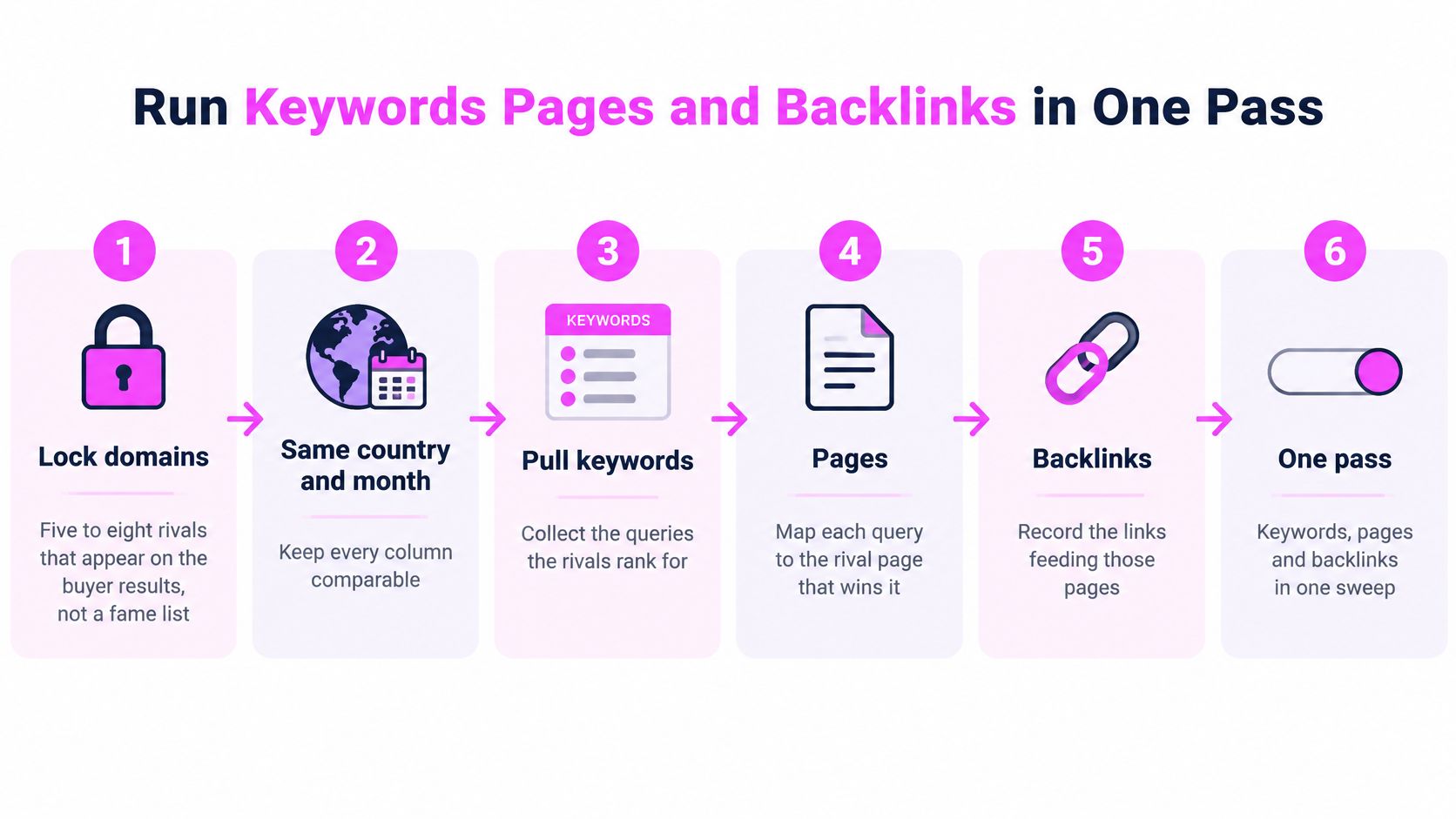
- Lock five to eight domains that appear on the buyer results. Not a fame list from a sales deck, and not every domain a tool suggests. Start with three and widen only when the shared-query evidence justifies it.
- Pull each domain's ranking keywords and keep the nonbranded queries whose intent matches the money page. A query with informational intent belongs in a different plan, even if the volume looks tempting.
- Map every kept query to the exact ranking URL. Delete rows where the tool gives you only a domain. This is the step people skip, and skipping it is why a keyword gap with no destination gets parked in a backlog forever.
- Cluster queries that already hit the same URL so two planned pages don't fight for one intent. Two pages targeting one intent split your internal links and your credibility in the results.
- Estimate organic visits for those URLs and express each rival as a share of the set, branded and nonbranded apart.
- Pull referring domains for the URLs creating that share. Flag domains linking to at least two rivals but not to you, plus broken links you could reclaim. The link-level workflow in SemDash's competitor backlink analysis guide is the version I'd hand to an outreach colleague.
- Write one action per real gap: new page, refresh, link pitch, or ignore. "Ignore" is a legitimate output and it keeps the list honest.
Edge cases to log, not to force
A homepage ranking for a commercial query is a template signal, not a page to match. A marketplace or video result absorbing the click means the intent isn't a document job at all, and no blog post will displace it. A query set polluted by another country's results will inflate overlap scores for a rival you don't compete with.
The pass fails at step three. A gap list without URLs feels productive and changes nothing, because nobody can brief a writer on "rival ranks for 1,400 keywords".
What I want at the end is a short stack of actions attached to named URLs and named domains. Anything that doesn't end in a page or a pitch stays out of the plan.
Check Who Gets Cited When Rankings Look Weak
A strong blue-link rank does not guarantee a place in the answer. For a query like “best anonymous VPS,” a vendor in third position can be named in an AI Overview through a review site's citation, while the review itself sits below the first results page. Ranking, citation, and mention are separate signals. Treat them separately.
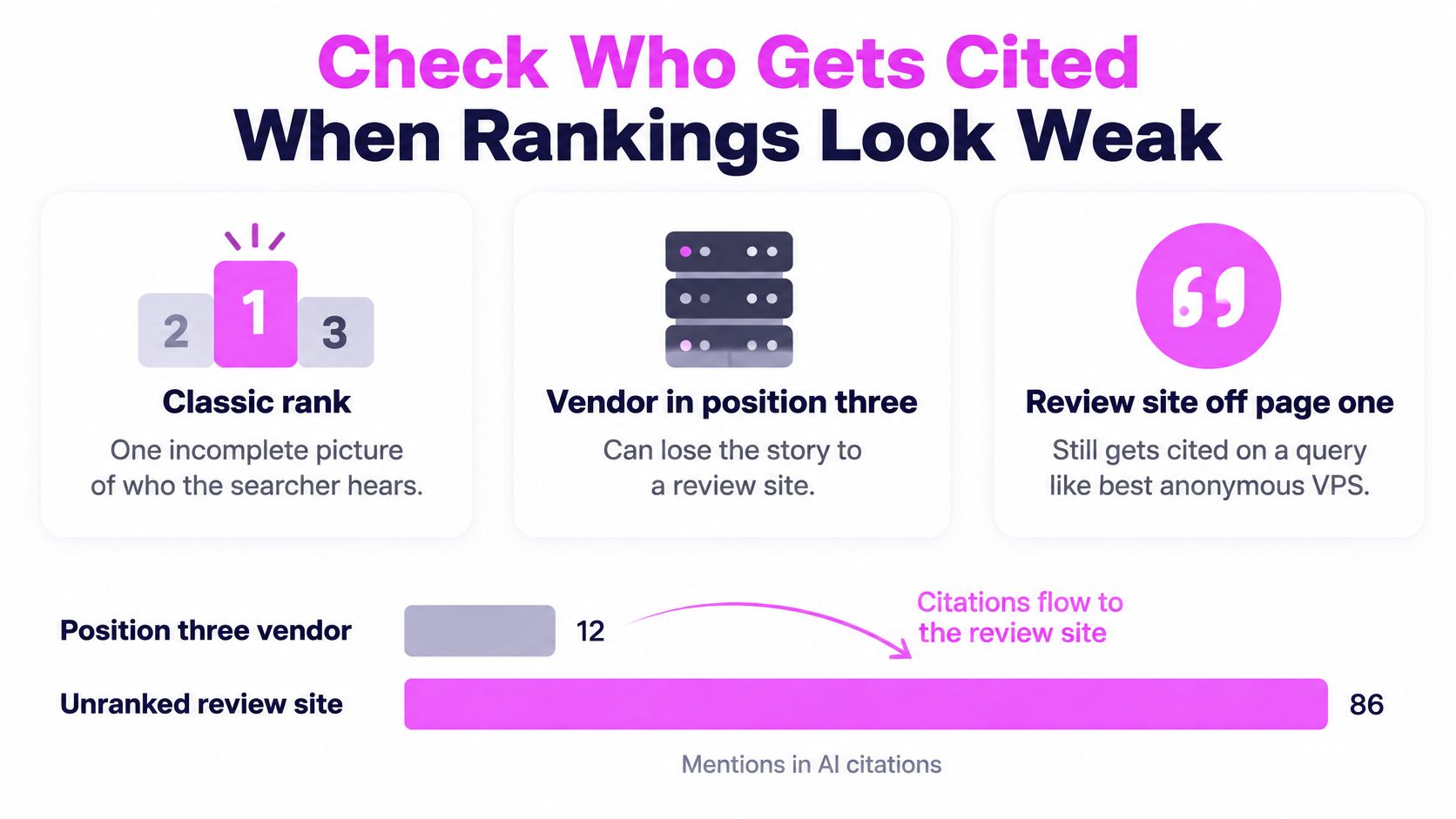
| Layer | Example on best anonymous VPS | What it tells you |
|---|---|---|
| Ordinary rank | Vendor in position 3 of the blue links | The vendor is visible in organic results |
| Citation | Review site URL cited in the AI Overview | The page supplies material for the generated answer |
| Mention | Vendor named in the generated answer | The brand enters the answer, but that does not establish a click |
A page can be cited without ranking on the first conventional results page. That makes the exact cited URL worth checking, especially when a rival's rankings look weak. The citation may point to a review, comparison, or other third-party page that shapes how the answer presents the options.
A sighting is not a pattern
One observation is a sighting. Repeated citations across the same query cohort are a stronger signal. Record the query, country, device, date, and whether the result was a mention, a citation, or both. Otherwise, a change in the results page can look like a competitive gain.
Practical rule: A citation indicates influence, not traffic. Track the two separately.
AI Overviews can change the path from search to site visit. A competitor may gain visibility in an answer without gaining visits, so report citation presence and organic traffic as distinct outcomes. For the same query, also record the precise URL Google cites. A domain-level mention alone does not show which page supplied the answer.
When rankings look weak but citations recur, inspect the cited page's role and claims. Then decide whether the gap calls for a clearer page on your site, a more useful comparison, or accurate coverage on a third-party source. SemDash's AI Overviews tracking workflow helps identify keywords that trigger mentions and the exact URLs Google cites.
The useful comparison has four layers: who ranks, which URL ranks, who gets cited, and which brand gets mentioned. Keeping them distinct shows whether a rival's visibility comes from its own pages or from sources describing it.
Repeat the Same Rival Set Every Month
One scorecard is a snapshot. I keep the same rivals, country and query cohort and rerun monthly, adding a domain only when it newly shares the buyer results. The comparison I want is change in nonbranded share, not a fresh beauty contest every quarter with a different cast.
The volatility is real. Ahrefs' analysis of AI Overviews on branded searches tracked coverage rising from 61.3% of branded keywords in July to 65.1% in August and 73.3% in September, with one late-September crawl reaching 82.91%, while a separate set of 282 brand and product names climbed from 19% to 64% between mid-August and late October. Different keyword sets, different methods, so the numbers aren't interchangeable. That inconsistency is the point: any visibility percentage needs its cohort, dates, device and country attached, or it isn't a metric.
The monthly rerun is where SemDash does the boring part. Entering a rival domain returns the keywords it ranks for, with search volume, estimated monthly traffic and Keyword Difficulty, which fills the first two rows of the scorecard. Traffic Share lines up the top 100 sites pulling organic traffic from a seed set, which is the concentration screen. Backlink Gap surfaces domains linking to those rivals but not to your site, which is the outreach list. I still throw out brand navigation and any URL that doesn't match the money-page intent.
The decision at the end of each month is short: which one page to build or revise, and which referring domains to ask for. Check every tool figure against the live results before it enters the plan. A traffic estimate is a model output, so the month-over-month direction of nonbranded share matters far more than any single reading.
If you want the same four layers on one screen, SemDash gives you the domain keyword list, the traffic share of your rival set, the backlink gap and the AI Overview citations behind them, which is exactly the worklist this scorecard needs. Pull your top three rivals and see where the nonbranded share sits. Start free at SemDash and run the next monthly rerun on the same set.