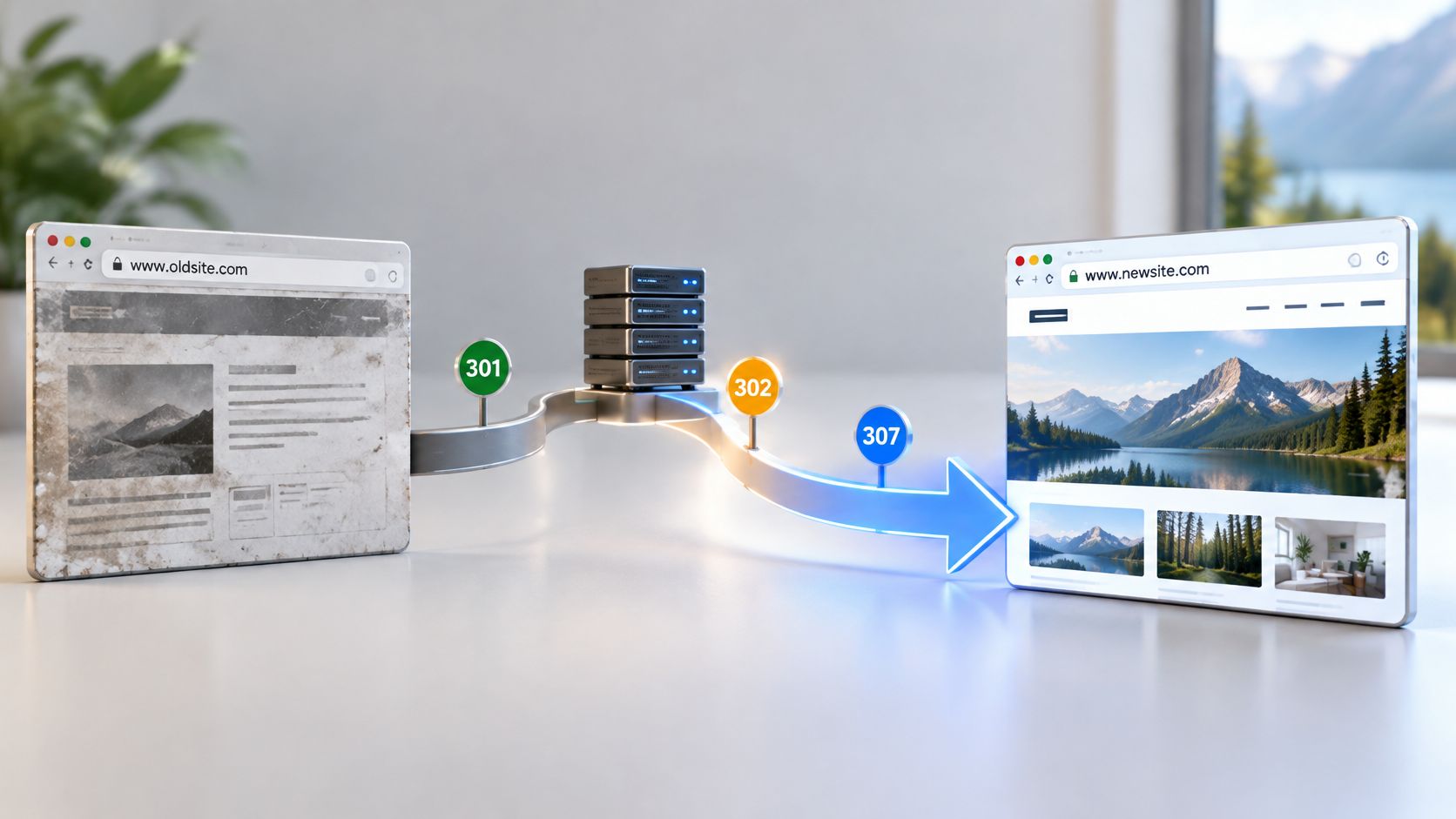


An independent summary of a 2025 study covering 75,000 brands reported that branded web mentions correlated with AI Overview visibility at 0.656, compared with 0.218 for backlinks, roughly three to one, in Userp's link building statistics roundup. I treat that ratio as a correlation from one study, not proof that mentions cause AI citations.
Link counts alone often look healthy while the target query stays flat. A pile of new referring domains can climb for a quarter and the money term still sits on page two. One total hides three jobs you can track apart: ranking movement from editorial links, recognition from independent mentions, and whether an AI answer cites the page.
I score those three on their own. Any off-page activity that feeds none of them is a vanity metric, however clean the referring-domain chart looks. Mentions led backlinks on AI Overview correlation in that study, yet a mention still will not replace a followed editorial link on a competitive URL. Splitting the report takes more time than exporting one link count. It is the only way to see which outcome moved.
Table of Contents
- What Off-Page SEO Means in 2026
- Core Off-Page Activities and What Each One Builds
- How Search Engines Turn Links and Mentions Into Visibility
- How to Judge Link Quality Before You Chase It
- A Practical Workflow for Earning Links and Mentions
- Off-Page Mistakes That Quietly Waste Months
- Your First 30 Days of Off-Page SEO
What Off-Page SEO Means in 2026
Say a B2B tool sits on page two for "customer onboarding software." The article is specific, titles are clean, and internal links point at the right URL. Off the site, almost nobody names the product except a partner footer. Classic search has a thin reason to prefer it, and an AI answer has almost none.
Off-page SEO is the practice of earning independent signals, links, mentions, reviews, citations, and press, that establish a site's reputation elsewhere on the web.
On-page SEO is what you control on the page: content, titles, and internal links. Technical SEO is how efficiently the site is crawled and rendered, and off-page SEO is how the rest of the web vouches for you.
Google has used links since launch both to discover pages and to weigh them. That mechanism still matters. AI answers add pressure for independent recognition, because a model has to point at something other people already treat as real. Links stay useful. They are no longer the only asset worth counting.
I separate the work into three outcomes and I don't blend the numbers.
Ranking influence: followed editorial links that help a specific URL compete for a query.
Entity recognition: consistent independent mentions, linked or not, so the brand is a known thing.
AI-answer visibility: being the page authoritative sources cite when a generated answer needs a source.
Unlinked mentions, editorial citations, expert quotations, reviews, and community threads are not interchangeable. I log them apart. A quarter with fewer links and more relevant, independent mentions can beat a higher-volume link push when discovery runs through an AI answer. I would defend that trade in a client review before I would defend a domain total nobody clicks.
Core Off-Page Activities and What Each One Builds
I don't pick a channel because it is fashionable. I pick the lever whose signal I am short on, then I check whether the team can repeat it.
| Activity | What it looks like | Primary signal built | Best first move |
|---|---|---|---|
| Editorial backlinks | A trade publication cites your benchmark report in its own article | Relevance plus authority for the linked page | Publish one original data study per quarter |
| Digital PR | Journalists quote your founder or cover your survey | Brand mentions plus high-authority links | Pitch three journalists per launch with an exclusive angle |
| Unlinked brand mentions | Forums and newsletters name your product without linking | Entity recognition and trust | Set alerts and politely request a link where context allows |
| Reviews and ratings | G2, Google Business Profile, and app-store reviews | Trust signals, strongest for local and ecommerce | Ask happy customers at the moment of success |
| Business citations | Consistent name, address, and phone across directories | Location trust for local search | Audit the top 20 directories for consistency |
| Community participation | Helpful answers in Reddit threads, Slack groups, and niche forums | Recognition and referral traffic | Answer only where you have real experience |
| Partnerships and podcasts | Guest appearances, co-marketing, and expert roundups | Mentions plus followed links | Offer a concrete point of view, not a pitch |
How the levers stack
One asset can feed more than one row. A quarterly data study is the cleanest example I know. Journalists cite the number, newsletters mention the brand without a link, and a podcast asks for the method. You didn't run seven campaigns. You shipped one citable thing and let other people reuse it. Digital PR for SEO is where I send teams who keep pitching the homepage instead of a finding.
Emphasis shifts with the business, and ignoring that wastes the quarter.
Local and ecommerce: reviews and consistent citations carry more weight than another guest post. A shop with messy names across directories and a thin Google Business Profile will not be saved by a DR 70 mention.
B2B SaaS: digital PR, expert quotes, and a real community presence usually beat review volume. Buyers look for a point of view, not a star rating on a directory they don't use.
The sustainability rule: the best activity is the one the team can run every week. Authority compounds through repetition. A heroic launch in March and silence until October does not.
Links are still the strongest lever for most sites that need a URL to rank. The next decision is whether a given link is worth chasing, and what it does once it exists.
How Search Engines Turn Links and Mentions Into Visibility
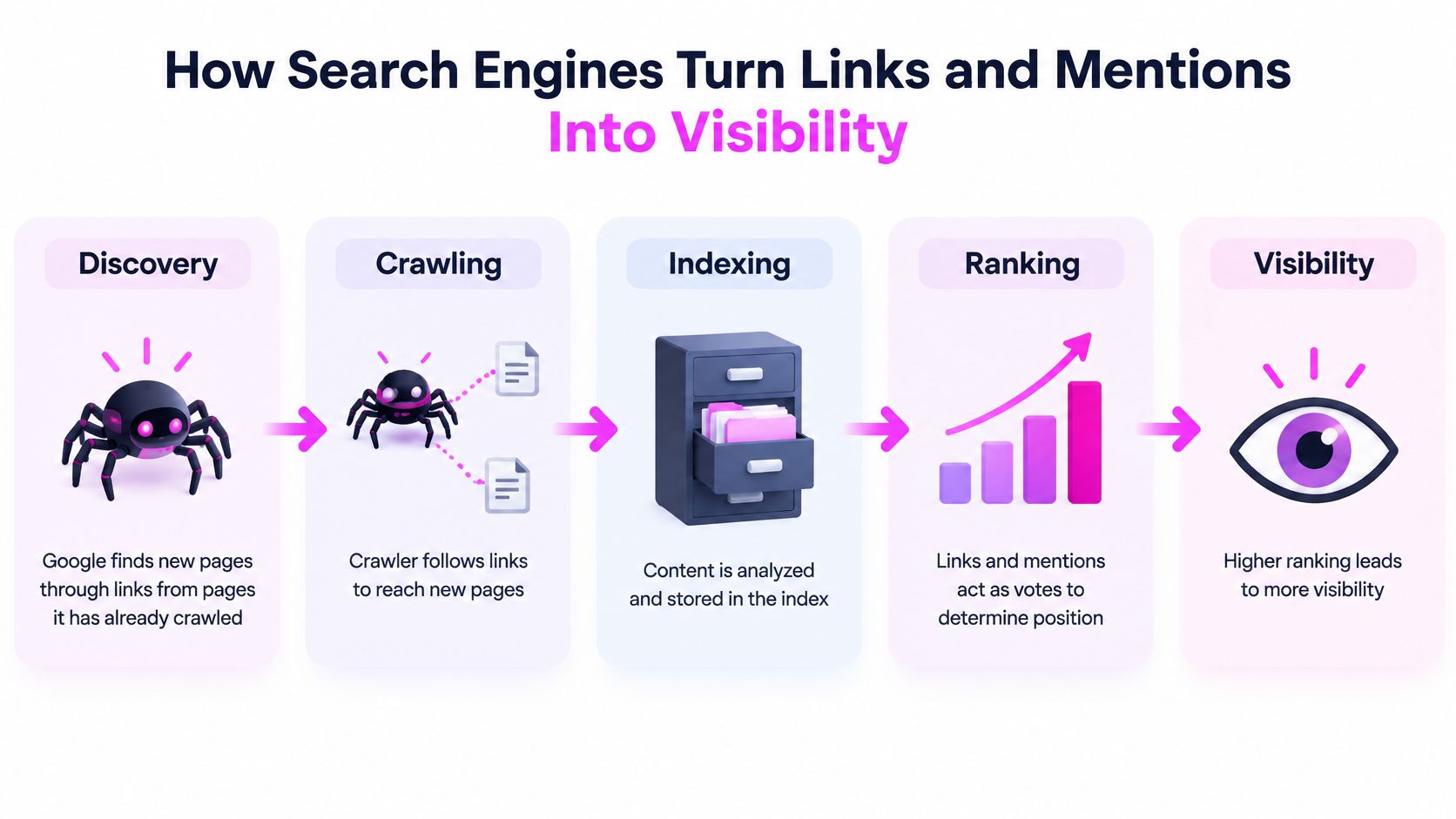
I judge a placement by the stage it improves. If it improves none of them, it is noise with a URL attached.
Discovery
Google's documentation on crawlable links says Google uses links to discover new pages and as a relevance signal, and that it primarily finds pages through links from pages it has already crawled. A strong new URL with no inbound links can sit unseen for a long stretch. The first job of off-page work is making important URLs reachable, not collecting logos.
Practical consequence: point the first links at the pages that should rank, not at the homepage by default.
Relevance
Anchor text and the paragraph around it tell Google what the destination covers. A descriptive, concise anchor from a page on the same subject beats a keyword-stuffed one. Image-only links and links injected only by script are harder to read and verify, so I treat them as weaker. I want a normal HTML link, in the sentence that makes the citation necessary.
Practical consequence: if you can't read the anchor and the surrounding sentence out loud without wincing, don't ship that pitch.
Authority
PageRank, the original Google ranking system, analyzes links between pages. Google is also clear that PageRank is one component among many ranking systems. A backlink is not an independent guarantee of a position. I still want relevant, editorially placed links from pages that support the topic. I don't want a pile of unrelated domains that inflate a count.
Practical consequence: connect the referring page, the exact target URL, and the topic. Total backlinks are a bad success metric.
Recognition for AI answers
Generative answers tend to cite authoritative, frequently linked pages. Mentions on those pages matter for whether an entity shows up at all. Discovery and relevance feed indexing and ranking. Authority feeds ranking. Recognition feeds whether you get named in an AI answer. I score a tactic against that map before I assign it to anyone.
Practical rule: if a placement doesn't improve discovery, relevance, authority, or recognition, don't report it as off-page progress.
How to Judge Link Quality Before You Chase It
A 2025 digital PR statistics report found that fewer than one in seven respondents, 13.5%, said they use relevance to determine backlink quality. That gap is why campaigns still buy famous placements that never rank anything. Buying or selling links to pass ranking credit, paid posts meant to pass credit, excessive exchanges, and automated link creation are link spam. A high-authority domain is not automatically a prospect I want.
I score the page, not the logo. A tighter pass-fail view is in this backlink quality analysis. The eight checks I won't skip:
| Criterion | Strong signal | Weak signal |
|---|---|---|
| Topical fit | Site covers your subject's niche | General site with random categories |
| Editorial independence | Content chosen by real editors | Pages that publish anything for a fee |
| Page relevance | Article is specifically about your topic | Link dropped in an unrelated roundup |
| Real audience | Growing organic traffic and engaged readers | Flat traffic, thin pages, no ranking keywords |
| Link placement | In-content citation supporting the point | Footer, sidebar, or author-bio link |
| Anchor text | Descriptive and natural | Exact-match keyword stuffed |
| Rel status | Followed editorial link, or correctly labeled sponsored or ugc | Paid link disguised as editorial |
| Destination value | Link points to a genuinely useful resource | Link points to a sales homepage |
The two checks people skip
Link placement. An in-content citation that supports the article's point beats a footer or author-bio link on the same domain. Same site, very different meaning. Readers and crawlers both see the difference.
Rel status. rel="sponsored", rel="ugc", and rel="nofollow" are hints that disclose the link's nature. A labeled sponsored placement can be compliant advertising. A paid link dressed up as an editorial endorsement is the problem. I don't trust the CMS preview. Plugins and templates rewrite attributes on render, so I view the published HTML.
Specialist or famous
When the choice is a relevant specialist site with modest authority or a famous publication that doesn't cover the topic, I take the specialist almost every time. Google uses how pages link to one another to understand what a page is about and which results help a query. An unrelated feature doesn't supply that context.
Would this page's readers click and benefit? If the honest answer is no, I don't write the email.
A Practical Workflow for Earning Links and Mentions
I don't measure a campaign by links acquired. Google's explanation of how Search works says crawlers regularly explore the web, primarily find pages through links from pages already crawled, and may still not index or show a page that meets basic requirements. Published, discovered, and indexed are different statuses. I keep all three.
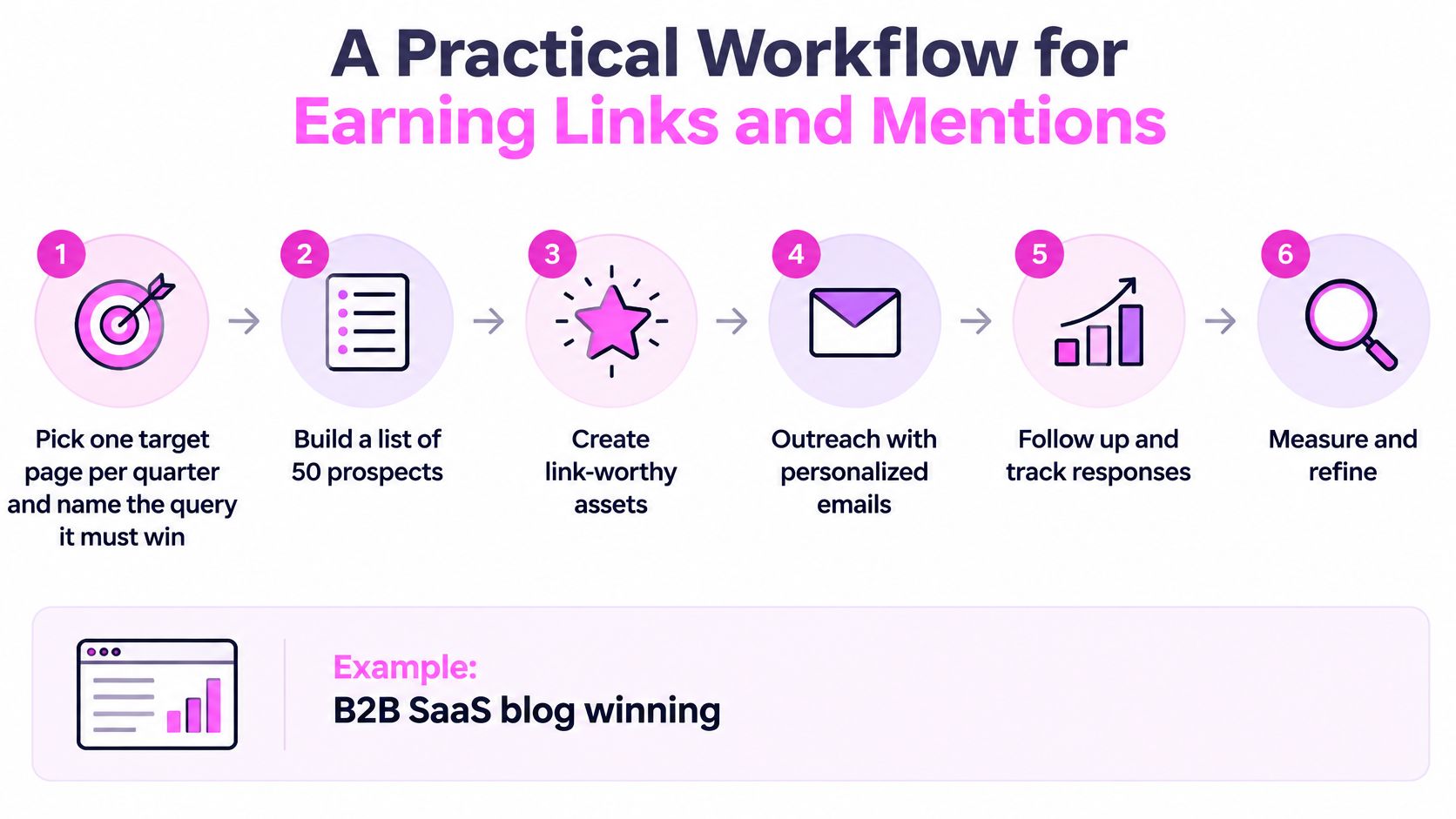
Here is the sequence I use for a B2B SaaS blog that needs to win "customer onboarding software."
- Pick one target page per quarter and name the query. One URL, one query it must win. Splitting effort across five posts is how nothing moves.
- Build a linkable asset on that URL. Original data, a benchmark, a free tool, or a definitive comparison. Say you analyze 1,200 onboarding flows and find that 68% of teams lose most users in week one. Journalists can argue with your product. They have a harder time writing around a number with a method behind it.
- Prospect 50 to 100 domains. Use competitor backlink gaps, unlinked-mention searches, and publications that already cite similar studies. In 2025, 66% of surveyed link builders said they struggled to identify effective backlink tactics, according to Citation Labs and BuzzStream's link-building survey. Prospect quality decides the quarter more than email volume.
- Qualify every target before you write. Run the scorecard. Topical fit, independence, placement, anchor, and whether the page has readers. A famous mismatch gets cut here, not after three follow-ups.
- Pitch a reason their readers need the asset. Ask for a contextual citation on a relevant page, not a homepage link. Name the sentence where the number belongs.
- Track published, discovered, and indexed. Record the exact anchor and destination URL. A "link acquired" tally hides redirects, deleted pages, and links to the wrong version.
What I baseline before the first email
I record impressions, branded searches, and target-page rankings before launch. Later movement gets blamed on the placement otherwise, even when a title rewrite or a product launch did the work. I watch the referring page and the destination separately. I check that the link is in rendered HTML, the destination returns a successful response, and nothing blocks crawling with a login wall.
Referral traffic can be real when rankings barely move. I report those apart. Collapsing both into one authority score is how teams renew a tactic that only sent 40 curious visitors.
Off-Page Mistakes That Quietly Waste Months
These are ordered by how expensive they get, not by how common they look in Twitter threads.
Chasing volume. Buying links or joining schemes is the fastest way to lose the quarter. Google's spam updates documentation records the path: Penguin was announced in April 2012 to combat link schemes and webspam, folded into core ranking systems in 2016, and a July 2021 link-spam update was built to nullify link spam more broadly across languages, with a rollout of about two weeks. When those links are neutralized, the ranking benefit can be removed and may not come back just by waiting. Corrective habit: earn editorial relevance, or don't add the link.
Anchor over-optimization. Exact-match anchors at unnatural rates flag a profile faster than a modest site with plain language. Corrective habit: write the anchor the way the journalist would if you weren't in the thread.
Blanket nofollow. Treating every outbound link as a liability hides real relationships. Use sponsored, ugc, and nofollow as accurate labels, not as a shield on every citation. Corrective habit: label the relationship you have.
Measuring link count instead of outcomes. A placement matters once it is discovered and indexed. Referral traffic or a lift in branded search can be real while rankings barely move. Corrective habit: three status fields, plus a traffic field that isn't "domain authority."
Ignoring unlinked mentions. The cheapest win is a polite ask to turn an existing mention into a link, when the context already supports it. Corrective habit: alerts first, cold pitches second.
One-and-done campaigns. Authority compounds monthly. A sprint in Q1 and silence after it leaves you where you started, minus the budget. Corrective habit: one repeatable asset and a weekly outreach block, not a launch week.
The price that buys risk
In 2025, the average acceptable price for a high-quality backlink was $508.95, based on Editorial.Link's survey of 518 SEO professionals, as reported by Rocking Web. I hear that number used to justify a marketplace order. That budget usually buys policy risk, not a durable ranking. If I spend near that, I want a journalist placing a finding because readers need it.
Two outreach failures waste more hours than bad tools. "Great guide, thought you'd like it" gives the editor no reason to care. Asking only for a homepage link gives you a URL that doesn't rank for the query. Both feel productive because the send count goes up.
Your First 30 Days of Off-Page SEO
Thirty days is enough to install the system. It is not enough to "finish SEO." I want four checkpoints, each with something that exists on disk.
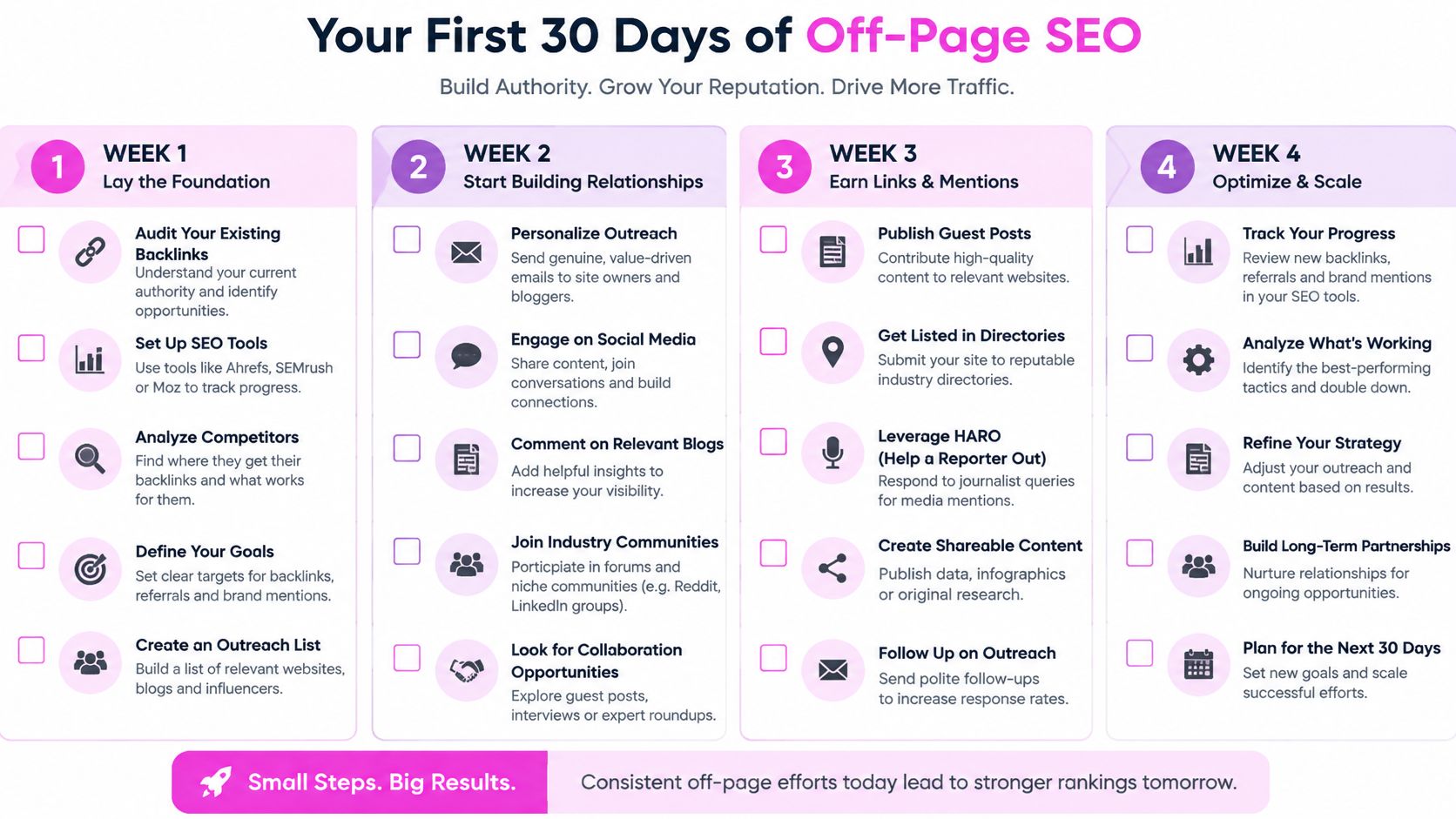
Week 1, audit. Pull your backlink profile, two competitors' referring domains, unlinked brand mentions, and citation mismatches across the top directories. Checkpoint: a ranked list of the 20 most promising gap domains.
Week 2, the asset. Lock the target page and the query. Build the data study, tool, or benchmark that makes that URL citable, and link to it from relevant pages you already have. Checkpoint: the asset is live on the target URL.
Week 3, the list. Build 50 to 100 domains, score each on the quality scorecard, and draft outreach that names a person. Checkpoint: every pitch has a reason their readers need it and a specific placement, not "any mention would be great."
Week 4, send and baseline. Send the pitches, set mention alerts, and record rankings, branded search, and referral traffic before you attribute anything. Checkpoint: each placement has a row for published, discovered, and indexed.
Today, run one competitor through SemDash's Backlink Gap view and list domains that link to them and not to you. Then check which of your target URLs already show up when Google's AI mentions a site, including competitors, and which exact URLs those answers cite. That pair of lists tells you whether the next month is a link gap, a citation gap, or both. We don't promise a ranking from the list. We do make the gap obvious enough to act on. You can get started for free across the research toolset and sort the list before you write a single pitch.
SemDash brings keyword, backlink, and AI Overview research into one workspace so you can see who links to competitors, which queries surface a brand in Google's AI answers, and which URL gets cited. That is the off-page picture a raw link count never gives you. Start with one target query in SemDash.