%20(1)-B86R08ZzwhPzS6UZbG3mSxRWPCwGwn.png)


Backlink Indexing: Fast, Test-Backed Methods and Top Tools

The fastest reliable approach to backlink indexing combines Google Search Console or the Indexing API for pages you control with a vetted indexing service or tier-2 linking workflow for third-party pages. A backlink only passes authority once Google has indexed the page containing it, so an unindexed link delivers zero PageRank regardless of its quality.
Take these four actions now:
- Check index status. Run a
site:query or use Google Search Console’s URL Inspection tool to confirm whether the referring page is already indexed. - Request indexing for pages you control. Submit via GSC’s URL Inspection or the Indexing API for priority crawling, often within hours in practice.
- Push third-party pages via IndexNow and social. IndexNow notifies Bing and Yandex instantly at no cost; pair it with a Reddit or X post to generate crawl signals for Google.
- Enroll stubborn links in a vetted indexer or run a tier-2 linking push. For pages that still haven’t indexed after 2–4 weeks, a transparent paid indexer or a small tier-2 link build is the practical escalation step.
Key Takeaways
Backlink indexing only delivers ranking value when the referring page reaches Google’s index and the link is followed, making verification before and after any submission the non-negotiable first step.
| Point | Details |
|---|---|
| Verify before submitting | Use GSC URL Inspection or a site: query to confirm index status before paying for any indexer. |
| Free tools first | GSC URL Inspection and IndexNow cost nothing and carry zero risk; exhaust them before escalating. |
| Expect 1–6 weeks | Pages on quality hosts typically index within days to two weeks; flag anything past four to six weeks. |
| Vet vendors with a trial | Run a 10-URL test across mixed host types and compare results against a GSC-only control group. |
| Semdash for discovery | Use Semdash’s backlink research tool to identify which links need indexing before spending on submission services. |
Which backlink indexing services should you actually use?
Semdash leads this comparison as the recommended pick for practitioners who want backlink discovery, monitoring, and indexing-workflow management under one subscription rather than juggling a separate research tool and a separate indexer.
Semdash stands apart because it is not purely an indexer. Its backlink research tool surfaces referring domains, anchor text distribution, and follow/nofollow ratios, letting you identify which links need an indexing push before you spend a dollar on submission services. That discovery-first workflow prevents wasted spend on links that are already indexed or on low-quality pages Google will never crawl regardless.

Rapid URL Indexer is the most transparent of the paid-only indexers: it charges per successfully indexed URL rather than per submission, and it publishes success-rate logs. That pricing model aligns vendor incentives with your outcome, though it covers indexing only and offers no discovery or monitoring layer.
Platinum Indexer is worth considering when your client contract requires a refund guarantee. Its reporting dashboard and money-back policy give you a paper trail, even if the underlying submission methods are not fully documented.
Omega Indexer and GigaIndexer suit high-volume campaigns where per-URL pricing would become expensive. Both use points-based or bulk subscription models, but neither publishes detailed methodology, so treat them as volume tools rather than precision instruments.
The remaining services (FreeIndexer, Links Indexer, OneHourIndexing, Indexification, SpeedyIndex, IndexMeNow, BoostMyURL, addtoindex, Backlink Indexing Tool) range from free utilities to low-cost bulk submitters. Most rely on ping networks and RSS pushes. They can accelerate discovery for links on crawlable hosts, but their opacity makes them a poor fit when you need auditable proof of indexing for a client.
Google Search Console and IndexNow belong in every workflow before any paid service is considered. They are free, official, and carry zero risk.
How do you evaluate and choose an indexing service safely?
Indexing services commonly rely on a mix of mechanisms, including Indexing API calls, social pushes, RSS pings, and tiered linking. Many paid indexers automate tactics you could reproduce yourself with basic tooling. That reality shapes the vetting checklist below.
Before you buy, ask the vendor:
- Do you use the Google Indexing API, or do you rely on third-party ping networks?
- What proof do you provide after submission (logs, screenshots, GSC inspection outputs)?
- How do you define and measure a “successful” indexing?
- Do you offer a retry or refund if URLs fail to index within your stated window?
Red flags to walk away from:
- No submission logs or screenshots provided after a campaign
- Reliance on private blog networks (PBNs) or throwaway Web 2.0 farms as the primary submission channel
- Guaranteed indexing claims with no independent verification or public success-rate data
- Pressure to buy large bulk packages before you can run a small sample test
- Vague descriptions of “proprietary methods” with no technical detail
Pro Tip: Run a 10-URL trial across three host types (one high-crawl site you control, one guest post on a third-party domain, one new Web 2.0 page) before committing to a bulk package. Record baseline index status via site: checks and GSC, submit, then recheck at 24 hours, 72 hours, and two weeks. A vendor that indexes 7 of 10 URLs in a reproducible trial is giving you real signal; a vendor that indexes 10 of 10 on a single run but can’t replicate it is not.
How does backlink indexing actually work?
Google processes a URL through four states before a backlink on that page delivers any SEO value:
- Discovered. Googlebot finds the URL via a sitemap, internal link, or external crawl signal.
- Crawled. Googlebot fetches the page content.
- Indexed. Google stores the page and its outbound links in its index.
- Indexed + followed. The link on that page passes PageRank to the target URL.
Only state 4 matters for link equity. States 1 through 3 are prerequisites, not outcomes.
Discovery signals that trigger crawls:
- Internal links from already-indexed pages
- Sitemap updates submitted via GSC
- GSC URL Inspection requests
- IndexNow pings (Bing and Yandex; not Google)
- Social posts on Reddit, X, or LinkedIn
- RSS feed updates
- Tier-2 links pointing at the referring page
Typical indexing timelines vary significantly by host quality:
| Link Type | Typical Index Window | Action Threshold |
|---|---|---|
| Contextual guest post on a frequently crawled domain | 1–7 days | Flag if not indexed after 4 weeks |
| Niche edit on an established site | 3 days | Flag if not indexed after 4–6 weeks |
| Web 2.0 property (new) | 2–6 weeks | Flag if not indexed after one to two months |
| Forum or profile link | 2–8 weeks | Flag if not indexed after about two months |
| New domain with thin content | Months or never | Consider disavow if no indexing after several months |
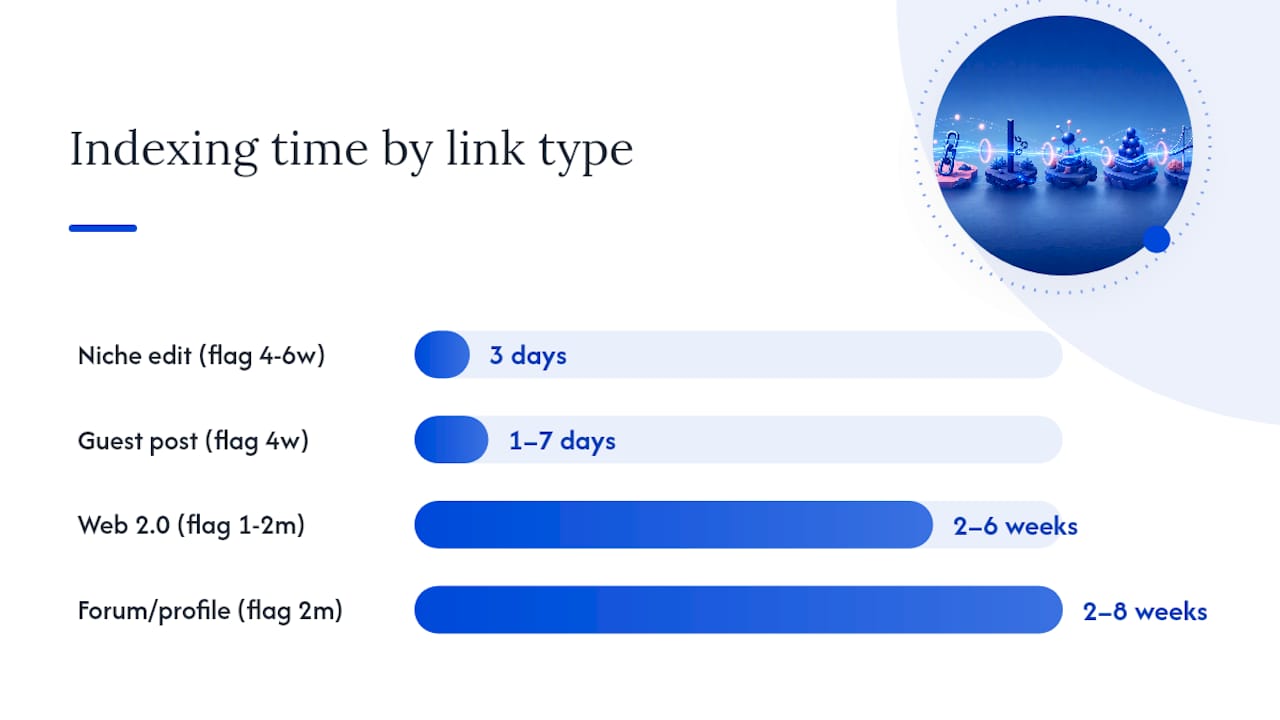
Timeline guidance sourced from Saaslinks’ backlink indexing guide.
A short note on link velocity: Google representatives confirm that raw link-acquisition rate is not a named ranking signal, but spiky or uncorroborated acquisition patterns can trigger spam classifiers. The practical implication is that indexing 500 links in 48 hours on a site that normally earns 10 links per month creates a pattern shape that looks unnatural, even if each individual link is legitimate. Measure velocity as new referring domains per month relative to your existing referring-domain count, not as an absolute number.
Key stat: Pages on frequently crawled hosts can index within days, while pages on slower hosts can take 2–4 weeks or longer. If a quality host still hasn’t indexed after 4–6 weeks, treat it as a problem requiring active intervention.
How we tested indexing services
Our testing framework is reproducible. Any SEO team can run the same protocol to validate vendor claims independently.
- Prepare test URLs. Select three URL types: one page on a high-crawl host you control, one third-party guest post on an established domain, and one new Web 2.0 page with original content.
- Record baseline. Run a
site:query and a GSC URL Inspection for each URL. Screenshot and timestamp every result. - Submit via the service under test. Use only that service for the test batch; do not submit the same URLs via GSC or IndexNow simultaneously.
- Set control URLs. Submit an equivalent batch via GSC URL Inspection only, with no paid indexer, to measure the natural indexing rate for comparison.
- Check at 24 hours. Repeat
site:and GSC Inspection. Record which URLs have moved to “indexed.” - Check at 72 hours. Repeat and record.
- Final check at two weeks. Record final indexed count, calculate success rate per batch, and compare against the control group.
- Collect artifacts. Save GSC screenshots,
site:results, and any submission logs the vendor provides.
Metrics to record per batch: time to discovery, time to crawl, time to index, success rate (indexed URLs / total submitted), and artifact completeness (did the vendor provide logs?).
Keep content stable during the test window. A page that changes significantly after submission can invalidate the crawl signal and skew results.
What our recommended workflow looks like in practice
My standard workflow starts with verification, not submission. Before touching any indexer, I pull the referring domain list into Semdash’s backlink research tool and filter for links that are already indexed. Paying to re-index a link that Google already knows about is pure waste.
For pages I control, I use GSC URL Inspection first. It’s free, it’s official, and it works. For third-party pages, I run an IndexNow ping for Bing/Yandex coverage and pair it with a social push on Reddit or X to generate an organic crawl signal for Google.
If a link still hasn’t indexed after three to four weeks, I escalate: a small tier-2 link build pointing at the referring page, or a 10-URL trial with a transparent paid indexer like Rapid URL Indexer. I never buy a bulk package until a trial confirms the vendor’s claimed success rate holds up across different host types.
For client reporting, I keep a log with three columns: URL submitted, date submitted, and date indexed (with a GSC screenshot as proof). Google’s Links report shows only a sampled view of inbound links, so a third-party tool showing a backlink in its own crawl index does not prove Google has indexed that page. GSC Inspection is the only authoritative confirmation.
On risk: avoid bulk packages that rely on low-quality networks. The short-term indexing gain rarely outweighs the long-term pattern risk, especially for sites in competitive niches where Google’s spam classifiers are already active. Prefer vendors that publish logs and explain their methods.
Semdash gives you discovery and monitoring before you spend on indexing
Most indexing services tell you nothing about the links you’re submitting. Semdash flips that sequence: start with a full backlink profile analysis to see which referring domains are already indexed, which carry follow status, and which are worth pushing at all. That single step eliminates wasted submissions on links Google has already processed or on low-authority pages it will never prioritize.
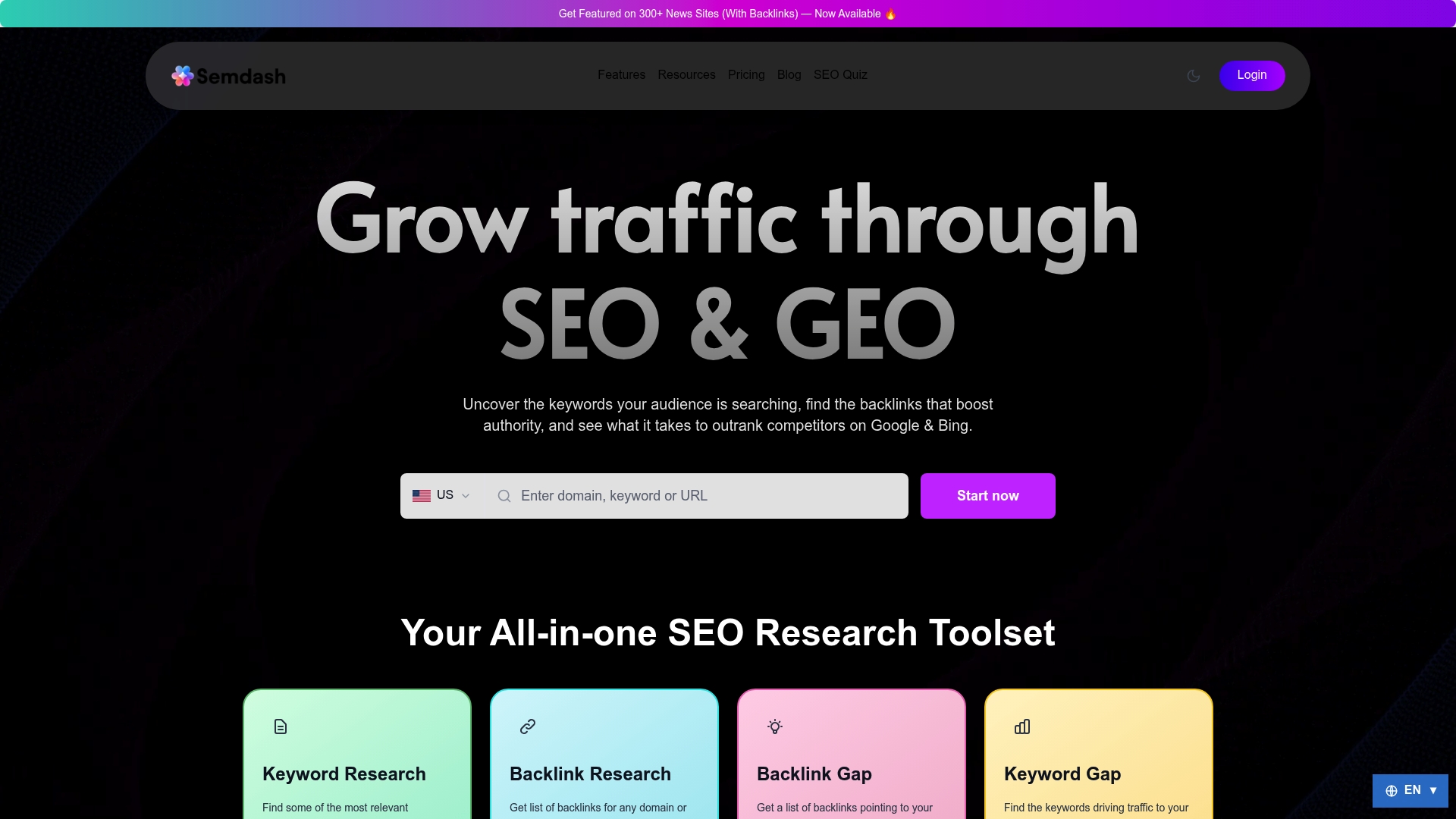
For teams running ongoing campaigns, Semdash’s monitoring layer tracks new and lost referring domains over time, so you catch indexing drops before they affect rankings. Pair that with the free SEO tools to run a quick URL check before committing to a paid indexer. The workflow: discover in Semdash, verify in GSC, escalate to a paid indexer only for links that genuinely need the push. Try a free check now at Semdash to see which of your backlinks are actually working.
Sources
- Backlink Indexing: Why Links Must Be Indexed to Count · Saaslinks
- See backlinks to your site — Google Search Central
- How to Index Backlinks? Helpful Methods for Indexing
- How to Index Backlinks: 4 Ways To Make Sure You’re Seen
- Link velocity: Is it a ranking factor? · Search Engine Journal
FAQ
What is backlink indexing?
Backlink indexing is the process of getting Google to crawl and store the page that contains your backlink, so the link can pass PageRank to your site. An unindexed referring page delivers no ranking benefit regardless of its authority.
How do you get your backlinks indexed quickly?
For pages you control, use Google Search Console’s URL Inspection tool to request indexing directly. For third-party pages, combine an IndexNow ping for Bing/Yandex coverage with a social push and, if needed, a tier-2 link build or a vetted paid indexer.
Are backlinks still relevant in 2026?
Yes. Google continues to use links as a core authority signal, but only indexed, followed links contribute to PageRank. Monitoring which referring pages are actually indexed remains a practical requirement for any link-building campaign.
What is an example of a backlink?
A backlink is any inbound link from an external domain pointing to your site, such as a contextual mention in a guest post on an industry blog or a citation in a news article. The link only passes SEO value once Google has indexed the page containing it.
How do I verify whether a backlink is indexed?
Run a site: query for the referring URL or use GSC’s URL Inspection tool on that page. Note that GSC’s Links report shows only a sampled view of inbound links, so a third-party tool showing a backlink in its crawl index does not confirm Google has indexed that page.