%20(1)-B86R08ZzwhPzS6UZbG3mSxRWPCwGwn.png)


Generative Engine Optimization: A Practical GEO Playbook

Generative engine optimization (GEO) is the practice of structuring and positioning content so that AI-powered answer engines, including Google’s AI Overviews, Perplexity, and ChatGPT, cite or surface it in their generated responses. Your single most important next action: run an AI citation audit on your top-traffic pages using Google Search Console and Semdash’s AI Overview checker to find where you’re already being cited and where you’re invisible.
Three fastest wins you can implement this week:
- Add verifiable citations and source links to any factual claim on your page, giving AI systems something concrete to attribute.
- Insert a concise statistic or data point near the top of each section, since GEO-bench evaluations show that adding citations, quotations, and statistics can increase visibility in generative engine responses by a significant margin.
- Break content into short, scannable paragraphs with clear H2/H3 headings so machine extraction is straightforward.
Pro Tip: Don’t wait to overhaul entire pages. Pick your five highest-traffic informational posts, add one sourced statistic and one pull-quote to each, and re-check AI Overview mentions in Semdash within two weeks.
Key Takeaways
Generative engine optimization requires earned authority, verifiable citations, and machine-readable structure, built on a solid SEO foundation and measured through AI citation tracking.
| Point | Details |
|---|---|
| GEO extends SEO, not replaces it | Technical crawlability and content quality remain prerequisites; GEO adds earned media and citation tactics on top. |
| Citations, quotes, and stats drive the biggest lift | GEO-bench evaluations show adding these signals can increase AI visibility by roughly 30–40% in controlled tests. |
| Earned media is the highest-leverage tactic | AI systems favor independent authoritative sources; third-party mentions outperform internal optimization alone. |
| Engine-specific adaptation matters | Google AI Overviews, Perplexity, ChatGPT, and Gemini differ in domain diversity, freshness, and language sensitivity. |
| Semdash monitors AI Overview citations | Semdash’s AI Overview checker tracks citation status across your keyword set and surfaces gaps for testing. |
What generative engine optimization (GEO) actually means
GEO is the discipline of optimizing content to be cited, quoted, or included in AI-generated answers, rather than simply ranked in a traditional blue-link SERP. Where classic SEO targets a position on a results page, GEO targets inclusion in the answer itself.
Several related terms float around this space, and they overlap more than they differ in practice:
- AEO (Answer Engine Optimization): Focuses on earning featured snippets and direct answers, the predecessor concept to GEO.
- AIO (AI Overview Optimization): Specifically targets Google’s AI Overviews feature within Search.
- LLMO (Large Language Model Optimization): Emphasizes optimizing for how LLMs like GPT-4 or Gemini represent your brand or content in their outputs.
- AI SEO: A broad umbrella term covering any SEO work that accounts for AI-driven ranking or answer systems.
In practice, most teams use these terms interchangeably. GEO has emerged as the most widely adopted label, partly because it maps cleanly to the “generative” nature of the engines involved.
The measurable outcome GEO targets is citation or inclusion in an AI response, not a rank position. That shift matters because AI systems often synthesize multiple sources into a single answer, so your content may influence a response without ever appearing as a standalone link. Practitioner guidance from Backlinko confirms that earned third-party mentions, structured scannable content, and verifiable citations are the central tactics, because AI systems systematically favor independent authoritative sources over brand-owned content.
Google’s official guidance is explicit that foundational SEO best practices, clear technical structure and unique, valuable content, remain the primary requirement for visibility in generative AI features. GEO doesn’t replace that foundation; it extends it.
How GEO differs from traditional SEO
The short answer: your existing SEO work still matters, but GEO shifts emphasis toward earned media, machine-readable structure, and content that AI systems can justify citing. Crawlability, indexability, and page authority remain table stakes. What changes is where you spend the marginal hour.
Key differences practitioners feel immediately:
- Signal type: Traditional SEO weights backlinks and on-page keyword relevance. GEO weights earned mentions, co-citations, and the presence of verifiable facts.
- Discovery surface: SEO targets a rank position a human clicks. GEO targets inclusion in a synthesized answer a human reads without clicking.
- Role of mentions vs. backlinks: A backlink from a high-DA domain helps rankings. A co-citation in a trade publication or forum post helps AI systems recognize your content as authoritative, even without a direct link.
- Phrasing sensitivity: AI systems parse natural language questions and match them to content that directly answers them. Keyword density matters less; question-answer structure matters more.
- Freshness and authority bias: Generative engines often favor recently updated content from recognized publishers, making content freshness and author credentialing more important than in traditional SEO.
| Signal type | How AI uses it | What your team should do |
|---|---|---|
| Technical crawlability | Prerequisite for indexing and AI training data | Maintain clean sitemaps, canonical tags, and fast load times |
| Backlinks | Indirect authority signal | Keep building, but pair with earned-media outreach |
| Earned mentions and co-citations | Direct trust signal for AI citation | Pursue PR, guest research, and third-party coverage |
| Structured headings and scannable paragraphs | Enables machine extraction of key claims | Reformat long prose into clear H2/H3 blocks |
| Verifiable statistics with source links | Gives AI systems citable evidence | Add sourced data points to every major claim |
| Author credentials and bylines | E-E-A-T signal for quality filtering | Add author bios, credentials, and publication dates |
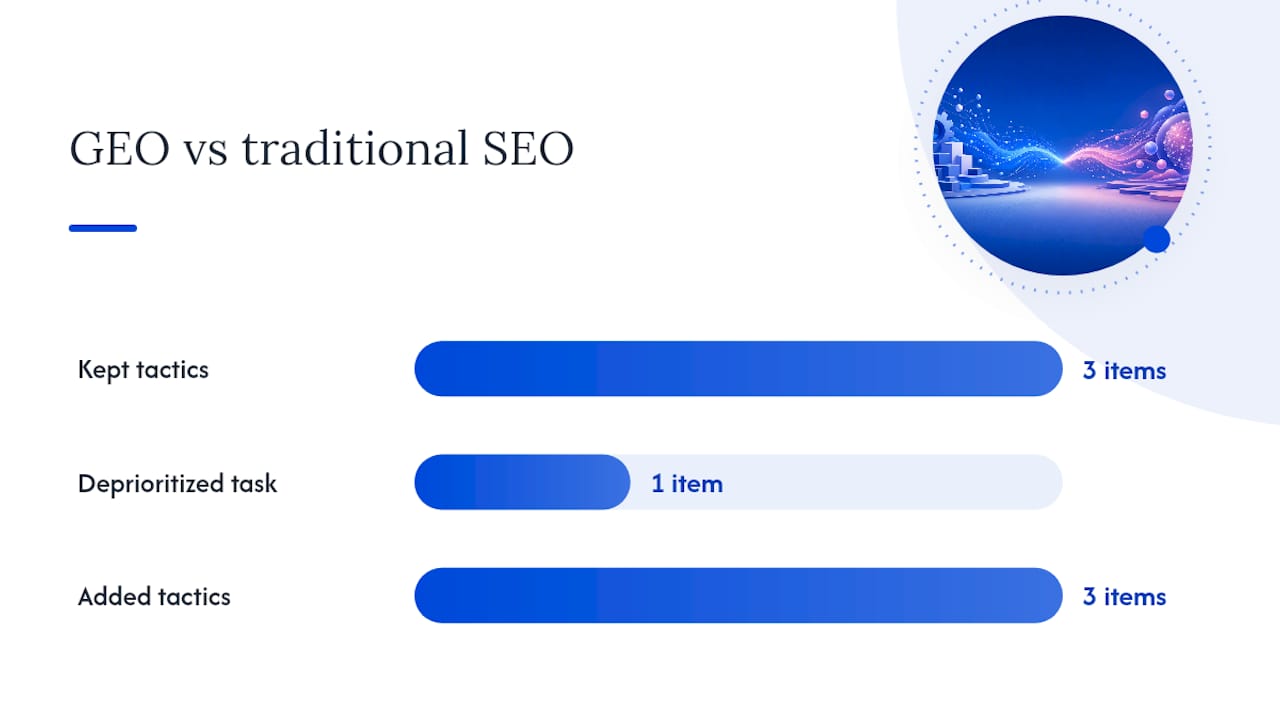
What to keep: technical SEO, link building, and content quality. What to deprioritize: obsessing over exact-match keyword density in body copy. What to add: a systematic earned-media program, a citation-insertion workflow, and AI-citation monitoring.
Core GEO tactics every content team should implement
The tactics below are ordered by impact, based on GEO-bench controlled evaluations and practitioner consensus. Start at the top and work down.
-
Earn third-party citations and co-citations. AI systems favor independent authoritative sources. Pitch original research, data, or expert commentary to trade publications, industry forums, and news outlets. Each earned mention is a trust signal that generative engines can reference. This is the highest-leverage activity in a GEO program, and it’s the one most content teams underinvest in.
-
Add verifiable statistics with clear source attributions. Every factual claim should carry a linked source. GEO-bench data shows that statistics addition is one of the three tactics with the largest measured visibility lift. A sourced number gives AI systems something concrete to cite and attribute back to your page.
-
Insert concise quotes and pull-outs. Short, quotable sentences, ideally 15–25 words, that summarize a key insight are easier for generative engines to extract and reproduce. Add a pull-quote block or a clearly formatted expert quote to each major section.
-
Structure content for scannability. Use short paragraphs (3–5 sentences), descriptive H2/H3 headings that mirror natural-language questions, and one main idea per paragraph. Backlinko’s practitioner guidance recommends monitoring multi-platform presence, including forums and videos, so AI systems have credible signals across surfaces.
-
Secure technical discoverability and canonical signals. Confirm pages are indexed, canonical tags are clean, and structured data (FAQ, HowTo, Article schema) is implemented where relevant. Google’s Search Central guidance treats these as prerequisites, not optional enhancements.
-
Monitor AI Overview mentions actively. Use Semdash’s AI Overview checker to track which of your pages appear in Google’s AI Overviews and which competitor pages are being cited instead. Spot-check Perplexity and ChatGPT manually for your core queries. Frase and Surfer are useful for aligning content structure and semantic coverage to intent before publishing.
Pro Tip: To adapt existing content quickly, open each post and search for any paragraph that makes a factual claim without a source. Add a linked citation and a one-sentence pull-quote. That single pass often takes under 20 minutes per page and directly addresses the two highest-impact GEO signals.
Statistic to know: GEO-bench evaluations report that adding citations, quotations, and statistics can measurably increase visibility in generative engine responses. That’s a measurable lift from content edits alone, before any technical changes.
How to perform GEO: a step-by-step workflow
Run an AI-citation audit, prioritize pages with clear intent matches, test targeted changes, then measure and iterate. Here’s how that plays out in practice.
Step 1: Audit your current AI citation footprint.
- Pull the Generative AI report in Google Search Console to see which queries trigger AI Overviews and whether your domain appears.
- Run your top 20 informational queries through Semdash’s AI Overview checker to identify citation gaps.
- Spot-check 10–15 queries in Perplexity and ChatGPT manually. Note which sources they cite for your core topics.
- Log results in a simple spreadsheet: query, engine, cited source, your page’s status (cited / not cited / not indexed).
Step 2: Form a hypothesis.
For each gap, identify the most likely reason your page isn’t cited. Common hypotheses: missing source citations, no statistics, weak authority signals, poor scannability, or thin content. Pick one variable to test per page.
Step 3: Implement the change.
Make the single targeted edit. Add a sourced statistic, insert a pull-quote, restructure a section with clearer headings, or add a FAQ schema block. Use Frase or Surfer to check semantic coverage and intent alignment before publishing.
Step 4: Run a staged test.
- Hypothesis: Adding a sourced statistic to the intro of Page X will increase its citation rate in Google AI Overviews.
- Pages: 3–5 pages with similar traffic and intent profiles.
- Change type: Statistics addition with linked source.
- Metric to track: AI Overview citation count (Semdash), impressions from AI features (Google Search Console).
- Duration: 4–6 weeks minimum, since AI systems re-crawl and update on their own cadence.
- Success criteria: Citation appears in AI Overview for target query within the test window.
Step 5: Measure and iterate.
Review Semdash monitoring data and Search Console’s Generative AI report at the end of the test window. If the hypothesis held, apply the same change to the next batch of pages. If it didn’t, revisit the audit and test a different variable. Bing Webmaster Tools provides a parallel signal for Copilot-driven visibility.
Pro Tip: Keep a running GEO experiment log, one row per test, with the hypothesis, change date, and outcome. After six months, patterns emerge that tell you which signals matter most for your specific vertical and audience.
How to measure GEO performance: the right metrics and tools
Measure AI citations, citation-weighted impressions, and downstream business metrics. Each tells a different part of the story.
- AI citation count: The number of times your content is cited or quoted in AI-generated responses. Tracked via Semdash’s AI Overview checker and manual spot-checks in Perplexity and ChatGPT.
- Generative AI impressions: Impressions attributed to AI Overview features in Google Search Console’s Generative AI report. This is the closest proxy to “reach” in AI-driven search.
- Position-adjusted word count (GEO-bench method): A research-derived metric that weights your content’s word count by its position in an AI response, giving higher weight to content cited early or prominently.
- Referral traffic from AI features: Sessions arriving from AI-driven surfaces, trackable via UTM parameters and referral source analysis in your analytics platform.
- Conversions from AI sessions: The downstream business metric. Segment AI-referred sessions and track goal completions to connect GEO activity to revenue.
| Metric | How to measure it | Recommended tool |
|---|---|---|
| AI citation count | Query target keywords, log citations | Semdash AI Overview checker, manual Perplexity/ChatGPT checks |
| Generative AI impressions | Generative AI report | Google Search Console |
| Copilot/Bing AI visibility | Bing AI features report | Bing Webmaster Tools |
| Referral traffic from AI | Referral source segmentation | Google Analytics 4 |
| Conversions from AI sessions | Goal tracking by traffic source | Google Analytics 4 |
On attribution: AI-driven sessions often arrive without a clear referral tag, especially from ChatGPT and Perplexity. Set up UTM tracking on any links you control in those environments, and monitor direct traffic trends alongside AI citation counts as a correlated signal. Experiment windows of 4–6 weeks are realistic; AI systems don’t update citation pools in real time.
Engine-specific differences and when to adapt your tactics
Engines differ on domain bias, freshness, and language sensitivity. A single GEO playbook won’t perform equally across all of them. Adapt when your audience or vertical is concentrated on a specific engine or language.

A 2025 comparative analysis found that AI search engines show a strong bias toward earned media and differ significantly in domain diversity, freshness, and language sensitivity, recommending engine-specific and language-aware strategies.
Engine-level behavioral differences to know:
- Google AI Overviews (SGE): Draws heavily from indexed web content and applies Google’s existing quality and E-E-A-T signals. Broad consumer informational queries are its primary surface. Prioritize here for general-audience content.
- Perplexity: Shows stronger preference for recently published, citation-rich content and tends to cite a more diverse set of domains. Technical and research-oriented queries perform well here. Run Perplexity spot-checks for any content targeting technical Q&A.
- ChatGPT (with browsing): Favors authoritative publishers and earned media. Its domain diversity is narrower than Perplexity’s, making publisher outreach more important for ChatGPT citation. Language sensitivity is high; content in the user’s query language performs better.
- Gemini: Tightly integrated with Google’s index and knowledge graph. Schema markup and structured data have a more direct influence here than on other engines.
| Engine | Domain diversity | Freshness sensitivity | Language sensitivity | Best content type |
|---|---|---|---|---|
| Google AI Overviews | Moderate | Moderate | Low | Broad informational, evergreen |
| Perplexity | High | High | Moderate | Technical, research, news |
| ChatGPT (browsing) | Low-moderate | Moderate | High | Authoritative, publisher-backed |
| Gemini | Moderate | Low-moderate | Low | Structured, schema-rich |
Practical adaptations: for multilingual content, research confirms that language-aware GEO strategies outperform translated-only approaches. For news and product pages, a freshness cadence of weekly or biweekly updates signals recency to Perplexity and ChatGPT. For earned citations, publisher outreach targeting recognized trade outlets gives the broadest cross-engine lift.
Risks, ethics, and practical limits of GEO
GEO is powerful but bounded. Manipulative or inauthentic tactics don’t just fail; they can actively damage your credibility with both AI systems and human readers.
Risks to watch:
- Hallucination and attribution errors: AI systems sometimes misattribute quotes or statistics to your page even when the content doesn’t support the claim. Monitor citations actively and correct inaccuracies through content updates and structured data.
- Manufactured quotes: Inserting fake expert quotes or fabricated statistics to game AI citation systems violates Google’s spam guidance and, if discovered, destroys the trust that makes earned citations valuable in the first place.
- Over-optimizing thin pages: Adding citations and statistics to a page with genuinely thin content doesn’t make it authoritative. AI systems evaluate the full context of a page, not just the presence of a sourced number.
- Relying on unstable engine behavior: Generative engines update their citation logic frequently and without notice. A tactic that earns citations today may stop working in 90 days. Build for durable authority, not for a specific engine’s current behavior.
- Scaled content spam: Publishing large volumes of AI-generated content to capture citation surface area is explicitly against Google’s helpful content guidance and tends to dilute domain authority over time.
Risk mitigation comes down to three principles: prioritize verifiable citations from real sources, run controlled experiments rather than site-wide changes, and maintain clear authoritativeness and provenance on every page. In the US market, the FTC’s guidelines on endorsements and testimonials apply to AI-generated content that makes commercial claims, so any content that could be read as a product endorsement should carry appropriate disclosure.
Pro Tip: Before publishing any new GEO-optimized page, run it through a manual Perplexity and ChatGPT check to see what those engines currently say about your topic. If their existing answer contains a factual error, your well-sourced content has a real opportunity to displace it.
A GEO checklist your team can run this week
The fastest path to GEO traction is a focused one-week sprint on your highest-traffic informational pages. Here’s the checklist and the daily plan.
Top 10 GEO checklist items:
- Confirm all target pages are indexed and crawlable (use Semdash’s free SEO tools for a quick crawl check).
- Verify canonical tags are clean and there are no duplicate-content issues.
- Add FAQ or Article schema to pages targeting question-based queries.
- Insert at least one sourced statistic per major section, with a linked citation.
- Add a concise pull-quote or expert quote to each page’s top section.
- Reformat long prose blocks into short paragraphs with descriptive H2/H3 headings.
- Target earned mentions by identifying two or three trade publications covering your topic and pitching original data or commentary.
- Run Perplexity and ChatGPT spot-checks on your 10 core queries and log which sources are cited.
- Set up Semdash AI Overview monitoring for your target keyword set.
- Establish a GEO experiment log with hypothesis, change date, and success criteria for each test.
One-week plan for a small content team:
- Monday: Run the AI citation audit (Search Console, Semdash, manual spot-checks). Log gaps.
- Tuesday: Prioritize 5 pages with the highest intent match and lowest current citation rate. Form hypotheses.
- Wednesday: Implement changes on the first 3 pages: add statistics, pull-quotes, and schema where applicable.
- Thursday: Implement changes on the remaining 2 pages. Begin publisher outreach for earned mentions.
- Friday: Document all changes in the experiment log. Set calendar reminders for 4-week and 6-week measurement checkpoints.
Quick wins (do this week): statistics insertion, pull-quote addition, schema markup, Perplexity spot-checks. Foundational work (ongoing): earned-media program, author credentialing, content freshness cadence, and systematic experiment tracking.
Why GEO deserves a permanent place in your content strategy
The conventional wisdom in SEO circles is that GEO is either a passing trend or a complete replacement for traditional search optimization. Both readings miss the point. GEO is neither a fad nor a revolution; it’s a structural extension of what good content strategy has always required: be authoritative, be citable, and be findable by the systems people use to discover information.
What I find underestimated is the earned-media angle. Most content teams treat PR and third-party coverage as a brand-awareness activity, separate from SEO. In a GEO context, that separation is a strategic mistake. AI systems are trained on and retrieve from the broader web, which means a mention in a respected trade publication carries more weight than a dozen internal links. The teams winning in AI-driven search right now are the ones that have been running serious earned-media programs for years, not the ones scrambling to add schema markup.
The practical stance: keep your core SEO program running, add GEO experiments as a parallel workstream, and measure both. For executive stakeholders, the clearest framing is this: GEO is how you protect organic traffic as the share of zero-click and AI-answered queries grows, and WIRED’s reporting on early commercial moves like OpenAI partnerships signals that the ecosystem is moving faster than most roadmaps account for.
Semdash gives you the monitoring and testing tools GEO requires
Tracking AI Overview citations manually is slow and incomplete. Semdash surfaces AI Overview mentions automatically, so your team knows exactly which pages are being cited, which queries trigger citations, and where gaps exist, without running manual spot-checks across every engine every week.
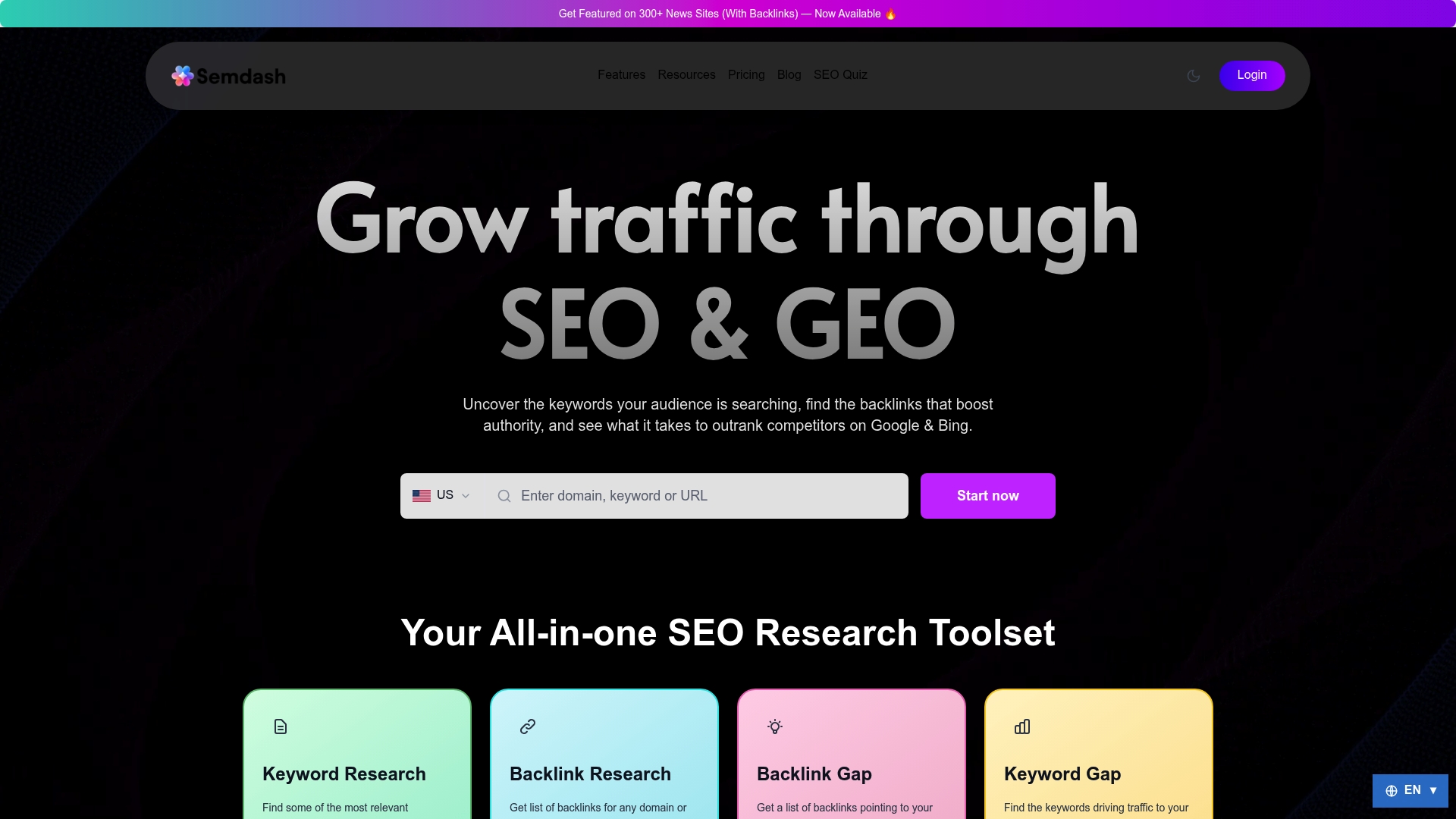
The features that map directly to a GEO workflow: the AI Overview checker monitors citation status across your keyword set; keyword research tools identify the generative-query intent patterns worth targeting; backlink research surfaces earned-mention opportunities and tracks co-citation signals; and SERP tracking with historical data lets you measure how citation rates shift after content changes. For technology brands looking to build visibility in AI-driven search, pairing Semdash’s monitoring with a structured SEO strategy for technology companies gives you both the data layer and the tactical framework.
A typical use case: a content team notices a drop in AI Overview appearances for their core product queries. They pull the Semdash AI Overview report, identify three pages that lost citations after a site redesign, trace the issue to missing schema and broken canonical tags, fix both, and confirm citation recovery within the next monitoring cycle. That loop, detect, diagnose, fix, verify, is exactly what Semdash is built for. Start your GEO monitoring program at Semdash.
Sources
- Optimizing your website for generative AI features on Google Search | Google Search Central
- Generative Engine Optimization: How to Dominate AI Search (ACM / arXiv abstract)
- Forget SEO. Welcome to the World of Generative Engine Optimization | WIRED
- Generative Engine Optimization (GEO): How to Win in AI Search | Backlinko
FAQ
What is generative engine optimization in plain terms?
GEO is the practice of structuring content so AI-powered answer engines, like Google’s AI Overviews, Perplexity, and ChatGPT, cite or include it in their generated responses. It builds on traditional SEO foundations but adds tactics like earned citations, sourced statistics, and scannable structure.
How is GEO different from traditional SEO?
Traditional SEO targets a rank position in a blue-link SERP; GEO targets inclusion in an AI-synthesized answer. The signals shift from keyword density and backlinks toward earned mentions, verifiable citations, and machine-readable content structure.
Which GEO tactics produce the biggest measurable lift?
GEO-bench controlled evaluations found that adding citations, quotations, and statistics to content can significantly increase visibility in generative engine responses. These three tactics consistently outperform structural changes alone.
How do I track whether my content is being cited by AI engines?
Use Semdash’s AI Overview checker to monitor citation status across your keyword set, Google Search Console’s Generative AI report for impression data, and manual spot-checks in Perplexity and ChatGPT for your core queries.
Does GEO work the same way across Google, Perplexity, and ChatGPT?
No. A 2025 comparative analysis found significant differences in domain diversity, freshness sensitivity, and language handling across engines. Perplexity favors recently updated citation-rich content; ChatGPT favors recognized publishers; Google AI Overviews applies existing E-E-A-T signals. Adapt tactics by engine and vertical.