%20(1)-B86R08ZzwhPzS6UZbG3mSxRWPCwGwn.png)


Most advice on how to check keyword difficulty starts and ends with one number. That's the mistake. A KD score is useful, but it's only a snapshot of the current page-one competition, and it says nothing about whether your site can compete, whether the SERP is crowded with features, or whether the ranking pages are even well optimized.
I've watched teams lose weeks by trusting a single score and skipping the rest of the page-one read. I've also seen them dismiss terms that were absolutely winnable because the raw difficulty number looked ugly in the wrong tool. The right approach is a triangulation exercise, universal KD, personal difficulty, manual SERP audit, and SERP feature density all checked before anyone commits to a target.
Table of Contents
- Why a Single Keyword Difficulty Score Is Not Enough
- How Major Tools Actually Calculate Keyword Difficulty
- Translating KD Bands Into Real Ranking Odds
- Running the Check Inside a KD Tool Step by Step
- The Manual SERP Audit That Catches What KD Misses
- Personal Difficulty, AI Overviews, and the Final Go or No-Go Call
- The One Habit That Keeps Improving My Targeting
Why a Single Keyword Difficulty Score Is Not Enough
A lone KD number feels clean, but it hides the underlying decision. In practice, I've seen it push teams toward keywords they had no realistic shot at ranking for, and just as often, it's made them overlook terms that were ripe for the taking. That happens because a KD score is a proxy for the live first page, not a verdict on your site's odds.
The first thing to remember is that most major tools score against the current top 10 organic results. Moz says its Difficulty metric runs from 1 to 100, where 1 means not difficult at all and 100 means very difficult, and it derives the score from Page Authority, Domain Authority, and a projected CTR adjustment in the first-page results Moz keyword difficulty. DataForSEO describes the same basic reality in more mechanical terms, it analyzes the top 10 organic websites, assigns page and domain values, then combines them with a weighting system into a 0-to-100 score DataForSEO keyword difficulty mechanics.
What the score misses in real life
A KD score does not know whether your domain already has topical authority in the space. It doesn't know that the SERP is packed with snippets, AI answers, or product modules that reduce clicks even if you rank. And it doesn't tell you whether the pages ranking ahead of you are strong because they're superior, or just because they've accumulated more links and brand weight.
Practical rule: treat KD as a filter, not a final answer. If the score looks reasonable, the page-one audit still has to pass.
That's the habit that saves the most time. A keyword can look “easy” on paper and still be a bad bet if the first page is dominated by authority brands and answer features. It can also look hard and still be a smart target if the current results are thin, poorly aligned to intent, or weak on links. The rest of the workflow is about separating those cases before content gets briefed.
How Major Tools Actually Calculate Keyword Difficulty
Knowing how tools build KD changes how you read the number. If you don't know what's inside the score, you end up comparing tools as if they were measuring the same thing in the same way, and they usually aren't.
Read the formula, not just the label
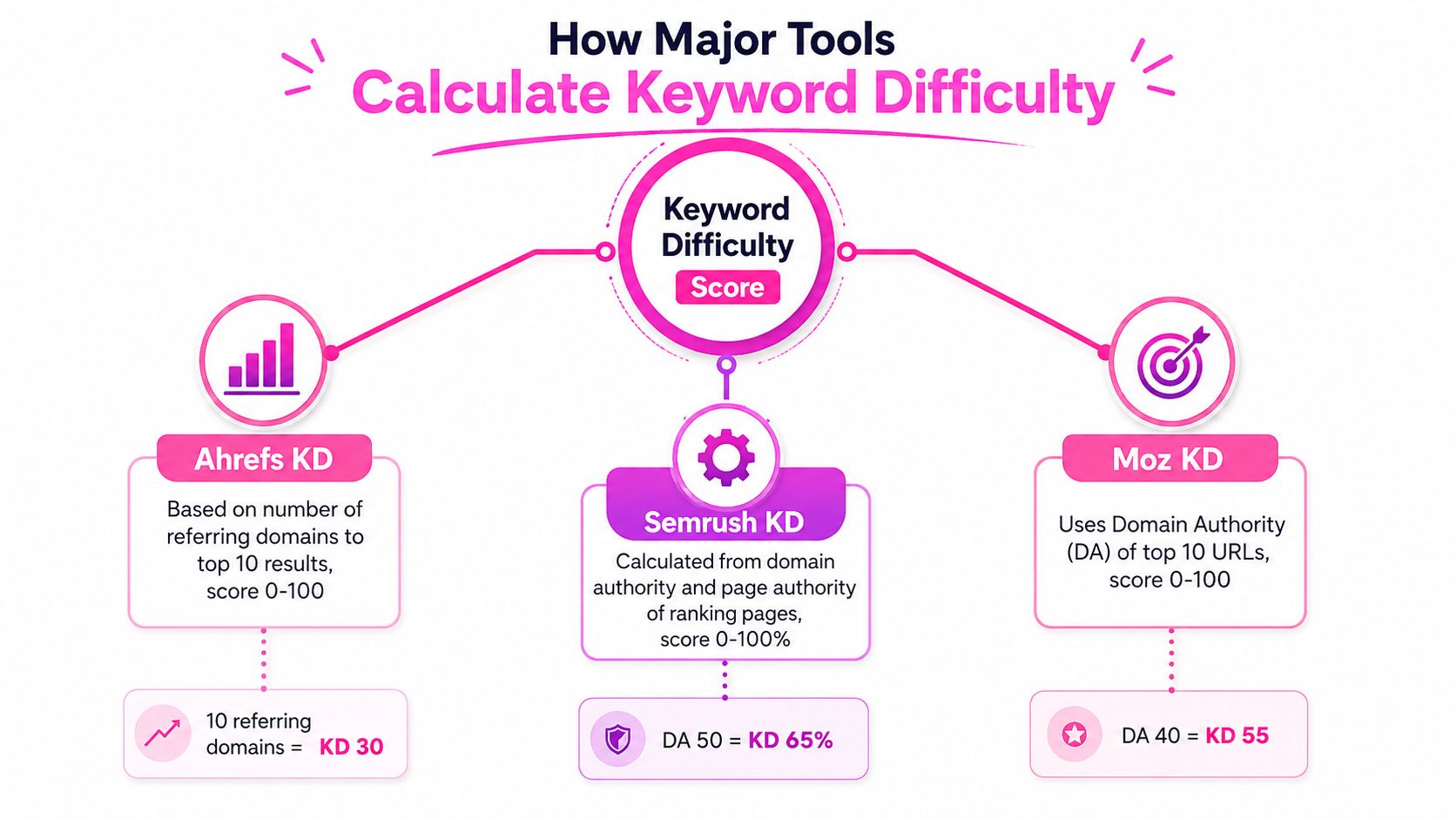
Moz's Difficulty score is explicitly built from PA, DA, and a projected CTR adjustment, which is why it can feel more conservative or more forgiving depending on the keyword and the result set Moz keyword difficulty. Ahrefs says it calculates keyword difficulty by analyzing the search results and counting the referring domains pointing to the top 10 ranking pages Ahrefs keyword difficulty. Keywords Everywhere also describes a live-top-10 approach, pulling the current top 10 Google results for the keyword and location and rolling those page strengths into a 0-to-100 score Ahrefs keyword difficulty.
DataForSEO is helpful because it shows the mechanics more explicitly. It looks at the top 10 organic websites, assigns ranking values to the domain and page, combines them with a 0.1/0.9 weighting, converts the result into a 0-to-100 score, and uses the greater of the median or average values in the final formula Moz keyword difficulty. That tells you KD is fundamentally a summary of who's already occupying page one.
Why different tools disagree
Two tools can return very different scores for the same keyword because they weight different signals. One may lean harder on backlinks, another on authority, another on projected click opportunity. That's not a bug, it's a clue that you should not anchor your content plan to a single platform's score.
Moz also notes that its Keyword Explorer combines Difficulty, Volume, and expected Organic Click-Through Rate into a Priority score, while Semrush's overview workflow has you enter a keyword, choose a target location, and then review keyword difficulty, monthly search volume, and the results Moz keyword difficulty, Semrush Keyword Overview. That pairing is the right mental model, because raw KD alone doesn't tell you whether the opportunity is worth the page.
When I'm auditing a cluster, I read the score as shorthand for the current page one. Nothing more. If the score and the live SERP agree, I move forward. If they don't, the SERP wins.
Translating KD Bands Into Real Ranking Odds
A score becomes useful when it maps to a decision. The 2025 compilation data makes the pattern obvious, average keyword difficulty sits around 38 to 42, about 35% of keywords fall in the KD 20 to 40 medium band, about 32% sit in the KD 0 to 20 low band, and only 15% are above KD 60 Moz keyword difficulty. That distribution matters because a lot of teams still behave as if most keywords are either easy or impossible, when the market is full of middle-ground terms.
What the bands mean in practice
The same data shows a steep drop in top-10 success rates as difficulty rises. Average websites hit the top 10 at 78% for KD 0 to 20, 42% for KD 20 to 40, 18% for KD 40 to 60, 6% for KD 60 to 80, and 1.2% for KD 80 to 100 Moz keyword difficulty. Those numbers don't predict your exact outcome, but they do give you a sane starting point for fit.
| KD Range | Share of Keywords | Avg. Site Top-10 Chance | Practical Read |
|---|---|---|---|
| 0 to 20 | about 32% | 78% | Often worth testing early if intent fits |
| 20 to 40 | about 35% | 42% | Solid target zone for many growing sites |
| 40 to 60 | not specified | 18% | Needs stronger content and authority |
| 60 to 80 | not specified | 6% | Usually a stretch unless your site is established |
| 80 to 100 | 15% above KD 60 overall | 1.2% | Generally a long shot for average sites |
How I use the bands
Low KD doesn't automatically mean easy money. A weak result set can still be a terrible bet if search intent is wrong for your offer. Medium KD is often the most practical zone, but only when the page one shows room to compete and your site already has some topical depth.
Rule I use in audits: if a keyword looks attractive only because the volume is high, I slow down. Volume can hide a SERP that's too mature for your current authority.
A lot of planning goes wrong because teams overvalue raw search volume and underweight actual competitiveness. I'd rather target a smaller term with a winnable page one than chase a bigger keyword where the probability of success is poor and the content team burns a month for nothing.
Running the Check Inside a KD Tool Step by Step
I start with location before I trust anything else. Semrush's checker tells you to enter a keyword, choose a target location, and then review keyword difficulty, monthly search volume, and the search results, and Exploding Topics says the location dropdown affects the score you get back Semrush Keyword Overview. If you skip that step, you're not checking a keyword, you're checking a vague global average that may not match the market you sell into.
The sequence I use
The first pass is simple. I enter the phrase, lock the country, and compare the KD against the search volume and the live SERP preview. Then I look at whether the same term behaves differently in different markets, because location can change the shape of the result set and the competitiveness of the pages.
For local work, I also like pairing the check with a local seo tool such as LocalHQ when I'm validating location-sensitive terms, because local intent can bend the result set in ways a generic keyword tool won't surface fast enough.
Bulk checks save the real time
Bulk checking changes the workflow. SEO Review Tools accepts up to 10 keywords, Natiad accepts up to 42, and KeySearch supports bulk checks after you select multiple keywords, while Exploding Topics notes that Semrush can show KD% side by side for multiple keywords Exploding Topics keyword difficulty checker. That's the part many teams miss, because one-at-a-time checking hides better variants in the same cluster.
If I'm looking at a content brief, I'll compare the head term against longer variants, questions, and modifiers in one batch. The goal isn't to find the easiest term in a vacuum, it's to find the best mix of feasible and relevant keywords before anyone writes.
The video below is useful if you want to watch the workflow instead of only reading it.
I've seen teams waste an entire sprint because they checked one keyword, liked the score, and never compared the adjacent variations. The fix is boring but effective, always check location, always compare clusters, and always read the SERP snapshot before you move on.
The Manual SERP Audit That Catches What KD Misses
KD assumes the first page is uniformly strong. It usually isn't. I've found that the manual audit is where you catch the keywords that look hard on paper but have obvious gaps in the actual result set.
Split the page one into three reads
Content Harmony's framework breaks difficulty into content difficulty, link difficulty, and domain difficulty Content Harmony keyword difficulty. That split is useful because it stops you from treating every page-one result as equally formidable.
Content difficulty is the fastest check. I look for the keyword in the title tag, URL, H1, and body copy of each ranking page, using the “brute force keyword match” idea Content Harmony describes Content Harmony keyword difficulty. If several pages rank without really targeting the query, that's a sign the SERP may be more fragile than the KD score suggests.
Link difficulty is the next layer. Ahrefs says the more referring domains the top-ranking pages have, the higher the KD score Ahrefs keyword difficulty. Content Harmony also normalizes the average referring-domain profile of page-one results onto a 0-to-100 scale, which makes the backlink picture easier to compare across terms Content Harmony keyword difficulty.
The shortlist rule I actually use
I shortlist terms where competitors already rank in positions 1 to 10, my site is absent from the top 20, and the SERP shows real content gaps plus manageable authority thresholds Content Harmony keyword difficulty. That combination usually means the result set is competitive but not locked.
The same pattern often shows up in adjacent topics, so I'll open a SERP analysis view and map which pages are winning for which intent. A helpful internal reference here is the SERP analysis workflow in SemDash, because the page-level read is where the keyword stops being abstract.
The best opportunities rarely hide in the lowest KD score. They hide in the SERP where the current winners are misaligned, thin, or narrowly optimized.
Domain difficulty is more qualitative, but it matters. If the same few authoritative brands keep winning every neighboring term, I treat the niche as heavier than the score alone suggests. If the brands rotate and the content is inconsistent, I get more aggressive.
Personal Difficulty, AI Overviews, and the Final Go or No-Go Call
The last filter is whether the keyword is hard for your site, not just hard in general. Semrush distinguishes generic KD from Personal Keyword Difficulty, which recalculates difficulty using your domain as the benchmark, and Mangools' KWFinder offers Relative Keyword Difficulty based on the URL's link strength Semrush keyword difficulty. That difference matters more than commonly acknowledged, because a keyword that looks blocked on a global score can still be realistic for an authoritative site.
Calibrate against your own site
I use the universal KD first, then I compare it with site-specific difficulty and current rankings. If my site already has topical authority, I can sometimes push into terms that would be pointless for a newer domain. If the site is weak on links and shallow on the topic, I downgrade even a decent-looking score.
The second issue is the SERP itself. Semrush now tracks AI Overviews visibility and the exact URLs cited, and its SERP Checker includes 12-month history for volatility and intent shifts SemDash AI Overview Checker, Search Engine Land keyword difficulty checker context. That's a reminder that the question isn't just whether you can rank, it's whether you can still earn clicks when answer features are crowding the page.
For a practical reference on that environment, I also keep AI SEO Tracker's guide to ranking in Google SGE in the mix when I'm judging whether a term has enough click opportunity left.
My go, stretch, or skip decision
A keyword is a go when universal KD is manageable, personal difficulty fits the site, and the SERP still leaves room for clicks. It's a stretch when the topic fits but the authority gap is real. It's a skip when AI answers, snippets, and entrenched pages leave no practical path to traffic.
I've learned to write that verdict next to every keyword in the research sheet. That one habit prevents a lot of self-deception.
The One Habit That Keeps Improving My Targeting
The habit that keeps paying off is embarrassingly simple. I score every shortlisted keyword against the same four-point rubric, universal KD, personal difficulty, manual SERP audit, and SERP feature density, then I write the verdict beside the term before anything gets briefed. That stops shiny volume numbers from hijacking the plan.
I also keep seeing the same mistakes. Teams chase volume over fit, leave the location dropdown on the wrong market, and skip the page-one audit because the KD number looked friendly. For SaaS work, I've pointed teams toward RankingonAI's SaaS-focused AI SEO agency resource when they need a sharper view of how AI-era visibility changes the target list.
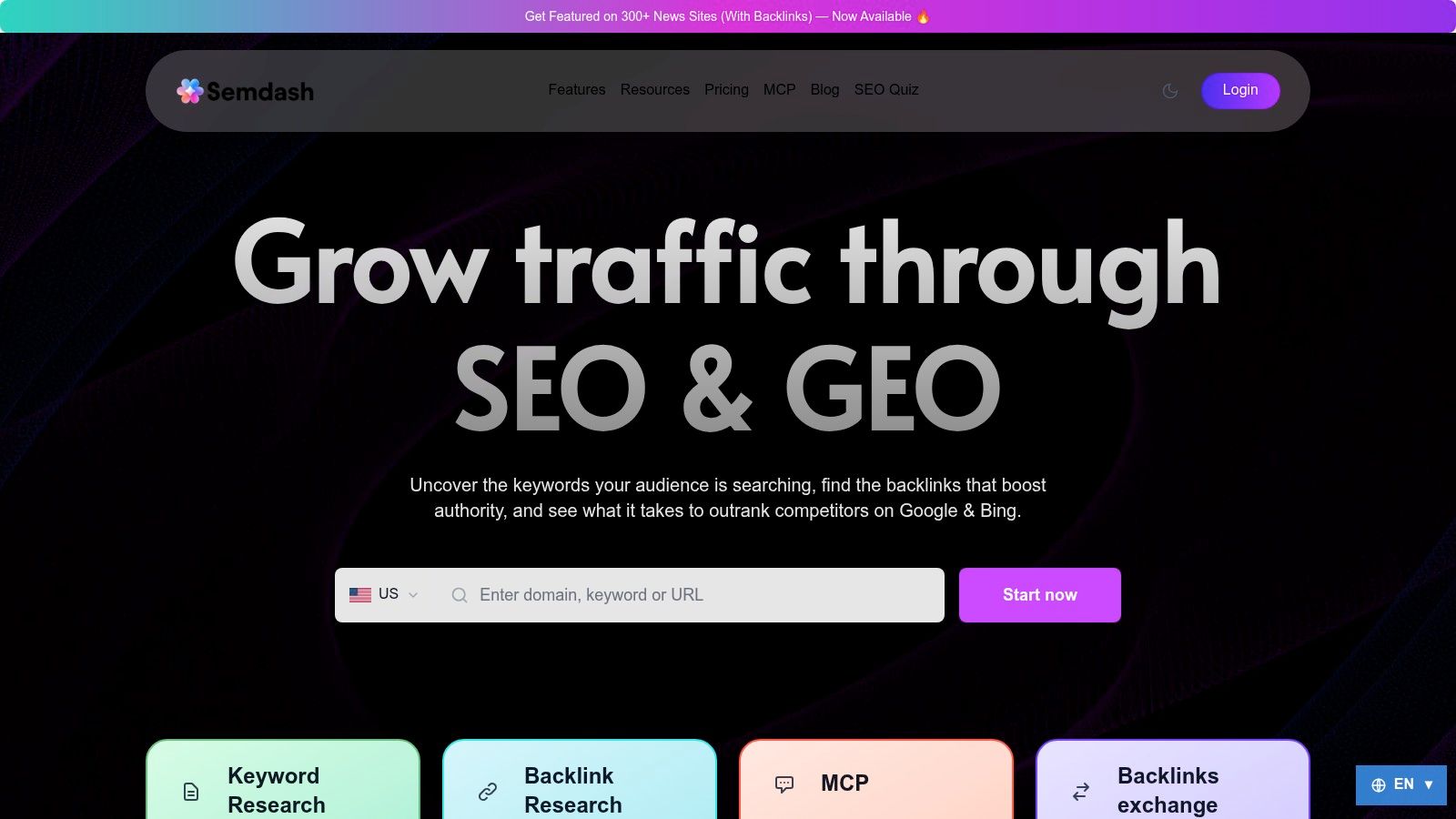
SemDash gives you keyword difficulty, search volume, SERP data, and AI Overviews visibility in one place, which makes this kind of triangulation faster to run on every target. If you want to compare universal KD with live page-one signals and build a cleaner keyword shortlist, visit SemDash and test your next cluster against the actual SERP before you commit to content.