%20(1)-B86R08ZzwhPzS6UZbG3mSxRWPCwGwn.png)


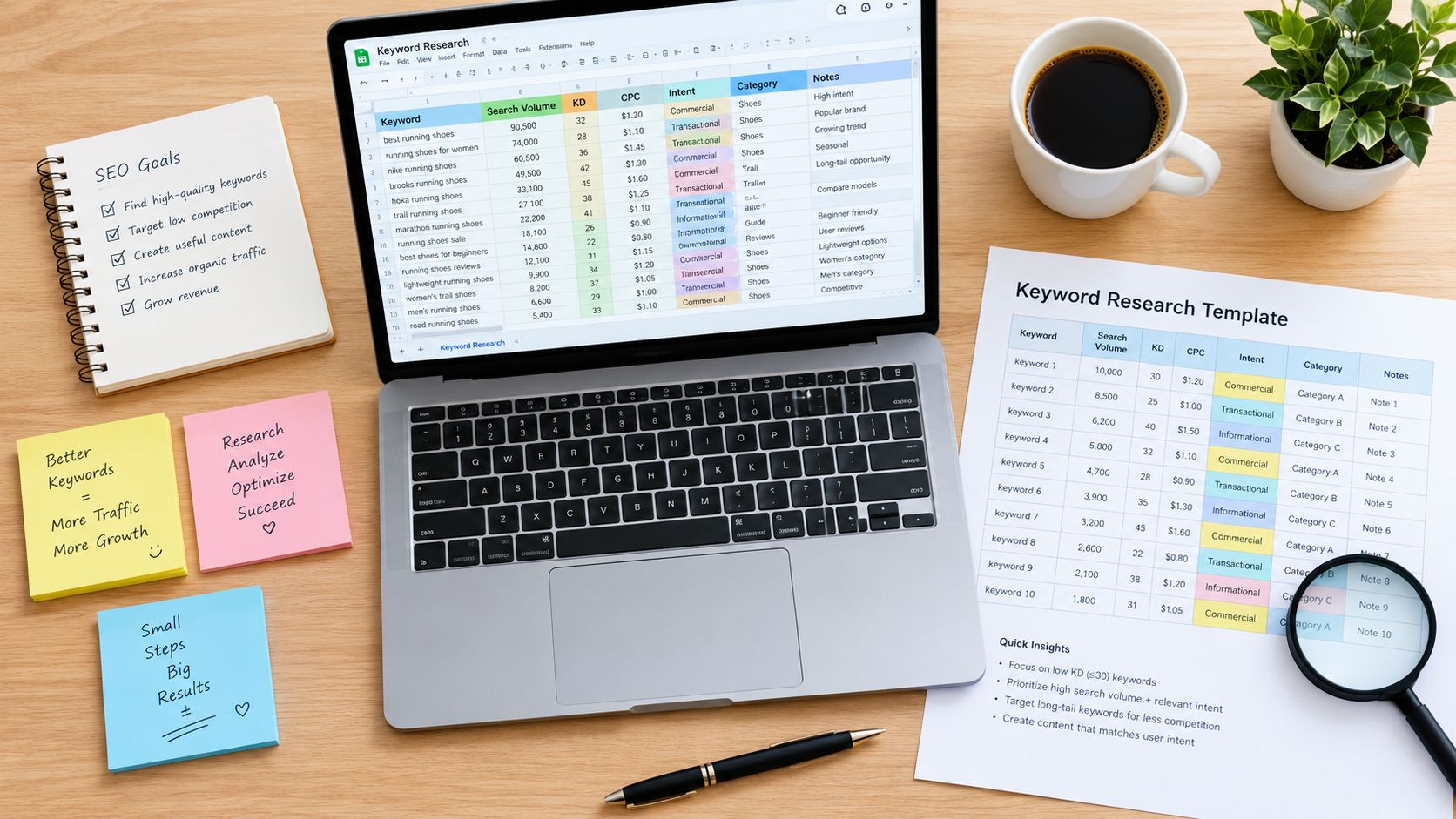
The popular advice is to export every keyword with meaningful volume, sort the spreadsheet by potential traffic, and start publishing from the top. That workflow creates busywork more reliably than it creates a strategy. A useful keyword research template should tell me not only what people search for, but also which page should satisfy the query, what the live SERP rewards, whether a click is realistically available, and when the decision needs revisiting.
I treat keyword research as a dynamic page-mapping system. Search demand changes, result formats change, and one attractive phrase can create several competing pages if I don't check the actual ranking URLs. The spreadsheet is valuable only when it connects demand to architecture, intent, conversion role, and measurable visibility.
Table of Contents
- Why Most Keyword Spreadsheets Fail
- Essential Columns for a Modern Template
- Populating Your Sheet with SemDash Data
- Clustering Keywords to Prevent Cannibalization
- Prioritizing Targets Based on Click Opportunity
- Maintaining a Living SEO Document
Why Most Keyword Spreadsheets Fail
Teams typically begin in the wrong place. They open a keyword tool, enter a seed term, export thousands of suggestions, and call the export research. The file may contain volume, difficulty, and variations, but it rarely answers the operational question that matters: what should we publish, update, consolidate, or reject?
A static list also assumes that known demand is the whole market. Google has said that approximately 15% of daily searches are new, and Google representatives described that share in 2013 as roughly 500 million previously unseen queries per day, based on an estimated 100 billion monthly searches. Google reaffirmed the 15% figure in 2017, explaining that users continually submit queries its systems haven't encountered before, as reported by CNET's coverage of Google's search disclosures.
That changes how I design the sheet. I need fields for seed terms, questions, long-tail variants, emerging language, discovery date, source, intent, and target URL. Otherwise, I optimize only for the vocabulary already present in a database and miss demand created by new products, events, terminology, and customer problems.
Practical rule: A keyword without a page decision is an unprocessed lead, not a target.
Volume is a clue, not a forecast
Search volume helps me compare candidates, but I don't use it as expected traffic. Ahrefs reports that 94.74% of keywords generate 10 or fewer monthly searches, while only 0.0008% exceed 100,000 searches. Those figures make a strong case for preserving specific, low-volume queries when they show clear commercial or problem-solving intent. The distribution is documented in Ahrefs' SEO statistics research.
A phrase with modest demand can belong on a high-conversion comparison page, an integration page, or a support-style guide. A broad head term can attract attention while failing to match the offer. The mistake isn't collecting broad terms. The mistake is allowing volume to decide the publishing queue by itself.
For a complementary perspective on turning keyword discovery into a more deliberate process, I recommend Online Brand Growth's keyword research guide. I use resources like that for idea generation, then validate every candidate against the live SERP and the site's page architecture.
SERP awareness belongs in the template
A keyword can have demand and still offer limited organic click potential. Featured snippets, local packs, shopping results, knowledge panels, People Also Ask, and AI Overviews all compete for attention above traditional listings. SparkToro research cited in industry reporting found that approximately 60% of Google searches ended without an external click in 2024, while Ahrefs reported that AI summaries reduced clicks by 34.5% in its 2025 analysis, summarized by ClickForest's discussion of zero-click search.
I therefore record the SERP features, whether the result answers the query completely, and whether the objective is a blue-link visit, a featured result, an AI citation, or brand visibility. A spreadsheet that ignores those conditions can rank a page successfully and still misjudge the business outcome.
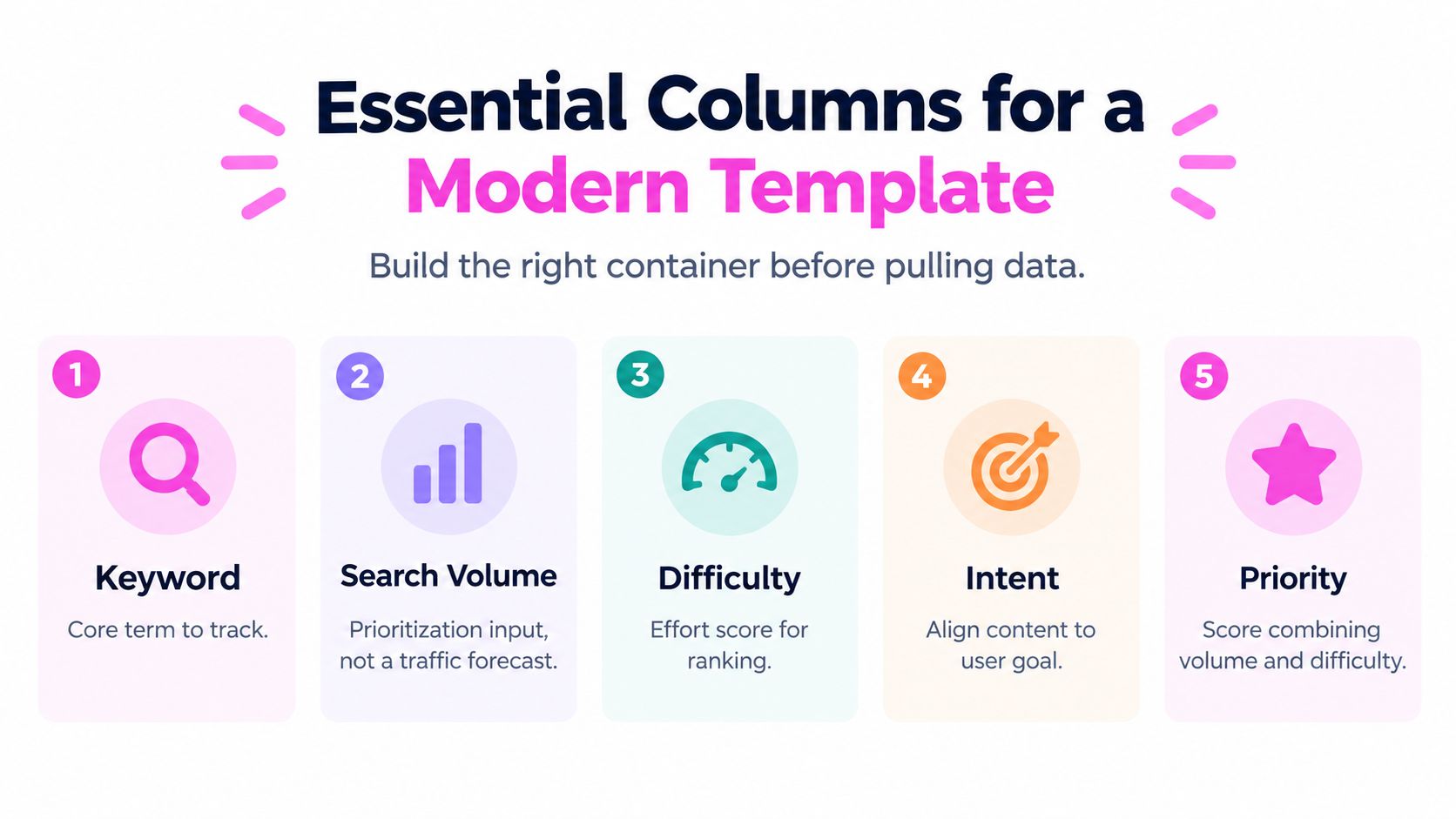
Essential Columns for a Modern Template
I build the container before collecting keywords. My core sheet includes the query, topic, country, language, device, source, discovery date, intent, trend direction, seasonality notes, SERP format, AI Overview status, current ranking URL, proposed URL, conversion role, freshness requirement, cannibalization decision, volume, difficulty, and priority.
The reason for the extra context is simple. Google recommends examining search interest over time, geographic popularity, related topics, related queries, and rising terms. Google Trends allows comparison of up to five terms at once, and Google recommends using Search Console's Performance report to connect exploratory research with queries already producing impressions and clicks. The Google Search Central guidance on search trends supports this feedback loop.
The fields that change publishing decisions
- Query and source: Record the exact wording and whether it came from a competitor, Search Console, People Also Ask, People Also Search, autocomplete, a customer conversation, or another source. This preserves provenance and makes new demand easier to audit.
- Market and trend: Store country, language, device, date checked, trend direction, and seasonality notes. The same wording can represent different opportunities across markets.
- Intent and SERP format: Classify the live result as informational, commercial investigation, transactional, or navigational. Add the dominant content type, freshness requirement, and SERP features rather than inferring intent from wording alone.
- Page decision: Use explicit values such as new page, existing-page section, consolidate, update, or reject. Include the proposed URL, current ranking URL, primary term, supporting terms, and cannibalization risk.
- Business and visibility value: Add conversion role, business value, achievable ranking probability, click potential, AI Overview trigger status, cited URL, and visibility objective.
I keep volume and difficulty, but I place them beside evidence rather than at the front of the decision. Keyword Planner estimates also need caution. Ahrefs reports that Google Ads Keyword Planner overestimates search volume 54.28% of the time and is approximately accurate 45.22% of the time, which is why I compare estimates with Search Console impressions, ranking history, and competitor evidence in the same row.
Populating Your Sheet with SemDash Data
I start with the business, not the keyword box. I define the products, use cases, markets, competitors, conversion actions, and existing URLs before collecting suggestions. Then I use SemDash as one research option to connect competitor discovery, keyword metrics, SERP observation, clustering, and page-level mapping in one workflow.
My collection sequence
- Start with Domain Keywords. I enter a competitor domain and export the terms associated with its visible pages. I remove branded terms where they don't represent an opportunity, then keep the ranking URL beside every query. This immediately shows whether a competitor's visibility comes from a product page, comparison page, guide, integration page, or another format.
- Run Keyword Gap. I compare several relevant domains and isolate terms where competitors appear but the client doesn't. I don't publish the entire gap. I mark each term with business relevance, existing-page fit, likely intent, and a proposed action.
- Expand the language. Long-tail, People Also Ask, and People Also Search suggestions help me find questions and scenario-based wording. I place those terms into supporting-topic candidates until a SERP check proves they deserve separate pages.
- Check the SERP history. I review the available 12-month SERP history for priority candidates. Stable rankings suggest a different content challenge from volatile results, where intent, freshness, or result format may be shifting.
- Map the URL. I record the exact current ranking URL for the client and the exact proposed URL for new work. A keyword should never remain detached from a content asset.
The research workflow is also available through SemDash keyword research, where keyword discovery, competitor analysis, suggestions, and SERP data can support the same page-mapping process.
I add a short evidence note to every important row. For example, “same result set as integration page,” “PAA question suitable for section,” or “AI Overview cites competing guide.” That note prevents the next writer or strategist from treating a decision as an unexplained spreadsheet label.
The video below is useful when I need to align another team member with the research workflow before handing over a content map.
I also separate discovery from approval. The first pass can be broad. The approval pass is where I reject terms with no suitable page, merge duplicates, distinguish branded from non-branded demand, and assign a measurable visibility objective.
Clustering Keywords to Prevent Cannibalization
I treat keyword clustering as a page-mapping exercise, not just a way to tidy a spreadsheet. The practical mistake I've made is grouping every synonym under one broad topic, then publishing separate pages that compete for the same result. A safer workflow compares the actual ranking pages for each query. If the same URLs repeatedly appear, I place those terms in one cluster and assign one primary URL.
SERP overlap beats linguistic similarity
Suppose two queries use different wording but return substantially the same pages, content formats, and intent. I cluster them and write one useful page with clear sections. If the result sets differ, I split them even when the phrases look interchangeable. One phrase may demand a definition, while the other signals product evaluation or implementation.
SemDash's clustering workflow can accelerate the first grouping, but I treat the output as a hypothesis. I still inspect the live SERP, compare ranking-page overlap, record the date, and decide whether the cluster should produce a new page, a section, an update, or no page. The practical implementation principles around accessible text, descriptive headings, and unique content are covered in Google's SEO getting-started documentation.
My stop condition: If I can't explain why two queries deserve different pages after comparing their SERPs, I don't publish two pages.
The page brief carries the decision
For each approved cluster, my brief includes:
- Primary query: The clearest expression of the page's main job.
- Supporting queries: Variants and questions that the page can answer naturally.
- Intent evidence: Dominant SERP format, ranking-page type, and conversion role.
- URL decision: Existing URL, new URL, consolidation target, or rejection.
- Cannibalization note: Related pages that need redirects, internal-link changes, section consolidation, or monitoring.
This approach protects against intent dilution. A page that tries to satisfy a definition, a comparison, a tutorial, and a product evaluation without clear structure often satisfies none of them well. A cluster should produce one genuinely useful asset, not a thin page that repeats variants mechanically. I document the evidence in the spreadsheet so future updates don't reopen the same debate.
For a practical discussion of the workflow and its implementation, I use SemDash's keyword clustering resource alongside the manual SERP review. The tool can reduce sorting work, but it can't replace the editorial decision about what a visitor needs.
Prioritizing Targets Based on Click Opportunity
I don't treat search volume as the finish line. I estimate the click opportunity after checking the SERP, then combine that estimate with business value and the probability that the site can reach a meaningful position.
A large analysis of 4 million Google results, covering 1,312,881 pages and 12,166,560 queries, found that position one received an average 27.6% organic click-through rate and was 10 times more likely to earn a click than position 10, as reported in Backlinko's Google CTR study. The same analysis found that positions 8 through 10 had nearly identical CTRs. I therefore distinguish a realistic move to the lower first page from a plausible move into the top three.
My opportunity score
I use a simple weighted score rather than pretending that one metric predicts the outcome:
| Input | Question I ask | How it changes priority |
|---|---|---|
| Business value | Does the query support acquisition, retention, or a strategic product area? | High-value commercial relevance raises priority |
| Achievable ranking | Can the current site compete with the result type and authority shown? | A credible path beats a theoretical volume win |
| Click potential | Does the SERP leave room for an external visit? | Answer-complete SERPs receive a lower click expectation |
| URL alignment | Does the proposed page match the search language and intent? | Strong alignment improves the publishing case |
| Visibility objective | Is the goal a click, citation, snippet, or brand presence? | The objective determines the measurement plan |
I also record query length and URL alignment. The same study found that queries of 10 to 15 words generated 1.76 times more clicks than single-word terms, while URLs containing terms similar to the query had a 45% higher CTR than URLs without them. These figures are not guarantees, so I use them as directional inputs rather than promises.
AI visibility changes the target
I add a separate field for AI Overview status, cited sources, target-URL mention, factual gaps, and expected value of a citation. A query may be worth pursuing even when a conventional click is constrained, but the objective needs to be explicit. It might be an AI citation, a trusted brand mention, a featured result, or a click from users who need deeper information.
Reported effects vary by device, query class, and methodology. One study covering 53 brands, 5.47 million queries, and 2.43 billion impressions reported 0.61% organic CTR for queries with an AI Overview versus 1.62% without one, while another analysis reported that the top-ranking page's average CTR was about 58% lower when an AI Overview appeared, as summarized by Relevant Audience's analysis of AI Overview impact. I don't turn those findings into a universal exclusion rule. I track the actual SERP and validate the eventual result with Search Console.
Maintaining a Living SEO Document
I review the template on a recurring schedule, but I don't refresh every row with equal effort. Priority pages receive current SERP checks, updated intent notes, and Search Console comparisons. I look for new queries, changed result formats, lost rankings, emerging competitors, and pages that now overlap.
Google's 15% new-query disclosure reinforces the operating principle: the document must capture both known demand and language that wasn't visible during the original research. I add new terms from Search Console, customer conversations, product releases, competitor changes, and rising related queries. Deprecated language gets marked rather than deleted outright, because it may explain historical performance or reveal an older URL that needs consolidation.
What I change after publication
If impressions rise but clicks don't, I inspect the SERP features, title, snippet, and AI Overview status before rewriting the whole page. If several pages trade rankings for the same queries, I compare their current result sets and decide whether to consolidate, clarify intent, or strengthen internal linking. If a page has thin coverage and another URL now satisfies the same need, I prefer a deliberate consolidation decision over endless minor edits.
I also use a content scheduling workflow to turn approved clusters into accountable briefs and publication tasks. A tool such as the StreamGen content scheduler can help organize that operational handoff, but the keyword sheet remains the source of truth for intent, URL ownership, and measurement.
The best template I've used is not the one with the most rows. It's the one that makes outdated assumptions visible, records why each page exists, and gives the team a clear action when demand or SERP behavior changes.
Use SemDash to combine competitor keyword discovery, long-tail and question expansion, SERP history, clustering, URL-level mapping, and AI Overview citation tracking in one research workflow. Build your next page map around actual click opportunity and page ownership, then visit SemDash to turn the keyword research template into an actionable SEO plan.