%20(1)-B86R08ZzwhPzS6UZbG3mSxRWPCwGwn.png)


Most rank trackers still pretend organic search visibility is a single number. It isn't. A page can move up, earn more impressions, and still send fewer visits if the SERP fills up with richer answers, features, and AI-generated summaries that satisfy the query before anyone clicks. That's the mistake I keep seeing in audits, and it's why “what's my ranking?” is the wrong first question.
The more useful question is, how much of the search result page do you own? That means classic links, SERP features, and AI answer surfaces, all measured together. If you only watch positions, you can miss the full picture completely.
Table of Contents
- Why Your Visibility Metrics Are Probably Lying to You
- What Organic Search Visibility Really Means in 2026
- The Signals That Actually Move the Needle
- How I Measure Visibility Beyond Rank Trackers
- A Workflow for Improving Visibility with SERP History
- Shifting from a Rank-Based to a Share-Based Mindset
Why Your Visibility Metrics Are Probably Lying to You
Most SEO reporting still treats visibility like a clean ladder. Move up a few positions, and the report looks healthier. In practice, the SERP is crowded, the click path is uneven, and rank alone misses most of what users see.
The problem with rank-only reporting
I've watched sites gain ranking positions and lose visits in the same month. That is not a contradiction, it is a measurement problem. Analysts at Neil Patel found a recent multi-site trend where a visibility-and-impressions index rose from 100 in June 2025 to about 150 by May 2026, while the corresponding organic traffic index fell from 100 to about 75 over the same period, a 25% decline source.
That gap matters because it breaks the old assumption that more visibility always means more clicks. It often means your pages are showing up in more places while the SERP absorbs the click.
Practical rule: if impressions are rising but visits are softening, do not celebrate the impression trend. Check whether SERP features, answer boxes, or AI summaries are taking the click.
Why the top spots matter more than the rest
The click curve is heavily concentrated at the top. The strongest organic results still collect most of the traffic, and the first five organic results together account for over 67% of total clicks source. That is why a small improvement in position can change traffic far more than the number of keywords in a report.
This also explains why a page sitting on page two can feel invisible even if it technically ranks for dozens of terms. The position exists, but the commercial value does not show up until the page gets into a part of the SERP people commonly access.
What I stop trusting
I stop trusting isolated rank snapshots when they are disconnected from impressions and CTR. I also stop trusting any dashboard that treats a single keyword as a proxy for the whole topic. Organic search visibility is a distribution problem, not a scoreboard problem.
The sites that perform best in my audits are not the ones with the prettiest rank chart. They are the ones that show up where buyers look, then convert that presence into clicks. If you are also tracking AI surfaces, the guide to Generative Optimization at https://nanopim.com/post/what-is-generative-engine-optimization is a useful companion, because the measurement problem now extends beyond blue links.
What Organic Search Visibility Really Means in 2026
The old definition was simple. Rank higher, get more traffic. That definition is too small now, because the SERP itself has become a layered interface where the user can click, expand, compare, or leave without ever visiting a page.
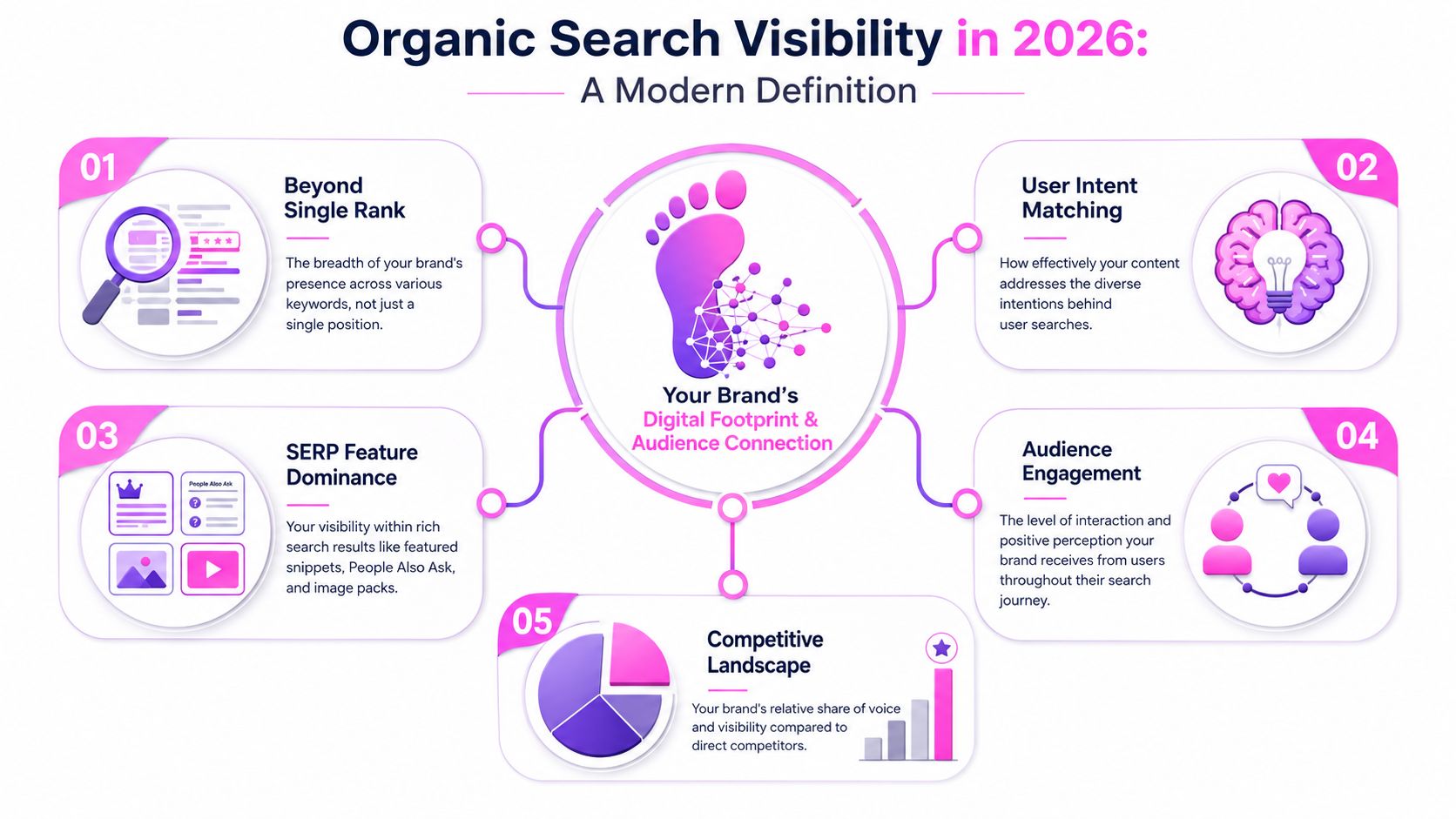
Think in shelf space, not slot number
I like to explain modern organic search visibility as digital shelf space. Being present on one blue link is like being stocked on the bottom shelf. Showing up in a featured snippet, a People Also Ask box, or an AI Overview is closer to an end-cap display or a front-of-store promo.
That framing matters because it changes the optimization target. You're not just trying to move up a ladder. You're trying to occupy more of the search experience in places where real attention happens.
Recent industry commentary describes organic visibility as non-paid discoverability across traditional search engines and generative engines and recommends tracking impressions, citations, and mentions together rather than rank alone because zero-click search and AI answers can reduce clicks without reducing impressions source. That matches what I see in practice. A page can “perform” in a rank tracker and still lose meaningful share of the conversation.
The modern components I measure
I usually break visibility into four layers.
- Classic organic listings. These are still the backbone of search discovery, and they matter more on transactional queries where the user wants a source, not a summary.
- SERP features. Featured snippets, People Also Ask, image packs, and similar surfaces can own attention before the blue links even get a chance.
- AI answer surfaces. If a query is being answered inside an AI Overview, the page's job changes. It's no longer only about rank, it's about being cited or referenced.
- Brand presence across query variants. If your site appears for a topic in one query shape but disappears in others, your visibility is thinner than it looks.
If you want a useful companion to that thinking, NanoPIM's guide to Generative Optimization is worth a read because it frames visibility as an answer-engine problem, not only a ranking problem.
The practical takeaway is simple. Visibility now means how often your brand is seen, cited, and chosen across the full search interface. Rankings still matter, but they're only one layer of the stack.
The Signals That Actually Move the Needle
When visibility stalls, the root cause usually lives in one of three places. I look for crawl and index problems first, then topical coverage, then authority signals. If the foundation is broken, the other two never get a fair shot.
Crawl and index architecture come first
Technical visibility is often boring, and that's exactly why it gets ignored. It shouldn't. Organic search visibility is strongly constrained by crawl and index architecture, and technical audits that surface orphan pages, redirect chains, and JavaScript crawlability issues matter because they directly affect bot access and signal flow source.
I've seen strong content underperform because the important URLs were buried behind messy internal paths or muddy canonical signals. If search engines can't find, render, or consolidate the right version of a page, everything else becomes theory.
A page doesn't need perfect prose to rank, but it does need to be discoverable, renderable, and clearly canonical.
Topical depth beats scattered keyword targeting
After the technical layer, I look at whether the site covers the topic the way users search for it. Thin pages chasing isolated keywords usually lose to clusters that answer adjacent questions, comparison intent, and follow-up intent in one place.
That's where many SEO teams still drift into the wrong habit. They write for one phrase instead of a topic ecosystem. The better move is to map the underlying questions behind the query set, then decide which page should own which intent. That's how you reduce cannibalization and give the strongest page a cleaner shot at visibility.
Authority still matters, but it has to support the topic
Links still matter, but not as a detached trophy count. They work when they reinforce the pages that already deserve to rank, especially the pages that solve a hard problem or establish expertise in a narrow area. Weak content with links is still weak content.
The best pattern I've seen is this. Technical cleanup makes the site readable, topical depth makes the page relevant, and authority makes the page competitive. If one of those is missing, visibility usually plateaus.
How I Measure Visibility Beyond Rank Trackers
A rank tracker still has a place, but only as one layer in a broader measurement stack. On its own, it shows where a URL sits at a point in time. It does not show whether that position is earning attention, clicks, or meaningful coverage across the SERP.
Start with Google Search Console
My baseline is always Google Search Console. I want impressions, CTR, and landing-page performance before I add any competitive layer. That gives me a direct view of what Google is surfacing, what searchers are noticing, and where the click pattern is breaking.
From there, I compare those numbers with the pages I care about. If a page has healthy impressions but weak CTR, I look at the title, the snippet, and the SERP layout. If CTR is decent but impressions stay low, the issue is usually narrow query coverage or a topical gap.
Add competitor context and query overlap
Tools like SemDash help me compare organic presence against competitor domains, inspect keyword gaps, and see how a page sits relative to other results. If I am comparing SERP parsing approaches, I have also found MapLeads' Serper vs Serpapi insights useful for weighing data collection trade-offs before I set up a reporting workflow.
The goal is not another dashboard for its own sake. It is a sharper read on whether we are visible for the same query cluster competitors are already winning, or whether we are missing the commercial slice entirely.
Measure share, not just rank
I prefer share-based reporting because it matches how the SERP behaves. The top organic result gets a disproportionate share of attention, and the first five listings capture most clicks source. A small position gain can matter more than several average positions improving by a point or two.
For broader traffic modeling, I also use SemDash traffic estimation tools to sanity-check whether a keyword set deserves the effort. That does not replace Search Console. It puts the query set in context.
A useful dashboard usually includes:
- Keyword rank
- Search volume
- CTR
- Feature ownership
- AI Overview citation presence
- Landing-page traffic quality
That mix gives me a cleaner read on visibility than rank tracking alone ever could. If a page is being seen but not clicked, the issue is probably SERP-facing. If it is not being seen at all, the problem is usually content, crawlability, or both.
A Workflow for Improving Visibility with SERP History
I start by analyzing historical SERP data before I change a page. Historical SERP data, which you can learn more about in our guide to SERP analysis, tells you whether a keyword is stable, volatile, or exhibiting a subtle shift in intent under your feet. That is usually the first place I look when a page has stalled but does not look obviously broken.
Read the pattern before you rewrite the page
I usually open a keyword in SemDash's SERP Checker and review the last 12 months of movement. I am looking for three things, changes in the top results, new SERP features, and signs that the query has shifted from informational to commercial or comparison-driven. If the query itself has changed shape, the page needs to change with it.
I often see teams rewrite copy without first asking whether the query has become a different kind of search. That is where most “update the content” advice fails. If intent changed, the old page structure is now the wrong answer.
A practical example from an intent shift
I worked on a page that had held steady traffic for a long time, then started flattening. The rank had not collapsed, but the SERP had changed. The top results moved from generic how-to articles toward pages comparing tools, workflows, and implementation steps, which told me the query had become more decision-oriented.
I rewrote the page around that newer intent, expanded the comparison language, tightened the headings to match what the SERP was rewarding, and adjusted internal links so the updated page sat inside a stronger topical cluster. I did not change it because “SEO best practice” said to. I changed it because the historical SERP showed a different search conversation.
When the SERP changes, your old content strategy might still be correct in theory and wrong in practice.
Watch organic and AI visibility together
The AI layer is hard to ignore. In a February 2026 analysis, every subfolder that lost organic visibility on Google also saw a decline in total AI search citations, with an average drop of -22.5% source. I do not treat that as a separate channel anymore. When classic organic visibility falls, citation exposure often falls with it.
That is why I keep SERP history, content changes, and AI citation checks in the same workflow. I am not just asking whether the page can rank again. I am asking whether it can reclaim enough share of the search experience to matter across both classic and AI surfaces.
If I spot a volatility spike, I do not rush into rewriting everything. I first decide whether the page needs a content refresh, a stronger internal-link path, or a total intent realignment. That sequence saves a lot of wasted work.
Shifting from a Rank-Based to a Share-Based Mindset
The biggest upgrade I make in SEO conversations is simple. I stop asking, “What's the rank?” and start asking, “What's our share of the search conversation?” That shift forces better decisions because it acknowledges how search functions now.
Rank is still useful, but only as one signal inside a broader picture. Share-based thinking makes you measure classic results, SERP features, and AI answers together, then judge performance by whether your brand is visible where the user's attention goes. That's a much harder standard, but it's the right one.
The teams that adapt fastest usually do three things well. They redefine their KPIs around visibility, they build dashboards that combine impressions, CTR, and feature presence, and they use historical SERP data to react to shifts before traffic decays. That's the difference between reporting on SEO and managing it.
If you want a clearer view of where your pages appear, SemDash pulls keyword data, SERP history, competitor gaps, and AI Overview visibility into one workflow. That makes it easier to measure share of search instead of chasing rank alone. Visit SemDash and use it to audit the queries, pages, and SERPs that decide your real organic search visibility.