%20(1)-B86R08ZzwhPzS6UZbG3mSxRWPCwGwn.png)



Most advice about structured data for SEO starts with “add schema and win rich results.” That's the part that causes the most wasted work. I've seen teams roll out Organization, Article, BreadcrumbList, and Product markup across thousands of URLs, then wait for a visible change that never appeared.
The deployment wasn't necessarily useless. The measurement model was incomplete. Structured data can make content understandable to search engines, support eligibility for rich results, clarify relationships between entities, and expose implementation failures across a site. Google's documentation is explicit that structured data isn't a direct ranking factor, but it can help Search understand a page and determine whether the page qualifies for a richer result format, as explained in Google's structured data introduction.
The practical question isn't “Did we paste schema into the template?” It's “What can a search engine confidently understand, validate, and use from this page?”
Table of Contents
- What Structured Data Actually Does on a Live Site
- Schema Markup Explained Without the Jargon
- Schema Types Worth Your Time in 2026
- Choosing a Format and Shipping Markup the Right Way
- Coverage Is the Real Problem, Not Presence
- Testing, Debugging, and Monitoring Structured Data
- Using SEO Research Tools to Prioritize Schema Work
- Your Structured Data Checklist and What to Watch Next
What Structured Data Actually Does on a Live Site
On one publisher deployment, the team had implemented several schema types across a large content library. The markup was present, the templates rendered, and the developers considered the project complete. Rich results didn't arrive in the way stakeholders expected, so the project was initially labeled a failure.
I disagreed with that conclusion, but I also wouldn't call the deployment successful. The team had treated structured data as a single job, when it was doing at least three different jobs with very different success criteria.
It labels entities instead of guessing
The first job is entity identification. A page can mention a brand, a product, an author, a medical practice, or a review subject whose name resembles other entities on the web. Schema gives machines explicit labels such as Organization, Product, Person, Article, and Review.
That doesn't magically prove every statement on the page. It does create a clearer data layer. An Article can point to a Person author, a Product can point to an Offer, and an Organization can connect to authoritative profiles through sameAs. Those relationships are more useful than a flat block that only repeats the page title.
It supports machine interpretation beyond the SERP
The second job is less visible. Structured data can help systems interpret what a page is about even when no visual enhancement appears in the search results. This matters as search interfaces increasingly summarize, compare, and answer rather than displaying only ten blue links.
I don't treat schema as a guaranteed route into AI-generated answers. No markup can force a system to cite a page. I do treat it as a way to reduce ambiguity, especially when the page includes connected entities, clear authorship, dates, products, or organizational information.
It exposes quality problems
The third job is operational. Clean markup forces a team to answer uncomfortable questions. Which person wrote the article? Which image represents the product? Is the displayed price the same as the structured price? Does the breadcrumb reflect the actual hierarchy?
Practical rule: Structured data should describe the page users receive, not the result you hope Google will display.
After the publisher changed its review process from “Is the script present?” to “Can the engine parse the intended entities and relationships?”, the team found template inconsistencies that ordinary SEO checks had missed. That shift is the foundation for evaluating schema types by actual business value rather than by how impressive a deployment looks in source code.
Schema Markup Explained Without the Jargon
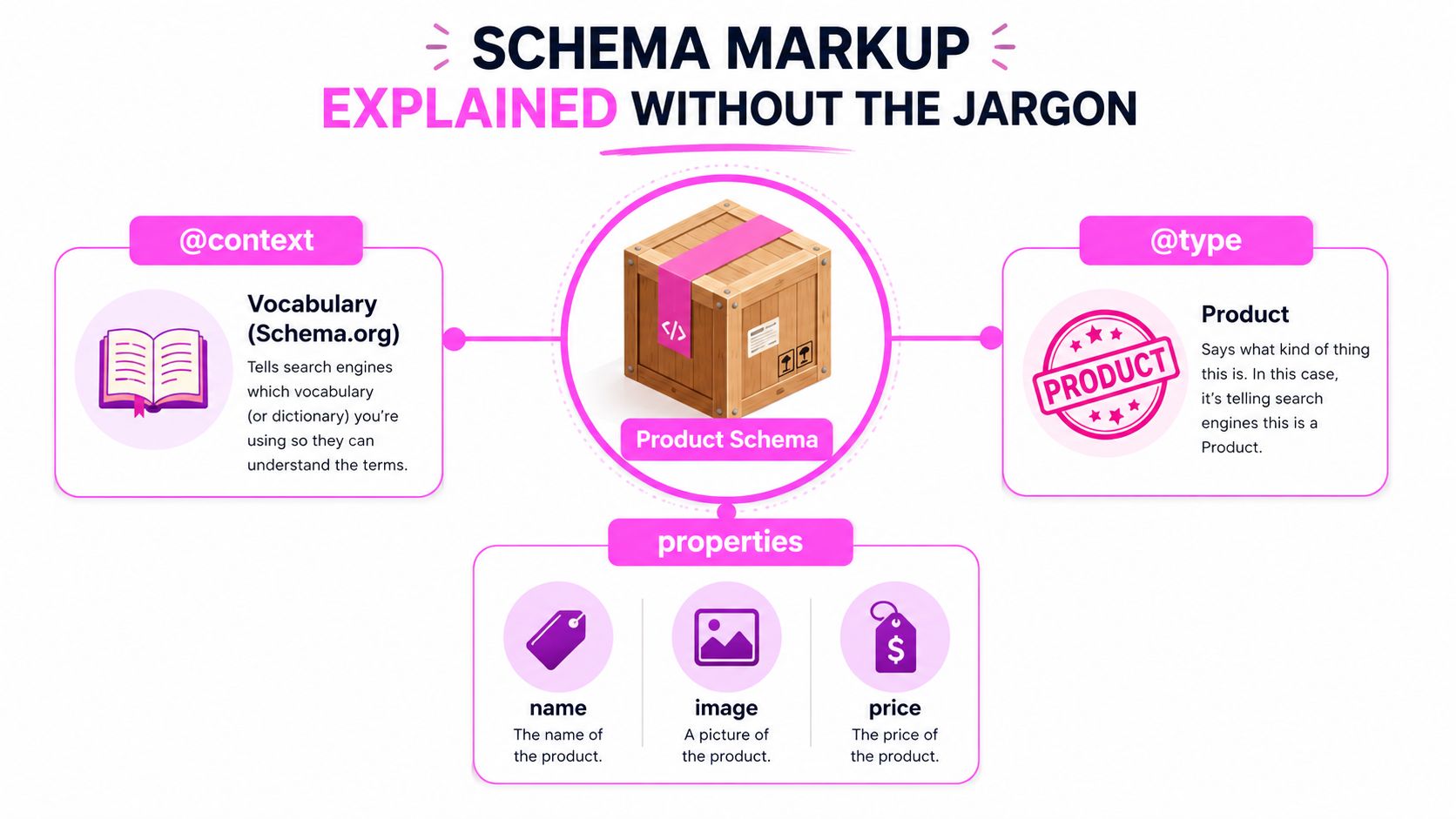
Think of a schema block as a shipping crate with labels. The crate contains information about one thing, or several related things. The outside labels tell a machine which vocabulary you're using and what kind of object it has received.
@contextidentifies the vocabulary, usually Schema.org.@typeidentifies the thing, such asArticle,Product, orOrganization.- Properties identify its parts, such as
name,image,author, orprice.
A minimal article object might look conceptually like this:
<script type="application/ld+json">
{
  "@context": "https://schema.org",
  "@type": "Article",
  "headline": "A Practical Guide to Structured Data"
}
</script>
The type tells the parser that this is an article. The headline gives it a named property. That's enough to understand the basic shape, but production markup normally needs more context:
<script type="application/ld+json">
{
  "@context": "https://schema.org",
  "@type": "Article",
  "headline": "A Practical Guide to Structured Data",
  "author": {
    "@type": "Person",
    "name": "Alex Morgan"
  },
  "datePublished": "2026-08-20",
  "image": "https://example.com/images/structured-data.jpg"
}
</script>
The nested author object matters because the author is a person, not just an unqualified text string. That distinction lets a system understand the relationship between the article and its creator.
Why JSON-LD is usually my default
Google recommends JSON-LD as the preferred structured data format. The format sits in a script element, separate from the visible HTML, so engineers can generate it from CMS fields without weaving attributes through every content element. Google's structured data gallery also describes JSON-LD as a recommended format placed in the head or body.
Microdata and RDFa can work, but they bind metadata more tightly to the page markup. That increases maintenance risk when designers change HTML structure or component names. For teams that template schema across many URLs, separation makes auditing and deployment easier.
Common failures are easy to recognize:
- A required property is missing, so the item may not qualify for a rich result.
- A
Productis declared as anArticle, so the properties describe the wrong entity. - A nested object is reduced to a string, such as an author name without identifying the author as a
Person. - A price, review, or date in JSON-LD disagrees with what users can see.
Schema is metadata, not content. It should clarify visible content and relationships. It shouldn't introduce claims, offers, reviews, or answers that the page doesn't support. If your work involves making entities understandable across complex industries, this practical guide to AI-first SEO for medical practices is a useful companion because entity clarity becomes especially important when services, practitioners, and locations overlap.
Schema Types Worth Your Time in 2026
I rank schema types by the outcome they can support, not by how often a plugin offers them. Google's documentation makes the key distinction clear: structured data can enable rich results, but it isn't itself a direct ranking signal. The type only matters when the page is eligible, the markup is accurate, and the search experience still displays that feature.
| Schema Type | Rich Result in 2026? | Primary SEO Value | Common Pitfall |
|---|---|---|---|
| Product with Offer | Yes, where eligible | Product visibility, price, availability, and commercial context | Emitting stale or blank offer fields |
| Review or AggregateRating | Yes, where eligible | Review presentation and trust context | Marking up reviews that don't meet policy requirements |
| Recipe | Yes, where eligible | Recipe-specific search presentation | Applying recipe fields to generic food articles |
| Event | Yes, where eligible | Dates, locations, and event discovery | Leaving cancelled or expired events active |
| LocalBusiness | Yes, where eligible | Business identity, location, and service context | Using one generic business object for every location |
| JobPosting | Yes, where eligible | Job search visibility | Keeping filled or expired roles live |
| VideoObject | Yes, where eligible | Video discovery and enhanced presentation | Missing the actual video relationship |
| Organization | Usually indirect | Brand and entity disambiguation | Inconsistent names, logos, or sameAs profiles |
| BreadcrumbList | Usually indirect | Site hierarchy and navigational understanding | Generating breadcrumbs that don't match visible navigation |
| WebSite with SearchAction | Usually indirect | Internal search relationship and sitelink context | Pointing to a search URL that doesn't work |
| Article with author | Sometimes eligible | Content type, authorship, and editorial context | Using placeholder authors or inaccurate dates |
| Person | Usually indirect | Author and expert entity clarity | Creating duplicate person entities for one author |
| FAQPage | Visual benefit has narrowed | Machine-readable question and answer relationships | Expecting expandable FAQ blocks automatically |
| HowTo | Visual benefit has narrowed | Instructional structure and machine readability | Adding it to content that isn't a genuine how-to |
High-yield types
For ecommerce, Product paired with accurate Offer data deserves early attention. The implementation must reflect the visible product name, price, availability, and image. Recipes, events, local businesses, jobs, and videos can also justify focused work when the page accurately represents that entity and meets Google's documented requirements.
Google's structured data policies warn that missing required properties can make an item ineligible. That's why I'd rather deploy a smaller set of complete product objects than emit every possible property with empty values.
Indirect types are becoming more valuable
Organization, Person, BreadcrumbList, and connected article entities often won't produce a dramatic visual change. They still help establish who publishes content, how pages fit into the site, and which external profiles represent the same entity.
I'm especially careful with sameAs. It should point to authoritative profiles that represent the organization or person. It isn't a place to add every social URL a marketer can find.
FAQ and HowTo need a different expectation
The FAQ and HowTo types have been overpromoted because older guides focused on expandable search-result blocks. Coverage of Google's changes reports that Google removed FAQ rich results on May 7, 2026, after earlier restrictions, while many sites continue to retain FAQPage markup for machine-readable interpretation. The relevant coverage of Google's structured data changes frames the remaining opportunity around entity clarity, internal search, and AI citation potential rather than a guaranteed SERP feature.
I keep FAQ markup when the questions and answers are visible and useful. I remove it when a plugin creates generic, duplicated questions across unrelated URLs. The decision is editorial and operational, not sentimental.
Choosing a Format and Shipping Markup the Right Way
I use JSON-LD by default because Google recommends it and because it keeps structured data separate from presentation code. Microdata and RDFa remain valid formats, but their coupling to HTML makes large template changes harder to review.
| Criterion | JSON-LD | Microdata | RDFa |
|---|---|---|---|
| Placement | Script in the head or body | Attributes within HTML | Attributes within HTML |
| Maintenance | Centralized and template-friendly | Tied to visible markup | Tied to visible markup |
| Engineering fit | Strong for CMS and component systems | Useful when metadata must follow elements | Useful for systems already built around RDFa |
| Auditability | Easy to extract and diff | Requires parsing page HTML | Requires parsing page HTML |
| Default choice | Usually my recommendation | Situational | Situational |
A deployment flow that survives scale
I start by defining the entity model. For a product page, that might include Product, Offer, Brand, and selected review information. For an article, it may include Article, Person, Organization, ImageObject, and breadcrumbs.
Then I map each property to a trusted source field:
- Choose the source. Pull the title, author, image, price, and dates from CMS fields or a product database.
- Generate conditionally. Don't print blank properties just because a schema library supports them.
- Render centrally. Put JSON-LD in a shared layout or page component, not in hand-written body copy.
- Compare environments. Create a pre-production schema diff that highlights changed types, identifiers, and required properties.
- Release selectively. Start with representative templates, then expand after validation.
I often use a JSON formatter such as this free JSON formatting tool to inspect generated output during development. It's not a substitute for Google's testing tools, but it makes malformed nesting and accidental string values easier to spot.
Policy problems cause more damage than syntax errors
Google says structured-data pages must remain accessible and warns against blocking them with robots.txt, noindex, or other access controls. The page also needs to show the information the markup describes. Review data is particularly sensitive. Don't mark up a review relationship that the visible page doesn't support, and don't place product review markup on a page that only contains general praise about a category.
A valid JSON document can still represent an ineligible or misleading implementation. Syntax is the first gate, not the final approval.
Coverage Is the Real Problem, Not Presence
A homepage with Organization schema doesn't prove that your site has a structured data program. Product pages can emit nothing. Recipe pages can output incomplete objects. FAQ templates can create duplicated markup with empty answers. Yet a CMS report may still say, “Schema enabled.”
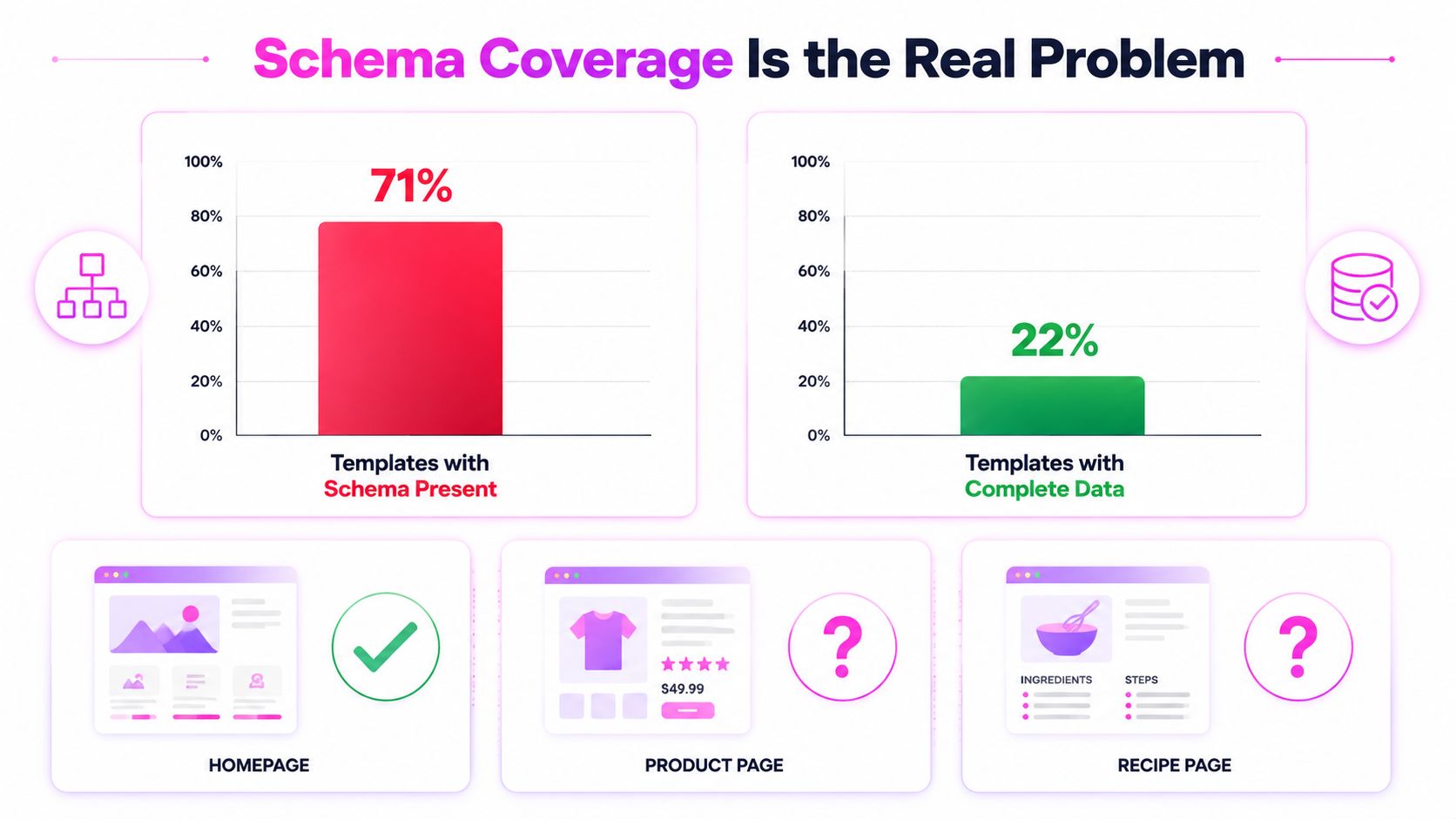
An independent 2026 audit reported that 71% of sites used at least one schema type, while only 22% passed the Rich Results Test cleanly across every @type they emitted. Those figures are documented in the schema adoption and implementation audit. The gap points to a coverage and quality problem, not a lack of schema awareness.
Audit URLs, not templates
A template-level check answers whether code exists. A URL-level check answers whether the code receives the fields it needs.
For each schema type, I build a simple inventory:
- Eligible URLs
- URLs emitting the intended type
- URLs passing validation
- URLs with warnings or missing properties
- URLs blocked, noindexed, or inaccessible
Then I calculate an eligibility-to-deployment ratio for each type. The exact ratio matters less than separating the denominator from the URLs that happen to have markup. A product template can be technically enabled while most products lack images, offers, or reviews.
Fix the largest gaps first
I crawl the site with a schema-aware crawler and group failures by template and error category. A product template with a missing price field deserves more attention than a low-traffic page using an optional type perfectly.
My prioritization is:
- Crawl all eligible URL classes.
- Group URLs by missing field and template branch.
- Prioritize revenue pages and pages tied to high-impression queries.
- Fix data sources before adding new schema types.
- Recheck coverage after deployment.
I stop expanding the schema catalogue until existing coverage is above 80%, using that threshold as an internal operating target rather than a Google requirement. Presence is a checkbox. Coverage tells you whether the system works across the pages that matter.
Testing, Debugging, and Monitoring Structured Data
A Product page once failed the Rich Results Test with a price invalid error. The page looked correct to a visitor because the visible sale-price component handled an empty CMS value gracefully. The JSON-LD branch didn't. It serialized the blank sale field as the offer price.
I reproduced the URL in Google's Rich Results Test documentation and workflow, then inspected the parsed JSON-LD rather than the page source alone. The test supports JSON-LD, RDFa, and Microdata, and it shows which Google result types the page can generate.

The debugging path
The blank value traced back to a conditional template branch that fired only for sale products. The fix was not to remove the price property. We patched the fallback so the structured offer inherited the list price when the sale-price field was empty, while preserving the visible page's own pricing logic.
After redeployment, I verified the parsed object again. I also checked the Schema Markup Validator, because Google eligibility and Schema.org validity answer related but different questions. One confirms what Google can use for supported rich results. The other helps identify vocabulary and structural problems more broadly.
A good debugging sequence is:
- Reproduce the failure. Test the live URL and the staging version.
- Inspect parsed output. Look for blank strings, wrong data types, and unexpected nesting.
- Trace the source field. Follow the value through CMS logic and conditional branches.
- Patch the template. Fix the data path, not only the affected URL.
- Redeploy and retest. Confirm the error disappears in the parsed result.
- Check Search Console. Review enhancement reports for recurring patterns.
The following video is useful when a visual walkthrough helps explain the testing interface.
Monitoring catches silent drift
I use three monitoring layers. Critical commercial templates get near-real-time checks during releases. A weekly batch validates representative URLs and watches for changes in valid and invalid item counts. A monthly crawl measures coverage across the full URL inventory.
Search Console's reporting workflow lets site owners track how valid and invalid structured data items change over time. I don't interpret every warning as an emergency, but I do investigate sudden changes, especially after CMS, pricing, navigation, or author-profile releases.
Using SEO Research Tools to Prioritize Schema Work
Schema shouldn't sit in a separate technical backlog. I prioritize it alongside keyword, SERP, internal-link, and backlink research because those datasets identify where structured data has a realistic chance to improve the search experience.
I begin with pages ranking in the middle of the first page and the top of the second page for commercial or transactional queries. Then I compare their impressions and click-through behavior in Search Console. A page that already earns impressions but lacks an eligible product, breadcrumb, video, or local enhancement is a stronger candidate than a page with no meaningful query demand.
Let SERP evidence choose the schema type
SERP feature tracking shows whether the target query family displays product results, sitelinks, event information, video results, or other enhancements. That observation determines the markup to test. I don't add FAQPage because a plugin makes it easy. I add it only when the page contains a useful, visible question-and-answer resource and the markup serves machine readability.
Backlink and internal-link reports add another filter. A recipe or product URL buried beyond the site's useful navigation structure may remain difficult to discover even when its schema is perfect. Fixing orphaned pages and weak internal paths can be a prerequisite for schema work.
The workflow is straightforward:
- Find queries with a relevant rich-result opportunity.
- Map each query to the ranking URL.
- Confirm the URL's eligibility and schema gap.
- Validate the page's visible content and data fields.
- Queue the implementation by expected business value.
For a broader process covering keyword gaps, SERP analysis, and backlink discovery, I'd use this guide to SEO research tools. The key is to make schema an output of research. That prevents teams from spending weeks polishing markup on URLs that have no search opportunity or unresolved technical barriers.
Your Structured Data Checklist and What to Watch Next
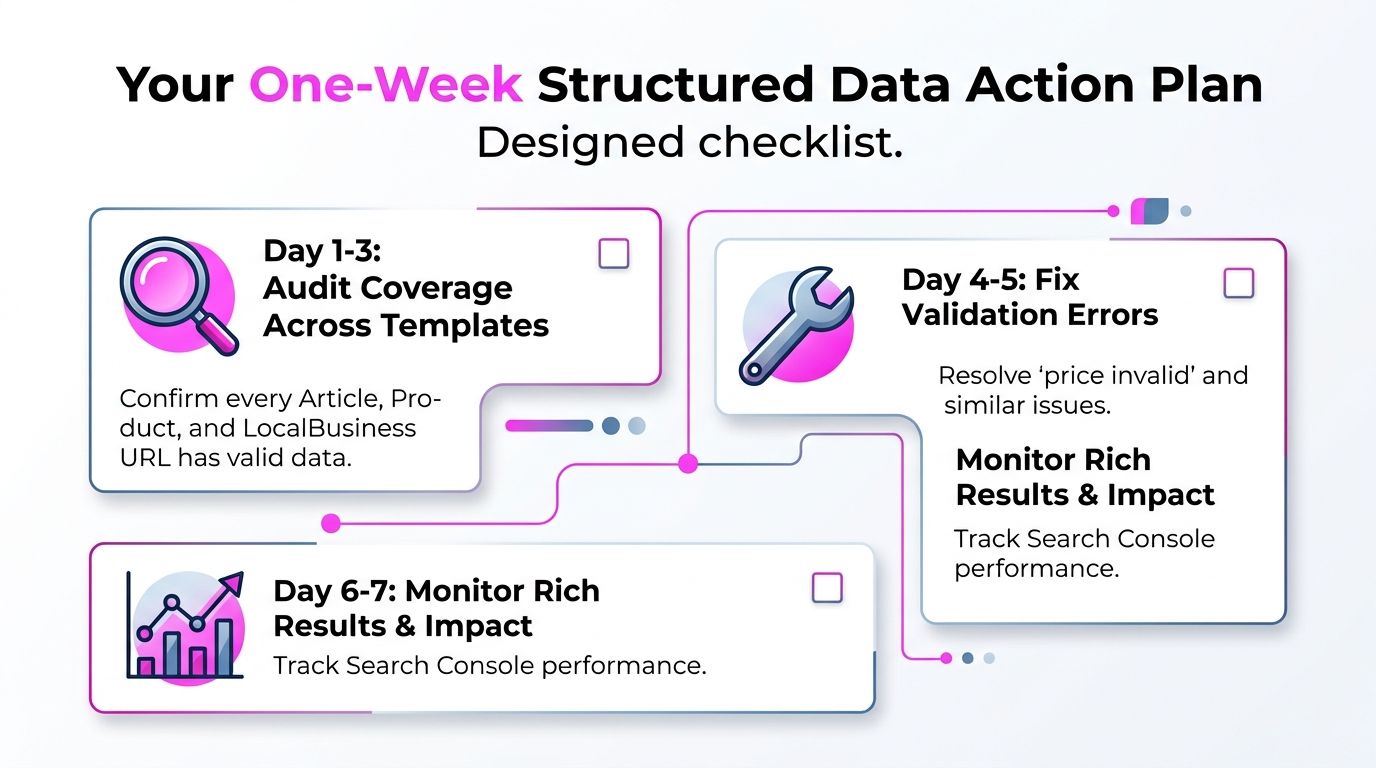
If I had one week to make a schema program useful, I wouldn't begin by adding new types. I'd spend the first three days auditing coverage across Article, Product, and LocalBusiness URLs, then sample 10% of those URLs with the Rich Results Test. That sampling figure is an internal operating choice for a practical audit, not a Google requirement.
My first week
Days 1 to 3 go to URL inventory, template classification, and validation. I confirm that each priority URL emits the intended JSON-LD and that its properties match visible content. I also record blocked, noindexed, inaccessible, and incomplete pages separately, because each needs a different fix.
Days 4 and 5 go to the most common error categories. Missing images, authors, and prices usually point to source-field or conditional-template problems. I fix those at the data layer, then rerun validation against pages from every affected template.
Days 6 and 7 go to measurement. I submit the sitemap, inspect priority URLs as Google sees them, and tag query groups where a rich result could plausibly affect the listing. Google's Dataset implementation workflow recommends adding required properties, validating with the Rich Results Test, fixing critical errors, deploying a few pages, inspecting them, and keeping Google updated through a sitemap.
What I'd defer
I'd postpone long-tail types such as Course or JobPosting when the relevant pages have little search demand or incomplete source data. I'd also defer markup that needs policy review for paywalled, login-restricted, or government content until access and eligibility are clear.
Monthly, I'd review Search Console enhancement reports, compare click-through changes for tagged query groups, and re-audit after Google retires or restricts a rich-result type. FAQPage is a good example of why this matters. Markup that once had a visible search benefit may later serve mainly as a machine-readable relationship layer.
The durable asset is a living schema inventory. Templates change, CMS fields are renamed, prices expire, authors move, and search features disappear. Treat structured data like analytics. Configure it carefully, validate it continuously, and assign someone ownership of the checks.
Use SemDash to connect keyword, SERP, competitor, and backlink research with the URL-level schema gaps that deserve attention first. Start by identifying pages with real search opportunity, then use the platform's research and tracking workflows to prioritize implementation you can validate and measure.