


Copying your top competitor is the most popular advice in SEO, and I think it's the fastest way to waste a quarter. I've watched teams replicate a rival's headings, word count, and link targets, then wonder why nothing moved. A ranking doesn't tell you which tactic caused it, whether that page earns clicks, or whether the same page would work for your intent, authority, and device mix.
I run website competitive analysis differently. I treat every competitor metric as a testable hypothesis, then I check it against traffic direction, the exact ranking URL, search features, AI citations, and my own Search Console data. That discipline turns a bloated report into a short list of pages worth building, fixing, or leaving alone.
Table of Contents
- The Website Competitive Analysis KPIs That Matter
- Setting Goals and Choosing Who to Compare Against
- How to Run a Traffic Share and Top Pages Comparison
- Reading Backlink Profiles Beyond Referring Domain Counts
- Core Web Vitals Benchmarks Worth Measuring
- Separating Real Visibility From Clicks and AI Citations
- Turn the Findings Into a Prioritized Action Plan
The Website Competitive Analysis KPIs That Matter
I keep this table open during the first pass because it stops me collecting metrics that won't change a decision.
Core KPIs for website competitive analysis
| KPI | What it tells you | How to measure it | Common pitfall |
|---|---|---|---|
| Traffic share | Your slice of organic traffic within a competitor set | Estimated organic traffic per domain across seed keywords, tracked over 6 to 12 months | Estimates, not analytics; read the trend, not the exact number |
| Top pages | Which URLs earn a competitor's organic traffic | Ranked list of pages by estimated traffic, reviewing the top 20 | Homepage often ranks first for brand terms; read past it |
| Keyword overlap and gaps | Terms competitors rank for that you do not | Keyword gap report by domain, filtered by intent | Search volume alone misleads; check intent and difficulty |
| Referring domains | Breadth of sites linking to a competitor | Count of unique linking domains | Sitewide footer links inflate the count |
| Anchor and link context | Why others link and to which page | Anchor text and linking page review for ranking URLs | Brand anchors reveal little about topical authority |
| Core Web Vitals pass rate | Page experience on ranking URLs | 75th-percentile field data per URL, split mobile and desktop | Lab scores alone mislead |
| SERP feature and AI citation presence | Visibility beyond the blue link | Feature tracking and AI Overview citations by keyword | A mention does not mean a click |
How I Read These Seven Numbers
Traffic share tells me who's gaining or losing ground in a defined set, but I never present the estimate as actual visits. Direction over time is useful, false precision isn't.
Top pages show me where a competitor's model works. I skip past the homepage because brand demand often puts it first, then I look for the guides, tools, product pages, and comparisons carrying nonbrand traffic.
Keyword gaps give me candidate topics, not a publishing plan. I filter by intent first because a high-volume informational term won't help you if you need buyers comparing pricing.
Referring domains are only a breadth check. I don't reward a competitor for hundreds of footer links, and I don't panic until I see which pages earned editorial links.
Anchor and link context explain why someone linked. That reason becomes your outreach angle, and it's far more useful than a domain count.
Core Web Vitals belong at URL level. A sitewide average can hide the one slow template competing for your most valuable cluster.
SERP features and AI citations capture exposure that a position report misses. I record them separately because visibility, clicks, and revenue don't always move together.
Pick three KPIs for your first pass. A 30-metric report usually hides the one decision you need to make.
Setting Goals and Choosing Who to Compare Against
I won't start until I can write one sentence naming the page or cluster this work should move. Something like this works: move our invoicing software cluster from position 6 into the top three within two quarters. If I can't name the target, I'll collect interesting data and make no decision.
One more thing belongs in that sentence: what counts as a win. A position gain is a hypothesis, not a result. If your money term sits inside an AI Overview or a featured snippet that answers the question without a click, moving from 6 to 3 can change your visibility while doing nothing for sessions. I write the goal as a ranking target plus a visibility check, so I can tell later whether the hypothesis paid off or the SERP itself swallowed the click.
Your goal determines your competitor set. I use four types because the company your sales team fears isn't always the domain Google rewards.
Competitor types and why each one matters
| Competitor type | Who it is | What it reveals | Where to find it |
|---|---|---|---|
| Direct rival | Same product and same buyer | Which commercial queries you share | Brand searches, sales calls, customer comparisons |
| SERP rival | Wins your target queries, may sell something different | Who owns the results page for your money terms | Keyword research on your target terms |
| Content rival | Publishes on your topics at volume | Content gaps, formats and topic clusters | Top pages and topic clustering reports |
| Emerging entrant | New or fast-growing site | Early signs of a shift in the market | 12-month SERP history for your core keywords |
Keep the Set Small and Split It by Device
I cap the working set at 5 to 8 domains. With 30 domains, every metric becomes noisy and the three rivals who can take your clicks disappear into averages. I note each domain's target country, audience, and main offer before I compare a single number.
Device changes the answer more than most reports admit. The U.S. Department of Justice description of search engine market share records Google at 78.96% in the United States in 2009 and 86.88% in 2018, and Google's share runs higher on mobile than on desktop. I read that as a measurement rule, not trivia. Compare mobile and desktop separately, prioritize Google, and keep Bing as a secondary check instead of blending everything into one score.
Say a rival sits at position 9 on desktop for a pricing term but position 3 on mobile in your market. I watch that rival first. The aggregate view calls them weak, the device view shows they're taking the searches most likely to convert on a phone.
For each domain in the final set, I also note whether its target keywords trigger AI-generated answers and whose URLs Google cites in them. A tool like SemDash shows which keywords trigger Google's AI to mention a site and the precise URLs cited, so a rival who never outranks you can still absorb the attention your position report credits to you. That citation check is what turns rank tracking from the whole story into one chapter of it.
How to Run a Traffic Share and Top Pages Comparison
I timebox this routine to half a day for five competitors. Longer than that, I'm usually polishing exports instead of finding the pages that matter.
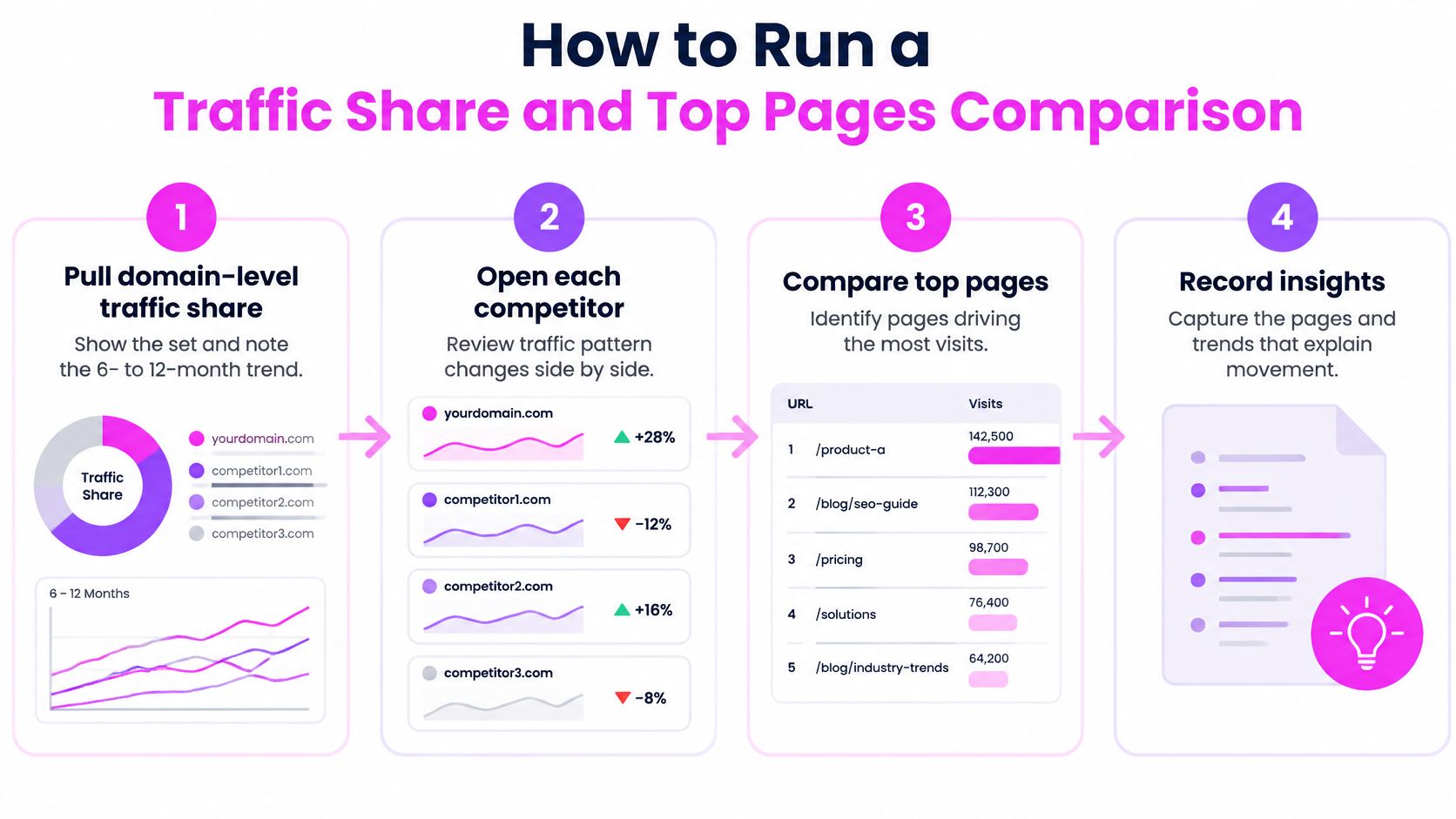
My Seven Step Routine
Pull traffic share for the full set. I record each domain's estimated share from the same seed keywords and check the 6 to 12 month trend. A rival losing share for three straight quarters is a different problem from a rival who had one strong month.
Open each competitor's top 20 pages. I tag every URL as a guide, product page, comparison, tool, category, or homepage. Page type matters because comparing your blog post with their interactive tool produces the wrong fix.
Map URLs to query clusters. I group terms only when they return substantially overlapping results and the same page types. If two similar phrases produce different competitors, I keep them separate so I don't build one unfocused page for two jobs.
Run the keyword gap report. I delete queries where the intent doesn't match what you sell, even when volume looks tempting. I've made this mistake myself, chasing a large informational gap that produced traffic our sales team couldn't use.
Check the exact page receiving traffic. Domain level rankings hide cannibalization and weak internal linking. I want the precise URL Google sends people to, plus its position, device, and location on the day I checked.
Score every cluster. I use three plain factors, traffic opportunity, your current position, and effort to close the gap. A cluster where you're already seventh with the wrong page type often beats a brand new topic where every competitor has stronger evidence.
Record everything in one sheet. I include date, device, market, cluster, competitor URL, your URL, and the hypothesis. Without that context, next month's movement is impossible to interpret.
What a Usable Output Looks Like
I don't finish with 400 keywords. I finish with five to ten clusters, each assigned to one owner page to build, merge, rewrite, or leave alone.
My rule: If a finding doesn't name the URL you'll change, it isn't a finding yet. It's trivia.
Estimated traffic carries error, so I validate the shortlist against Search Console impressions and queries for my own site. The competitor data tells me where to look. My data tells me whether Google already considers one of my pages relevant enough to improve.
Reading Backlink Profiles Beyond Referring Domain Counts
I found after years of leading with the wrong number: referring domains is the metric clients ask for first, and it's the one I trust least on its own.
The image below captures the working setup I use when I move from domain totals to individual linking pages.

Links matter for two reasons. Google's SEO Starter Guide says Google primarily discovers new pages through links from pages it has already crawled, and it identifies PageRank, which evaluates links between pages, as one of its core ranking systems. That doesn't make every link equal, and it doesn't make a raw count a strategy.
Separate Homepage Links From Ranking Page Links
I split a competitor's profile into links to the homepage and links directly to pages ranking for valuable queries. Then I open the linking page and check the anchor, surrounding paragraph, placement, and whether an editor had a clear reason to cite that URL.
Say one competitor has 400 referring domains, mostly sitewide footers and directory listings. Another has 60 domains linking to a research guide, a calculator, and two product comparisons. I'd study the second competitor first. Their links point at assets with a repeatable reason to earn coverage.
I use the workflow in our competitor backlink analysis guide to turn that inspection into a prospect list instead of a vanity comparison. The anchors report helps me see whether people cite the page for data, a definition, a tool, or a product claim, so my pitch matches the original reason.
This short walkthrough shows why I inspect linking pages rather than exporting every domain and sending the same outreach email.
My output is specific: domain, linking page, competitor URL, my equivalent URL, anchor context, and outreach reason. I don't copy a whole profile because half of it usually has no relevance to the page I'm trying to move. I pick the few prospects where my page gives the editor a better, newer, or more complete resource.
Core Web Vitals Benchmarks Worth Measuring
Page experience is the benchmark competitor reports skip because keyword exports are easier. I measure it at page level, for the exact URLs competing in the same cluster, and I treat a weak score as a hypothesis to test: does experience help explain the gap, or is the competitor winning on intent and links anyway?
Core Web Vitals thresholds for competitor pages
| Metric | Good threshold | What it measures |
|---|---|---|
| Largest Contentful Paint (LCP) | 2.5 seconds or less | How quickly the main content loads |
| Interaction to Next Paint (INP) | 200 milliseconds or less | How quickly the page responds to clicks and taps |
| Cumulative Layout Shift (CLS) | 0.1 or less | How much the layout moves while loading |
Google's page experience documentation gives those thresholds as LCP of 2.5 seconds or less, INP of 200 milliseconds or less, and CLS of 0.1 or less. Many sites still miss at least one of them, so a page that passes all three can hold an experience advantage when relevance is comparable.
Field Data Beats One Lab Test
I use 75th percentile field data, split by mobile and desktop, and I record the template type beside each URL. A lab test on an office connection shows what might happen under controlled conditions. Field data shows what visitors experienced on slower phones and networks.
Page weight points me toward the fix. I compare transferred bytes, image payload, JavaScript execution, and third party requests across competing URLs under the same device conditions. Then I ask which payload helps the reader complete the task and which payload only decorates the page. I compress above the fold images first, defer noncritical scripts, and remove redundant tags, then I wait for field LCP and INP to confirm the change.
Speed does not replace relevance. A fast page with thin evidence still deserves to lose. My best opportunity is a commercially valuable cluster where a competitor ranks with a slow, unstable page and I can match the intent with stronger content that renders cleanly.
Separating Real Visibility From Clicks and AI Citations
A rank only report is where I stop trusting the analysis. Position tells me a URL appeared somewhere in a result set. It doesn't tell me whether anyone clicked, whether an AI answer satisfied the search, or whether my competitor was cited as the source.
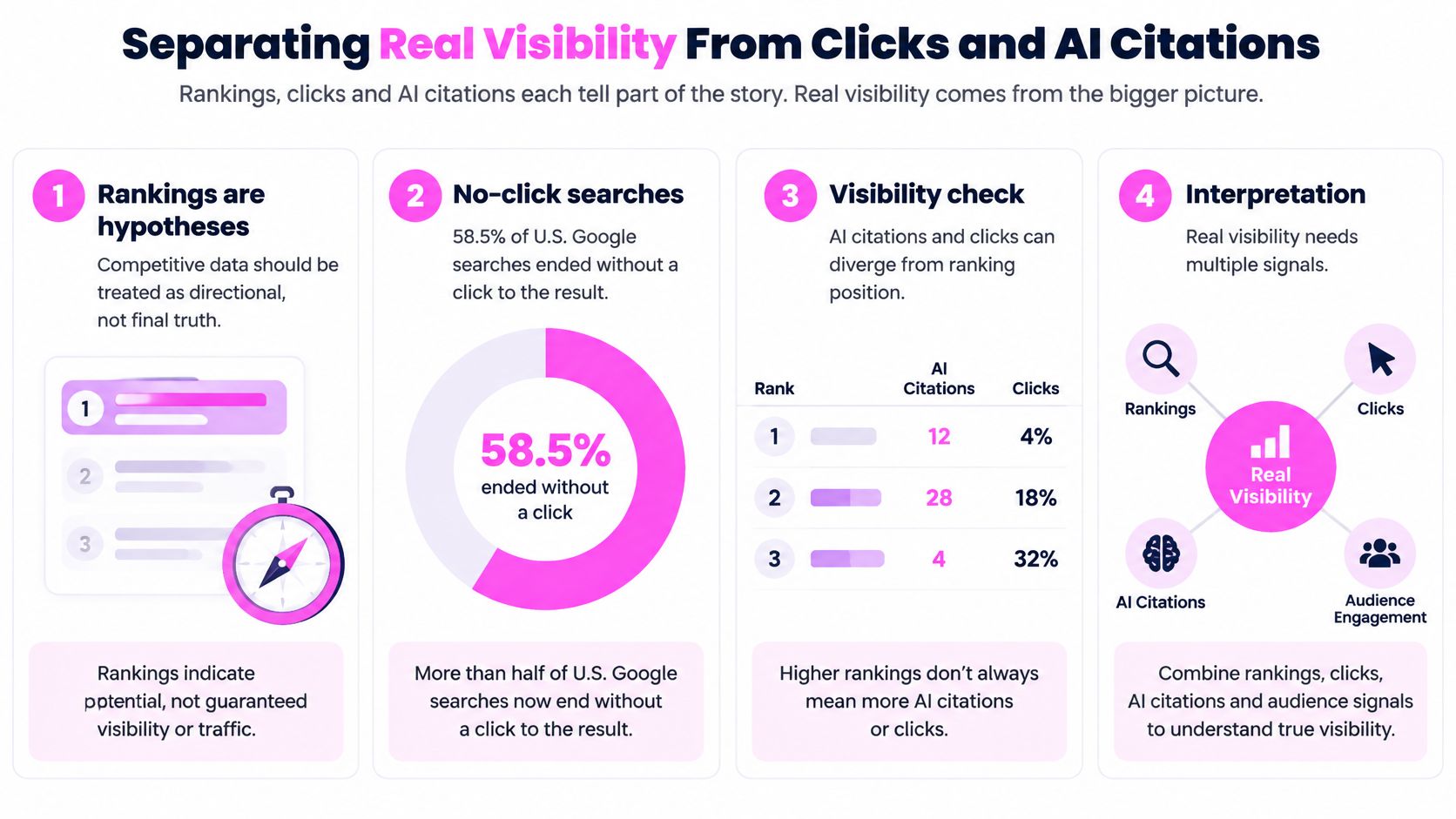
The click problem is large enough to change your priorities. A 2024 study summarized by PPC Land, using Datos data, found that 58.5% of U.S. Google searches and 59.7% of European Union Google searches ended without a click to the open web. The same summary reports Seer Interactive's analysis of 3,119 informational queries across 42 organizations, where organic click through fell from 1.76% to 0.61% when an AI Overview appeared.
Track Four Surfaces Separately
- Traditional rankings: I record query, URL, device, location, date, and position.
- Impressions and clicks: I compare Search Console data for my pages so I can see where visibility exists without visits.
- SERP features: I note featured snippets, People Also Ask, local results, video, shopping, and maps, plus which competitor occupies each one.
- AI citations: I record the exact cited URL and the claim it supports, following the process in our guide on tracking AI Overviews.
That last detail changes the content decision. One question may cite a competitor's pricing page for a cost claim, while a related question cites their methodology article for a definition. If I merge both topics into one broad page, I can weaken the clear scope that made each URL citeable.
I also track changes over time instead of treating one snapshot as market truth. AI answers and features can shift by wording, subtopic, and date, so a competitor who owns fewer keywords may still control the cited source for the questions buyers ask before purchase.
Turn Visibility Into Three Decisions
For each cluster, I choose one primary outcome: pursue rankings, earn citations, or improve source credibility. Pursuing rankings fits transactional pages where clicks still carry commercial value. Earning citations fits definitions, comparisons, original data, and narrowly scoped evidence pages. Improving credibility comes first when competitors get cited because their claims are clearer, better sourced, or easier to verify.
A competitor's rank is a hypothesis about what Google rewarded. Your test, measured in Search Console and ranking history, is what proves or kills it.
Turn the Findings Into a Prioritized Action Plan
I end with one decision, not a backlog of 80 tasks. I choose the cluster with the highest traffic opportunity and the lowest credible effort, assign one owner page, and define the change I'm testing.
Say your comparison page sits on page two, the leading competitor uses a short commercial format, and your page is a long informational article. My first hypothesis is intent mismatch, not insufficient length. I'd rebuild the page around comparison criteria, pricing evidence, and task completion, then judge impressions, clicks, query mix, and position after a 90 day check.
Put Every Task on the Same Sheet
- Content tasks: Cluster, owner URL, page type change, missing evidence, and the ranking or citation target.
- Link tasks: Prospect domain, competitor URL they cite, your replacement asset, and the reason an editor should switch.
- Technical tasks: Ranking URL, device, failing metric, template owner, and the field result that will confirm the fix.
When signals disagree, I slow down. If a competitor gains AI citations while losing conventional clicks, I rank that cluster lower until my own Search Console data confirms there's still a traffic or revenue case. Exposure has value, but I won't spend a quarter chasing mentions for a query that no longer sends buyers anywhere.
I keep the workflow in one workspace because switching between five exports is where analysis dies. We built SemDash to hold Traffic Share, Keyword Gap, Top Pages, Backlink Gap, and related competitor views together, and Traffic Share shows the top 100 websites with the most organic traffic based on seed keywords. That consolidation helps me keep the sheet current without rebuilding the same comparison every month.
Run the KPI table against your own five competitors, pick one cluster, and write the hypothesis before you edit a page. That single discipline will do more for your results than another exhaustive report.
Start your next website competitive analysis with one cluster, five rivals, and a clear hypothesis, then use SemDash to compare traffic share, top pages, keyword gaps, backlink gaps, and AI visibility in one place. You'll spend less time stitching exports together and more time testing the page changes that can win clicks.