


The top three organic results received 54.4% of all clicks in a 2025 study attributed to Backlinko, covering 1,312,881 pages and 12,166,560 search queries, according to GrowthVector's SEO statistics summary. If you want to get competitor keywords that deserve investment, start with the queries and pages already earning that visibility, not a brainstorming session sorted by search volume.
Table of Contents
- Why Competitor Rankings Are Worth Reverse-Engineering
- How to Build a Real Competitor List From the SERP
- How to Export Domain and Keyword Gap Data
- How to Map Each Keyword to the Ranking URL
- How to Prioritize Gaps by Expected Clicks
- Confirm Each Gap Before You Commit
- How to Turn the Lists Into Content and Outreach Work
Why Competitor Rankings Are Worth Reverse-Engineering
A competitor's ranking gives you something a topic brainstorm can't: evidence that Google considers a particular page relevant to a particular search. That doesn't prove the traffic converts, or that you can take the position. It gives you a concrete page to evaluate instead of an abstract topic to debate.
I would start with that distinction. Competitive visibility is evidence of an opportunity, not proof of profitability. You still need to establish whether the searcher fits your offer, whether the results leave room for organic clicks, and whether you can produce the right page.
Keep the search results and the keyword export visible together while you work.
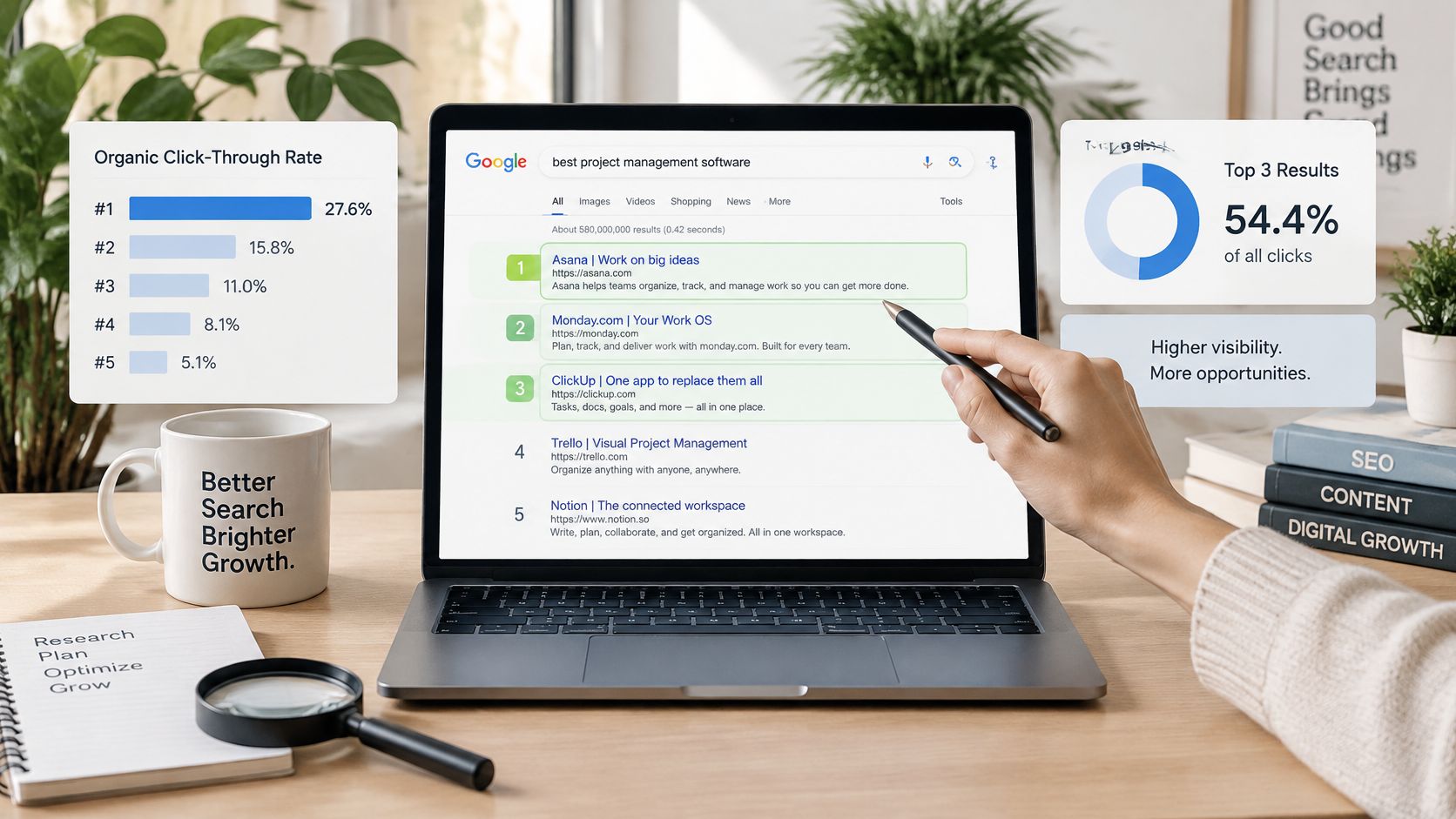
Turn competitive visibility into decisions
Build your competitor list from live search results, export the ranking keywords and gaps, and attach every candidate to its exact ranking URL. Then score realistic clicks and separate the output into content work and link research.
That order matters. If you brief content before checking the ranking page, you can commission an article for a query that needs a product category, comparison tool, or local service page. If you prioritize before checking click exposure, you can spend your budget chasing visibility without visits.
Practical rule: Use competitor rankings to decide what to investigate, not what to publish automatically.
Treat published click-through benchmarks as directional. Device, intent, advertising, and search-result features can change the clicks available at a given position. Your useful output is a working gap list, a defensible scoring rule, and an explicit reason to reject attractive-looking terms.
How to Build a Real Competitor List From the SERP
Start with the sites you meet in search, not the companies you discuss in sales meetings. Use Google's SEO Starter Guide as the foundation: help people find useful content, then compare the pages already serving those needs.
Use this sequence to keep business competitors separate from search competitors.
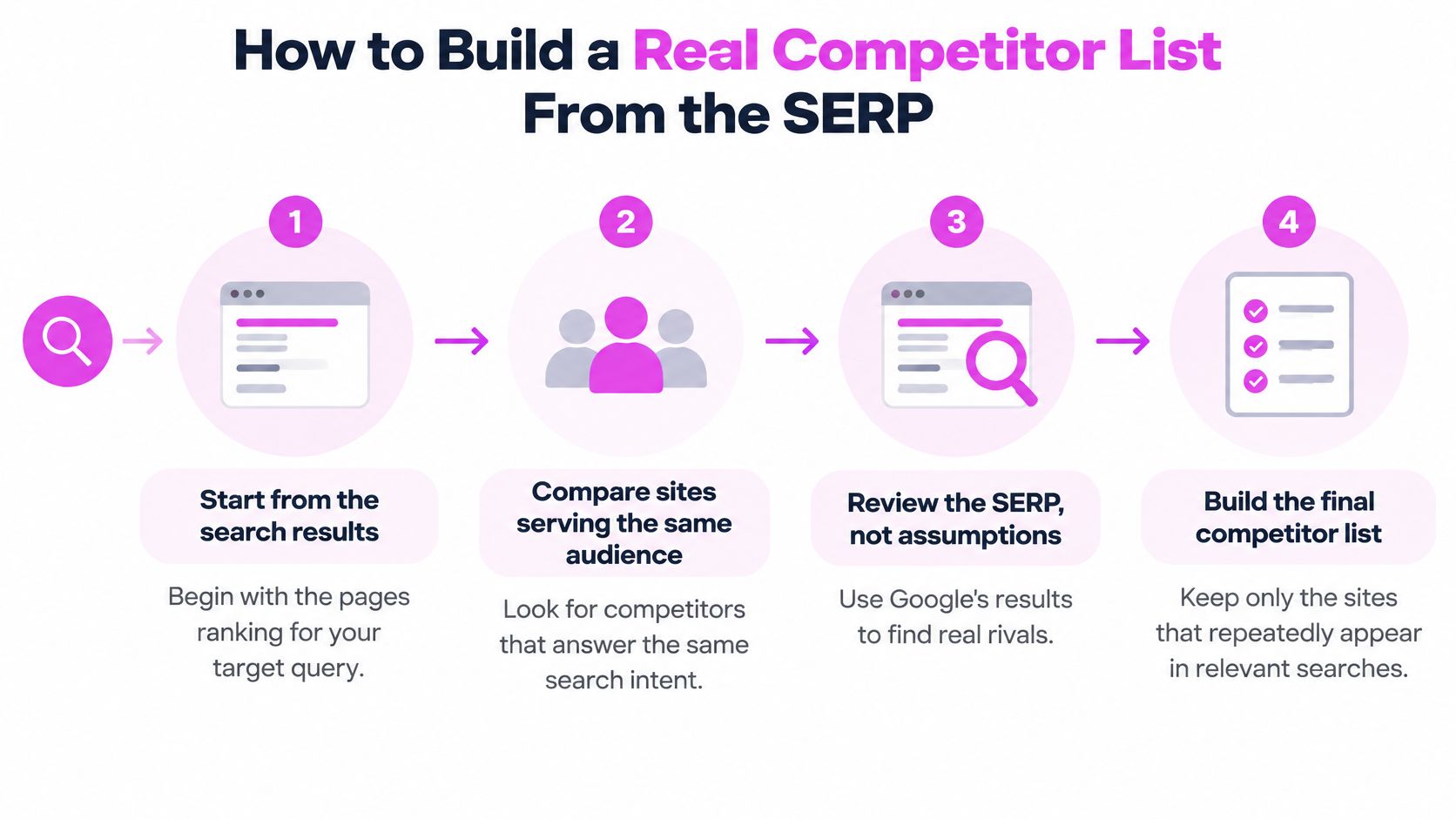
- Collect buyer-language seeds. I'd start with 10 to 20 queries covering the core offer and two or three problems you solve. For project management software, include searches about client approvals, task dependencies, and agency workflows, not just the product category.
- Record repeated domains. Run the seeds in your target country and note which organic domains appear repeatedly. Keep the ranking URLs too, so you can distinguish a dedicated topic section from an isolated article.
- Filter for commercial relevance. Keep sites serving a comparable audience, offer, and search intent. Exclude marketplaces, directories, and unrelated brands from your primary domain comparison, while retaining their pages as SERP-format references when useful.
- Choose a manageable comparison set. I'd use three to five comparable domains plus one larger leader. Treat those counts as a working setup, not a requirement.
Choose overlap over fame
A large publisher can expose formats and topics worth studying, but its full-domain export can bury your actual opportunity under unrelated queries. A comparable specialist gives you a cleaner basis for evaluating what you can realistically build and promote.
Don't assume similar company size means similar ranking difficulty, either. Inspect the relevant topic section and pages, not the logo or employee count.
Use the walkthrough alongside your own seed-query sheet.
Before retaining a domain, check that it appears for a handful of your seeds. If you only encounter it on an isolated query, keep that page for reference rather than treating the entire domain as a primary competitor.
How to Export Domain and Keyword Gap Data
Pull exports in a fixed order so you can refresh the comparison without rebuilding your spreadsheet. Set the same country, search engine, and reporting scope before you start. Otherwise, you'll compare different markets and mistake a settings mismatch for a keyword gap.
Export first, filter second
- Open Domain Keywords. Enter each retained domain and collect its ranking queries with search volume, estimated traffic, Keyword Difficulty, intent, ranking URL, and position.
- Run Keyword Gap. Compare those domains against yours. Separate missing queries from queries where you already rank below your chosen threshold, such as position 10 or 20.
- Preserve the page evidence. Keep ranking URL and position columns even if you hide them temporarily. Without them, you can't distinguish page-level opportunities.
- Save each competitor's export. Use consistent filenames with the domain, market, and export date. Keep an untouched copy before editing.
- Normalize and deduplicate. Lowercase queries, trim whitespace, and standardize incidental punctuation. Preserve meaningful differences, such as product model names, and retain a record of every competing domain and URL.
- Assign a gap bucket. Mark each query as shared, competitor-only, or below-threshold on your site. These categories need different actions, so don't leave them mixed together.
Avoid exporting only the top 100 terms by volume. That shortcut removes specific queries before you've assessed their intent or realistic ranking opportunity.
Export fields and the decision each one drives
| Field | What it tells you | Decision it drives |
|---|---|---|
| Keyword | Normalized query the competitor ranks for | Deduplication key across competitors |
| Ranking URL | Exact page Google sends traffic to | Page-level mapping and cluster grouping |
| Position | Competitor's current reported rank for the query | Gap threshold and quick-win selection |
| Search volume | Average monthly searches | Demand check only, never the sole ranking signal |
| Estimated traffic | Modeled monthly visits attributed to the competitor page or keyword | Expected-click calculation cross-check |
| Keyword Difficulty | Estimated competition for the query | Ranking-probability input |
| Intent | Likely purpose of the query | Page-type match against the live SERP |
| SERP features | Snippets, People Also Ask, AI Overviews, packs | Click-loss adjustment in scoring |
Keep estimates separate from measurements
Estimated traffic isn't access to a competitor's analytics. Use it to compare opportunities within a consistent dataset, not to claim that a page receives a verified number of visits.
Likewise, Keyword Difficulty is an input, not a production decision. A low score won't rescue an irrelevant query, and a difficult query may still belong in your plan when you already have a strong matching page.
Add separate columns for your proposed destination URL, market, validation status, and exclusion reason. That makes the export usable as a decision log rather than another spreadsheet nobody trusts.
How to Map Each Keyword to the Ranking URL
Don't read average position as a fixed location. In Google's Search Console documentation, position uses the topmost result from your property for each impression: if your results occupy positions 2, 4, and 6, the position recorded for that impression is 2.
That definition applies to Search Console, not automatically to every competitor platform. Check your tool's methodology, then use reported positions to prioritize verification rather than assuming they describe the entire live layout.
Build a page-level cluster
- Capture the exact URL. Save the ranking page, not merely the domain or homepage.
- Inspect the live results. Check what you'd need to deliver: a tutorial, product page, comparison, calculator, or another format. Don't force a buying query into an educational article because that's easier to commission.
- Group by ranking page and intent. When related queries consistently lead to the same competitor URL, evaluate them as a potential page-level cluster.
- Investigate competing URLs. If several pages alternate for the same query, check whether they address distinct needs or overlap. Multiple results alone don't prove cannibalization.
- Inspect the page's advantages. Review format, freshness, internal links, structured data, and relevant backlinks. Look for the work required to compete, not just missing keywords.
Map the page you need to build before you write the brief.
Say you're evaluating agency project management queries. If the winning page includes workflow screenshots, client-permission details, and a product comparison, a general productivity article won't offer an equivalent answer.
Your final mapping decision should be explicit: improve an existing page, create a new page, merge overlapping pages, or drop the term. The domain tells you who competes. The URL lets you examine what you're competing against.
How to Prioritize Gaps by Expected Clicks
Say you're comparing a hypothetical 2,000-search query where a competitor ranks at position 2 with a 20,000-search query where it ranks at position 40. I wouldn't automatically choose the larger term. The smaller query can be more valuable if you can reach a prominent position and attract qualified visitors.
Don't copy the competitor's position into your own forecast. Estimate where your page could realistically rank, considering format, topic coverage, links, and your existing visibility.
Model attainable traffic
Use this scoring formula, with each adjustment recorded rather than hidden inside a subjective priority label.
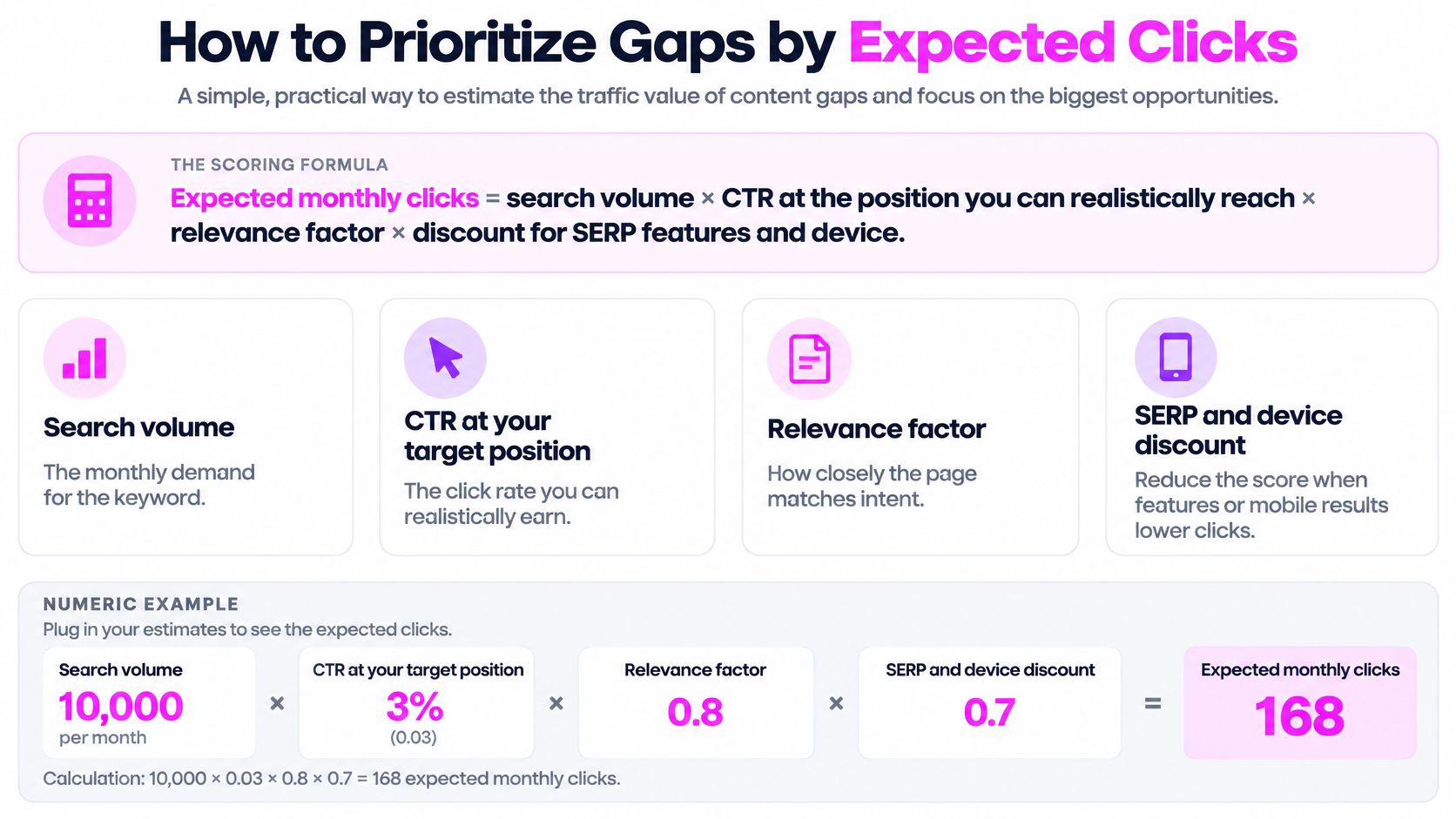
Expected monthly clicks = search volume × CTR at an attainable position × relevance factor × SERP and device adjustment.
Then calculate expected conversion value = expected clicks × conversion rate × customer value. Use your own conversion evidence where available, and label assumptions when you don't have it.
For a directional position benchmark, Backlinko's CTR analysis reported a 27.6% average CTR for the first organic result, about 10 times the click likelihood of the tenth result, and 1.76 times as many clicks for queries of 10 to 15 words compared with single-word terms.
Those findings support testing specific long-tail clusters rather than dismissing them for low individual volume. They don't mean adding words to a target query creates more traffic, or that a benchmark CTR applies unchanged to your market.
Separate quick wins from new production
- Existing-page opportunities: Keep pages ranking in positions 4 to 20 in a dedicated quick-win queue. Check whether a focused improvement can resolve the gap before commissioning another URL.
- Net-new topics: Estimate content, design, evidence, and promotion requirements separately. A relevant missing page can still demand more work than an existing-page update.
- Uncertain opportunities: Reduce priority when you lack a credible target position or evidence that searchers will click.
Use the keyword research metrics guide to keep demand, difficulty, and traffic potential distinct in your scoring sheet.
Avoid double-discounting: if your CTR estimate already reflects a feature-heavy mobile SERP, don't apply the same reduction again. Recheck AI answers, local packs, shopping results, ads, and device layout before approving production. An aggregate CTR curve is a starting assumption, not a traffic commitment.
Confirm Each Gap Before You Commit
High volume doesn't guarantee available clicks. A Pew-based analysis of 900 U.S. adults found external-result clicks on 8% of pages showing an AI Overview, compared with 15% without one. A 2024 Botify and DemandSphere study covered by Search Engine Journal found overviews for 47% of searches in its sample of more than 120,000 keywords across 22 websites.
Validate click exposure and market fit
- AI exposure: Record overview presence and the cited URLs. I'd downgrade an uncited, fully answered informational query before a query requiring a product evaluation or action, but I wouldn't reject either without checking business value.
- Transferability: Validate country, language, device, and SERP history. Locally phrased demand can require a different page from a direct translation.
- Format: Check whether local packs, shopping, or video make your proposed page unsuitable. Use search intent classification to organize the review, then inspect the results yourself.
In SemDash, use Domain Keywords and Keyword Gap for the exports and AI visibility to inspect cited competitor URLs. We also find low-competition, high-volume keywords competitors missed, offer more than 20 SEO research tools, and let you get started for free.
Select five clusters with the strongest expected clicks that pass both the AI and market checks. Treat that as a manageable first production batch, not a universal quota.
How to Turn the Lists Into Content and Outreach Work
Don't send the same file to writers and outreach specialists. A writer needs a page objective and evidence requirements. An outreach specialist needs a relevant referring page, link context, and a credible reason to contact its owner.
Keep the handoff tied to a specific page and action.
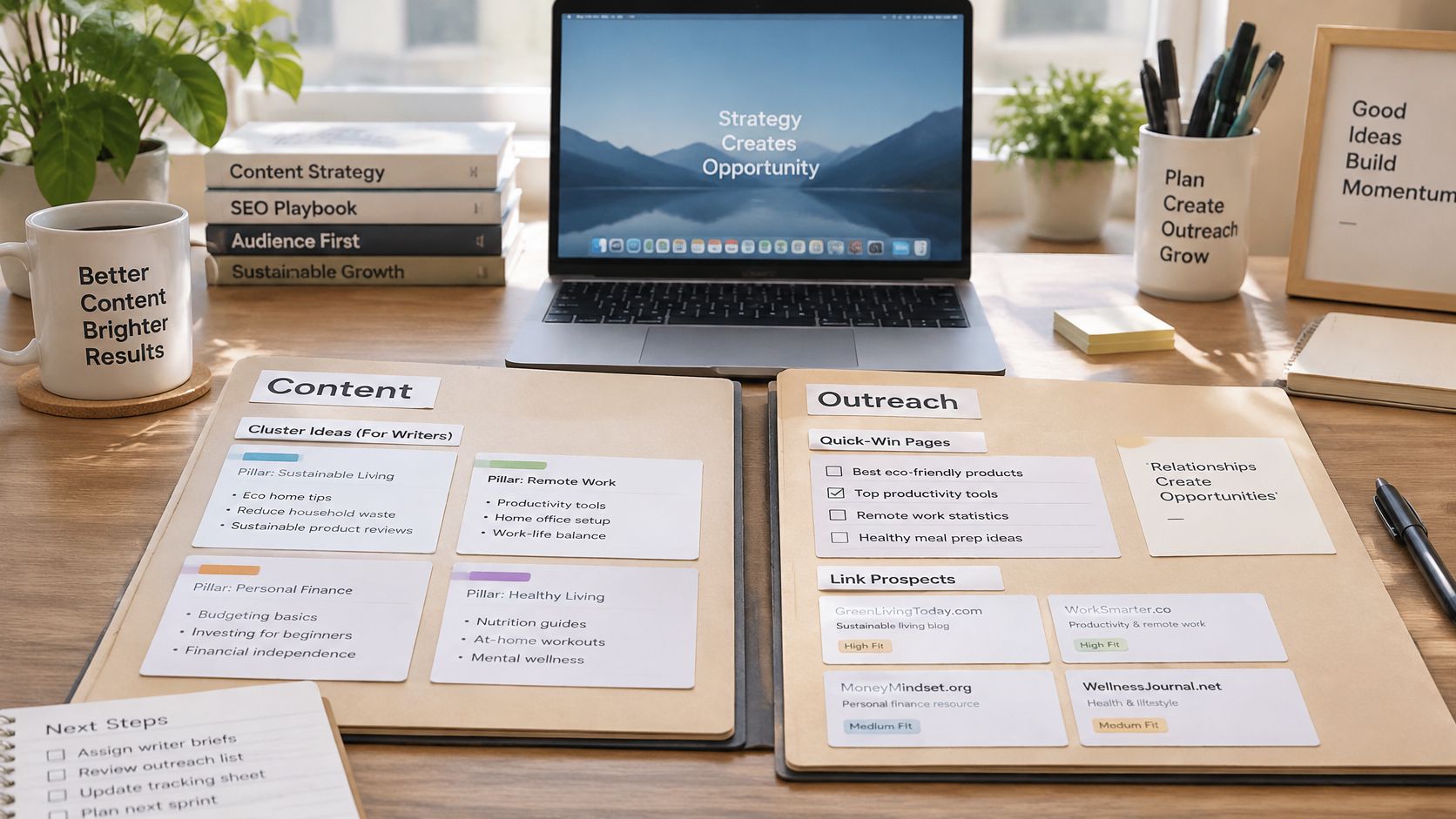
Lists to produce from one gap export
| List | Core columns | Goes to | First action |
|---|---|---|---|
| Content gap clusters | Keyword, cluster name, competitor URL, intent | Content writers | Brief one page per cluster |
| Quick-win list | Keyword, your page, current position 4 to 20 | SEO owner of that page | Optimize the existing page first |
| Link prospect list | Referring domain, linked competitor URL, anchor context | Outreach team | Build a better resource, then pitch |
| Broken-link list | Dead or redirected competitor URL, referring domains | Outreach team | Confirm the URL is gone, then offer your replacement |
| Excluded terms | Keyword, reason such as intent mismatch, branded, or AI-answered | Keep for reference | Prevent rework in the next review |
Make each handoff actionable
For content clusters, include what your page must do better, such as demonstrate the workflow, document a limitation, or supply original evidence. For quick wins, assign the existing page owner and specify the missing answer rather than requesting a vague refresh.
For link prospects, examine backlinks to the exact competing URL. Read the referring page and anchor context, separating relevant editorial recommendations from footer links and accidental mentions. Google's SEO documentation explains how links help discovery, but a backlink count alone isn't a keyword-targeting formula.
Don't pitch until you can explain why your resource belongs on that particular referring page.
If you're replacing a study, build a stronger resource before requesting a mention. For broken-link outreach, verify the current destination: a redirect to a valid replacement isn't automatically a broken-link opportunity.
Keep excluded terms and consistent column names for the next refresh. I'd rerun the same views after 60 to 90 days, then compare cluster movement, actual clicks, and qualified conversions against your assumptions before expanding production.
Use our keyword, backlink, and SERP research tools to turn competitor visibility into page-level decisions. Visit SemDash to get started for free, export your competitor gaps, and build a shortlist ranked by realistic clicks rather than search volume alone.