%20(1)-B86R08ZzwhPzS6UZbG3mSxRWPCwGwn.png)


Keyword Difficulty Explained: Pick the Right Targets

Keyword difficulty (KD) measures how hard it is for your site to earn a top organic position for a given query, expressed on a 0–100 scale where higher scores signal stronger competition and greater resource investment to rank. Two things to act on right now:
- Prioritize or skip? Compare your domain’s authority against the median authority of the current top-10 results. If your domain trails by a substantial margin, treat that keyword as a future target, not a current one.
- Next step: Run a site-adjusted SERP audit (personal keyword difficulty check) to see how your specific page strength stacks up against the pages already ranking, not just the abstract score.
Key Takeaways
Keyword difficulty is a prioritization filter, not a ranking guarantee. The most effective approach combines a raw KD score with a site-adjusted gap analysis and a manual SERP audit to produce a realistic go/no-go decision.
| Point | Details |
|---|---|
| KD is an estimate, not a prediction | Scores vary by tool and input signals; always cross-check two tools before committing to a target. |
| Personal KD changes the picture | Compare your domain authority against the top-10 median to get a site-adjusted difficulty that reflects your actual ranking gap. |
| Score bands guide effort levels | Low (0–30) targets rank in 1–3 months; medium (31–60) in 3–9 months; high (61+) requires 12+ months and active link acquisition. |
| Backlinks alone can mislead | Google has signaled that backlinks’ relative ranking weight may decline, so KD scores built on link counts can overstate difficulty for content-quality-driven queries. |
| Semdash consolidates the workflow | Semdash combines keyword research, SERP snapshots, and backlink gap analysis in one platform for faster, more accurate KD assessments. |
What keyword difficulty explained really measures, and why scores differ
Keyword difficulty is an estimate of the competitive effort required to reach page one for a specific query. It is not a traffic forecast or a content quality grade. The metric tries to answer one question: given the pages currently ranking, how much authority, content depth, and link equity would a new page need to displace them?
Every major tool produces a KD score, but they do not all produce the same number for the same keyword. That divergence is not a bug. Different tools use different inputs: some weight referring domains heavily, others blend domain authority, CTR curves, SERP feature presence, and topical relevance into the calculation. Semrush factors in the authority of ranking domains alongside SERP features. SpyFu weights competitive density and paid competition signals. seoClarity uses a page-strength aggregate that combines multiple ranking signals rather than backlinks alone. The result is that the same keyword can score 35 in one tool and 58 in another, which is why cross-tool validation matters before you commit budget to a target.
One concept worth previewing here: personal keyword difficulty (PKD). This is a site-adjusted view of KD that accounts for your domain’s specific authority and topical footprint, rather than treating all sites as equal. A keyword with a raw KD of 55 might be genuinely attainable for a domain with strong topical coverage in that niche, and nearly impossible for a brand-new site. PKD is covered in depth later in this article.

Why keyword difficulty should shape your SEO prioritization
KD is primarily a prioritization filter. It tells you where to spend your content and link-building budget now versus where to invest for the long game. Without it, you risk pouring six months of effort into a keyword your domain cannot realistically rank for yet, while leaving easier wins untouched.
Here is how KD maps to strategic decisions:
- Low-hanging fruit: Low-KD keywords (roughly 0–30) often yield rankings within weeks to a few months, require minimal link acquisition, and are ideal for new sites or new content clusters building topical authority.
- Content cluster staging: Medium-KD keywords anchor pillar pages. You build toward them by first ranking supporting cluster content at lower difficulty, then using internal links and accumulated authority to push the pillar up.
- Link-building budgeting: High-KD keywords require sustained link acquisition campaigns, often taking several months to years of effort, and are only viable once your domain has established authority in the topic area.
- Funnel alignment: Informational keywords tend to carry lower KD than transactional ones because fewer commercial pages compete for them. A keyword like “how to set up a content cluster” will typically score lower than “buy SEO software,” even at similar search volumes.
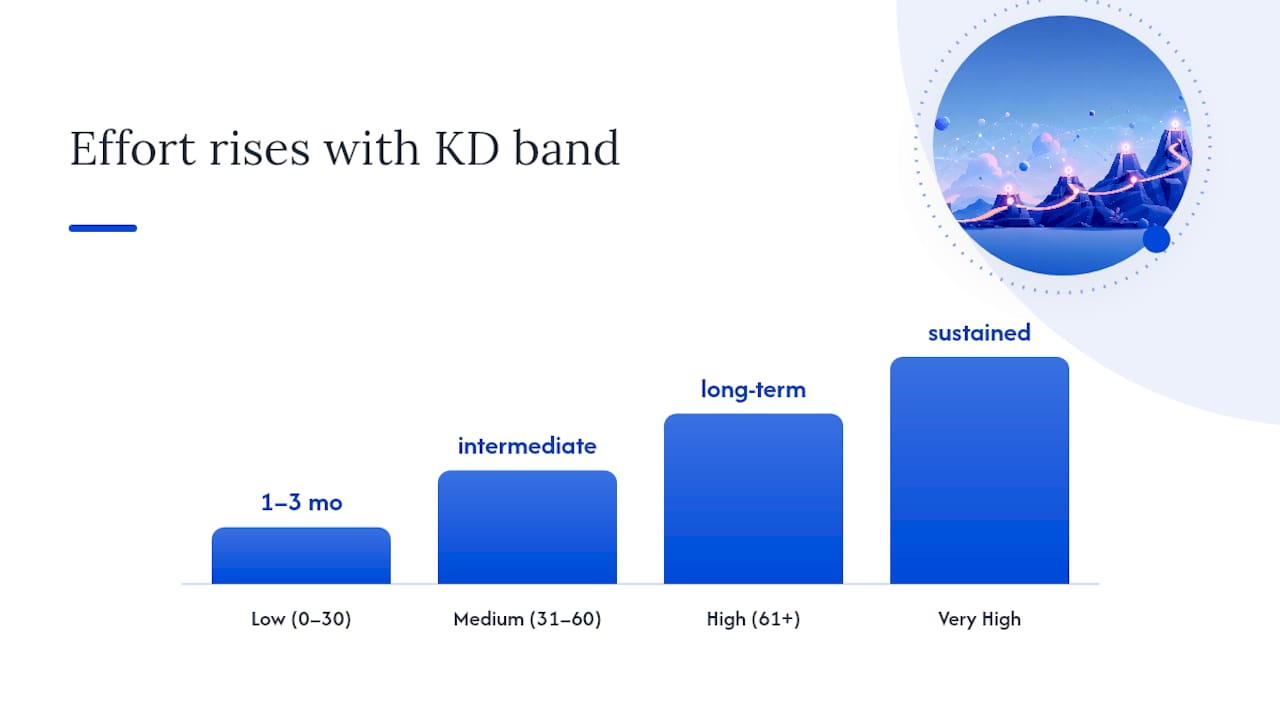
- Time-to-ROI framing: Low KD can deliver traffic within one to three months. Medium KD typically takes three to nine months. High KD is a twelve-plus-month investment, and it should be treated as such in any content roadmap.
Combining KD with conversion potential and funnel alignment is what separates a keyword plan from a keyword list.
How to read KD scores: low, medium, and high bands
Score bands vary slightly by tool, but broadly accepted interpretations across the industry provide guidance on difficulty levels. Use it as a starting benchmark, then adjust based on your domain’s authority and the specific SERP you are entering.
| KD Band | Score Range | What It Signals | Typical Effort Required |
|---|---|---|---|
| Low | 0–30 | Few strong pages ranking; thin link profiles in top 10 | Quality content, minimal link building, 1–3 months |
| Medium | Moderate range | Mix of established and newer pages; moderate link equity | Content depth, some link acquisition, intermediate timeframe |
| High | High range | Strong domains dominating; high referring domain counts | Active link campaigns, E-E-A-T signals, longer-term investment |
| Very High | Very high range | Brand-heavy SERPs; difficult without major authority | Sustained investment, often not worth pursuing early without strong resources |
A few caveats: niche markets can show inflated KD scores because a handful of authoritative sites dominate a small topic, even when actual competition is thin. Seasonal keywords can also vary in difficulty during peak periods. Always cross-reference the score with a manual SERP look before treating any band as definitive.
What signals tools and analysts use to estimate difficulty
KD scores are built from a stack of signals, and understanding which signals matter most helps you evaluate whether a score is accurate for your situation.
Backlink signals remain the most heavily weighted input in most tools. Referring domain counts to the top-ranking pages, the authority of those linking domains, and anchor text distribution all feed into the calculation. A SERP where every top-10 result has hundreds of referring domains from high-authority sites will push KD toward the upper bands. That said, Google has signaled that backlinks’ relative strength as a ranking factor may decline over time, which means tools that weight links too heavily can overstate difficulty for queries where content quality and E-E-A-T are the real differentiators.
Domain-level and page-level authority are the second major input. Metrics like Domain Authority (DA), Domain Rating (DR), and page-level authority scores reflect the cumulative link equity and trust signals a site has built. seoClarity’s research argues that page strength, an aggregate of multiple ranking signals, yields more accurate KD estimation than backlinks alone.
- SERP features as modifiers: Knowledge panels, local packs, shopping carousels, and featured snippets all reduce the organic click-through rate available to standard blue links. A keyword with a KD of 45 that also triggers a featured snippet and a local pack is functionally harder to monetize than the score alone suggests.
- Search intent: Queries with mixed intent (informational and transactional signals in the same SERP) are harder to target because you cannot optimize for both simultaneously. Tools rarely capture this nuance in a single number.
- Content quality and E-E-A-T: For YMYL-adjacent topics (health, finance, legal), Google’s quality signals weight author expertise, site trustworthiness, and content depth heavily. A keyword in these verticals may carry a moderate KD score but require significantly more editorial investment than the number implies.
Understanding domain authority and how it interacts with these signals is foundational to reading KD scores accurately.
Practical measurement: tool scores plus a manual SERP audit
Automated KD scores give you a starting point. A manual SERP audit gives you the reality check. Here is a reproducible process that combines both:
- Pull the KD score from at least two tools. Use Semrush and one other (SpyFu or seoClarity work well). If the scores diverge by more than 15 points, dig into why before proceeding.
- Export the top-10 SERP results. Capture each URL’s referring domain count, domain authority, page-level authority, and estimated organic traffic.
- Map SERP features. Note which features appear (featured snippet, People Also Ask, local pack, shopping results). Each one reduces available organic CTR.
- Check content format and freshness. Are the top results long-form guides, product pages, or forum threads? When were they last updated? A SERP full of stale content is an opening.
- Identify brand presence. If three or more top-10 results belong to the same domain or brand, the SERP is partially locked. Factor that into your go/no-go decision.
- Compute your site-adjusted gap. Compare your domain’s authority and referring domain count against the median of the top-10 results. The gap tells you how much work remains before you are competitive.
Pro Tip: When doing a quick manual check, look specifically for exact-match anchor text in the top results’ backlink profiles. Heavy exact-match anchor concentration often signals an older, link-built page that may be vulnerable to a fresher, better-structured piece, even at high KD scores.
A hybrid workflow combining tool scores with manual SERP validation consistently produces more reliable KD decisions than either method alone.
How your site changes the difficulty picture
Personal keyword difficulty (PKD) reframes KD from an abstract market-level score into a site-specific ranking gap. The core idea: a keyword’s raw KD tells you how competitive the SERP is in general. PKD tells you how competitive it is for you, given your domain’s current authority, topical coverage, and page-level signals.
To approximate your PKD for any keyword:
- Compare your domain metric to the median top-10 domain metric. If the median DR of the top-10 results is 62 and your DR is 38, you have a 24-point gap. That gap is your PKD signal.
- Assess topical footprint. If you already have five published, ranking pieces on closely related subtopics, your topical authority compresses the effective difficulty. Google treats established topical clusters as trust signals.
- Check for existing page equity. An existing page on your site that already ranks on page two for this keyword has accumulated some authority. Updating and expanding it is almost always faster than publishing a new URL.
Tactics that lower your PKD over time:
- Build topical clusters around the target keyword before attacking it directly.
- Use targeted internal linking from high-authority pages on your site to the target page.
- Pursue page-level link building (links to the specific URL, not just the homepage).
- Increase content depth to match or exceed the average word count and subtopic coverage of the current top-10 results.
A competitive keyword analysis of the pages already ranking is the fastest way to identify exactly where your content and link gaps sit.
Actionable rules for using KD in a keyword plan
KD becomes useful only when it drives decisions. Here are the priority rules that hold up across most niches and budgets:
- Chase low KD (0–30) first when your domain is new or entering a new topic area. These keywords build topical authority and generate early traffic signals that support harder targets later.
- Invest in medium KD (31–60) once you have at least five to ten ranking pieces in the topic cluster. These keywords carry meaningful search volume and conversion potential without requiring a full link-building campaign.
- Phase high KD (61+) keywords into your roadmap only after your domain authority and topical footprint are competitive with the current top-10 median. Treat them as twelve-plus-month projects with dedicated link acquisition budgets.
Track progress monthly using rank movement, not just final position, since high-KD keywords often show incremental gains before breaking onto page one.
For semantic keyword research strategies that map KD to content clusters, building the topical architecture first makes every subsequent KD target easier to reach.
Frequent mistakes when relying on KD scores
KD is a useful signal, not a precise prediction. These are the mistakes that cost the most time and budget:
- Treating KD as an exact predictor. A score of 52 does not mean you will rank if you hit some threshold. It is an estimate built on imperfect inputs. Use it directionally, not as a guarantee.
- Ignoring intent and SERP features. A keyword with KD 30 that triggers a featured snippet and three ads above the fold may deliver almost no organic traffic even if you rank on page one. Always check the actual SERP.
- Relying only on backlink counts. Industry reporting indicates backlinks may be a declining top-three ranking factor, so a KD score built primarily on link signals can overstate difficulty for content-quality-driven queries.
- Misreading branded results. If a top-10 SERP is dominated by brand navigational queries (users searching for a specific company), the KD score is inflated. You cannot displace branded intent with generic content.
- Ignoring niche and seasonal exceptions. A niche with three dominant authoritative sites will show high KD even when the actual competitive field is small. Seasonal keywords spike in KD during peak periods and drop off-season. Check historical SERP data before committing.
How to avoid these pitfalls: Always pair the KD score with a manual SERP audit, an intent check, and a CTR estimate. If the SERP is brand-heavy or feature-saturated, adjust your difficulty assessment upward regardless of what the tool reports.
A 6-step checklist to assess any keyword end-to-end
Copy and use this checklist whenever you are evaluating a new keyword target:
- Check search volume and trend. Confirm the keyword has consistent monthly search volume and is not declining. Flat or growing trends are the baseline requirement.
- Pull KD scores from two tools. Note both scores and flag any divergence greater than 15 points for deeper investigation.
- Map the SERP feature landscape. List every SERP feature present (featured snippet, PAA, local pack, shopping). Estimate the organic CTR available to standard blue links.
- Audit the top-10 results. For each result, record: domain authority, referring domain count to that URL, content format, and date last updated.
- Compute your site-adjusted gap. Compare your domain authority and referring domain count against the top-10 median. Note the gap in both metrics.
- Make a go/no-go decision. If your gap is manageable within your current content and link-building capacity, assign the keyword to a content sprint. If the gap is large, add it to your long-game roadmap with a defined milestone (e.g., “revisit when DR reaches 50”).
Quick-audit version: Volume check → two-tool KD pull → SERP feature map → top-10 authority median → site gap → decision.
How to run a KD assessment in Semdash
Semdash brings keyword research, SERP analysis, and backlink data into one interface, which removes the manual step of switching between tools mid-audit. Here is how the workflow runs in-product:
- Keyword research module: Enter your target keyword and pull the KD score alongside search volume, SERP feature flags, and related keyword clusters. Semdash’s semantic clustering groups related terms so you can evaluate a whole topic area at once, not just a single keyword.
- SERP snapshot: Pull the current top-10 results with their domain authority, referring domain counts, and estimated traffic. This is the data you need for step 4 of the checklist above.
- Backlink research: Use Semdash’s backlink research tool to compare your page’s referring domain profile against the top-ranking URLs. The gap you calculate here is your PKD signal.
- Competition analysis: Semdash’s SEO competition analysis view shows which competitors rank for the same keyword cluster, their authority, and where your content gaps sit.
Step-by-step in-product workflow:
- Open the keyword research tool and enter your target term.
- Review the KD score and note any SERP features flagged in the results.
- Pull the top-10 SERP snapshot and export domain authority and referring domain data.
- Open the backlink research module and compare your target URL’s referring domains against the top-10 median.
- Calculate your site-adjusted gap and assign the keyword to a sprint or long-game roadmap.
- Use the keyword clustering view to identify supporting subtopics that will build topical authority before you target the primary keyword.
| Workflow Step | Semdash Feature Used | Output |
|---|---|---|
| Pull KD and volume | Keyword Research module | KD score, volume, SERP features |
| Audit top-10 SERP | SERP Snapshot | Domain authority, referring domains per URL |
| Compare backlink gap | Backlink Research tool | Site-adjusted difficulty gap |
| Find content gaps | Competition Analysis | Missing subtopics and cluster opportunities |
| Prioritize keywords | Semantic Clustering view | Prioritized keyword sprint list |
Pro Tip: When Semdash’s site-adjusted signals show your domain authority is within 10 points of the top-10 median but your referring domain count to the target URL is significantly lower, that is a link acquisition signal, not a content signal. Escalate to a targeted link-building campaign for that specific URL rather than expanding the content further.
The number that matters more than the score itself
Most SEOs spend too much time debating whether a KD of 42 is “medium” or “medium-high” and not enough time asking whether the gap between their domain and the current top-10 median is closable within their actual budget and timeline. The raw score is a market-level average. Your PKD is the number that determines whether you should publish next month or next year.
One rule of thumb that holds up in practice: if your domain authority gap to the top-10 median is greater than 25 points AND you have no existing topical coverage in the area, treat the keyword as an eighteen-month project regardless of what the KD score says. Conversely, if you have strong topical authority and an existing page already sitting on page two, a KD of 65 can be attainable in three to six months with a focused link push. The score sets the context. Your site’s position within that context sets the timeline.
Semdash gives you KD analysis without the tool-switching tax
Pulling KD data from one tool, backlink data from another, and SERP snapshots from a third is how audits take three hours instead of thirty minutes. Semdash consolidates keyword research, SERP analysis, backlink tracking, and competitor gap analysis into a single credit-based platform, priced as an affordable alternative to the enterprise tools that charge for each module separately.

For SEOs who need to run KD assessments regularly, whether for a single site or across a client portfolio, Semdash’s integrated workflow means you go from keyword to prioritized action without leaving the platform. The semantic clustering view alone can cut keyword planning time significantly by grouping related terms and their difficulty scores into a single topical view. Start your KD assessment today at Semdash’s keyword research tool, or explore the full platform to see how backlink research and SERP tracking fit into the same workflow.
Sources
- Keyword Difficulty Explained: How to Win
- Keyword Difficulty: What It Is and How To Measure It
- Google predicts strength of backlinks as ranking factor will drop
- What Is Keyword Difficulty? (And How to Measure It for SEO)
FAQ
What is keyword difficulty in SEO?
Keyword difficulty is a 0–100 score that estimates how hard it would be to rank on page one for a given query, based on the authority and link profiles of the pages currently ranking. Higher scores indicate stronger competition and greater resource investment to displace existing results.
Why do KD scores differ between tools like Semrush and SpyFu?
Each tool uses different inputs: some weight referring domains most heavily, while others blend domain authority, CTR curves, and SERP feature presence into the calculation. That is why the same keyword can score 35 in one tool and 58 in another, making cross-tool validation a standard part of any reliable KD assessment.
What is personal keyword difficulty (PKD)?
Personal keyword difficulty is a site-adjusted view of KD that compares your domain’s authority and topical footprint against the median authority of the current top-10 results. A keyword with a raw KD of 55 may be attainable for a domain with strong topical coverage in that niche, and out of reach for a newer site with no related content.
How long does it take to rank for a high-KD keyword?
High-KD keywords typically require a long-term sustained effort, including active link acquisition and deep content investment, and are only viable once your domain has established authority in the topic area. Low-KD keywords (0–30) can yield rankings within one to three months with quality content and minimal link building.
Can Semdash help me assess keyword difficulty for my site?
Yes. Semdash’s keyword research module pulls KD scores, SERP snapshots, and backlink gap data in one interface, so you can calculate your site-adjusted difficulty without switching between multiple tools. The semantic clustering view also groups related keywords by difficulty, making it easier to build a mixed-KD content portfolio.