%20(1)-B86R08ZzwhPzS6UZbG3mSxRWPCwGwn.png)


Press Release Backlinks: Earn Editorial Links That Count

Press release backlinks from wire syndication are almost always nofollow or rel=sponsored, meaning the wire itself rarely passes ranking authority. The real SEO value comes from editorial pickups that follow distribution, where journalists cite your release on their own domains with followed links. Treat wire distribution as amplification, not the primary link-building product.
Here is where each service type fits:
- Premium journalist reach (PR Newswire, Business Wire): Best when you need editorial desk exposure for funding rounds, M&A, or major product launches. High cost, highest pickup probability.
- Mid-tier syndication + editorial (eReleases, Newswire, PRWeb): Solid for brand citations and moderate journalist outreach. Better cost-per-pickup than premium wires for most campaigns.
- Budget syndication and brand citation (EIN Presswire, PR Underground, NewswireJet, PR.com): Good for building a brand-citation footprint and Google News indexing. Minimal editorial pickup.
- SEO-integrated campaigns (Semdash): Recommended when you want press distribution paired with backlink research, keyword targeting, and editorial pickup tracking in one workflow.
- Niche/targeted outreach (Sitetrail, BrandPush): Useful for guaranteed placements on specific publications, though links are often sponsored.
The right choice depends on whether your goal is journalist pickup, brand citation, or a tracked SEO campaign. Premium wires serve the first goal; budget services serve the second; Semdash serves the third.
Key Takeaways
Press release distribution earns SEO value through editorial pickups, not wire syndication, making journalist outreach and a newsroom-hosted canonical release the two highest-leverage investments in any press release SEO campaign.
| Point | Details |
|---|---|
| Wire links are nofollow | Syndicated copies carry nofollow or rel=sponsored attributes; editorial pickups are where followed links originate. |
| Host canonical on your domain | Publish with schema.org NewsArticle markup before distributing; this makes your site the canonical source for editorial links. |
| Measure editorial referring domains | Track followed links from editorial domains at 30, 60, and 90 days, not raw syndication counts. |
| Match service tier to goal | Use premium wires for journalist pickup; budget services for brand citation and Google News indexing. |
| Semdash for SEO-integrated campaigns | Semdash pairs press distribution with backlink research and editorial tracking in one platform. |
What do press release distribution services actually deliver for backlinks?
Before spending a dollar on distribution, you need to understand the two-tier reality of press release link building. Premium wire services like PR Newswire and Business Wire increase the probability of journalist pickup substantially, but charge accordingly. Mid- and budget-tier services mainly create a syndication and brand-citation footprint rather than followed backlinks.
Here is the ranked breakdown of paid services, organized by where they sit on the premium-to-budget spectrum.
1. PR Newswire
Starting price: Varies by release length and geography; national distribution typically costs a significant amount per release. Reach: AP wire, Google News, thousands of newsrooms and journalist desks globally. Links: Typically nofollow or rel=sponsored on syndication copies; editorial pickups may carry followed links. Media: Images, video, and multimedia supported. Editorial review: Standard review before distribution. Turnaround: Same-day to next business day. Best for: Investor-funded announcements, IPOs, major product launches where journalist desk access justifies the cost. PR Newswire’s journalist-facing infrastructure is its primary differentiator.
2. Business Wire
Starting price: Premium tier, comparable to PR Newswire. Reach: Direct feeds to newsrooms, financial terminals, and AP; strong financial and regulatory coverage. Links: Nofollow/sponsored on syndication; editorial pickups are organic. Media: Full multimedia support. Editorial review: Yes, with compliance checks for regulated industries. Turnaround: Same-day. Best for: Public companies, regulated industries, and announcements requiring financial-wire reach. Business Wire is the go-to for SEC-adjacent announcements.
3. eReleases
Starting price: Around $299 per release for national distribution. Reach: PR Newswire network access at a fraction of direct pricing; solid journalist database. Links: Nofollow on wire copies; editorial pickups vary. Media: Images supported. Editorial review: Yes. Turnaround: 1–2 business days. Best for: Small businesses and agencies that want PR Newswire-level reach without the enterprise price tag. eReleases also offers practical keyword guidance for optimizing releases before submission.
4. Newswire
Starting price: Plans from around $349 per release; subscription options available. Reach: AP, Google News, regional outlets, and a media contact database. Links: Nofollow on syndication; editorial pickups organic. Media: Images and video. Editorial review: Yes. Turnaround: Same-day to 24 hours. Best for: Brands that want combined wire distribution and media outreach tools in one platform. Newswire publishes keyword selection guidance that aligns with SEO best practice.
5. PRWeb
Starting price: From around $99 per release. Reach: Google News, regional outlets, industry sites; lighter journalist-desk access than premium wires. Links: Nofollow on syndication. Media: Images supported. Editorial review: Basic. Turnaround: 24–48 hours. Best for: Budget-conscious brands seeking Google News indexing and brand-citation volume.
6. EIN Presswire
Starting price: From $49.95 per release. Reach: Google News, industry-specific outlets, some AP pickup. Links: Nofollow on syndication. Media: Images supported. Editorial review: Basic compliance check. Turnaround: Same-day. Best for: High-volume brand citation campaigns and SEO teams running frequent releases on a tight budget.
7. PR Underground
Starting price: Free tier available; paid plans from around $49. Reach: Google News, regional outlets. Links: Nofollow. Media: Basic image support. Editorial review: Minimal. Turnaround: Same-day. Best for: Local businesses and solopreneurs building a citation footprint without a significant budget.
8. NewswireJet
Starting price: From around $49 per release. Reach: Google News, niche industry sites. Links: Nofollow on syndication. Media: Images. Editorial review: Basic. Turnaround: Same-day. Best for: Budget syndication and entity-building for newer domains.
9. Sitetrail
Starting price: Varies by placement package. Reach: Guaranteed placements on specific named publications. Links: Often sponsored/nofollow; some dofollow placements depending on package. Media: Supported. Editorial review: Varies by outlet. Turnaround: 2–5 business days. Best for: Brands that want guaranteed brand mentions on specific sites rather than broad syndication.
10. BrandPush
Starting price: From around $195 per campaign. Reach: Guaranteed placements on 200+ news sites. Links: Typically nofollow/sponsored. Media: Supported. Editorial review: Minimal. Turnaround: 2–3 business days. Best for: Brand-awareness campaigns where citation volume matters more than link authority.
11. PR.com
Starting price: Free tier available; paid plans from around $30. Reach: PR.com directory, Google News indexing, limited syndication. Links: Nofollow. Media: Basic. Editorial review: Minimal. Turnaround: Same-day. Best for: Free or near-free brand citation and directory presence.
12. Semdash
Semdash offers press release distribution as part of its SEO platform, pairing distribution with its backlink research tool and keyword research capabilities. This means you can research target keywords, distribute your release, and then track editorial referring domains inside the same interface. Best for: SEO professionals and agencies who want distribution integrated with backlink auditing and pickup tracking, rather than managing separate tools.
Pro Tip: Before choosing a service, ask the sales team for a sample partner list and a real example of an editorial pickup (not a syndication copy) generated by a recent release. If they cannot provide one, that tells you everything about their actual journalist reach.
Quick specs: comparing top press release distributors
Pro Tip: The single most useful metric for SEO is editorial referring domains earned per dollar spent, not total syndication pickups. A release that generates three followed editorial links from niche trade publications outperforms one with 400 nofollow syndication copies.
How do you choose the right press release distribution service?
The decision framework comes down to five questions, answered honestly before you open a vendor’s pricing page.
1. What is your announcement type? Original research, funding rounds, and major product launches earn editorial pickup. Routine product updates and promotional releases rarely do, regardless of which wire you use. If your announcement is not genuinely newsworthy, no distribution service fixes that.
2. What is your actual SEO goal? If you want followed editorial backlinks, you need journalist desk access, which means premium or mid-tier services plus targeted outreach. If you want brand citation and Google News indexing, budget services are sufficient and far cheaper.
3. What is the service’s link policy? Ask directly: “Do outbound links in my release get rel=sponsored or rel=nofollow on syndication copies?” The honest answer is almost always yes. Follow up with: “Can you show me an example of an editorial pickup from a release you distributed?” That second question separates services with real journalist reach from those selling syndication volume.
4. Can you canonicalize to your newsroom? Hosting the canonical release on your own domain with schema.org NewsArticle markup earns more editorial referring domains than wire-only distribution over a 90-day window. Ask whether the service supports a canonical URL pointing back to your site, or whether their hosted copy will compete with yours for indexing.
5. What does the syndication partner list actually include? Vague claims like “distributed to 500+ outlets” are meaningless without a named list. Ask for the actual partner list and check whether those outlets have real editorial audiences or are content farms.
Red flags to avoid
- Promises of “hundreds of dofollow backlinks” from a single release.
- Keyword-stuffed anchor text packages sold as an SEO add-on.
- No named syndication partner list available on request.
- Automated spinning of releases across multiple versions.
- Pricing that bundles “SEO backlinks” as a feature rather than earned editorial coverage.
When to pay premium vs. use budget options
Pay premium (PR Newswire, Business Wire, eReleases) when your announcement has genuine news value and journalist pickup would materially move brand authority or referral traffic. Use budget or free options (EIN Presswire, PR Underground, PR.com) when your goal is entity building, Google News indexing, or citation volume for a new domain. Mid-tier services (Newswire, PRWeb) sit in between and suit most ongoing PR programs.
How do you write a press release that earns editorial backlinks?
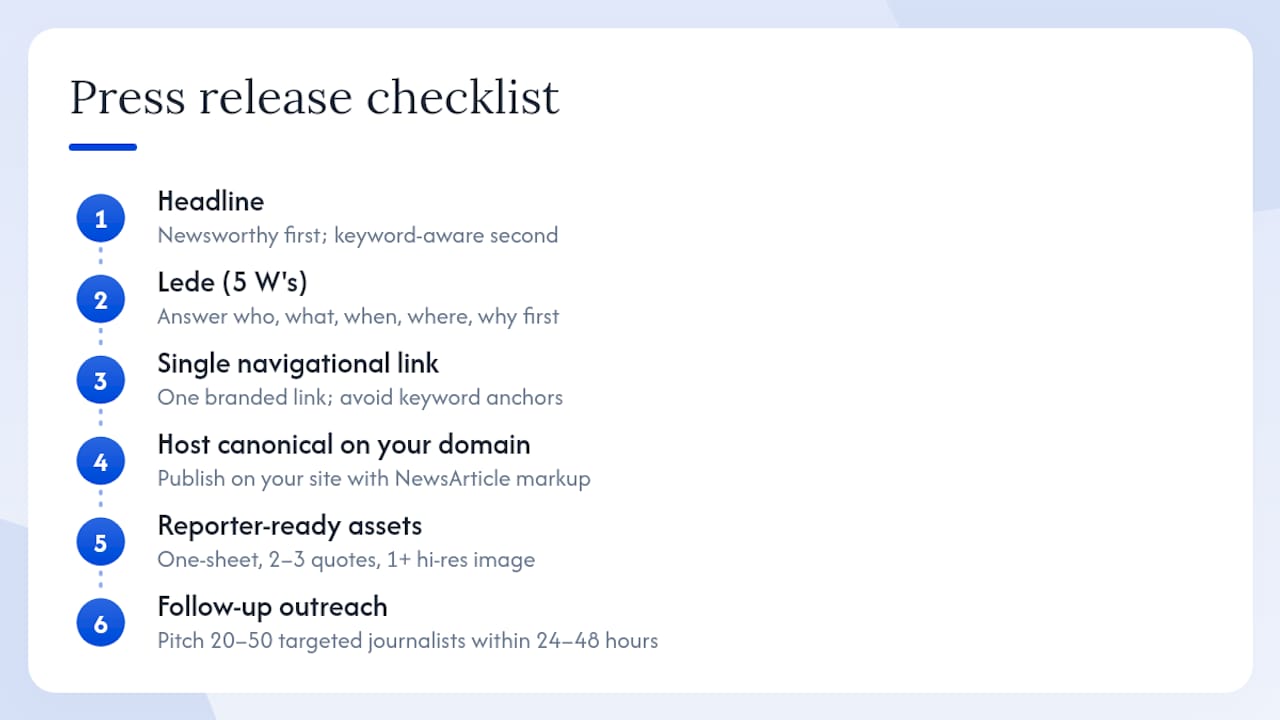
The structure of a well-optimized release is not complicated, but most SEO teams get the keyword and link strategy wrong. Here is a step-by-step checklist.
Step 1: Write a headline that is newsworthy first, keyword-aware second. Your headline should answer “why does this matter today?” before it targets a keyword. If a keyword fits naturally, use it. If it forces the headline into awkward phrasing, leave it out. Target one or two relevant keywords per release and use them where they read naturally, not where they are crammed in.
Step 2: Open with the 5 W’s in the lede. Who, what, when, where, and why belong in the first paragraph. Journalists scan ledes to decide whether a story is worth pursuing. A lede that buries the news under marketing language gets ignored.
Step 3: Include one natural navigational link. Place one link to your brand name or newsroom URL in the body of the release. Use branded or navigational anchor text, not exact-match commercial anchors. Keyword-rich anchor text is appropriate only when it naturally supports the story, not as a link-building tactic.
Step 4: Host the canonical version on your domain. Publish the release on your own newsroom or blog with schema.org NewsArticle markup before distributing via wire. This makes your domain the canonical source, so any editorial pickup links back to you rather than to the wire’s hosted copy.
Step 5: Include reporter-ready assets. Attach a one-sheet with key statistics, two or three pull quotes from named spokespeople, and at least one high-resolution image. Releases with original data or proprietary research consistently produce more editorial pickup than promotional releases without supporting assets.
Step 6: Follow up with targeted journalists within 24–48 hours. Wire distribution opens the window; direct outreach closes the deal. Identify 20–50 beat journalists covering your industry and send a personalized pitch referencing the release. The 24–48 hour window after distribution is when pickup probability is highest.
Measuring what actually matters
Track these metrics, not raw syndication counts:
- Editorial referring domains: New domains linking to your newsroom URL or the release page, measured at 30, 60, and 90 days post-distribution.
- Followed links from editorial pickups: Use Semdash’s backlink research tool to filter for followed links from editorial domains versus nofollow syndication copies.
- Referral traffic from editorial sources: Sessions from editorial domains in Google Analytics, separated from wire syndication traffic.
- Branded search lift: Monitor branded query volume in Google Search Console in the 30–60 days following a major release.
Allow 60–90 days before evaluating a release’s full editorial impact. Journalist pickups often appear weeks after initial distribution.
Pro Tip: Build a “reporter-ready data sheet” for every release: one page with your key statistic, a chart, three pull quotes, and a high-res image. Journalists who cannot quickly extract a visual or a quotable number move on. This single asset increases pickup probability more than any distribution upgrade.
How we evaluated and scored services in this guide
Every service in this guide was assessed against six criteria, weighted toward what actually moves SEO outcomes rather than what vendors advertise.
- Journalist reach and pickup probability: Does the service have documented journalist desk access, and can it show real editorial pickup examples?
- Link policy transparency: Is the nofollow/sponsored policy on syndication links clearly stated, or buried in fine print?
- Canonical support: Can the service point syndication copies to a canonical URL on your domain?
- Pricing clarity: Are prices publicly listed, or do you need to request a quote for every tier?
- Historical pickup examples: Can the vendor provide verifiable examples of editorial coverage generated by releases they distributed?
- Editorial review time: Does the service review releases before distribution, and how does that affect turnaround?
Data sources used for verification include public pricing pages, platform documentation, published partner lists, and industry analyses of wire syndication link policies. To separate editorial links from syndication noise, we cross-referenced claimed reach against known editorial pickup patterns documented in industry research.
Transparency note: Semdash, the publisher of this guide, offers its own press release distribution service. Semdash was evaluated against the same criteria as every other service. Its inclusion as a recommended option reflects its integration of distribution with backlink research and editorial tracking, which is a genuine workflow advantage for SEO-focused campaigns. Readers should weigh that context accordingly.
The part of press release SEO that most guides get backwards
Most guides on press release backlinks spend the majority of their word count on which wire service to pick. That is the wrong priority. The wire is a delivery mechanism. The editorial pickup is the product.
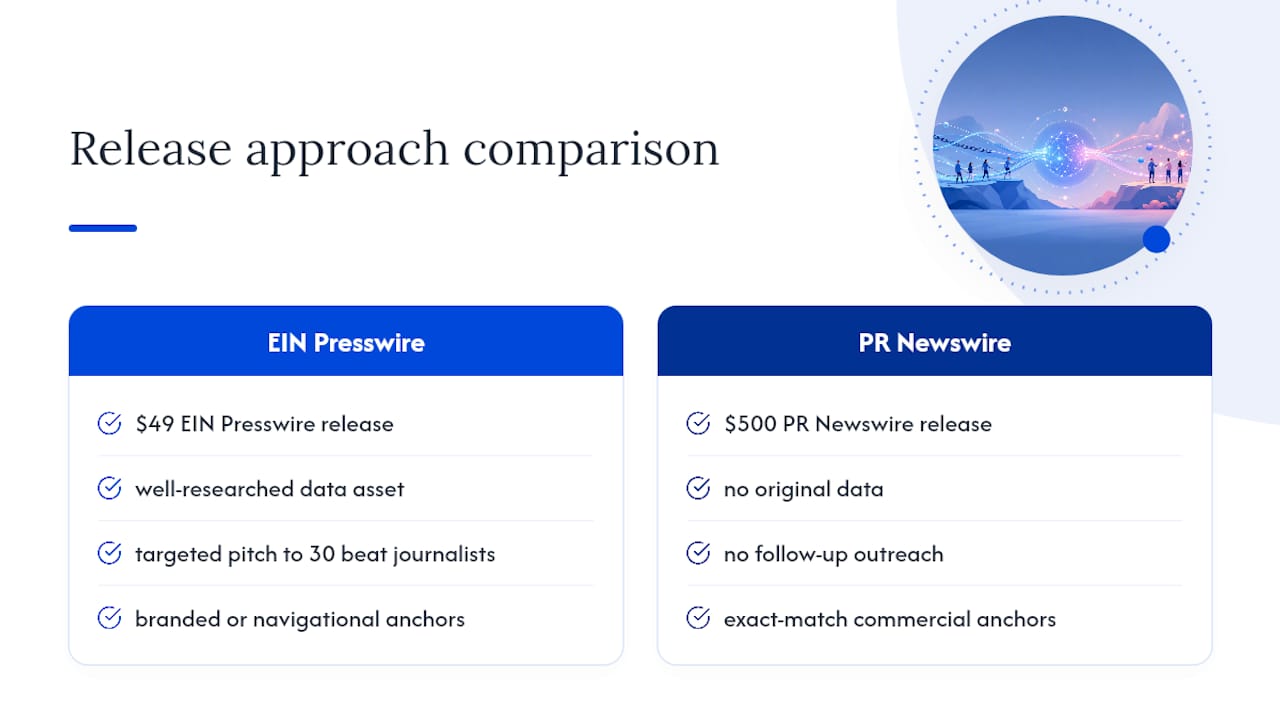
Here is what that means in practice: a $49 EIN Presswire release paired with a well-researched data asset and a targeted pitch to 30 beat journalists will almost always outperform a $500 PR Newswire release with no follow-up outreach and no original data. The wire gets your release in front of journalist feeds. Your newsroom page, your data, and your outreach are what convert that exposure into a followed editorial link.
The second thing most guides get wrong is anchor text. SEO teams that have spent years building links through guest posts and outreach instinctively reach for exact-match commercial anchors in press releases. That is the fastest way to trigger a Google link scheme flag. Press releases should use branded or navigational anchors, one link per release, pointing to your newsroom or homepage. The SEO value of a press release is not in the anchor text of the wire copy. It is in the followed link a journalist places in their own article when they cover your story.
The third mistake is measuring too early. Editorial pickup from a release often surfaces 3–6 weeks after distribution, not in the first 48 hours. Teams that evaluate a release’s SEO impact at the one-week mark and declare it a failure are abandoning campaigns that would have paid off with patience and a 90-day measurement window.
Press releases are a digital-PR play, not a link-building shortcut. The teams that treat them as the latter consistently underperform. The teams that treat them as the former, with a newsroom-first strategy, original data, and journalist relationships, consistently earn the editorial backlinks that actually move rankings.
Semdash connects press distribution with the SEO data you need
Running a press release campaign without tracking editorial referring domains is like sending outreach emails without checking your reply rate. Semdash closes that gap by pairing press release distribution with its backlink research tool, so you can see exactly which editorial domains picked up your release, whether those links are followed, and how they compare to your competitors’ link profiles.

Beyond distribution, Semdash’s keyword research tool helps you identify the one or two keywords worth targeting in each release before you write it, and the AI Overview checker monitors whether your brand earns citation signals in AI-generated search results following a major announcement. The platform’s competitor analysis tool also shows which publications are linking to competitors in your space, giving you a ready-made outreach target list for journalist follow-up. Start with Semdash’s free SEO tools to audit your current backlink profile and identify the editorial gaps a press campaign can fill.
Sources
The following sources were used to verify claims, link policies, and distribution reach figures in this guide. Wire policy pages in particular are worth bookmarking, since link treatment on syndication copies can change without announcement.
- Press Release Link Building: Does It Work? (2026)
- Press release SEO in 2026: what still works and what doesn’t | PressPilot
- Press Release Distribution in 2026: What Still Works for Links - Link Building Journal
- Choosing the right keywords for your press release | eReleases
A note on interpreting wire policy pages: Most wire services describe their distribution reach in marketing terms (“500+ outlets,” “AP wire access”) without specifying link treatment on syndication copies. Always read the terms of service or ask directly about rel=nofollow and rel=sponsored policies before purchasing. The editorial pickup rate, not the syndication count, is the metric that matters for SEO.
FAQ
What are press release backlinks?
Press release backlinks are links generated when a press release is distributed via wire services or picked up editorially by journalists. Wire syndication copies almost always carry nofollow or rel=sponsored attributes; the SEO-valuable links come from editorial coverage where journalists independently cite your release on their own domains.
Are press releases good for SEO?
Press releases can support SEO when they generate editorial backlinks, brand citations, and Google News indexing, but wire syndication alone rarely passes ranking authority. The SEO value depends on editorial pickup, which requires genuinely newsworthy content, a newsroom-hosted canonical release, and targeted journalist outreach.
What are the 5 W’s in a press release?
The 5 W’s are who, what, when, where, and why. They belong in the opening lede paragraph so journalists can immediately assess whether the story is worth covering.
Are backlinks still relevant for SEO?
Yes. Followed editorial backlinks from authoritative domains remain one of the strongest ranking signals in Google’s algorithm. The key distinction for press releases is that wire syndication links are typically nofollow and carry limited ranking value, while editorial pickups from journalists can deliver followed links that move rankings.
How do you track editorial backlinks from a press release?
Monitor editorial referring domains at 30, 60, and 90 days after distribution using a backlink research tool. Filter for followed links from editorial domains and separate them from nofollow wire syndication copies. Semdash’s backlink research tool lets you run this audit and compare your editorial link growth against competitors in the same timeframe.