%20(1)-B86R08ZzwhPzS6UZbG3mSxRWPCwGwn.png)


3 Layer Topical Authority Plan for SEO to Get Cited by AI

Topical authority is the degree to which search engines and AI systems trust a site as a reliable source on a given subject, measured by content depth, entity coverage, and third-party proof rather than any single score. Sites with real topical authority rank for more long-tail variations, capture more SERP features, and get cited more often by tools like ChatGPT and AI Overviews. Building it takes three moves: mapping topic coverage completely, structuring it into pillar and cluster pages, and backing claims with proof search engines can verify.
TL;DR:
- Building top-tier topical authority depends on complete topic mapping, structured content clusters, and external proof through citations and references from credible sources.
- Focus on entity richness, subtopic coverage, internal linking, and third-party mentions to strengthen search engine trust and AI citation frequency.
- Prioritize depth over volume by answering all related questions, using semantic clustering, and filling fan-out gaps to enhance coverage and ranking potential.
- Maintain a clean URL structure, use canonical tags appropriately, and regularly audit internal links to prevent topical drift and technical indexation issues.
- Tracking keyword coverage, internal-link density, backlinks, and AI citations provides the best proxy measurements for improving and maintaining topical authority.
What Topical Authority Actually Means in SEO
Topical authority is not the same thing as domain authority, and conflating the two is one of the most common mistakes in this industry. Domain authority is a third-party metric estimating overall link strength. Topical authority is Google’s (and increasingly, an AI model’s) internal judgment about whether your site actually knows a subject, built from how completely you cover it, how your pages interlink around it, and how often other credible sources reference your work.
Google has confirmed it runs topic-authority systems for specialized areas like news, health, and finance, and one of the strongest signals in those systems is how often a publisher gets cited by other organizations. That single data point reframes the whole discipline: authority isn’t just what you publish, it’s what other people say about what you publish.
Under the hood, ranking systems appear to use overlapping mechanisms rather than one visible score. Google has never published a “topical authority number” you can check in Search Console, but SEO researchers describe systems that behave like topic embeddings and site-level focus scoring, essentially checking whether your content clusters tightly around a subject or scatters across unrelated ground. Depth beats volume in that evaluation almost every time.
A few things consistently move the needle inside these systems:
- Entity richness — how many named people, tools, standards, and related concepts your content correctly references and connects.
- Cluster completeness — whether you’ve covered the subtopics a real expert would expect to see, not just the head keyword.
- Structural consistency — internal links that reinforce the same topic rather than pulling traffic sideways into unrelated content.
- External corroboration — mentions, citations, and links from other sites that treat you as a source, not just a competitor.
Miss any one of these and you can still rank for a handful of keywords. You won’t build the kind of topical footprint that gets a site treated as the default answer for a subject.
Why Topical Authority Matters Now for Rankings and AI Visibility
Topical authority used to matter mostly for breadth: rank the pillar page, then watch a handful of related long-tail terms follow. That effect still holds, but it’s no longer the main reason to care.
Google increasingly uses topic-specific systems to decide who counts as an expert source, particularly in news, health, and finance. Its own documentation on news topic authority points out that smaller, specialized publishers can outrank larger outlets on a specific subject when they’ve shown sustained, focused coverage. Size loses to depth.
The bigger shift is what happens after the click, or rather, what happens instead of the click. AI Overviews, ChatGPT, and Perplexity are pulling answers from sources with strong topical footprints, and depth and structured coverage across a subject directly raise the odds an AI tool cites you instead of a competitor with thinner coverage. With enough citations on a topic, you may begin appearing as a reference for related queries even if you have not targeted them explicitly.
Statistic Callout: Google explicitly credits frequency of citation by other organizations as a signal in its topic-authority systems, meaning your backlink and mention profile within a subject now functions almost like a trust score for that niche specifically, not just for your domain overall.
What this buys you in practice:
- Broader keyword coverage without a linear increase in content spend, since one well-linked cluster feeds dozens of long-tail rankings.
- A better shot at featured snippets, People Also Ask boxes, and AI-generated summaries.
- Lower reliance on paid search, since organic visibility compounds across a topic rather than resetting with every new page.
The Topical Authority Pyramid: A Sequencing Framework
Building on the Topical Authority Pyramid framework, organize your effort into three layers: foundational signals (basic coverage, clean structure), a clear point of view (original analysis, not just summary), and proof-backed authority (third-party verification of your claims).
- Foundational signals first. Get baseline coverage and site structure right before chasing differentiation.
- Layer in a point of view. Add original data, frameworks, or arguments no competitor page states the same way.
- Build proof last, but don’t skip it. Earn the citations and mentions that let outside sources vouch for your claims.
Start wherever your site already has depth. Authority compounds faster on ground you’ve already partly claimed than on a brand-new pillar topic.
Topic-Based Keyword Research: Mapping the Full Query Space
Most topic research stops at the head keyword and its ten closest variants. That’s not enough to establish topical authority SEO results at scale, because search engines and AI models are evaluating whether you cover the subject the way a genuine expert would, including the questions a beginner asks and the edge cases a specialist debates.
- Run a full query audit. Map the head term, buyer-intent queries, brand-plus-topic searches, and narrow angle queries a practitioner would type. Backlinko’s research recommends this exact structure, head, best-of, brand, and specific-angle queries, to identify who currently “owns” a topic and where the gaps sit.
- Use semantic clustering to surface subtopics you’d otherwise miss. Tools built for semantic keyword research group queries by underlying intent rather than surface wording, which catches variations a manual brainstorm skips entirely.
- Prioritize by existing depth, not just search volume. A subtopic where you already rank on page two is usually a faster win than a fresh topic with a bigger keyword but zero content history.
- Check for fan-out coverage. AI systems answering a complex query often break it into sub-questions before generating a response. If your site answers only the main question and none of the sub-questions, you’re invisible to that fan-out process even when you rank fine for the primary term.
Search intent matters as much as volume here. A page-type decision framework helps separate informational subtopics that deserve a blog post from transactional ones that need a dedicated landing page, which keeps your cluster from becoming a pile of near-duplicate articles competing with each other.
Pro Tip: Pull the “People Also Ask” boxes and related searches for your head term, then check which of those questions your site already answers somewhere. The gaps are your next content sprint, prioritized for you by Google itself.
Building Topic Clusters and Pillar Pages Without Diluting Focus
A pillar page states the broad claim; cluster pages back it up with depth on each subtopic, then link back to reinforce the pillar’s authority. Get the architecture wrong and you dilute the exact signal you’re trying to build.
The pillar page should answer the head query comprehensively and link out to every cluster page covering a subtopic. Each cluster page should link back to the pillar using anchor text that reflects the subject, not generic phrases like “click here” or “learn more.” That two-way linking pattern is what tells search systems the cluster is one coherent topic rather than a loose pile of related posts.
A few structural habits keep the cluster tight:
- Keep cluster URLs in a consistent folder or subdirectory pattern so the topical grouping is visible in the URL itself.
- Link laterally between cluster pages when one subtopic naturally references another, not just up to the pillar.
- Avoid linking cluster pages out to unrelated content on your site purely for “internal linking volume.” Every off-topic link is a small signal that dilutes focus.
This same architecture works for SaaS and technical publishers building comprehensive topic coverage around a product category, not just content sites.
Pro Tip: Audit your cluster’s internal links quarterly. If a cluster page has more outbound links to unrelated topics than to its own pillar, that page is actively working against your topical authority, not for it.
The failure mode to watch for is topical drift, publishing content adjacent to your core subject because it’s trending, then linking it into your main cluster anyway. Do that a few dozen times and your site-wide topic signal gets muddier, even though individual page quality never dropped.
Creating Authority Content That Signals Real Expertise
Google’s own guidance is blunt on this point: helpful, people-first content built around clear topic focus is the foundation for being recognized as an authoritative source. That’s not a suggestion to write more. It’s a directive to write with more evidence per page.
Authority content carries specific ingredients competitors’ thinner pages skip:
- Original data or analysis, even something as simple as a small survey or an audit of your own client work, gives a page something to be cited for.
- Named contributors with real credentials, not an anonymous “team” byline, because both readers and AI systems weigh attributed expertise differently than unsigned content.
- Citations to primary sources, government data, academic research, or original studies, rather than links to other blog posts making the same secondary claim.
- Disambiguation of related terms, explicitly distinguishing your topic from adjacent concepts readers commonly confuse it with (the domain authority versus topical authority distinction earlier in this piece is exactly that kind of move).
Author bios and an editorial or “about” page matter more than most teams assume. They’re not decoration, they’re on-page trust cues that both readers and machine evaluators use to judge whether a credible person or organization stands behind the claim. Practical E-E-A-T guidance covers this in more depth, but the short version is: attach a real name and real credentials to your highest-value pages, every time.
Case studies and original research age well precisely because they’re hard to copy. A competitor can rewrite your explainer post in an afternoon. They can’t replicate a proprietary dataset or a client result you documented first. General guidance on structuring content for optimization covers formatting and on-page mechanics that make this kind of proof easier to scan and cite.
Wiring Your Site So Search Engines Can See the Coverage
Content depth doesn’t help if crawlers can’t find, group, and index it efficiently. Large topic clusters create real technical risk, mainly around crawl budget and duplicate signal dilution, that smaller sites rarely think about until traffic plateaus for no obvious reason.
- Keep a clean, logical URL structure that groups cluster pages under a shared path so the topical relationship is machine-readable, not just human-readable.
- Submit an updated XML sitemap whenever you add cluster pages, and don’t let orphaned pages (no internal links pointing to them) pile up inside a topic.
- Use canonical tags deliberately when near-duplicate pages exist for different intents, so search engines don’t split ranking signal across two pages competing for the same query.
- Monitor index coverage in Search Console by folder or URL pattern, not just site-wide, so a stalled cluster shows up before it costs you months of visibility.
Pro Tip: If you’re publishing more than 20 pages in a single cluster, check your crawl stats report for that folder specifically. A crawl rate that lags your publishing pace is an early warning that Google isn’t prioritizing the topic the way you are.
Turning a Point of View Into External Proof
A signature proof point is the one piece of original research, data, or framework your site produced that other sites end up citing instead of restating in their own words. It’s the difference between a page that reads well and a page that becomes infrastructure other content relies on.
- Produce something worth citing. An original survey, a benchmark analysis, or a documented framework built from real client or product data works better than an opinion piece, because it gives outside writers a fact to reference rather than an argument to agree with.
- Pitch it where topic-relevant audiences already gather. Industry newsletters, niche communities, and trade press outrank generic guest-post outreach almost every time, because the resulting link sits inside genuinely relevant context.
- Distribute through channels that reinforce the same topic repeatedly. Partner mentions, community threads, and press coverage all count, but only if they consistently point back to the same proof asset rather than scattering links across unrelated pages.
This is where topical authority separates from raw link building. A backlink profile audit can tell you whether the links you’re earning actually cluster around your target subject or whether they’re scattered across topics that dilute the signal you’re trying to build. Ten links from sites discussing your exact subject beat fifty links from generic directories every time.
How to Measure Topical Authority: KPIs That Actually Track Progress
There’s no single “topical authority score” to check, since search engines infer it from overlapping signals rather than exposing one metric, so measurement has to happen through proxies that correlate with it.
Track these on a recurring basis:
- Ranking keywords per cluster — total keywords ranking for pages inside one topic, not just the pillar’s primary term.
- Keyword depth — how far down the fan-out (subtopics, sub-questions, edge cases) you actually rank, not just the head term.
- Content-to-topic ratio — the share of your published content that falls inside the target cluster versus scattered elsewhere.
- Internal-link coverage — the percentage of cluster pages properly linked to and from the pillar.
- Backlinks to topic pages specifically — not domain-wide backlink count, which tells you almost nothing about topic-level trust.
- AI/LLM citation frequency — how often your pages get referenced in AI Overviews or chatbot answers for queries inside your cluster.
Statistic Callout: Search Engine Land’s guidance on the discipline specifically recommends tracking cluster completeness and topic share instead of chasing a single authority score, because search engines themselves evaluate through multiple overlapping systems rather than one visible number.
Run a full topic-share audit quarterly, comparing your cluster’s ranking keyword count against the top three competitors covering the same subject. Weekly, just watch new keyword appearances and AI citation mentions, since those move faster and flag problems before a quarterly audit would catch them. A competitor analysis tool makes the quarterly comparison far less manual than pulling rankings by hand.
Entity Strategy and Raising Your AI Citation Odds
Fan-out coverage, answering every sub-question a complex query implies, strongly predicts whether AI tools cite you, and entity mapping is how you find those sub-questions before a competitor does.

Entity mapping means documenting the people, tools, standards, and concepts related to your topic, along with how they relate to each other, then making sure your content states those relationships explicitly rather than implying them. AI systems parse text for named entities and their relationships far more literally than a human skimmer does, so vague references cost you citation opportunities that precise ones would capture.
Practical steps that move this forward:
- Build an entity list for your topic (competing tools, named methods, relevant standards bodies) and check which ones your existing content mentions by name versus which it only gestures at.
- Audit your top pages against actual AI Overview results for your target queries, checking whether competitors get cited and you don’t, then diagnose why.
- Keep canonical references consistent. If you call something one name in one article and a slightly different name in another, you’re fragmenting the entity signal instead of reinforcing it.
Depth here compounds with everything already covered: a page with strong entity coverage inside a well-structured cluster, backed by real proof points, is exactly the profile these systems are built to reward.
What Most Teams Get Wrong About Building Authority
Most topical authority failures trace back to one of three habits, and none of them are exotic mistakes. The first is drift: publishing whatever ranks well this month and linking it into an existing cluster because it’s convenient, not because it belongs. Do that consistently and your strongest topic gradually loses definition even as your page count climbs.
The second is chasing volume over depth. Teams see “topical authority” and assume the fix is publishing faster, when the actual lever is closing fan-out gaps competitors haven’t covered yet. A cluster with 15 tightly connected pages answering every real sub-question will usually outperform 40 loosely related posts.
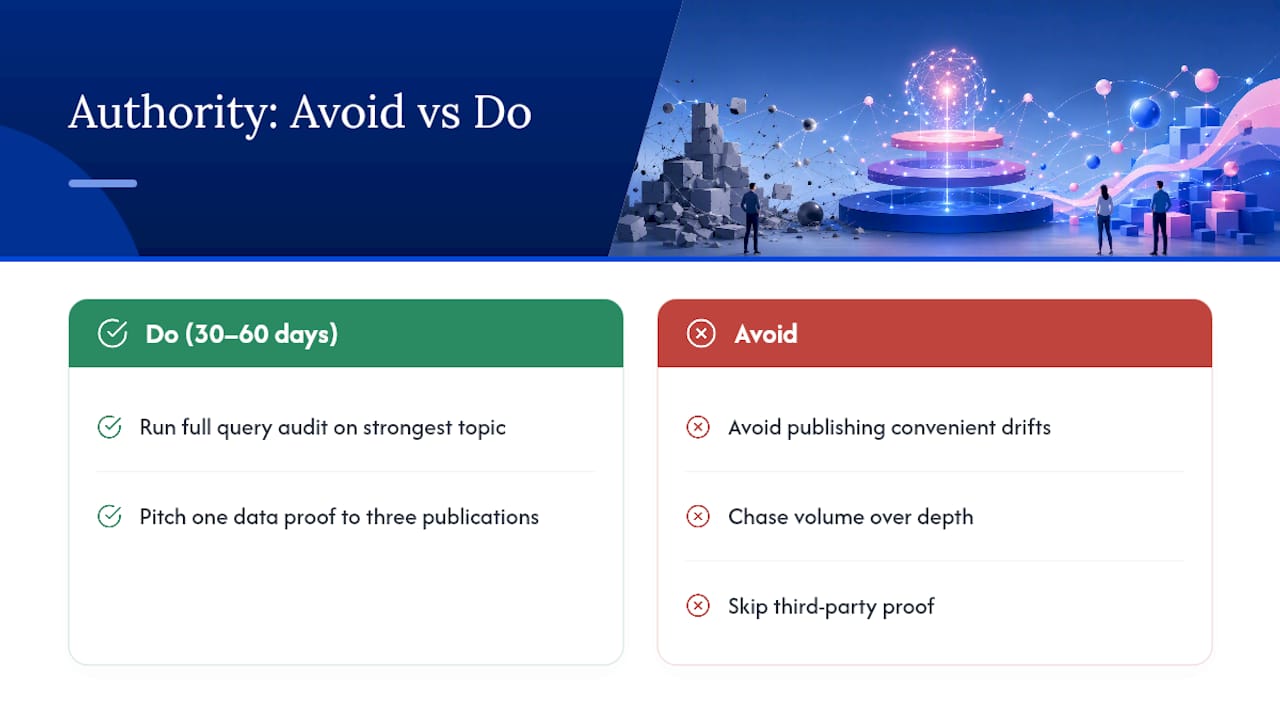
The third, and the one I think gets underrated most, is skipping third-party proof entirely. Plenty of sites build genuinely good on-page structure and never earn a single citation from an outside source, then wonder why AI tools keep referencing a competitor with thinner content but stronger external corroboration. Google’s own systems weight that citation frequency directly, and AI models seem to be converging on the same logic.
If you’re starting from scratch, run two experiments over the next 30 to 60 days. First, do the full query audit described earlier on your strongest existing topic, not a new one, and find the fan-out gaps you’re currently missing. Second, pick one piece of original data or analysis you already have sitting in a spreadsheet somewhere and turn it into a signature proof point worth pitching to three topic-relevant publications. Neither experiment requires new content infrastructure. Both will tell you more about where your real gaps sit than another generic content audit would.
— Leonid
Build and Track Topical Authority with Semdash
Every tactic above depends on seeing your topic coverage clearly, which is harder than it sounds once a cluster grows past a couple dozen pages. Semdash maps that work into one workflow instead of five disconnected tabs: semantic clustering surfaces the subtopics and fan-out queries you’re missing, content-gap analysis shows exactly where competitors out-cover you inside a topic, and backlink discovery tracks whether the links you’re earning actually cluster around your subject or scatter across unrelated ground.
AI Overview monitoring rounds it out by flagging when your pages get cited, or skipped, for queries inside your cluster, so you’re not guessing whether your entity coverage is working. A practical first step: run a keyword research pass on your strongest existing topic, map the fan-out gaps it turns up, and prioritize the two or three that competitors haven’t closed yet. That single audit usually surfaces more opportunity than another round of generic content production.
Sources
- Understanding news topic authority | Google Search Central Blog
- How to Build Topical Authority in the AI Search Era (7 Steps) | Backlinko
- Topical Authority: What Is It, & How Does It Work? | Neil Patel
FAQ
What is topical authority in SEO?
Topical authority is the trust search engines and AI systems place in a site as a reliable, complete source on a specific subject, built from content depth, entity coverage, internal structure, and third-party citations rather than any single visible score.
What is the difference between domain authority and topical authority?
Domain authority is a third-party metric estimating a site’s overall link strength across all subjects, while topical authority is a search engine’s internal judgment of expertise on one specific topic, which a site with modest domain authority can still hold if its coverage on that subject runs deep.
What is topical relevance in SEO?
Topical relevance measures how closely a specific page or piece of content matches a given subject or query, while topical authority measures whether the entire site has earned trust across that subject over time, so relevance is about one page and authority is about the whole cluster.
How do I check the topical authority of a website?
There’s no single public score to check, since ranking systems infer authority from overlapping signals rather than exposing one. The closest proxy is auditing ranking keywords per cluster, internal-link coverage, backlinks pointing to topic-specific pages, and how often AI tools cite the site for queries inside that subject, which a tool like Semdash’s competitor analysis feature can help track against rivals covering the same ground.