%20(1)-B86R08ZzwhPzS6UZbG3mSxRWPCwGwn.png)


Unlinked Brand Mentions: How to Find and Reclaim Them

Convert unlinked brand mentions into backlinks with a repeatable workflow: find them, verify they’re genuinely unlinked, score them against a prioritization rubric, run targeted outreach, and monitor for new mentions on a set cadence. That’s the whole game. The rest is execution detail.
Well-qualified mentions convert at materially higher rates than cold outreach, with reported ranges of 25% to 50% for opportunities that are recent, relevant, and positively framed. That’s a far better return on your time than blind link-building emails.
Three things to do this week:
- Run a Google search operator sweep for your brand name, product names, and known misspellings, excluding your own domain and major social platforms.
- Set up a Google Alert for your brand name and top product terms so future mentions land in your inbox automatically.
- Export your top 20 candidates into a spreadsheet with columns for URL, mention type, authority, and contact status.
Pro Tip: Start with a small batch of 20 to 30 mentions before you build a full pipeline. It’s faster to fix a broken scoring rubric on 20 rows than on 2,000.
What Are Unlinked Brand Mentions and Why Do They Matter?
An unlinked brand mention is a published reference to your brand, product, executive, or content asset that contains no crawlable link back to your site. Someone wrote your name, cited your data, or used your image, but a search engine crawler can’t connect that mention to your domain.
That gap matters more than most SEO teams treat it. Unlinked mentions function as entity signals that reinforce Experience, Expertise, Authoritativeness, and Trust, even before you convert them into links. Search engines and AI systems increasingly read the web as a graph of entities and relationships, not just a graph of hyperlinks. A mention on a respected industry site tells that graph your brand exists in a relevant context, whether or not the anchor text points anywhere.
Once you do convert the mention into a link, you get the more familiar benefits: referral traffic, a stronger backlink profile, and a small boost to how tools like Semdash’s AI Overview monitoring track your presence in generative search results. A single reclaimed link won’t rewrite your rankings on its own, since links remain one signal among several that feed both traditional search and AI visibility.
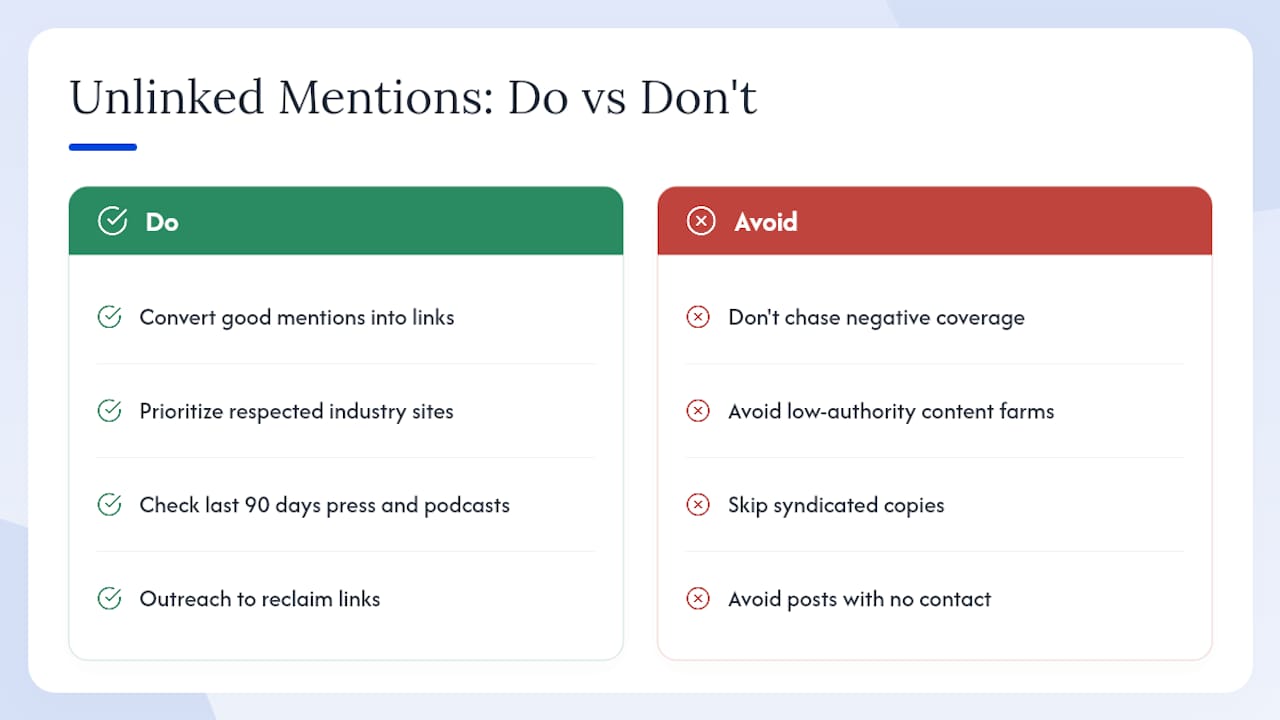
Not every mention deserves your time, though. Skip mentions embedded in negative coverage, low-authority content farms, syndicated copies of an article you’ve already handled, and posts where the author has no working contact method. Chasing those wastes outreach hours you could spend on mentions that actually convert.
Pro Tip: Before you build a query pack, pull your last 90 days of press coverage and podcast appearances. Those often generate the highest volume of fresh, unlinked mentions.
What Types of Unlinked Mentions Are Worth Pursuing?
Mentions show up in more forms than a simple brand name search. Building queries that catch all of them takes some planning.
- Editorial text mentions — a journalist references your product in a roundup or news piece. Outreach angle: frame the request as an editorial improvement, not a favor.
- Image attributions — a blog reuses your screenshot, chart, or product photo with a credit line but no link. Outreach angle: request a proper credit link, which tends to convert better than text-only requests because the site already owes you attribution.
- Product or campaign name drops — someone mentions a specific feature or campaign without naming your company directly.
- Executive or founder mentions — quotes or bios that name a team member but skip the company link.
- Misspellings and variant names — abbreviated or misspelled versions of your brand that still generate traffic and citations.
- Social profile links instead of your site — a Twitter/X bio link or post points to your social profile rather than your domain, a common substitute that’s worth converting separately.
- Republished or syndicated copies — the same article picked up by multiple outlets, usually not worth separate outreach unless the republishing site has stronger authority than the original.
Image credits and data citations tend to close fastest because the site already acknowledges you. A plain name-drop with no context takes more convincing.
How Do You Find Unlinked Brand Mentions?

Discovery works best as a layered system: fast manual sweeps for immediate wins, then a broader query pack, then tool-assisted bulk search for scale.
Start by building your query pack before you touch any tool. List every variant of your brand name, your top three product names, your founder or CEO’s name, common misspellings, past campaign hashtags, and filenames of any widely shared images or reports. This list becomes the input for every method below.
- Run manual Google operator sweeps first. A query like
"YourBrand" -site:yourbrand.com -site:twitter.com -site:linkedin.comsurfaces mentions fast, without paying for a tool. Addintitle:"YourBrand"to catch headline mentions, or wrap product names in quotes to avoid partial matches. - Layer in misspellings and variants. Run the same operator pattern against known misspellings and abbreviations. A B2B SaaS brand with an awkward name often picks up more misspelled mentions than correctly spelled ones.
- Set up Google Alerts for ongoing catch. Google Alerts won’t give you historical depth, but it catches new mentions as they publish, which matters for time-sensitive outreach.
- Run Google Reverse Image Search on your key visuals. Upload your logo, product screenshots, or any chart you’ve published. This surfaces sites reusing your images with a credit line but no link, often a faster conversion than text mentions.
- Reverse-engineer social platforms. Search Twitter/X for your brand name combined with terms like “check out” or “via” to find posts that reference you without tagging your handle, then trace whether the poster runs a blog or publication where a follow-up mention might exist.
- Manually crawl known high-value sites. If you know specific publications, podcasts, or partner sites that cover your space, search their archives directly for your brand name rather than relying on general search coverage.
Here’s a quick reference for which method fits which situation:
| Method | Best for | Limitation |
|---|---|---|
| Google operators | Fast, free, immediate results | No historical depth, manual effort |
| Google Alerts | Ongoing, low-volume monitoring | Misses older mentions, delayed alerts |
| Bulk brand-monitoring tools | Scale, historical depth, filtering | Requires a paid subscription |
| Reverse image search | Visual attributions and chart reuse | Only works on identifiable images |
| Twitter/X search | Social-driven mentions and influencer coverage | Noisy, needs manual filtering |
Pro Tip: Before adding any mention to your outreach list, check the mobile version of the page and view the actual page source. Some “unlinked” mentions carry a JavaScript-rendered link, a redirect, or a link buried in a collapsed mobile menu that a quick scan misses. A practical link reclamation workflow always builds in this verification step before outreach starts, since chasing a mention that’s already linked wastes a contact’s goodwill.
How Do You Evaluate and Prioritize Mention Opportunities?
Not every mention deserves equal outreach effort. A scoring rubric turns a messy spreadsheet into a prioritized queue.
Score each mention against six weighted criteria:
- Site authority (domain authority equivalent, whatever metric your tool provides) — weight heavily; a mention on a site with strong domain metrics and steady organic traffic is worth far more than ten mentions on obscure blogs.
- Page traffic — check if the specific page gets meaningful organic visits, not just the domain’s overall traffic.
- Topical relevance — does the page discuss your industry, or is your brand a passing reference in unrelated content?
- Placement and context — a mention in the body copy near a relevant claim outranks one buried in a footer or comments section.
- Sentiment — neutral or positive mentions convert; negative or ambiguous ones rarely do, and outreach can backfire.
- Freshness — a mention published in the last 90 days usually gets a faster response than one from three years ago.
Score high, medium, and low based on totals: high scorers go into this week’s outreach batch, medium scorers go into a nurture queue for next month, and low scorers get archived unless a new signal (like rising traffic) bumps them up.
For edge cases: if a page already links to your social profile instead of your site, treat it as a lower-effort ask (request an upgrade to your homepage, not a fresh link). If the correct target URL isn’t obvious, default to your homepage or the most topically relevant blog post rather than forcing a mismatch.
Reported conversion rates for prioritized, recent, positive mentions run between 25% and 50%, a range worth setting as your internal benchmark when reporting results to stakeholders.
How Do You Convert Mentions Into Backlinks?
Once you’ve scored your list, outreach is where most of the value gets captured, or lost, depending on execution.
Start with verification. Confirm the mention is genuinely unlinked by checking the page source, the mobile rendering, and any redirect chains, since a mention that already resolves to your domain through a redirect doesn’t need outreach. Then pick the exact target URL you’ll request: your homepage for a general brand mention, a specific product page for a feature mention, or a blog post for a data citation.
Finding the right contact takes a few tries in most cases:
- Check the author bio on the article itself; many include a direct email or a link to their own site.
- Search LinkedIn for the author’s name plus the publication to confirm their role and find a message option.
- Use the site’s contact form if no author byline exists, and address it to the editorial team.
- Try a Twitter/X DM for smaller blogs or independent writers who list their handle prominently.
- Fall back to WHOIS lookup only when every other method fails, and even then, expect a lower response rate.
Keep your outreach short and helpful. Open with a specific reference to their article, note that the mention already exists, and frame the ask as an editorial improvement, not a favor. Suggest the target URL, but avoid dictating exact anchor text. Editors respond better to flexibility than to a script that reads like a link request template.
Dos:
- Reference the exact sentence or paragraph where your brand appears.
- Offer the correct URL and let the editor choose the anchor text.
- Keep the email under 100 words.
Don’ts:
- Never offer payment for an editorial link. It violates most publications’ editorial policies and can flag your domain for manual review.
- Never demand an exact-match anchor.
- Never send more than three follow-ups.
A reasonable cadence: initial outreach, a polite follow-up seven to ten days later, and a final note around the three-week mark. After that, move on.
How Do You Automate Discovery and Monitoring at Scale?
Manual searching works for a pilot batch. Beyond that, you need a system that surfaces new mentions without you remembering to check.
Build your automation stack in this order:
- Set Google Alerts for your brand, product names, and top misspellings as the free, always-on catch net.
- Schedule recurring exports from your brand-monitoring or backlink tool on a weekly or biweekly basis, depending on your publishing volume.
- Add a reverse image watchlist if your brand publishes original charts, infographics, or product photography regularly.
- Push new mentions into a triage workflow using a Zapier or Make automation that drops alerts into Slack or a CRM ticket queue for review.
Operationalizing mention discovery this way turns a one-time cleanup project into a standing program. Track mention volume, conversion rate from mention to link, average time-to-conversion, and the distribution of domains you’re reclaiming from. Referral traffic from reclaimed links is worth watching separately from the SEO metrics, since it tells you which conversions actually drive people to your site.
Run a full audit quarterly, but keep the alert-based catch running continuously in between.
How Does Semdash Fit Into a Mention Discovery Workflow?
A practical example makes the workflow concrete. Here’s how a team might run it inside Semdash:
- Set up a brand-monitoring project using your query pack of brand terms, product names, and misspellings.
- Import the query list and run the search across the platform’s backlink research index to surface mentions across the web.
- Filter for pages with no existing backlink to your domain, isolating true unlinked opportunities from ones already resolved.
- Export candidates to a CSV with columns for source URL, mention type, authority score, contact name, outreach status, and result.
- Score each row using your rubric, then create outreach tasks for anything landing in the high or medium tier.
That export doubles as your stakeholder report. A clean CSV with those six fields shows leadership exactly what got found, what converted, and what’s still pending, without extra formatting work.
When a single high-authority mention needs a bigger push, or when your team wants broader press coverage rather than one-off reclamation, that’s the point to escalate to a press release distribution campaign instead of individual outreach.
Checklist to turn into a team playbook:
- Query pack built and saved as a reusable template.
- Weekly export scheduled.
- Scoring rubric applied before any outreach email goes out.
- CSV report shared with stakeholders monthly.
What Mistakes Waste the Most Outreach Time?
A few habits quietly drain hours without producing links.
- Chasing every mention regardless of score. Low-authority, low-traffic mentions rarely convert and crowd out higher-value outreach.
- Offering payment for a link. This crosses into paid link territory, which violates most editorial standards and risks a manual action if patterns emerge.
- Demanding exact-match anchor text. Editors control their own copy; dictating anchors reads as controlling rather than collaborative.
- Picking the wrong target URL. Sending a homepage link request when a specific product page fits the context better wastes the opportunity.
- Emailing the wrong contact. A generic info@ inbox for a personal blog post authored by a named freelancer rarely gets read.
Quick rule for when to ignore a mention entirely: negative sentiment, a domain with negligible organic traffic, a syndicated duplicate of a mention you’ve already pursued, or an author with no discoverable contact method after two search attempts.
Pro Tip: If a site declines your request or ignores three follow-ups, don’t burn the relationship by pushing further. Log it, move on, and revisit in six months if the site’s authority or your relevance to their content changes.
Ready-to-Copy Outreach Templates
Adapt these three starting templates rather than sending them verbatim. Personalize each one with a specific reference: the paragraph where you’re mentioned, the exact stat you provided, or the image being reused.
- Editorial correction angle: Thank the writer for the mention, note that a link to the specific page would help their readers verify the claim, and offer the URL.
- Image credit request: Thank them for using the image, note the existing credit, and ask for a link alongside it rather than text-only attribution.
- Data citation request: Reference the exact statistic they cited, confirm its source page, and offer that URL as the link target.
For follow-ups, keep them under three sentences: a brief nudge at seven to ten days, and a final, low-pressure note at three weeks. Match your suggested URL to the mention’s actual context every time, and never dictate anchor text.
Key Takeaways and a One-Week Action Plan
Converting unlinked brand mentions into backlinks requires a repeatable find, verify, score, and outreach workflow paired with ongoing monitoring to catch new opportunities.
| Point | Details |
|---|---|
| Define before you search | An unlinked mention is any reference to your brand with no crawlable link, found via text, images, or social posts. |
| Score before you email | Weight authority, traffic, relevance, sentiment, and freshness to prioritize the top 20% of mentions. |
| Personalize every outreach | Reference the exact paragraph, image, or stat rather than sending a generic link request. |
| Automate the catch | Combine Google Alerts, scheduled exports, and reverse image watchlists to avoid manual re-searching. |
| Use Semdash for scale | Run brand-monitoring projects, filter by no-backlink pages, and export scored candidates for outreach tasking. |
One-week plan:
- Day 1 to 2: Build your query pack and run discovery across Google operators and a bulk search tool.
- Day 3: Verify and score every mention on your list.
- Day 4 to 5: Send initial outreach to high scorers.
- Day 6: Send follow-ups on any unanswered outreach from a prior batch.
- Day 7: Report conversion rate and refine your scoring rubric for next week.
What Actually Makes This Workflow Stick
Most teams treat mention reclamation as a one-time cleanup sprint, then let it lapse the moment the spreadsheet gets stale. That’s backward. The highest-value part of this workflow isn’t the outreach email, it’s the standing query pack and the recurring export schedule that keeps feeding new candidates into your pipeline every week.
The teams that get real volume out of this treat scoring as a living document, not a one-time rubric. Revisit your weights every quarter based on which mentions actually converted, and you’ll find your own patterns, maybe image credits close faster for your brand than data citations do, or a certain publication always ignores cold outreach but responds to a LinkedIn message instead. That’s the kind of nuance a generic checklist won’t tell you, but your own conversion data will.
Where Semdash Fits Into Your Mention Reclamation Stack
Running this workflow by hand across dozens of sites eats a full day every week. Semdash folds the discovery, filtering, and scoring steps into one interface, so a brand-monitoring project surfaces candidates that already exclude pages you’ve been linked from, cutting the manual triage that usually eats the most time.
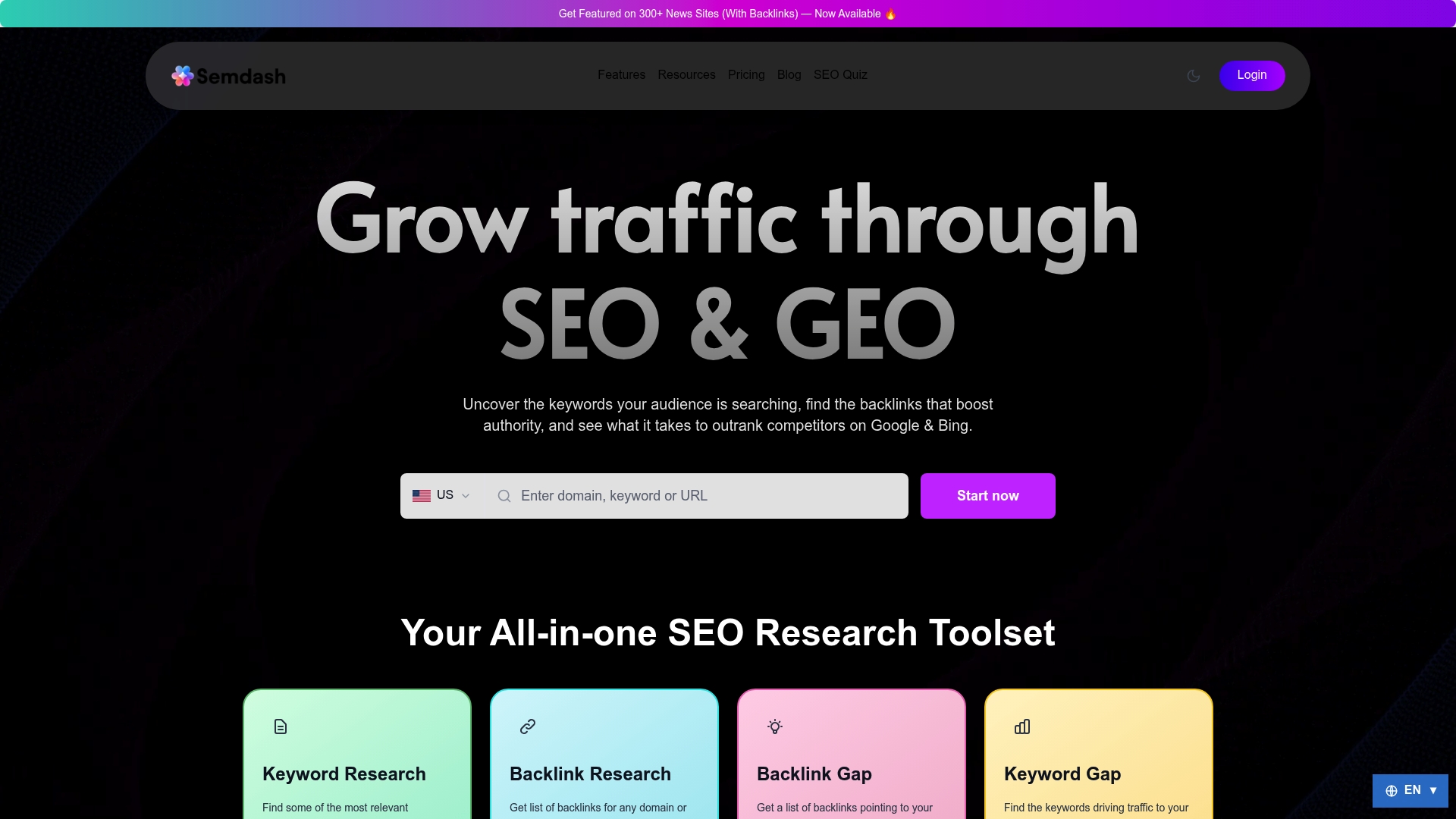
The platform’s backlink research tool doubles as your verification layer, confirming whether a mention already carries a link before you waste an outreach email on it, and its keyword research module helps you match the right target URL to each mention’s topic instead of guessing. This setup fits SEO teams juggling multiple client accounts and in-house brand teams tracking a single domain equally well, since the query pack and export structure scale with however many brands you’re monitoring. Start a project with your top three brand variants this week and export your first scored batch before your next outreach sprint. Head to Semdash to set up your first brand-monitoring project.
Sources
- Unlinked Mentions: Measure Brand Impact Beyond Links
- Unlinked brand mentions: A practical link reclamation guide
- Unlinked Mentions: How to Find Them and Turn Them Into Backlinks (2026)
FAQ
How Do You Find Unlinked Brand Mentions?
Combine Google search operators that exclude your own domain, Google Alerts for ongoing catch, reverse image search for reused visuals, and a bulk brand-monitoring or backlink research tool for scale and historical depth.
Do Backlinks Still Matter for SEO?
Yes. Backlinks remain one of several signals search engines and AI systems use for ranking and visibility, though a single link rarely moves rankings on its own and works best alongside strong content and entity signals.
How Do You Track AI Brand Mentions?
Monitor AI Overview appearances and generative search citations alongside traditional backlink and mention tracking, since tools like Semdash’s AI visibility monitoring track how often your brand surfaces in AI-generated answers.
What Are Unlinked Mentions in Content Tools Like Obsidian?
In note-taking and knowledge-management tools, an unlinked mention refers to a note that references another note’s title without creating a direct link between them, a similar concept to web-based unlinked brand mentions but applied to internal documentation.
How Long Does It Take to Convert a Mention Into a Backlink?
Response times vary widely, but a reasonable outreach cadence spans about three weeks: an initial email, a follow-up at seven to ten days, and a final note around three weeks before moving on.