%20(1)-B86R08ZzwhPzS6UZbG3mSxRWPCwGwn.png)



You open Search Console to a familiar mess, a handful of posts are getting impressions, one or two are stuck on page two, and the traffic graph looks like it's been flattened by your own content decisions. That's usually the moment bloggers realize the problem isn't writing harder, it's choosing and shaping keywords like an operating system, not a one-time list.
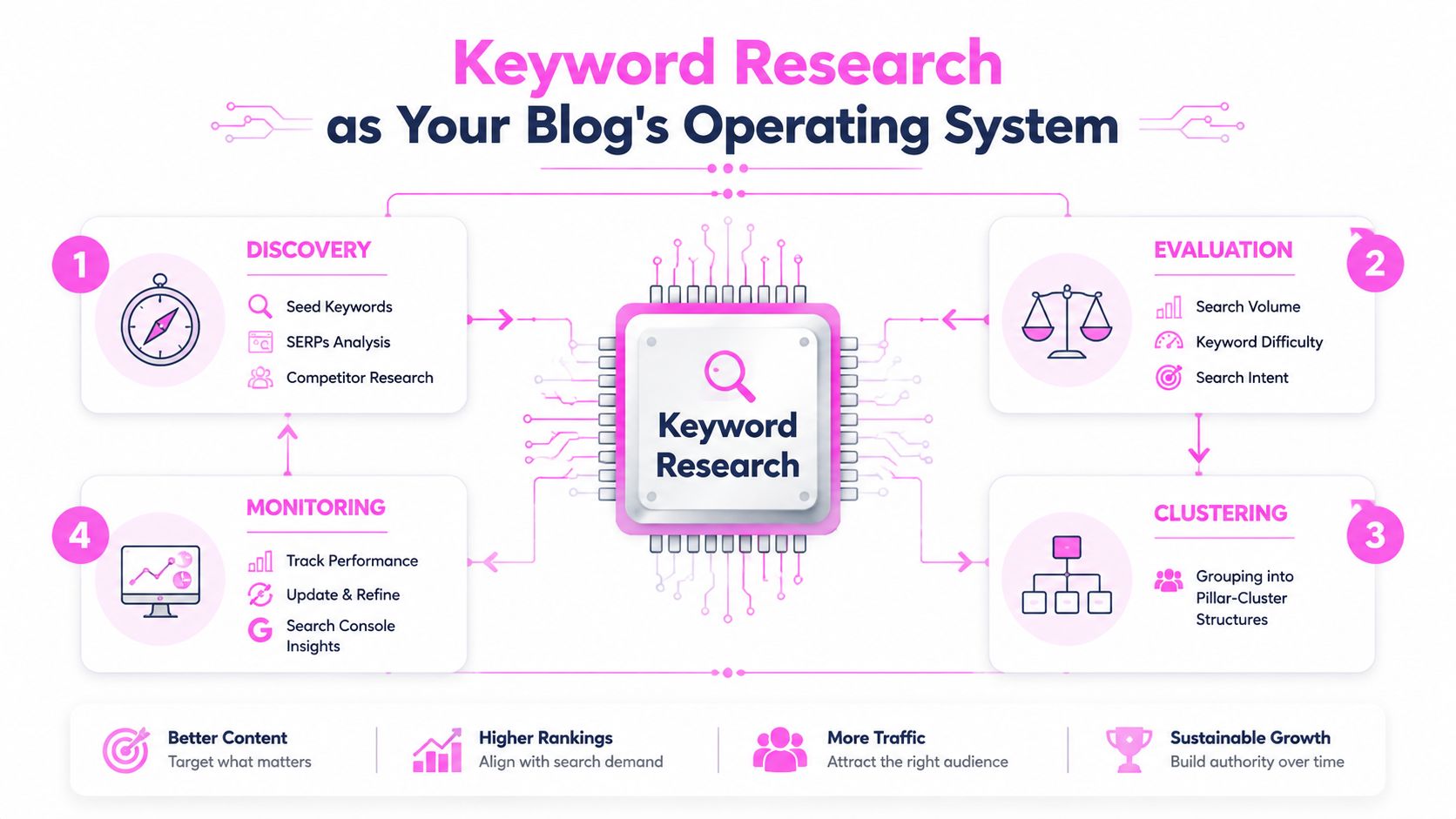
A lot of bloggers start keyword research with a seed topic and stop there. That's why the site stalls, the posts overlap, and the same broad phrases keep swallowing time without moving the needle. Keyword research for bloggers only starts to work when it becomes a repeatable loop, discover, score, cluster, brief, publish, and refine.
That shift didn't happen by accident. As blogging matured, keyword research moved from optional brainstorming into mainstream planning, and the signal is clear, GrowthBadger found that bloggers do keyword research when deciding what to write about or publish, and 64% of higher-income bloggers do so, which links keyword-driven planning with stronger monetization outcomes (GrowthBadger's blogger statistics report). The practical takeaway is simple, write for measurable demand, map each keyword to one page, and stop treating every post like a standalone gamble.
If your content plan is already drifting, a tighter editorial system often starts with the same discipline founders use to align content with business goals, like the framework in content strategy for founders. The difference is that a blog needs a search-first operating rhythm, not just a strategy doc that sits in a folder.
Table of Contents
- Why Keyword Research for Bloggers Is an Operating System, Not a To-Do
- Discovering Blog-Worthy Keywords From Seeds, SERPs, and Competitors
- Scoring Intent, Difficulty, and Traffic Potential Before You Write a Word
- Clustering Queries Into Pillar Pages and Cluster Posts
- Building a Publish-Ready Keyword Brief
- Monitoring Rankings and Updating Posts With Search Console Data
- The Weekly Blogger Keyword Operating Cadence
Why Keyword Research for Bloggers Is an Operating System, Not a To-Do
I've been in plenty of research sessions where the spreadsheet looks busy, but the blog still isn't growing. The problem is almost never a lack of ideas, it's a lack of process, because ideas aren't the same thing as page-level decisions. A keyword system gives every idea a job, a page type, and a place in the site architecture.
The plateau usually starts with topic confusion
A niche blog can publish 40 posts and still feel stuck if the articles all orbit the same fuzzy themes. That's where keyword research changes from “what should I write?” into “what page should exist for this query, and what role should it play later?” If the answer isn't clear, the post usually gets written twice, once in planning and once again in the rewrite after it fails.
Practical rule: if a keyword can't be assigned to a page type, it probably isn't ready to publish.
This is also where value shows up in blogging. Keyword research isn't just topic picking, it's aligning content with demand that can be measured, then structuring that demand so search engines can understand your site faster. The best workflows I've used follow a loop, discover, evaluate, cluster, brief, publish, monitor, then feed the results back into the next round.
That loop matters because search behavior isn't static. Long-tail queries dominate the accessible opportunities, with industry summaries reporting that long-tail keywords account for roughly 70% of all search traffic, another analysis saying 91.8% of search queries are long-tail, and 92.42% of all search queries have a monthly volume of 10 or fewer searches (long-tail keyword statistics). In practice, that means the phrases worth targeting are often detailed, specific, and easier for a smaller blog to compete for.
The operating system mindset fixes bad editorial habits
The old habit is to pick a phrase, write one post, and move on. The operating-system habit is to ask what belongs on the pillar page, what belongs in a supporting post, what needs refreshing later, and where query demand already exists. That's a different way of thinking about content, and it prevents the silent cannibalization that eats smaller blogs alive.
I'd also use a competitor perspective carefully. A search-led blog doesn't need to copy competitor topics, but it does need to know what already wins in the niche. When I'm mapping a content plan, I often compare that broader editorial view with a targeted resource like competitive keyword analysis, then decide which gaps are worth filling and which ones would just create more overlap.
Discovering Blog-Worthy Keywords From Seeds, SERPs, and Competitors
A good discovery session starts with one seed topic and then widens fast. If I begin with “emergency fund,” I keep expanding until the list reflects how people search, not a keyword export that was already stale when it was pulled. Autocomplete, People Also Ask, competitor pages, and the live SERP all help surface that shape.
Start with seed expansion, then verify against the live SERP
A seed phrase only matters if it opens a family of searchable questions. For a personal finance blog, “emergency fund” can branch into “how much emergency fund do I need,” “best place to keep emergency fund,” “emergency fund vs savings,” and “how to build an emergency fund fast.” That is the point where a content plan becomes useful, because each phrase usually points to a different intent and page type.
Autocomplete is still one of the quickest validation checks because it shows what people are typing. People Also Ask and People Also Search widen the field further, especially for informational queries built around questions. Live SERP review matters because volume alone cannot tell you whether Google wants a guide, a comparison, a calculator, or a product page.
Use competitor gaps to expose what your niche already rewards
Competitor data works best when it is handled with discipline. I look at 3 to 5 direct competitors, pull their Top Pages or keyword-gap data, then compare those terms with my own topic list. Rather than mirroring competitors, the goal is to surface the phrases driving traffic that I have ignored, underbuilt, or split across too many posts.
If you want a tool-assisted way to do that in one place, the Keyword Gap workflow inside SemDash makes the reverse-engineering easier to sort through, and the broader competitive keyword analysis guide is useful for checking how those gaps translate into page opportunities. I still sanity-check the live SERP before anything gets a publishing slot.
Working rule: discovery should produce more queries than you'll ever publish. If the list feels too small, you are probably under-expanding the seed.
A healthy query set looks specific, not broad
A useful discovery pass for “emergency fund” should include a mix of question, comparison, and action-intent phrases. It should also include variants that point to different page types, not just similar rewrites of the same idea. Once the list starts to cluster naturally into themes, you have enough material to score.
For a deeper competitor pass, the competitive keyword analysis guide keeps the workflow focused on real page opportunities rather than random keywords. That is what separates a blog calendar from a search map.
Scoring Intent, Difficulty, and Traffic Potential Before You Write a Word
Discovery gives you noise. Scoring turns that noise into a decision. The three filters I use are traffic potential, ranking feasibility, and business relevance, because a keyword only matters if all three line up enough to justify a post.
Read the SERP before you trust the keyword
I don't score intent from the wording alone. A phrase can look informational and still return transactional pages, or it can look commercial and return educational content. Live SERP review is the fastest way to see what Google already thinks the query deserves.
That matters even more now that intent can shift over time. Historical SERP tracking helps reveal when a keyword that used to reward list posts now prefers a different page shape, or when the results start leaning toward deeper answers and summary views. Some workflows also inspect SERP APIs and compare what different sources surface, which is useful if you're deciding whether to automate SERP capture or keep the review manual. A useful resource for that decision is comparing SERP APIs, especially if you're trying to keep the research process repeatable without losing the live-page context.
Use a simple scoring rubric, not a vanity-volume chase
I like a straight triage model. Every keyword gets a score for demand, a score for difficulty, and a score for relevance. If one of those is weak enough, the idea doesn't get written, no matter how pretty the volume looks.
| Axis | What to assess | Score 1, skip | Score 5, prioritize |
|---|---|---|---|
| Search volume | Whether the query has enough demand to justify a post | Thin demand, likely too narrow | Clear demand with enough upside |
| Keyword difficulty | Whether a small blog can realistically compete | SERP dominated by stronger pages | Attainable SERP with weaker or mixed competition |
| Business relevance | Whether the query fits the blog's topic and goals | Loose fit, indirect value | Directly supports the site's niche and offers |
For practical filtering, one framework I'd use for page-two opportunities is the Search Console-driven approach that prioritizes queries in positions 11+, with volume of 100 or more and keyword difficulty of 0%–49% (Search Console keyword filtering framework). That's not a magic threshold, but it's a defensible one for small blogs because it focuses effort where there's measurable demand and a plausible ranking path.
Difficulty is a probability, not a promise
A keyword can look easy and still stall if the intent is off. It can also look hard and still be worth a shot if the fit is perfect and the SERP is weak on depth. That's why I don't treat keyword difficulty as a verdict, I treat it as one input in a larger ranking decision.
If you want the mechanical side of difficulty checks, I'd pair the rubric above with a dedicated difficulty review like how to check keyword difficulty. The point is to separate “looks interesting” from “can win.”
Clustering Queries Into Pillar Pages and Cluster Posts
Once a keyword passes scoring, the next mistake is treating it as if it lives alone. A lot of beginner blogs create one post per phrase and end up with five near-identical articles competing for the same traffic. Clustering makes the site structure visible before a draft exists, so the content plan reflects how searchers move through a topic.
Collapse near-duplicates into one page intent
I usually start by reading the raw list out loud and grouping phrases that clearly want the same answer. “How to build an emergency fund,” “emergency fund steps,” and “how to save for emergency fund” may belong on one core page, not three. That kind of grouping reduces cannibalization before it starts, and it also makes later updates easier because you are refining one page instead of patching three.
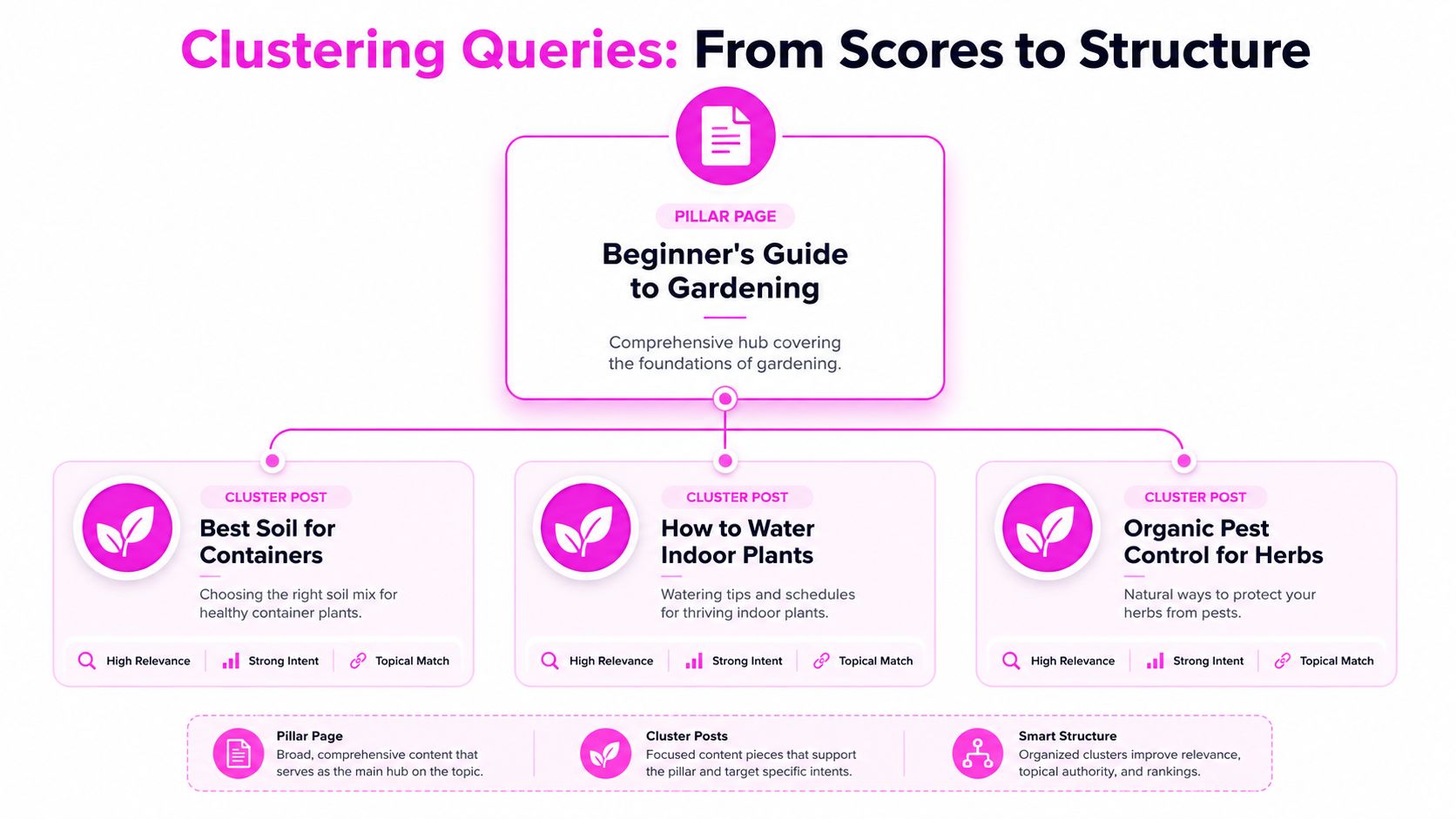
The aim is to decide which query deserves the pillar, which belong in a supporting post, and which should live as subheads or FAQs. That decision matters because the page structure should match the search intent, not the wording of the keyword list. Once the architecture is clear, the writing gets easier because each page has one job.
Use the cluster to assign page roles
A strong cluster usually has a broad pillar and several narrower support posts. The pillar handles the general concept, the cluster posts answer more specific questions, and together they show topical depth. That turns a query list into an editorial map instead of a backlog.
A cluster that cannot be mapped to page roles is still just a keyword dump.
For a worked example, take 18 related queries around “emergency fund.” I would likely turn that into one pillar page, then break out posts like “best place to keep emergency fund,” “emergency fund vs savings account,” “how much emergency fund do I need,” and “how to build an emergency fund on irregular income.” The remaining variants would either feed those pages as secondary terms or get handled inside the pillar's H2s and FAQ block.
Cluster tools matter because they reveal structure fast
Manual clustering works, but it gets slow once a niche blog has dozens of ideas in play. Tools that group semantically similar queries can speed up the decision, especially when the list gets large enough that overlap becomes hard to spot by eye. SemDash's cluster report can help here by grouping related queries into page-level topics, which is useful when you are trying to avoid duplicate posts and keep internal competition low.
For a practical walkthrough of how page-level grouping works, the embedded video below gives a useful visual reference.
Building a Publish-Ready Keyword Brief
A scored keyword and a cluster are still not enough. Writers need a brief that tells them what the page should accomplish, what to include, and what not to waste time on. The best briefs I've used are short enough to execute quickly and specific enough to keep the post from drifting.
The brief should answer five decisions before drafting starts
I always want the brief to settle the target query, the intent verdict, the secondary terms, the page outline, and the internal links. If those aren't clear, the writer ends up making structural decisions in the draft, which is where most SEO polish gets lost. The brief should also spell out the exact page type, because a guide, listicle, and comparison page don't earn the same result just by swapping a title.
A strong brief usually includes:
- Target query: The main phrase the page is meant to win.
- Intent verdict: Informational, commercial, comparison, or mixed.
- Secondary keywords: Variants, question forms, and close semantic terms.
- Required subheadings: The H2s that need to exist for coverage.
- Internal link targets: The pages that should pass and receive authority.
Placement still matters, but it's not the whole game
The on-page keyword checklist is still useful because it catches the structural signals people forget. Put the focus phrase in the title/H1, the URL if it fits naturally, the meta description, the first paragraph, at least one image alt tag, at least one H2, and naturally throughout the body and internal-link anchor text. That checklist comes from the same place as the classic blogger guidance that keyword placement belongs in the places readers and crawlers notice first.
The mistake I see most often is overdoing body repetition while forgetting the structural cues. A page can read beautifully and still be weak if the title, heading hierarchy, and internal linking don't reinforce the same topic. That's why the brief needs to call those out before writing starts.
Keep the brief tight enough to use in one sitting
I like briefs that a writer can open and execute without a second meeting. If the intent is mixed, the FAQ block should be listed. If the SERP is comparison-heavy, the comparison angle should be explicit. If the post needs to support a cluster, the linked pillar should be named so the draft can reinforce it naturally.
SemDash's AI-assisted briefs and intent classification can help with the outline stage, but the human judgment still matters at the point where you decide whether the page should be a guide, a comparison, or a support post. That's the difference between producing content and producing pages that are easier to rank.
Monitoring Rankings and Updating Posts With Search Console Data
A blog can look healthy on the publishing side and still leak traffic after the fact. Search behavior shifts, older posts get out of sync with newer SERPs, and two articles can end up chasing the same query. Search Console shows what the site is earning, which makes it the starting point for post-publish keyword work.
Start with impressions that don't turn into clicks
A useful refinement pass starts with queries that earn impressions but very few clicks. Google is already associating the page with those terms, but the title, snippet, or result shape is not convincing enough to earn the click. In practice, that usually means tightening the title, sharpening the intro, or matching the answer format more closely to the search result page.
Position data matters as well. Queries sitting on page two are often the fastest updates to prioritize when the intent is right and the page only needs a stronger section, better internal links, or clearer subheadings. I also check for pages that are splitting the same query, because cannibalization can drain performance faster than a weak ranking does.
Use the existing query data before you invent new ideas
Search Console already shows a lot of the next revision work. If a page ranks for a query you never targeted on purpose, that is a clue about how readers describe the topic in their own words. That clue should shape the refresh, because it shows what the page is already close to winning.
Update rule: if the query is already there, do not ignore it just because it was absent from the original brief.
A URL-level view makes the pattern clearer, because you can see which page ranks for which term instead of guessing from a cluster report. That helps when a blog has overlapping posts and one of them is taking the wrong query. SemDash's URL mapping does that kind of visibility well, which makes it easier to decide whether to expand, merge, or leave a post alone.
A common beginner pattern is creating one post per phrase, which often leads to five nearly identical articles competing for the same traffic.
Refreshing beats republishing in many cases
I usually update first when the page already has some traction. Often the fix is neither a rewrite nor a merge, sometimes the post just needs a sharper intent match, a stronger subheading, or a cleaner link path from the rest of the site.
Performance data should lead the decision. When Search Console shows that a page has reach but weak engagement, the fix usually sits in the page itself, not in another round of blind keyword hunting. That is where keyword research becomes refinement, not just discovery.
The Weekly Blogger Keyword Operating Cadence
A good keyword system shouldn't feel heroic. It should feel routine. If you can run the same cadence every week, the blog stops depending on random inspiration and starts compounding from small, repeatable decisions.
A simple Monday-to-Friday rhythm keeps the backlog honest
Monday is for discovery. I'd pull new seeds, competitor gaps, live SERP questions, and anything surfaced by autocomplete or People Also Ask. The aim is to widen the idea set without committing to anything yet.
Tuesday is for scoring and clustering. That's when the weak ideas get cut and the promising ones get sorted into pillars, supports, and revisions. Wednesday is brief-writing, because the page needs a clear intent verdict before anyone drafts.
Thursday is for publishing and QA. I'd check the title, heading hierarchy, internal links, metadata, and first-paragraph placement before the post goes live. Friday is for Search Console review, which is where new impressions, stuck queries, and overlap problems get flagged early.
The mistakes that quietly wreck the process
The first mistake is chasing vanity volume. Broad terms look exciting, but they usually eat time and win nothing for a smaller blog. The second is skipping intent classification, because a keyword with the wrong page shape can waste a perfectly good article.
Another common failure is ignoring AI Overviews and the other SERP features that reshape click behavior. If a query is being answered in a rich format, the page needs a stronger angle or a more useful structure to still earn the click. The last mistake is never revisiting old clusters, which is how duplicate posts and stale briefs slowly accumulate.
What the system should feel like after a few weeks
A healthy keyword cadence makes the editorial calendar less chaotic. You know which topics need a pillar, which need a cluster post, and which should be left out for now. You also stop confusing “more ideas” with “better ideas,” which is where a lot of blogs waste the most time.
When the workflow is working, keyword research doesn't feel like research anymore. It feels like editorial control.
If you want a keyword system that connects discovery, clustering, briefs, and Search Console refinement in one place, visit SemDash and use it to map the queries your blog can win. It's built for the kind of keyword research for bloggers that keeps pages from competing with each other. If you're ready to replace guesswork with a repeatable workflow, start there and build the next month of content from real search demand.